
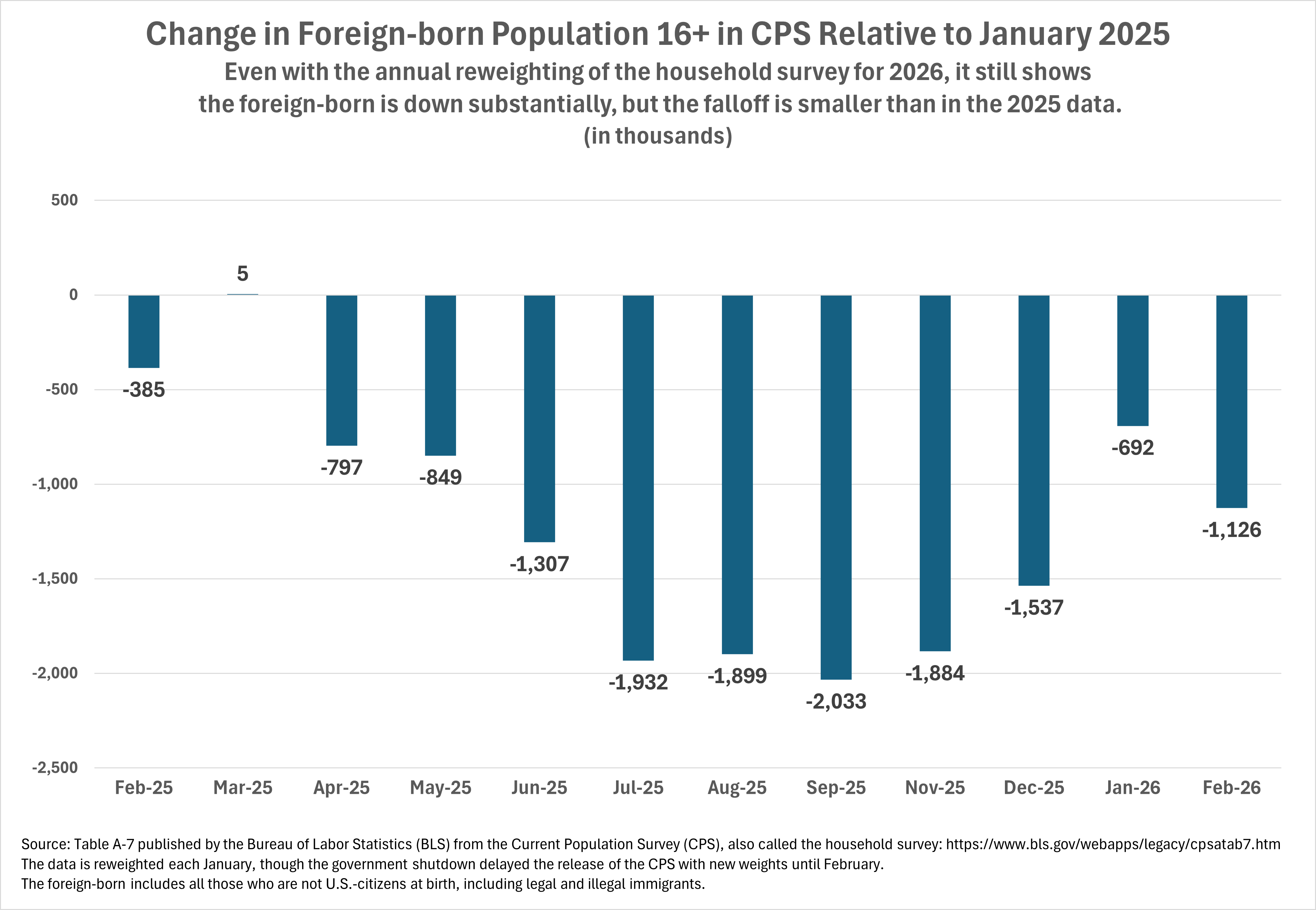
The latest Employment Situation Report from the Bureau of Labor Statistics was released today. It is based on the Census Bureau’s Current Population Survey (CPS), also called the “household survey”. It shows that the foreign-born or immigrant population, both legal and illegal, ages 16 and older, remains substantially smaller at the start of 2026 than it was in January 2025, when the Trump Administration took over. (Information on the 16+ population, not the entire population, can be generated at the BLS web site.) Although smaller now than it was, the January and February 2026 CPS, which uses new statistical weights, indicate that the decline since January of 2025 was not as large as the monthly data from 2025 showed.
The New Data. The CPS is usually reweighted each January, but the recent government shutdown delayed the release of the reweighted CPS until now. The new weights, also called “controls,” were used for the February data and have been applied back to the January 2026 data.
 |
The survey weights are based on annual population estimates created by the Census Bureau. In addition to births and deaths, these estimates also include net international migration (NIM). The Census Bureau found a much lower level of NIM in its 2025 estimates than was the case in the 2024 estimates. Although the estimate of NIM was much lower, it was still substantial at 1.3 million. (The Census Bureau’s population estimates are done from mid-year to mid-year.)
It is not entirely clear if this estimate of NIM is accurate, as it assumes there was not a substantial outmigration of illegal immigrants, which is always the most difficult part of migration to estimate. Furthermore, it is not clear whether the NIM migration in the second half of 2025 was actually similar to the level for mid-2024 to mid-2025, as the weights used for the 2026 CPS basically assume. The BLS reports that the updated population controls caused “decreases in both the White population and the Black or African American population, while there were substantial increases in the Asian population and people in other race groups.” The BLS also states that there has been “relatively little change” in the number of Hispanics.
Since a significant portion of recent immigrants are Asian, the re-weighting for 2026 could have implications for the size of the foreign-born. Fluctuations in the size of the foreign-born, even in 2025, and the reweighting at the start of 2026 create uncertainty about these estimates. However, the bottom line is that even assuming the weights used in the new data are accurate, the February 2026 survey still shows a substantial decline in the foreign-born population since January 2025 of 1.1 million. Once the public-use microdata is released, a clearer picture may emerge.
Employment of the U.S- and Foreign-born. The Current Employment Statistics (CES) survey, also called the “establishment survey”, was released at the same time as the CPS. The CES asks businesses about the number of employees they have. While in theory the CES and the CPS should show similar trends, they measure different things and do not always agree. The new CES data from February 2026 shows a decline in 92,000 jobs from January to February. Unfortunately, the establishment survey provides virtually no demographic information on who is gaining or losing jobs month to month.
However, the CPS does have this information. The CPS shows a decline in employed immigrants of 394,000 from January to February, while an increase of 877,000 employed native-born Americans. However, as we have previously noted, the growth in the number of U.S.-born workers as immigrants decline should be interpreted with caution because of the way the data is weighted. That said, the St. Louis Fed tries to adjust for this issue and still estimated a net gain of 590,000 jobs January to November 2025 for the native-born, which is certainly good news if correct. In short, although the information should be interpreted with caution, there is some indication that it is the foreign-born who have lost jobs, many of whom may be illegal immigrants who have left, while the native-born have gained jobs.