
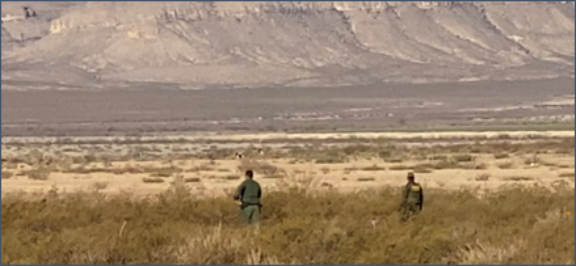
Border Patrol agents searching for an immigrant group face typically daunting odds in Big Bend Sector. Photo by Todd Bensman.
Judge Kathleen Cardone of the U.S. District Court for the Western District of Texas (W.D. Texas) granted a preliminary injunction earlier this month in Friends of the Ruidosa Church v. Mullin, blocking DHS from “build[ing] border barrier[s] or related infrastructure, or engag[ing] in any construction or ground disturbing activities, in” Border Patrol’s Big Bend, Texas, sector “until and unless” the department complies “with all applicable laws”. It’s still not clear what the court’s reasoning was, but with millions of dollars and border security on the line, DOJ is anxious to get this before the Supreme Court — and then we’ll get to see what the justices have to say.
Big Bend Sector
Big Bend sector is gigantic, covering more than 165,000 square miles, and agents there are responsible for 77 counties in Texas (out of 254 total in the Lone Star state) and all 78 counties in Oklahoma — the largest “area of responsibility” (AOR) of any Southwest Border Patrol sector.
Most importantly for this case, however, Big Bend has jurisdiction over 510 miles of the Southwest border along the Rio Grande — about a quarter of the total international boundary between the United States and Mexico and 40 percent of Texas’s 1,254 miles of that border.
It’s among the most desolate of sectors, with a few small towns (including Marfa and Van Horn) and also the remote and border-adjacent Big Bend National Park (BBNP).
Since at least the 1950’s, it’s been said that “everything is bigger in Texas”, but even by Texas standards, BBNP is big, “comprised of 1,252 square miles of land, making it larger than the state of Rhode Island”.
DHS’s Two Determinations and Waivers
BBNP’s tagline is “Perfect Solitude”, but that’s likely been less the case in its general vicinity since DHS issued two determinations — one on February 17 and the other on May 15 — that portions of Big Bend sector were “area[s] of high illegal entry” and that therefore there was “an acute and immediate need to construct additional physical barriers and roads” in those areas.
The February determination related to approximately 250 miles adjacent to the Rio Grande and the May one to BBNP and an additional 180 miles of the border.
Having made those determinations, the DHS secretary then also waived “certain laws, regulations, and other legal requirements in order to ensure the expeditious construction of barriers and roads” in the specified areas, including the National Environmental Policy Act (NEPA) and the Endangered Species Act (ESA).
The Complaint
On April 16, three plaintiffs — Friends of the Ruidosa Church, Danny William Miller, Jr. (“a longtime resident of the Big Bend region of Texas and a professional river and outdoor recreation guide who has lived and worked in the area since 2005”), and the Center for Biological Diversity — filed a complaint in the W.D. Texas against DHS, later amended on June 11, seeking injunctive and declarative relief to block the DHS secretary’s two determinations and waivers.
They alleged those actions violated the “major questions” doctrine, the “Take Care” clause of the U.S. Constitution, due process, and the “presentment clauses”, clauses 2 and 3 in Article I, section 7 of the Constitution, and that the law under which those waivers were issued violated the “non-delegation” doctrine.
Congress’ Grants of Waiver Authority — and Restrictions on Review
In the early 1990s, Congress and the executive branch noticed the effectiveness of physical barriers along the Southwest border.
And after border barriers became a part of the then-Immigration and Naturalization Service’s (INS’s) 1994 “Southwest Border Strategy”, Congress gave its blessing to them in the Illegal Immigration Reform and Immigrant Responsibility Act of 1996 (IIRIRA).
Section 102(a) of IIRIRA directed DOJ and the INS to “take such actions as may be necessary to install additional physical barriers and roads in the vicinity of the United States border to deter illegal crossings in areas of high illegal entry into the United States”, while section 102(b) required INS to complete certain projects.
More importantly for this case, however, section 102(c) of that act waived NEPA and the ESA “to the extent the Attorney General determines necessary to ensure expeditious construction of the barriers and roads under this section”.
In the wake of September 11 attacks, the need for better immigration enforcement became even more apparent, and consequently, Congress abolished INS and placed its immigration authorities within the newly formed DHS, with CBP taking over INS’s border responsibilities in March 2003.
Thereafter, Congress in the REAL ID Act of 2005 amended IIRIRA to give the new DHS secretary authority “to waive all legal requirements” the secretary, in his “sole discretion, determines necessary to ensure expeditious construction of the barriers and roads” provided for in IIRIRA (emphasis added).
In addition, REAL ID also amended section 102(c) of IIRIRA to provide: (1) only federal courts could hear challenges to DHS IIRIRA waivers; (2) only constitutional — not statutory — challenges would suffice; (3) all challenges must be brought within 60 days; and (4) that any “judgment, decree, or order of the district court may be reviewed only upon petition for a writ of certiorari to the Supreme Court of the United States”, cutting the circuit courts out entirely.
Border barriers got another big boost in the Secure Fence Act of 2006 (SFA).
Notably, section 2 of the SFA directed the DHS secretary to “take all actions the Secretary determines necessary and appropriate to achieve and maintain operational control over the entire international land and maritime borders of the United States”.
And to be clear about its intentions, Congress in section 2 of the SFA defined “operational control” as “the prevention of all unlawful entries into the United States, including entries by terrorists, other unlawful aliens, instruments of terrorism, narcotics, and other contraband.” (Emphasis added.)
Congress did not stop there, however, as section 3 of SFA directed the secretary to “provide for at least 2 layers of reinforced fencing, the installation of additional physical barriers, roads, lighting, cameras, and sensors” in high-traffic areas of the Southwest border.
Included in the “actions” available to the secretary to comply with that mandate was authority to erect “physical infrastructure enhancements to prevent unlawful entry by aliens into the United States ... such as additional checkpoints, all weather access roads, and vehicle barriers”.
DOJ’s Opposition
On August 7, DOJ filed its opposition to the plaintiffs’ complaint, contending from the get-go that there is “no genuine issue as to any material fact” in the case and that the government is entitled to a judgment in its favor “as a matter of law”.
Briefly, the “major questions doctrine” is a statutory interpretation tool, crafted by the Supreme Court to ensure that when an agency (in the words of the nonpartisan Congressional Research Service) “seeks to decide an issue of major national significance, its action ... be supported by clear congressional authorization”.
The best example is when the CDC attempted to impose a nationwide moratorium on evictions during the Covid-19 pandemic under its authority in 42 U.S.C. §264(a), a rarely invoked 1944 law that had previously almost exclusively been used for quarantine purposes.
A majority of the justices made short work of finding that moratorium was unsupported by the authority in the underlying statute in a per curiam August 2021 order.
As for the constitutional claims made by the plaintiffs, DOJ noted that “other courts have unanimously rejected” them in the past, and that the W.D. Texas should do so here.
What’s Really at Issue
Having played a role as a staffer in drafting the REAL ID Act and SFA, it appears that what is really at issue in this case is that while Congress has passed a lot of environmental and historic preservation laws — most of which would be at issue in most other federal construction projects in the BBNP and its environs — it has also given the DHS secretary the authority to waive all of them to secure the border.
The conference report for the REAL ID Act, in particular, detailed how state litigation over border projects had been delayed notwithstanding the broad grant of waiver authority in IIRIRA, and expressly stated the conferees’ intent “to ensure that judicial review of actions or decisions of the” DHS “Secretary not delay the expeditious construction of border security infrastructure, thereby defeating the purpose of the Secretary’s waiver”.
That lack of review rarely sits well with either environmental activists or many locals in the areas that are affected by border infrastructure construction and given that U.S. district court judges by definition usually live near those areas, their logical inclination is to take things more slowly.
Here, however, is how Judge Cardone explained her reasoning in granting a preliminary injunction in this case:
After considering the witnesses’ testimony, the parties’ exhibits, the pertinent legal authorities, and the arguments of counsel, the Motion is GRANTED. The Court finds that Plaintiffs are likely to succeed on the merits of at least one of the claims in suit, that there is a likelihood that they will suffer serious, irreparable harm without an injunction, and that the balance of the equities and the public interest weigh in their favor. [Emphasis in original.]
It would be helpful to know which of the plaintiffs’ claims the W.D. Texas thinks will be successful, but while she has promised that “A memorandum opinion will follow, explaining the Court’s rationale in greater detail”, it doesn’t appear Judge Cardone has issued one yet.
CBP is impatient to get back to work, however, and on October 8, DOJ filed a motion asking her to issue her promised opinion and to stay her order while the government seeks Supreme Court review. As the department explained therein:
Depending on the duration of the injunction, CBP’s contractors may also have to demobilize personnel and equipment from the project sites. Given the tight market for border barrier construction labor and equipment, if the injunction is stayed after the contractors have demobilized, the costs of remobilizing manpower and resources are likely to be significant. Equipment and specialized personnel may not be available for remobilization. Contractors have provided rough estimates of the cost to demobilize and remobilize, and the cost to demobilize the Big Bend 1-5 projects could be well upwards of $7 million. [Citations omitted.]
For now, a federal district court judge has halted border construction in and around the desolate and remote Big Bend National Park, though it’s not clear why. When millions of dollars and border security is on the line, maybe the court could share its reasoning with the taxpayers — and then let the Supreme Court have at it.