
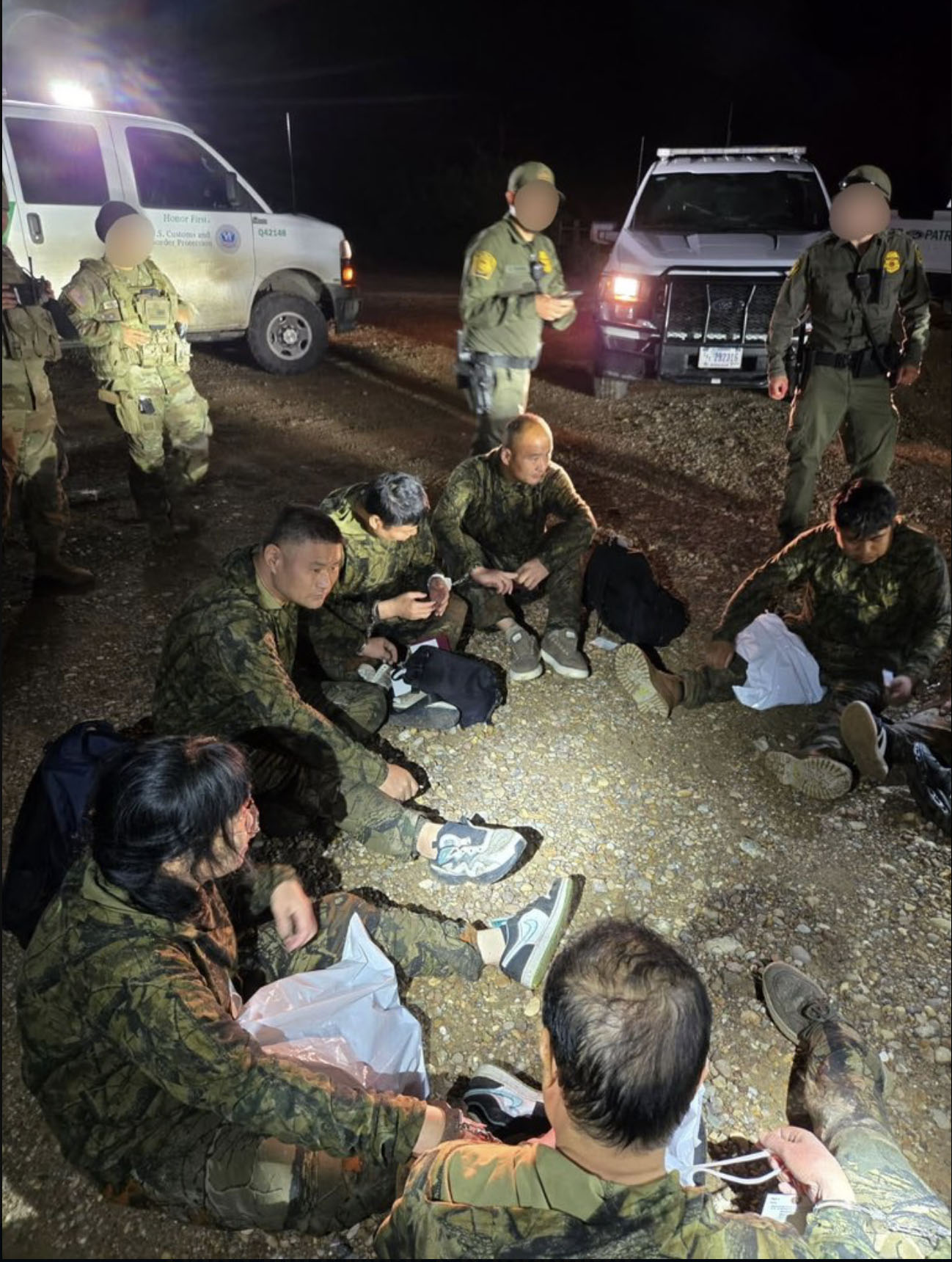
Photo: Texas DPS.
The Daily Wire has reported that on May 26 officers from the Texas Department of Public Safety (DPS) apprehended “six Chinese nationals dressed in camouflage as they tried to sneak across the southern border”. Technically, they had already snuck across the border, because DPS nabbed them and six other individuals on one of many private ranches that dot Maverick County, Texas — an area that saw relatively few Chinese entries even when it was a smuggling highway for migrants from less “sensitive” countries. The biggest question is why they were there, and how they arrived.
Operation Lone Star and the Biden Border Surge
Almost immediately after President Biden took office in January 2021, increasing numbers of migrants began pouring over the 1,954-mile Southwest border, and in particular the 1,254 miles of that border where Mexico is separated from Texas by the Rio Grande.
According to the DHS Office of Homeland Security Statistics (OHSS), Border Patrol agents in the Del Rio sector (which includes Maverick County) apprehended fewer than 133,500 illegal entrants in FYs 2018-2020, combined.
In FY 2021 alone, agents apprehended more than 259,000 illicit migrants there, and nearly 481,000 more in FY 2022. Add it up, and that’s roughly the population of Denver, Colo.
Among the migrants apprehended there in FY 2021 were more than 14,000 mostly Haitian nationals who crossed the river in less than a week into the small town of Del Rio (population: 34,715) that September.
Their arrival triggered a humanitarian meltdown, as agents and other state, local, and federal agencies struggled to house, feed, and provide for them all.
The Biden administration and several Democrat members of Congress attempted to deflect the blame by alleging mounted Border Patrol agents had “whipped” the migrants crossing the Rio Grande — a claim that was plainly fallacious in real-time and one the administration attempted to quietly bury thereafter.
Months before “Del Rio”, in March 2021, Texas Gov. Greg Abbott (R) had begun attempting to support and backfill increasingly overwhelmed Border Patrol agents when he launched “Operation Lone Star”.
Under the initial stages of that plan, state troopers and National Guard troops from all over the state were sent south to nab illegal entrants and hold them until Border Patrol could respond — and to arrest drug mules and other criminals they came across on state charges.
As my then-colleague Todd Bensman explained shortly thereafter, that operation “doubled the state’s law enforcement presence in” the easternmost Border Patrol sector, Rio Grande Valley (RGV), from the outset. The operation then expanded thereafter all the way west, to El Paso.
Lone Star ramped up from there. After Biden “paused” construction of new border infrastructure within hours of taking office, Texas found its own materials and started erecting fencing in high-traffic areas near Rio Grande City, in the RGV.
Then, in the weeks prior to the end of Title 42 in early May 2023, Texas under the auspices of Lone Star placed miles of concertina wire (c-wire) along the banks of the Rio Grande to deter cross-border traffic in the unpredictable river, backed by rows of National Guard vehicles and squad cars.
Maverick County again emerged into the national spotlight in September 2023, when — for reasons that remain unexplained — Biden’s CBP began cutting and removing sections of the c-wire barrier there (and only there) to allow migrants to cross illegally into the United States.
The Supreme Court greenlit that federal destruction of state property in late January 2024, but by then it was a moot point: The fight with Texas was a PR disaster for a White House contending it was doing all it could to stem the migrant flow, even as Border Patrol agents struggled to apprehend nearly 250,000 illegal migrants in December 2023, an all-time monthly record.
The Chinese Apprehension
While the pace of the operation has slowed since President Trump returned to office and triggered a massive decline in Southwest border apprehensions, Lone Star still chugs along and Texas state troopers continue to patrol the roads and lands adjacent to the Rio Grande.
Which brings me to the arrests of the six Chinese nationals in Maverick County on Tuesday.
As Chris Olivares, DPS spokesman, tweeted on Wednesday:
#NEW: SPECIAL INTEREST ALIENS APPREHENDED IN MAVERICK CO—TEXAS DPS K-9 BONA ASSISTS IN TRACKING GROUP ON PRIVATE RANCH
On 5/26/26, @TxDPS Tracking K-9 Bona and her handler assisted the U.S. Border Patrol in Maverick County, tracking, locating, and apprehending seven illegal… pic.twitter.com/zqKPbdEFJJ— Chris Olivarez (@LtChrisOlivarez) May 27, 2026
As an aside, K-9 Bona, a Malinois, plainly has some skills. You can check out her other adventures on Olivares’s X page, though my favorite is the time she saved a person with Down Syndrome who was lost for five hours in the Texas heat.
In any event, note that these six Chinese nationals were not apprehended crossing the river — while the exact location of the stop is not noted, most Maverick County ranches are miles from the Rio Grande, which raises the question of how they got there.
One guess would be that they crossed surreptitiously in the back of a vehicle (or vehicles) that crossed through one of the three local CBP Eagle Pass ports of entry and then dropped inland for some other smuggler to pick up.
According to CBP, 15 Chinese nationals have been encountered by officers from the agency’s Office of Field Operations (“OFO”, which has jurisdiction over the ports) Laredo Field Office (which includes Eagle Pass) in FY 2026 through the end of April, just less than 10 percent of the 157 Chinese encountered at the Southwest border ports this year.
By contrast, the OFO San Diego Field Office (with jurisdiction over the busy ports in the southern part of the Golden State) reports that its officers have encountered 132 inadmissible Chinese nationals since October 1, meaning California’s ports are either more desirable destinations for those coming from the Middle Kingdom or the officers at the ports there are better at catching them.
The other guess is that those six Chinese did cross the river without being apprehended, and either trekked inland for miles to the ranch where they were found or hitched a ride.
Historical Analysis of Chinese Illegal Entries
CBP reports that Border Patrol agents have apprehended 336 Chinese nationals at the Southwest border in the first seven months of FY 2026, down from nearly 3,900 last fiscal year (2,957, or 76 percent, during the last three full months of the Biden administration), and Del Rio sector accounted for 48 of them.
That pales in comparison to the 98 Chinese apprehensions in FY 2026 by agents in the historically busy RGV sector (again, the easternmost of the nine Border Patrol Southwest border sectors), but its pretty close to the 57 apprehensions by agents in the westernmost San Diego sector.
Using CBP encounters as a proxy for total attempted illicit entries, those figures suggest that Chinese nationals who are attempting to be smuggled through the ports head to California, while the ones who want to “jump the line” by crossing between the ports pick southern Texas as their intended destination.
That’s definitely a switch in illegal smuggling patterns from the recent past under Biden.
In FY 2024, the five Texas Border Patrol sectors (RGV, Laredo, Del Rio, Big Bend, and El Paso) accounted for just 124 Chinese apprehensions, total, whereas there were more than 37,000 apprehensions that year in San Diego sector alone.
Total Border Patrol Chinese apprehensions at the Southwest border under Trump II are a shadow of what they had been under Biden, but given that it’s common knowledge globally that every illegal migrant who is caught is going to be indefinitely detained by DHS, the question remains why these six risked it.
The bad news is that six Chinese men wearing camouflage illegally crossed into the United States, but the good news is that thanks to K-9 Bona (a very good girl) and a handful of Texas troopers, they didn’t get far. The better news is that illegal crossings by such “special interest” nationals is again newsworthy, unlike under the last administration, when it was just one more scary factoid at an insecure border.