
Listen to "J-1 Visa Program: A Cheap Labor Program" on Spreaker.
Americans visiting the beach, mountains, neighborhood pools, and summer camps this year are likely to encounter foreign guestworkers filling jobs as ice-cream scoopers, lifeguards, housekeepers, counselors, and fry cooks. Most people don’t realize that these temporary visa workers, also known as J-1 exchange visitors, are considered by proponents to be a major component of what the State Department calls “public diplomacy”.
The J visa program is run by the State Department’s Bureau of Educational and Cultural Affairs (ECA), currently headed by Assistant Secretary Cate Dillon. The bureau’s mission statement is as follows:
[T]o create lasting people-to-people ties that make America stronger, safer, and more prosperous. ECA programs increase mutual understanding between the people of the United States and the people of other countries through educational, professional, and cultural exchanges. Exchange programs strengthen the national security of the United States through improved foreign relations, support U.S. international leadership, and provide a broad range of domestic benefits by breaking down barriers and by investing in American communities and organizations.
While there are some legitimate exchange programs in which both American and foreign government officials, students, and professors complete structured programs aimed at advancing international understanding and goodwill, only one in five J-1 visitors meets that description. The J-1 program operates mainly as a one-way cheap labor program that brings more than 200,000 foreign workers a year to the United States — without consideration for U.S. labor-market effects and without requirements for appropriate wages and working conditions for the foreign workers. Program administration and oversight is largely outsourced by the State Department to third-party “cultural exchange” organizations, AKA: seasonal-worker staffing companies. Some have exciting names like Spirit Cultural Exchange, Life Adventures Inc., Center for International Career Development, and American Journey Cultural Exchange.
This report presents some of the official data on the J-1 program to show how many workers are participating, which countries they come from, and the most common destination states.
Key Findings
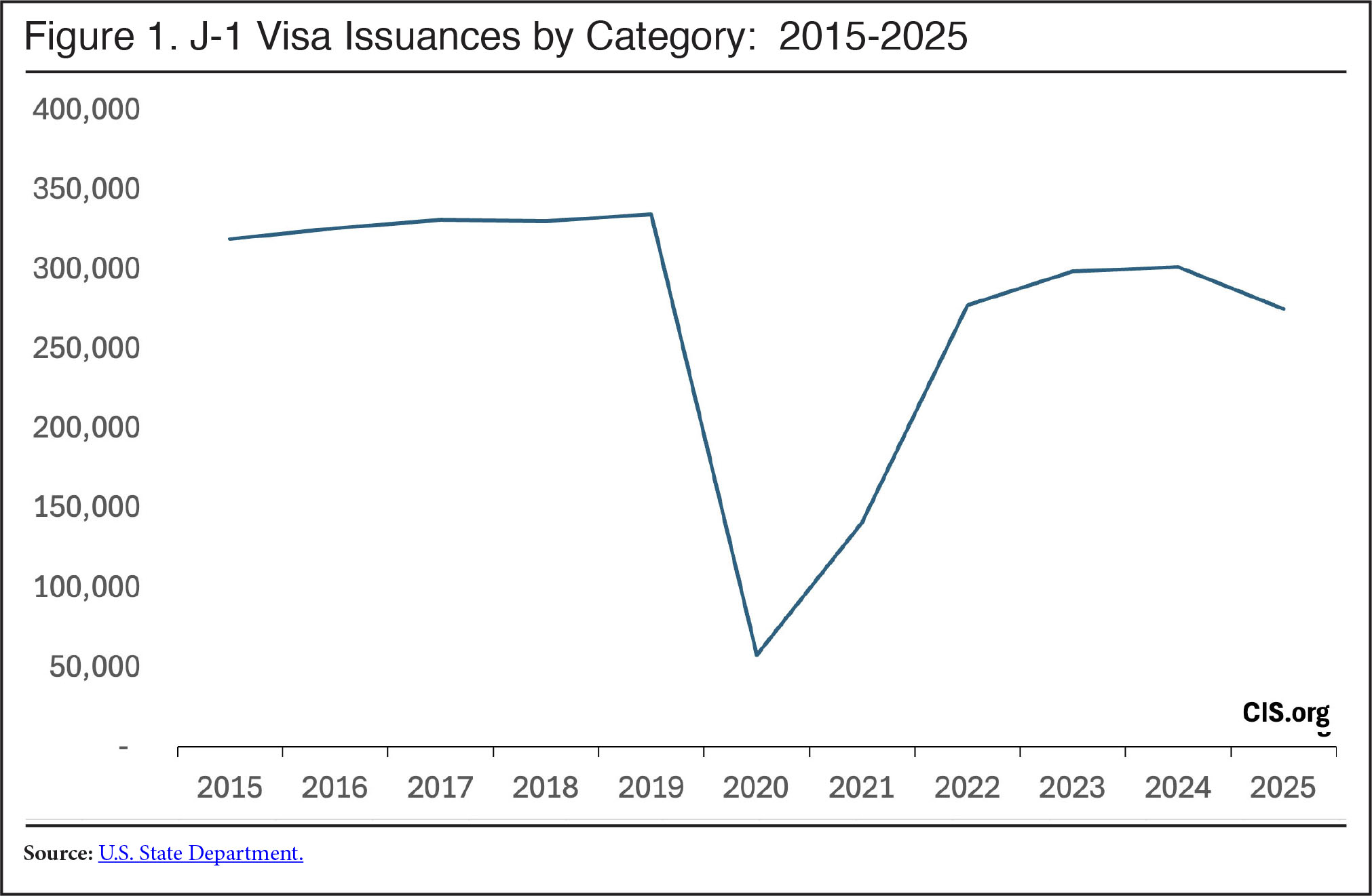
- The number of annual J-1 visa issuances has declined somewhat from the peak in 2019, from 335,000 to 275,000 (about 18 percent; see Figure 1).
- The number of J-1s issued in 2025 (275,000) also is down from nearly 302,000 in 2024 (see Table 1). 76 percent (208,667) of J-1 visa issuances in 2025 were for employment, and 24 percent were for more traditional exchange programs such as high school students, Fulbright scholars, and government-sponsored visitors in structured programs.
- 75 percent (185,000) of J-1 visa issuances in 2025 were for workers, and 25 percent were for more traditional exchange programs such as high school students, Fulbright scholars, and government-sponsored visitors in structured programs (see Table 2).
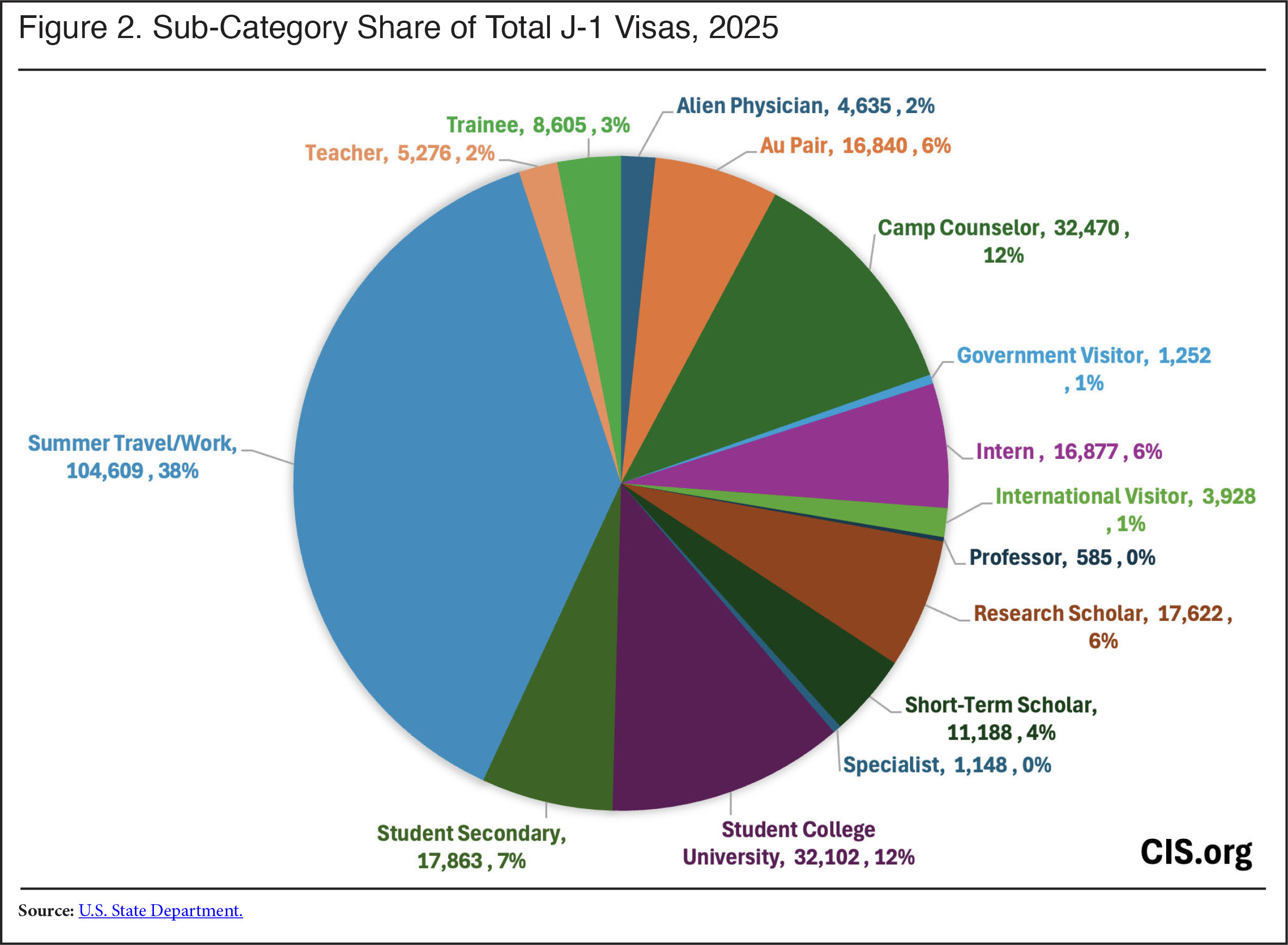
- Half of all J-1 exchange visitors came to work in summer jobs, with 105,000 under the Summer Work Travel program and another 32,000 working as camp counselors. These were the two biggest J-1 programs in 2025 (see Figure 2).
- The largest numbers of J-1 visas in 2025 were issued to visitors from the United Kingdom and Mexico, with about 16,000 to each of those two countries. China, Spain, and Germany round out the top five participating countries. The number of participants from China was much lower in 2025 than a decade ago; in 2015 China had by far the most J-1 visitors, with 35,700 that year (see Table 3).
- About 10 percent of the J-1 visitors in 2025 were headed to New York State. California, Massachusetts, Pennsylvania, and Florida rounded out the top five states (see Table 4).
- Exchange visitors have one of the highest overstay rates of any entry category, according to the annual DHS report on overstays. In FY 2024, the most recent year for which data has been released, the total overstay rate was 3.23 percent, which is nearly triple the average overstay rate for all categories (1.15 percent). According to the DHS statistics, this rate would have resulted in more than 14,000 new J visa overstays in 2024.
- A two-part series in the New York Times (published on September 20 and December 25, 2025) documented examples of J visa worker exploitation in New York, including unsafe conditions, harassment, wage theft, and indifferent sponsors.
- The State Department could suspend problem categories and increase oversight to rein in abuses.
 |
 |
Notable examples from the New York Times investigation include:
Dozens of visa workers from around the world came in recent years to Kurt Weiss Greenhouses on Long Island, one of the largest plant nurseries in the nation, where they helped grow, harvest and transport the millions of flowers and succulents the company ships to stores around the country. But the visa workers were unaware of the company’s safety record — one fatal accident and more than 35 injuries were recorded there from 2014 to 2017 — and they were expecting advanced training, good pay and ample time off. Instead, they worked up to 60-hour weeks for meager wages, doing grueling manual labor while their bosses threatened to have them deported if they did not work fast enough. One visa worker was sprayed with chemicals while working in the greenhouse without protective gear. Another had his hand mangled under a forklift.
Seven visa holders said they were choked, spanked or kissed against their will by their boss at a cafe called Marie Eiffel on Shelter Island, … according to a [2023] lawsuit.
Sponsors are supposed to intervene when visa workers have problems with their jobs. But workers said that when they have complained about abusive working conditions, sponsors and their representatives have done little to help. In 2016, Carolina Rodriguez pleaded with her sponsor for help when an architecture studio in Brooklyn refused to pay her the $2,400 monthly salary she was promised, records show. After she was fired from her job, she said her sponsor told her she had just weeks to line up employment elsewhere or would have to leave the country. She ended up returning to Colombia, forfeiting about $2,000 in fees she had paid the sponsor to come to the United States. She later sued the architecture firm, Studioteka, for breach of contract and received a settlement. (Studioteka’s chief executive disputed Ms. Rodriguez’s account and said she had been fired for performance issues.)
Recommendations
- Immigration law provides authority for the State Department to administer exchange visa programs for students, scholars, trainees, teachers, professors, research assistants, specialists, and leaders (Section 1101(a)(15)). The law does not stipulate that there must be visas made available for au pairs, camp counselors, and low-wage summer jobs in particular. Because these sub-categories have no meaningful public diplomacy value, the State Department should terminate them through regulation and greatly limit issuances for them in the meantime.
- The State Department must increase oversight of both work and study exchange programs and not outsource supervision to the third-party sponsors who create and profit from them. J visa study and worksites should be subject to unscheduled inspection visits.
- Sponsors should be held responsible for all actions of both employers and J visa participants. They should face significant consequences, potentially including criminal and civil liability, fines, and penalties such as debarment from the program for improper recruiting practices, misleading and exploiting participants, and even overstays under their programs.
- The State Department should allow only sponsors that have study-abroad and training programs for Americans as well as for foreigners coming to America. Sponsors should not be permitted to contract with overseas recruiters or charge more than nominal placement fees, approved by the State Department.
- All sponsors seeking to offer “training” exchange opportunities should be required to submit detailed training plans and curricula for approval by the State Department in consultation with appropriate academic or industry experts.
- The State Department should tighten up enforcement of Section 212(e), which requires J visa participants to return home for two years before applying for a green card or long-term temporary work visa.