

Nearly 17,000 aliens filed petitions seeking U visa protections in the first six months of FY 2026, according to the latest statistics released by USCIS. Another 11,000 filed petitions as family members of petitioners. The U visa was created to provide deportation protection, work authorization, and a path to citizenship for illegal aliens who are victims of serious crimes and who assist authorities in investigating the crime, but the program has become severely backlogged with frivolous and fraudulent petitions.
This pace of applications is down roughly 10 percent from FY 2025, but indicates that without action from federal and/or state lawmakers, the U visa program will remain oversubscribed for decades to come. The backlogs are not a barrier to benefits, because several administrations have established processes to enable most U visa petitioners to receive deportation protections and work permits even before their cases are scrutinized and adjudicated on the merits. These rules create an incentive to file bogus petitions to receive the benefits while the application sits on a shelf for years.
Figure 1 shows the application trends since 2009, when fewer than 7,000 people applied. More than five times as many petitions were filed in recent years as were filed back in 2009.
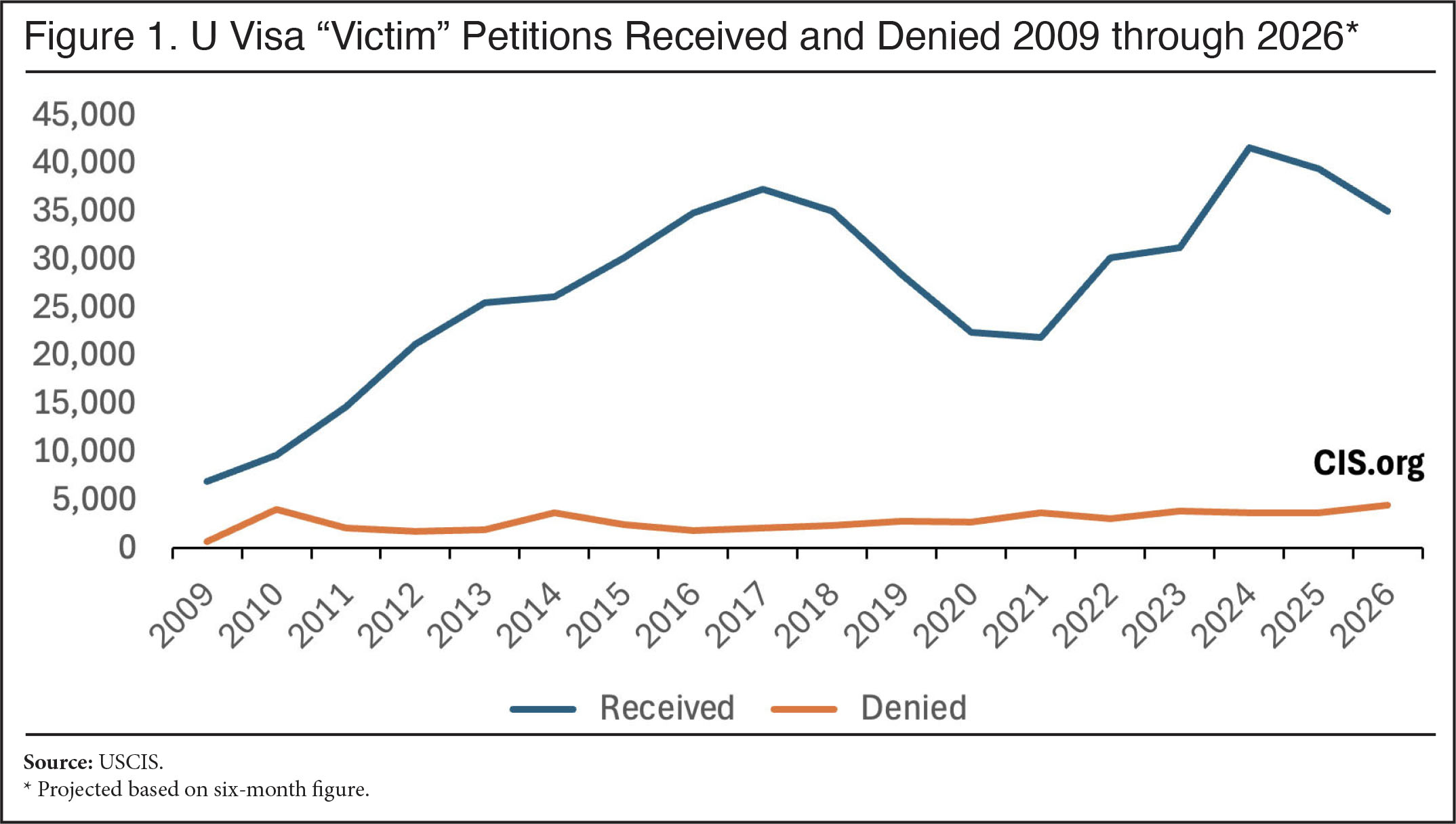 |
The number of U visa approvals remains constant at 10,000 per year, which is the annual cap established by Congress, plus another 16,000-18,000 annual approvals of visas for family members of the petitioners.
A number of workarounds to the cap have been implemented over the years. The most significant is the Bona Fide Determination (BFD). This process was established by the Biden administration in 2021. The BFD process is a basic review to determine if the petition forms are complete and to detect if the alien has a criminal history or has known national security risk associations. The BFD review is not an adjudication of the case on the merits.
From 2021 to 2025, more than 300,000 U visa petitioners and family members were approved for benefits under the BFD process (about 75 percent of all applicants). Just over 100,000 applicants were found ineligible for BFD benefits over the same time period. (See Table 1 and Figure 2.)
Table 1. U Visa Bona Fide Determinations Outcomes for Victims and Family Members, 2021-2026 (to date) | ||||
| Year | BFD Granted | BFD Ineligible | Total Completed | Pct. BFD Granted |
| 2021 | 17,990 | 5,009 | 22,799 | 78% |
| 2022 | 41,671 | 15,173 | 58,844 | 71% |
| 2023 | 39,110 | 13,847 | 52,957 | 74% |
| 2024 | 102,157 | 24,536 | 126,693 | 81% |
| 2025 | 103,196 | 42,290 | 145,486 | 71% |
| 2026 (thru 3/26) | 14,115 | 8,278 | 22,393 | 63% |
| Total | 318,239 | 109,133 | 429,172 | |
Source: USCIS. | ||||
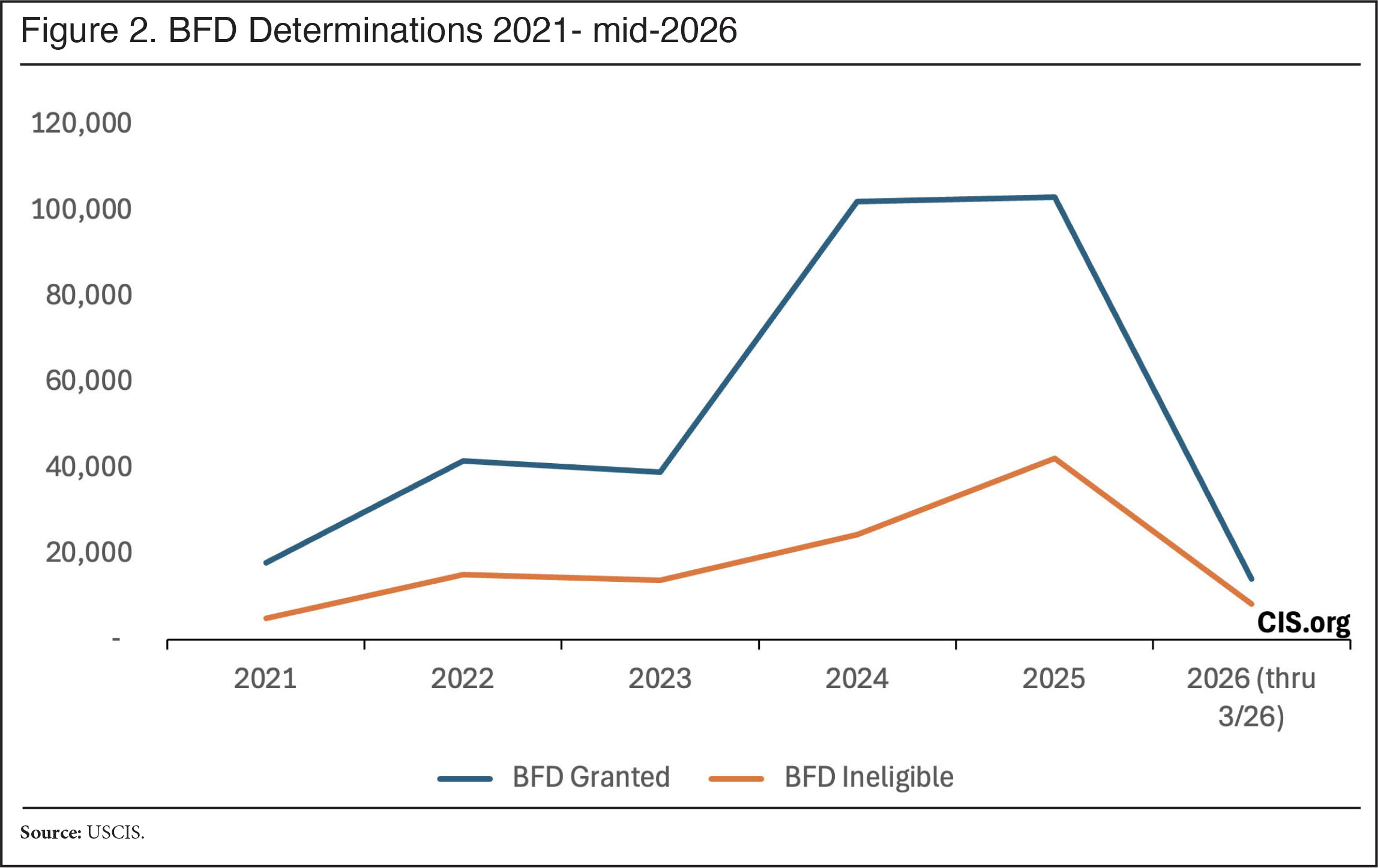 |
BFD processing slowed noticeably in the first half of 2026. During these six months, BFD benefits were approved for 8,785 petitioners and 5,330 family members, which is a rate of more than 70 percent less than the prior year. It seems logical, but it remains to be seen if allowing fewer petitioners to gain access to the (entirely discretionary) benefits of deportation protection and work authorization prior to adjudication will lead to fewer petitions being filed altogether.
Regardless of the future flow, USCIS must still work through a waiting list and backlog of more than 461,000 principal cases (as of March 2026). At the current rate, it could take at least 20 years for the most recently filed pending cases to be adjudicated.
Reducing the size of the backlog by weeding out non-meritorious cases would reduce the USCIS workload, eliminate access to benefits for unqualified petitioners more quickly, and speed adjudications for the qualified applicants.
Numerous reports have established that a large share of the backlog is made up of non-meritorious cases. One government investigation determined that two-thirds of U visa petitions it reviewed were based on alleged criminal victimizations that would not result in prosecution or were already closed cases, meaning there is no law enforcement or public safety interest in allowing the petitioner to remain in the United States. Laws in certain states, including Illinois, California, Maryland, Colorado, and Washington State that require law enforcement agencies to certify cases regardless of the merits further add to the problem.
USCIS should lead the way by asking certifying law enforcement agencies to review certain pending case to determine if the alien’s continued presence here still will assist in the prosecution of the crime and, if not, recommend withdrawal of the certification.
State authorities should launch a similar initiative to review all pending U visa certifications originating in the state, determine whether the certifications should be left in place, and in cases where the certification is no longer appropriate (or where fraud is discovered) direct the law enforcement agencies to withdraw the certification. Nationally, about 84 percent of U visa petitions are certified by local police or sheriff's departments, and 12 percent are certified by state officials.
The review could proceed as follows:
- Step 1. The governor and/or attorney general should ask USCIS for the records on all pending U visa cases filed by state law enforcement agencies.
- Step 2. The designated state U Visa review authority should examine the cases and determine if the certification should stand. Reviewers should look at factors such as a) whether there was ever or ever will be a prosecution of the alleged crime; b) whether the alleged victim provided meaningful assistance to the investigation or prosecution of the case; c) whether the petitioner has a criminal history, pending order of removal, or other criminal or immigration violations that would weigh against certification.
- Step 3. In cases where the state determines that certification of a U visa petition is no longer in the state's interest, the state should direct the certifying local or state LEA to notify USCIS that it will withdraw the certification, or inform the state why it will not do so. If cases of fraud or misrepresentation are discovered, these must be reported to USCIS and investigated and prosecuted if appropriate.
This initiative could be supported by state and local officers who are part of a state 287(g) program with delegated authority to enforce immigration laws.
To withdraw a previously filed U visa certification, a law enforcement agency should contact USCIS by emailing: [email protected]. In the email, provide: your agency name and contact; name of the certifying officer; name of the victim petitioner’s date of birth and A-number; the reason for withdrawal; and a copy of the original I-918. The request should have the signature and title of the certifying officer.