
Listen to "How a Visa for Crime Victims Became a De Facto Amnesty" on Spreaker.
Executive Summary

The U visa program was created by Congress in 2000 to help law enforcement agencies detect, investigate, and prosecute crimes by offering legal status to unlawfully present victims of serious crimes who might otherwise be reluctant to have contact with authorities, in exchange for their cooperation. In practice, the program has become a target for fraud, misuse, and frivolous applications by illegal aliens to gain a path to lawful residency that they would not qualify for otherwise.
The U visa has been sought by hundreds of thousands of illegal aliens in recent years because it is free and easy to apply for, and because it provides protection from deportation and permission to work in the United States for perhaps 10 years or more for the alleged victim and family members, even if they have criminal histories or prior immigration violations. Although numerous government studies have exposed alarming filing trends and significant problems with the program, it still has not been reformed to address the flaws that invite fraud and abuse in a way that will outlast individual presidential administrations.
This report analyzes the trends in U visa applications and provides insight into the fraud and abuse that occurs, much to the detriment of actual victims of crime who must wait longer for a visa because of the large volume of frivolous and fraudulent applications. Even as nearly 416,000 petitions are sitting on shelves awaiting adjudication at U.S. Citizenship and Immigration Services (USCIS), the agency has yet to implement significant reforms. Some states, including Illinois and California, have passed laws designed to pressure local law enforcement agencies, whose consent is a prerequisite to U visa approval, into endorsing these claims even if they have doubts about the validity of the claim, and even if the alien does not cooperate in investigating the crime. It is fair to ask whether the program is accomplishing the stated goals of strengthening law enforcement’s ability to detect, investigate, and prosecute crimes.
Key Findings
- U visa applications have shot up since early 2000, with more than 400,000 petitions pending as of June 2025, even though Congress set an annual cap of 10,000 issuances. Under current policies, in most cases simply filing a petition leads to eligibility for a work permit and protection from deportation.
- The U visa program has become a significant amnesty program, each year allowing tens of thousands of illegal aliens to obtain deportation protection and work permits who would not otherwise qualify to stay.
- Petitioners who apply may linger in the queue for decades without undergoing a meaningful background check.
- The law requires petitioners to agree to cooperate in the investigation or prosecution of the crime, and stipulates that the victim have information of use to the law enforcement agency. Nevertheless, USCIS often approves applications based on old cases and cases that were never opened for investigation or prosecution. A 2000 internal USCIS report found that in more than 60 percent of U visa cases, the statute of limitations for prosecution of the crime had passed, or that the crime was not investigated at all, raising questions as to whether the alien actually could assist a law enforcement agency in investigating or prosecuting the crime.
- Nearly 35 percent of those who filed a petition between 2012 and 2018 had a previous arrest for a criminal offense or an immigration-related civil offense, according to the internal USCIS study.
- The majority of law enforcement agencies surveyed for an Inspector General audit said that the program does not help them prosecute crimes and does more harm than good.
- The U visa is the only immigration benefit for which the consent of a state or local law enforcement agency is a requirement for eligibility; yet many of the local officers who are responsible for certifying the petitions are unfamiliar with the program requirements or that they may decline to certify them.
- There has been an increase in reports of fake crimes that have been staged by aliens and accomplices to instigate a certification and fraudulent application for U visa benefits.
- Some states, including California and Illinois, have passed laws designed to compel or accelerate approval of certifications by local law enforcement agencies, with consequences to agencies or officers for failure to approve certifications. For example, the Joliet, Ill., police department has been investigated and sanctioned by the state attorney general for failing to approve all requests for U visa certification.
What Is the U Visa and Why Is It in Demand?
In 2000, Congress passed the Victims of Trafficking and Violence Prevention Act, which included creation of the U visa program for victims of certain crimes. The objective was to “strengthen the ability of law enforcement agencies to detect, investigate, and prosecute cases of domestic violence, sexual assault, trafficking of aliens, and other crimes … committed against aliens, while offering protection to victims of such offenses in keeping with the humanitarian interests of the United States”.1 The U visa program was intended to encourage victims to report crimes committed against them and participate in the investigation and prosecution of those crimes, even if victims lack lawful immigration status. U visa holders are allowed to stay in the United States for up to four years, at which point they may apply to adjust to permanent status and potentially citizenship.
Congress set an annual numerical cap of 10,000 for U visa “principal aliens” — not including the spouses, children, or parents of the principal alien, who may be sponsored by the U visa recipient, whether they are already residing here illegally or live abroad.
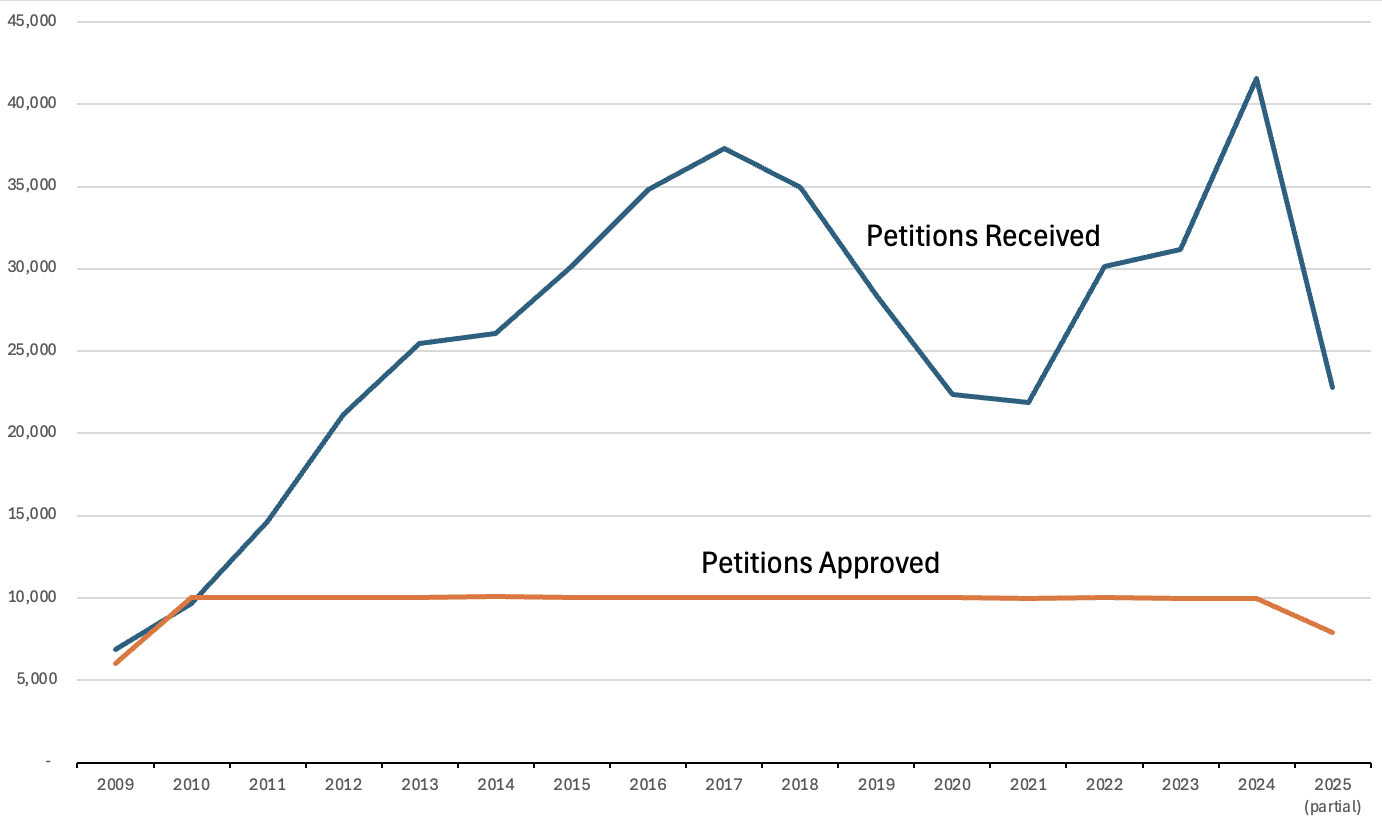
The number of applicants soon grew to far exceed the number of available visas (See Figure 1). As of June 2025, there were more than 416,000 U visa applications pending review with USCIS, with 250,000 for principal applicants and 166,000 for family members.
A number of policies have been adopted over the years that have created incentives to apply for the U visa and led to increasing demand that exceeded the annual limits. The spike in demand has led immigrant advocacy groups to call for an increase in the numerical limits (which Congress has not seen fit to do), and to allow petitioners to obtain protection from deportation and a work permit while awaiting adjudication and availability of a visa (which both the George W. Bush administration and the Biden administration granted, as discussed below).
U Visa Criteria
The U visa is one of just a few immigration benefit programs in which state and local authorities serve as gatekeepers, rather than a federal immigration agency alone. Aliens establish eligibility by filing a petition to USCIS that must include a certification form (I-918B). This certification must be completed by a law enforcement agency, and is intended to provide details about the victimization and confirm that the applicant has been helpful to the law enforcement agency in investigating or prosecuting the crime. The completed certification is returned to the petitioner and/or their attorney, not submitted directly to USCIS.
Table 1 lists the qualifying crimes. In addition to being the victim of a qualifying crime, the petitioner must meet the following criteria:
- The alien has suffered substantial physical or mental abuse as a result of having been a victim of certain defined criminal activity;
- The alien has information about the criminal activity;
- The alien has been helpful, is being helpful, or is likely to be helpful to law enforcement, local prosecutors, or a federal or state judge; and
- The criminal activity violates the laws of the United States or occurred in the United States.
Table 1. Qualifying Crimes* | |
|
|
* The qualifying criminal activities (QCA) were established by Congress in the Victims of Trafficking and Violence Prevention Act. A U visa petitioner must establish that he or she: (1) is a victim of a QCA; (2) has suffered substantial physical or mental abuse as a result of having been a victim of the QCA; (3) is able to provide credible and reliable information about the QCA; (4) is being, was, or is likely to be helpful to law enforcement, as reasonably requested, in the investigation or prosecution of the QCA; and (5) is admissible to the United States. | |
All of the qualifying crimes are stipulated in the statute, with the exception of "Fraud in Foreign Labor Contracting," which appears to have been added unilaterally by the Department of Labor in April, 2015.2
U Visa Application Trends
Since 2000, administration of the U visa program has undergone numerous regulatory and administrative changes — not as a result of laws passed by Congress passed, but in response to concerns of agency officials, often in response to demands of immigrant advocates and political advisors. For example, reacting to growing complaints from advocates that the congressionally mandated numerical limit of 10,000 was insufficient to meet demand, the Bush administration created a “waiting list” similar to other oversubscribed green card categories.3 USCIS stated that it had “determined that to balance the statutorily imposed numerical cap against the dual goals of enhancing law enforcement's ability to investigate and prosecute criminal activity and providing protection to alien victims of crime, it will create a waiting list should the cap be reached in a given fiscal year before all petitions are adjudicated”.4
However, unlike applicants on other immigration waiting lists, pending U visa applicants are deemed eligible for the same benefits as approved U visa recipients — a work permit and protection from deportation — in effect, negating the statutory numerical limits.
In 2008 and 2009, the number of petitions filed was relatively low, with fewer than 15,000 petitions received by the agency. There was a major uptick in petitions received starting in 2010, soaring to nearly 40,000 per year during the Obama administration. During these years, USCIS engaged in nationwide promotion of the visas to attorneys and advocacy groups through advertising, informational briefings, and webinars.
After dropping slightly under the first Trump administration, applications shot up again under the Biden administration, following further regulatory changes. These included allowing applicants to receive Deferred Action (deportation protection) and a work permit after merely filing petitions (before even a preliminary adjudication), re-defining “helpfulness” to include any petitioner claiming victimization in cases of crimes that will not be investigated and those who are never asked to help, and discontinuing deportation referrals in cases of denied applicants. Together, these changes ensured that U visa filers had nothing to lose and much to gain by submitting a frivolous or fraudulent petition.
Figure 1 shows the trend line in U visa applications since 2009. The annual number of petitions filed by the principal applicant (the alien claiming victimization) has grown from 6,850 in 2009 to 41,558 in 2024 — a six-fold increase. By the end of the Biden administration, the annual number of these applications had gone up nearly 10 percent from the previous peak at the end of the Obama administration.
Figure 1. U Visa Applications, Received and Pending Cases: FY 2009 – Present |
 |
Source: ”Immigration and Citizenship Data”, USCIS |
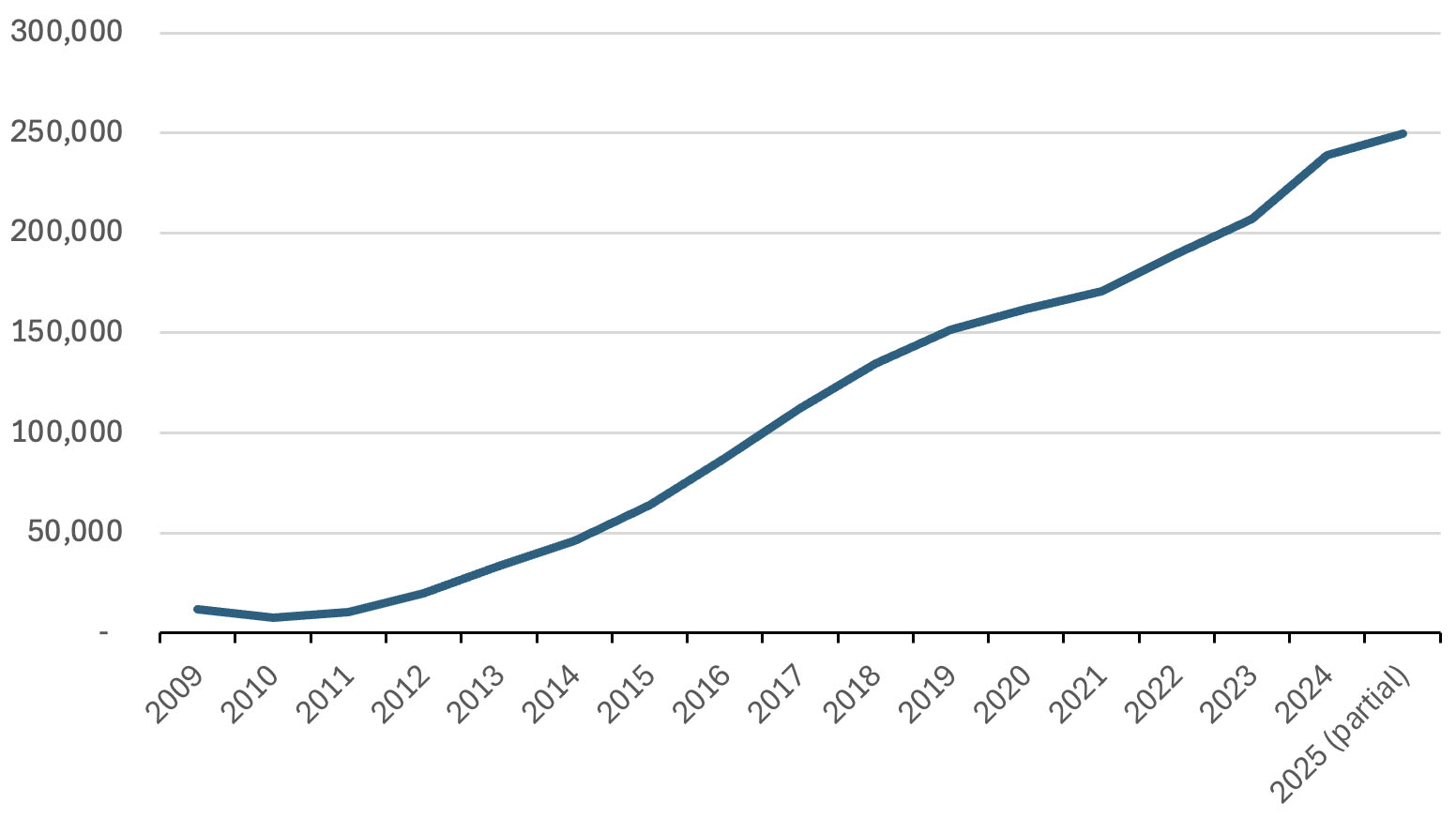
Since the number of new applications far outstrips the annual issuance limit of 10,000 per year, the surge in new applications means that the current stock of pending applications, which reached 250,000 in June 2025, would theoretically take 25 years to reach final adjudication and issuance if all were approvable.
Figure 2. U Visa Principal Pending Petitions |
 |
Source: ”Immigration and Citizenship Data”, USCIS |
Those whose U visa petitions are approved are permitted to sponsor certain immediate family members as well. Adults may sponsor spouses and children and those under 21 may sponsor spouses, children, parents, and unmarried siblings. The number of pending applications for family members of U visa petitioners is roughly 70 percent of the number of principal petitioners, and so represents a significant add-on to the size of the U visa program.
Government Investigations Expose Numerous Problems
The dramatic increase in U visa applications that rises well above the need that Congress anticipated when it created the program suggests that there are significant problems, both in concept and in operation. It has become a de facto amnesty program for tens of thousands of illegal aliens a year. The problems include a number of loopholes and fraud vulnerabilities, which have been confirmed by government investigations and news media accounts of prosecutions for U visa scams.
In 2020, USCIS completed a comprehensive study of the U visa program, examining the characteristics of the petitioners from 2012 to 2018.5 Among the findings:
- Only 5 percent of U visa petitioners reported having lawful immigration status at the time of application. Seventy-nine percent reported never having lawful status and 14 percent said they were visa overstayers.
- 22 percent of the petitioners reported that they had once been in deportation proceedings prior to seeking the U visa. Another 13 percent said that they were in deportation proceedings at the time they petitioned for the U visa.
- A significant share of U visa applicants are disqualified for admission to the United States, but may apply for a waiver of inadmissibility as a U visa applicant. The most common reason for needing a waiver was illegal presence (79 percent), followed by lack of a valid passport or visa (19 percent).
- Some approved U visa recipients had previously committed immigration fraud (10 percent) or re-entered illegally after removal (8 percent), which are both serious immigration violations. Six percent of those approved for the U visa had been ordered removed at some point before.
- About 1.5 percent of those who were approved for U visas during the time period studied, or roughly 1,800 people, had documented ties to criminal gangs.
- The largest number of petitions were filed by citizens of Mexico (68 percent), followed by Guatemala (7 percent), El Salvador (6.3 percent), Honduras (5.3 percent), India (3 percent), and Ecuador (1.9 percent).
- About 43 percent of the petitioners seek to sponsor family members. U visa petitioners sponsored an average of 1.5 family members.
- Roughly half (49.2 percent) of the family members sponsored were spouses, 42.5 percent were children, and 7.1 percent were parents.
- Of the family members, about one-fifth had been or were currently in deportation proceedings, 90 percent were also in the United States at the time of application, and 86 percent lacked lawful status.
In 2022, just two years after the USCIS report was completed, the DHS Office of the Inspector General, an independent auding agency, issued a report with the damning title “USCIS' U Visa Program is Not Managed Effectively and is Susceptible to Fraud”,6 confirming many concerns of outside observers. The report revealed the following problems:
- USCIS has not effectively addressed the fraud vulnerabilities in the U visa program, even after multiple internal reviews pointing out these risks and program weaknesses.
- USCIS had approved U visa applications with “forged, unauthorized, altered or suspicious law enforcement certifications”. Eight percent of the law enforcement certification forms reviewed by the investigators had been forged or altered.
- The report revealed findings from earlier internal reviews that had uncovered problems, including one 2020 review that found that 66 percent of U visa applications were based on closed crime cases, meaning that the applicants could not possibly provide assistance to law enforcement, which is one of the requirements for approval.
- USCIS cannot determine the number of arrests or prosecutions resulting from the cooperation of U visa applicants, making it impossible to determine whether the visas achieve the primary purpose of assisting law enforcement.
- The investigators surveyed law enforcement agencies about the program and found that 61 percent said it did not improve their ability to investigate or prosecute crimes. Forty-three percent said that the burden of dealing with the certifications outweighs any gains of participating. Only 18 percent of the respondents articulated any benefits of certifying U visa applications.
Faulty Statutory Language and Agency Policies Facilitate Fraud and Abuse
Despite years of reports on the program’s flaws, Congress has declined to amend the law that governs the program, despite having re-authorized the governing statute with significant amendments five times since 2020. Meanwhile, over the years most of the regulatory action by USCIS has been to incentivize applications and reduce scrutiny of petitioners. Together, these actions have created conditions that strongly incentivize the filing of U visa petitions as a way to obtain legal status or a reprieve from deportation.
First, the U Visa Petition Is Cost-Free to File. By statute, the U visa petition may be filed free of charge by the alien, despite the considerable financial benefits of work authorization that ensue, and even though there is a cost to the government to adjudicate the case and conduct background checks. Because USCIS is funded almost entirely by fees paid by other applicants for immigration benefits (who are primarily legal immigrants and their sponsors) the cost of adjudicating these petitions is borne by applicants in other categories, as is the case with asylum applications. In comparison, most other immigration benefits carry fees ranging from several hundred to more than $1,000 to apply.
Second, Forum Shopping Is Not Prohibited. While the alien must seek and obtain a law enforcement officer’s certification (Form I-918 Supplement B), some states, including Illinois and California, require law enforcement to assume that the request is valid rather than allow the agencies to use their discretion as to whether they should sign off on the petition. The 2020 internal USCIS report found that a disproportionate number (35 percent) of U visa petitions up to that point had been filed in California. The number filing in California is five times higher than the number filed in Texas and Florida (7 percent and 5 percent respectively), which also have large illegal alien populations.
Third, USCIS Currently Has a Policy to Allow for “Skeletal” Petition Filings. Despite regulations and form instructions, a U visa petitioner need not fill out all questions on the U visa form for the agency to accept it and issue interim benefits on the basis of a “pending” case. As noted by the Center for Immigration Studies in April 2021,7 the requirements for properly filing applications and petitions are clearly spelled out in Title 8 of the Code of Federal Regulations (CFR).8 The regulations clearly state that every benefit request must be filed in accordance with form instructions. According to the USCIS Policy Manual, “In order for USCIS to accept a benefit request, a submission must satisfy all applicable acceptance criteria.” The agency explains that this generally means (1) a complete, properly executed form, with a proper signature; (2) correct fees; and (3) the required initial evidence for intake purposes, as directed by the form instructions.
In 2019, the Trump administration found that many incomplete U visa petitions and applications (and petitions and applications in other categories) had been accepted by USCIS, sometimes lacking the main justification, evidence, or fee required to obtain the benefit. The agency made an operational change to align practice with the regulations and form instructions, and began rejecting U visa filings that were incomplete. This policy led to more efficient processing and reduced notices, requests for evidence, and other efforts by the agency to prompt petitioners to complete the forms as required — not to mention helping the agency to avoid processing and issuing work permits to frivolous and unqualified petitioners.
The Biden administration reversed the Trump policy of rejecting incomplete filings soon after taking over the agency, and the policy to allow skeletal applications remains in effect as of this writing.
Fourth, Oversubscription Allows Petitioners to Remain in the “Pending” Queue for Years. The rising number of applications relative to the limited number of visas that can be approved in a year has caused the size of the waiting list to balloon. This means that aliens can file a petition and wait years before it is reviewed. As the OIG report noted at the time, it took about four years for a petition to undergo the initial adjudication. If approved, the case would be eligible for placement on the waiting list and issuance of a work permit. Final review and visa issuance occurs when the visa becomes available within the statutory numerical limits. With more than 250,000 cases pending, the total waiting period for visa issuance is now more than 20 years, assuming most of the pending cases are approved. (An increased rate of denials of pending cases obviously would result in a shorter waiting period.)
Fifth, a Biden Administration Policy Change Further Incentivizes Frivolous Applications by Allowing Most Petitioners to Obtain a Work Permit Sooner after Filing, Before Meaningful Review of the Case. In response to demands from advocates for U visa petitioners about the several-year wait for initial adjudication and receipt of benefits, in June 2021 the Biden administration adopted a new procedure to enable petitioners to obtain a work permit earlier in the process. Under this procedure, USCIS conducts a “bona fide determination”, after which the agency may issue a work permit and deferred action (protection from deportation). While the official definition of “bona fide” is “made in good faith; without fraud or deceit”, USCIS has defined “bona fide” here as a completed petition and clearing initial background checks (meaning no very serious criminal convictions or associations with terrorism).9 According to practitioners, U visa petitioners now can receive a work permit within one to three years after filing, and before any review to determine if there has been fraud or deceit in the application.
Sixth, under Policies in Place under the Obama and Biden Administrations, All Those with a Pending Petition Were Protected from Deportation. Specifically, a 2009 ICE memorandum directed ICE to refrain generally from taking immigration enforcement action against aliens and their family members who were seeking U visa benefits until final adjudication, which, as noted above, could take decades. In addition, ICE was expected to seek to close any removal proceedings, release from detention, and request that USCIS expedite the adjudication of these applications. The first Trump administration issued a directive to supersede the 2009 memo, allowing ICE officers and lawyers to make exceptions to this policy under certain circumstances. In 2021, the Biden administration reverted back to the “safe harbor” approach to exempt all U visa petitioners from deportation until final adjudication, and additionally required ICE officers to proactively look for indications that the alien they had encountered or arrested might be the victim of a crime. In January 2025, Trump’s incoming acting ICE director issued a new memorandum10 rescinding the prior guidance and instead directing officers to coordinate with local law enforcement agencies and the ICE legal office about how to handle U visa applicants they encounter on a case-by-case basis and in consideration of ICE’s mission.
Finally, the Biden Administration Prohibited USCIS Officers from Exercising Their Authority to Issue Notices to Appear, or Charging Documents, to Potentially Removable Aliens Whose Immigration Benefit Applications Were Denied. As a result, those who filed frivolous or even fraudulent U visa applications faced no consequences for having done so. This policy was rescinded on February 28, 2025.11
Law Enforcement Agencies Face Conflicting Pressures
While many law enforcement agencies that are familiar with U visas recognize the potential value of the program in certain circumstances, such as cases in which a victim of a serious crime is reluctant to cooperate with authorities and this hampers an investigation, they still struggle to balance the benefits of participating appropriately with the need to avoid facilitating fraudulent or frivolous applications. As the DHS Inspector General’s survey found, a significant number of police agencies believe that the U visa program causes them more problems than it helps them address crime. Some worry that if they fail to thoroughly screen requests and if they show openness to certifying cases, then their agencies might become targets for frivolous filers (and their attorneys).
According to the USCIS report, a majority of petitioners seek certifications for crimes in which the statute of limitations has expired, or that were dealt with and/or closed years ago. Some agencies receive requests to certify a petition based on a crime that did not occur in their jurisdiction. Some officers have expressed confusion over the appropriate expectations for the petitioner’s helpfulness, especially when the likelihood of prosecution is extremely low. Some petitioners allege they are a victim of a crime that does not meet or stretches the definitions of qualifying crimes in the law.
Other law enforcement officers who are asked to certify cases do not fully understand the purpose of the program, what happens after they sign and return the certification, and that the U visa it is not intended as an entitlement or compensation for an illegal alien who has been the victim of a crime, but rather to assist in the investigation and prosecution of crimes. Some agencies lack adequate procedures or oversight to guard against fraud or frivolous requests for U visa certifications. According to the USCIS 2020 report, “In some cases, the certifying officials did not appear to have completed or sufficiently reviewed the Form I-918B before signing it.”12 The report also noted that some certifications or evidence may have been altered by the petitioner or their representative before being submitted to USCIS.
One of the most significant problems has been the emergence of schemes to stage fake crimes for the purpose of fraudulently qualifying for a U visa. Authorities have uncovered numerous schemes in recent years, typically involving staged gas station or convenience store robberies. One recent case prosecuted by the Department of Justice is typical. Defendants Rambhai Patel and Balwinder Singh were found guilty of staging 18 armed robberies at convenience stores, liquor stores, and fast food restaurants. A “robber” would threaten a clerk, take some cash and leave, all in view of security cameras. Then the “victims” (the clerks) would wait several minutes before calling police, and later apply for U visas. The “victims” paid as much as $20,000 to Patel and Singh, while the stores that were “robbed” would receive a share of the fees.13
These staged crimes are not without risk; one of the fake robbers in a faux U visa-inspired hold-up in Houston was shot and killed by a man who witnessed the “robbery” and believed he was disrupting an actual crime. Police and news media reporters later identified several individuals who had applied for U visas after claiming to have been robbed by the man who was killed.14
In another disturbing case, in 2020 a woman was convicted in Minnesota for her role in a U visa scheme, directing several other women to file false police reports alleging robberies and assault, and then using a box-cutter to cut the women to support their allegations.15
Occasionally, law enforcement officers have abused the program for profit or political motives. In July 2025, five individuals — four of whom were current or retired police chiefs and one of whom was an organizer — were convicted of filing hundreds of false police reports to support U visa certifications, charging $5,000 per case.16
In another high-profile case, Sheriff Javier Salazar of Bexar County, Texas, sought to criminally charge several Florida parties for “unlawful restraint” of a group of illegal migrants who had agreed to be flown to Martha’s Vineyard, Mass., from Texas after being released by the Border Patrol. The sheriff’s office provided certifications for U visa petitions for the migrants, who later received deferred action and work permits. However, in September 2025, the Bexar County District Attorney’s Office declined to pursue the case, saying there was not sufficient evidence to support the criminal charges, since the migrants denied they had been forced or intimidated into traveling to Massachusetts.17 It remains to be seen if USCIS will allow these U visa petitioners, and others in the system, who benefited from filing false or frivolous petitions, to avoid deportation after the basis for the U visa petition has been voided or was fraudulent.
Some State Laws Demand that Police Rubber-Stamp Certifications
In addition, legislatures in eight states have enacted laws designed to expedite and/or facilitate U visa certification requests to law enforcement agencies, and which tend to erode program integrity: California, Colorado, Connecticut, Illinois, Nevada, New York, Oregon, and Utah. Most of these laws include provisions that:
- Require the certifying LEA to complete the review within a specified time period, usually 30-90 days, with even tighter deadlines for petitioners who are already in deportation proceedings; these deadlines may result in certification of applications for petitioners who later decide not to be helpful or, in the case of those in proceedings, may end up stalling or preventing the removal of an alien who otherwise has no path to legal status;
- Stipulate that LEAs can and should issue certifications even if no charges were or will be filed in the case, or the case will not be investigated or prosecuted;
- Direct the LEAs to adopt a presumption that the petitioner will be helpful in any investigation or prosecution, rather than certify on the basis of the actual helpfulness or lack thereof on the part of the alien petitioner;
- Emphasize that USCIS makes the final determination over U visa eligibility, implying that local police should simply rubber-stamp the certification and not try to avoid facilitating dubious cases; and
- Allow aliens to “forum-shop”, or request certification from a different LEA if the original agency denies the request.
These laws can put law enforcement agencies in a difficult position when they receive requests that do not clearly fall within the parameters of federal law or that do not clearly provide value to the law enforcement agency in prosecuting a crime. The police agencies must avoid violating state law, while also being obliged to provide USCIS with factual and truthful information on the certification form, under penalty of perjury. Further, most police agencies do not want to become targets for fraud schemes and frivolous petitions and do not want to facilitate abuse of a government program. Yet these state laws seem designed to ensure that the certification process does not serve as a meaningful filter for bona fide cases, but rather a rubber-stamp enabling these illegal aliens to take advantage of the opportunity to obtain temporary protection from deportation and a work permit, at least until USCIS adjudicates the application.
The Attorney General for the state of Illinois, Kwame Raoul, has taken a particularly aggressive approach to ensuring that state police agencies abide by the Illinois law that all but requires law enforcement agencies to approve U visa certifications, using investigative and enforcement authorities granted to his office under that law.
In December 2022, responding to complaints from advocates for several aliens whose requests for U visa certifications were denied, the office launched an investigation into the Joliet Police Department’s practices. Raoul noted that under Illinois law, police departments “shall complete certification forms for any victim of qualifying criminal activity” (emphasis in original).18 According to the attorney general, Illinois law enforcement agencies must provide U visa certifications to requestors unless the officer cannot determine if a qualifying crime occurred, cannot determine if the requestor is the victim of such crime, or when the crime occurred out of the agency’s jurisdiction. Agencies are required to assume that the claimed victim is or will be helpful in investigating/prosecuting the crime and (contrary to USCIS guidance) must fill out, sign, and return the certification form for the alien to submit with their petition to USCIS, even if the agency determines that the alien has not been helpful. In addition, the certifying agencies typically must deal with the request within 90 days, and consider appeals to any denials, even without new information.
Raoul’s 18-month investigation found that the Joliet Police Department had failed to complete certifications within the mandated deadline and, out of dozens of cases examined, had “erroneously” denied two requests from aliens who refused to assist in investigations of the crime, improperly directed one alien to apply in another jurisdiction, and improperly denied one appeal that was submitted without new information to consider. He demanded that Joliet take remedial steps to reform their U visa certification process and re-adjudicate the five cases that were singled out for investigation.
In response, in May 2024 the city of Joliet complied with Raoul’s demands by updating the police department web page on U visas, providing further training to personnel, initiating a process to provide detailed reasons for any refused certifications, and improving its reporting on requests to the Attorney General’s Office. The police department also requested training for certifying officers directly from USCIS, but this request was first ignored by USCIS and then refused outright, according to the Joliet police chief.
Conclusion and Recommendations
The U visa program is failing to accomplish its twin goals of assisting law enforcement agencies in investigating and prosecuting serious crimes and providing relief to illegal aliens who are the victims of such crimes and who are helpful to law enforcement in dealing with that crime. This failure is primarily due to inadequate federal statutory and regulatory controls that facilitate fraud and abuse of the program. In addition, certain policies have created incentives for aliens to file false or frivolous applications and caused a steep spike in applications and resulting delays in adjudication of benefits for all, including the victims that the law was intended to help. Finally, misguided and politically motivated state and local laws and practices undermine the integrity of the program.
The best solution to address the problems in the U visa program would be for Congress to end it altogether, and replace it with a tightly regulated parole or deferred action program that offers temporary permission to remain and temporary work authorization to victims who are assisting in the active prosecution of a qualifying crime. In the meantime, the following array of options would be helpful.
Congress Must Revise the U Visa Requirements. Congress should amend the law in the following ways:
- Require that all petitions (and LEA certifications) be initiated and filed by the law enforcement agency, not the alien or the alien’s representative;
- Eliminate U visa recipient eligibility for green cards in favor of deferred action or deferred enforced departure (i.e. the visa is temporary, not a path to citizenship);
- Impose an application deadline or time limitation on qualifying crimes, requiring the alien to request certification within 30 days of reporting the crime;
- Disallow certifications and approvals for crimes that will not be prosecuted;
- Mandate background checks before LEA certification;
- Eliminate certain waivers of ineligibility and inadmissibility so that applicants with a serious criminal or immigration fraud history are disqualified;
- Prohibit issuance of work permits prior to final adjudication;
- Prohibit a private right of action to challenge denials of LEA certification;
- Permit USCIS to prioritize adjudication according to the seriousness of the crimes that are the basis of the petition;
- Define “helpfulness” as a requirement for petitioners; and
- Allow only those government agencies that investigate and prosecute crimes (not merely "detect" crimes) to certify U visa petitions.
USCIS Must Act to Shore Up Regulations and Address Fraud. Numerous regulatory and policy options are available to USCIS to address the problems in the U visa program, many of which already have been outlined in government audits and investigations. These include:
- Launch a targeted review process to weed out incomplete, fraudulent, or unapprovable cases from the current pending and waiting lists and speed up the adjudication of cases more likely to be approved;
- Create an electronic petition and certification process, whereby incomplete or skeletal petitions (likely filed solely to obtain deportation protection and a work permit) will be rejected, and whereby LEAs submit certifications directly to USCIS (instead of returning to the petitioner);
- Define “helpfulness”, qualifying crimes, and other visa requirements to avoid facilitating frivolous applications;
- Train state and local law enforcement agencies in program requirements and best practices, and update and disseminate the agency website and materials with detailed guidance on handling requests for certification;
- Interview all petitioners;
- Create an enhanced review process for applications filed in jurisdictions, such as Illinois, that have laws that conflict with federal rules, or which have indications of fraud;
- Consider litigation to challenge state laws, like in Illinois, that appear to contradict federal law, such as by mandating certification of cases and unwarranted assumptions of helpfulness;
- Eliminate the “bona fide determination” process and cease issuance of work permits to unadjudicated cases;
- Issue Notices to Appear (immigration charging documents) to denied petitioners who are removable;
- Dedicate certain USCIS enforcement agents to investigate U visa fraud and refer egregious fraud cases for prosecution;
- Create a user-friendly revocation process or portal for LEAs to withdraw certifications upon review or upon acquiring new information about the petitioner or the crime reported; and
- Launch an engagement program to solicit information and ideas from law enforcement agencies.
States Should Set Standards for Certification. In the absence of federal reforms, state lawmakers should establish appropriate standards to assist law enforcement agencies in navigating U visa certification requests and to set up guardrails against fraud. States can do this through legislation or executive action such as:
- Establish a centralized review process under the purview of the state attorney general or state law enforcement agency executive, and prohibit certifications that do not undergo review;
- Publish guidance and provide training to police certifying officers on best practices regarding qualifying crimes, jurisdiction, helpfulness, and background checks;
- Conduct a review of certified cases that are still pending final adjudication, and move to rescind certification in non-meritorious cases, such as those that were never prosecuted or where the alien did not assist the LEA;
- Require LEAs to publish reports on U visa certification requests; and
- Prosecute U visa-related crimes, including staged crimes.
Local Law Enforcement Agencies Need to Adopt Processes That Deter Fraud. All state and local law enforcement agencies need to establish appropriate U visa protocols that align with federal law. Even agencies in states with strict laws that aim to facilitate approval should refrain from automatic approvals and understand circumstances in which the state law may offer some limited discretion. Best practices include:
- Designate U visa certification officers and provide a signature example to USCIS;
- Interview aliens who request certification and perform a background check to determine criminal history, outstanding warrants, or other derogatory information;
- Take care to fill out the certification form completely and avoid leaving blank space for the alien or their representative to alter the form, and maintain a copy;
- Deny certification on the basis of crimes that allegedly occurred out of your jurisdiction, were not reported, do not meet the definition of a qualifying crime, or will neither be investigated nor prosecuted;
- Especially in states with U visa facilitation laws, make a specific request to the alien for information or assistance, in order to ascertain helpfulness;
- Establish a process to periodically review U visa certifications to determine if certification is still warranted;
- Communicate with USCIS about any new information or concerns about petitioners, and revoke any certifications if warranted;
- Establish relationships with trusted advocates for alien victims of crime to communicate what is necessary to certify U visa petitions;
- Participate in individual or group action, such as through an association of LEAs, to provide information to USCIS and federal lawmakers on U visa issues, and to offer comments on needed or proposed regulatory or legislative reforms; and
- Refer U visa-related fraud for prosecution.
End Notes
1 See Conference Report (H. Rept. 106-939) accompanying H.R. 3244, the Victims of Trafficking and Violence Protection Act of 2000, October 5, 2000.
2 See "U and T Visa Certifications", U.S. Department of Labor, Wage and Hour Division,
3 See 8 CFR 214.14:
Waiting list. All eligible petitioners who, due solely to the cap, are not granted U-1 nonimmigrant status must be placed on a waiting list and receive written notice of such placement. Priority on the waiting list will be determined by the date the petition was filed with the oldest petitions receiving the highest priority. In the next fiscal year, USCIS will issue a number to each petition on the waiting list, in the order of highest priority, providing the petitioner remains admissible and eligible for U nonimmigrant status. After U-1 nonimmigrant status has been issued to qualifying petitioners on the waiting list, any remaining U-1 nonimmigrant numbers for that fiscal year will be issued to new qualifying petitioners in the order that the petitions were properly filed. USCIS will grant deferred action or parole to U-1 petitioners and qualifying family members while the U-1 petitioners are on the waiting list. USCIS, in its discretion, may authorize employment for such petitioners and qualifying family members.
4 “New Classification for Victims of Criminal Activity; Eligibility for ‘U’ Nonimmigrant Status”, Federal Register, September 17, 2007.
5 “U Visa Demographics”, USCIS, March 2020.
6 “USCIS’ U Visa Program Is Not Managed Effectively and Is Susceptible to Fraud (REDACTED)”, Office of the Inspector General, Department of Homeland Security, January 6, 2022.
7 Robert Law, “USCIS Announces It Will Violate the Law: Back to accepting incomplete applications filed only to gain work permits”, Center for Immigration Studies, April 2, 2021.
8 8 CFR 103.2 says that:
Every form, benefit request, or other document must be submitted to DHS and executed in accordance with the form instructions regardless of a provision of 8 CFR chapter I to the contrary. The form's instructions are hereby incorporated into the regulations requiring its submission. Each form, benefit request, or other document must be filed with the fee(s) required by regulation. All USCIS fees are generally non-refundable regardless of if the benefit request or other service is approved, denied, or selected, or how much time the adjudication or processing requires. Except as otherwise provided in this chapter I, fees must be paid when the request is filed or submitted.
9 USCIS Policy Manual, “Chapter 5 – Bona Fide Determination Process”, USCIS, current as of December 18, 2025.
10 Caleb Vitello, “Interim Guidance on Civil Immigration Enforcement Actions Involving Current or Potential Beneficiaries of Victim-Based Immigration Benefits”, ICE, undated.
11 “Issuance of Notices to Appear (NTAs) in Cases Involving Inadmissible and Deportable Aliens”, USCIS Policy Memorandum, February 28, 2025.
12 “U Visa Demographics”, USCIS, March 2020.
13 “Indian National Sentenced for Visa Fraud Conspiracy”, USCIS, August 22, 2025.
14 Luke Jones, “Indian immigrant denies staging robbery to obtain U-visa”, ABC 13 Eyewitness News, April 6, 2024.
15 “Woman Orchestrated Scheme To Obtain U Visas, Charged With Visa Fraud”, U.S. Department of Justice, February 3, 2020.
16 “USCIS Uncovers U Visa Fraud Scheme by Corrupt Law Enforcement, Leading to Federal Indictments”, USCIS, July 17, 2025.
17 David Lynch, “Bexar County DA won't pursue criminal charges after dozens of migrants were flown to Martha's Vineyard in 2022”, KENS5, September 10, 2025.
18 “Findings in VOICES Act Investigation of Joliet Police Department”, Kwame Raoul, State of Illinois attorney general, memorandum to Joliet Police Chief William Evans and Joliet City Manager Beth Beatty, August 1, 2024.