
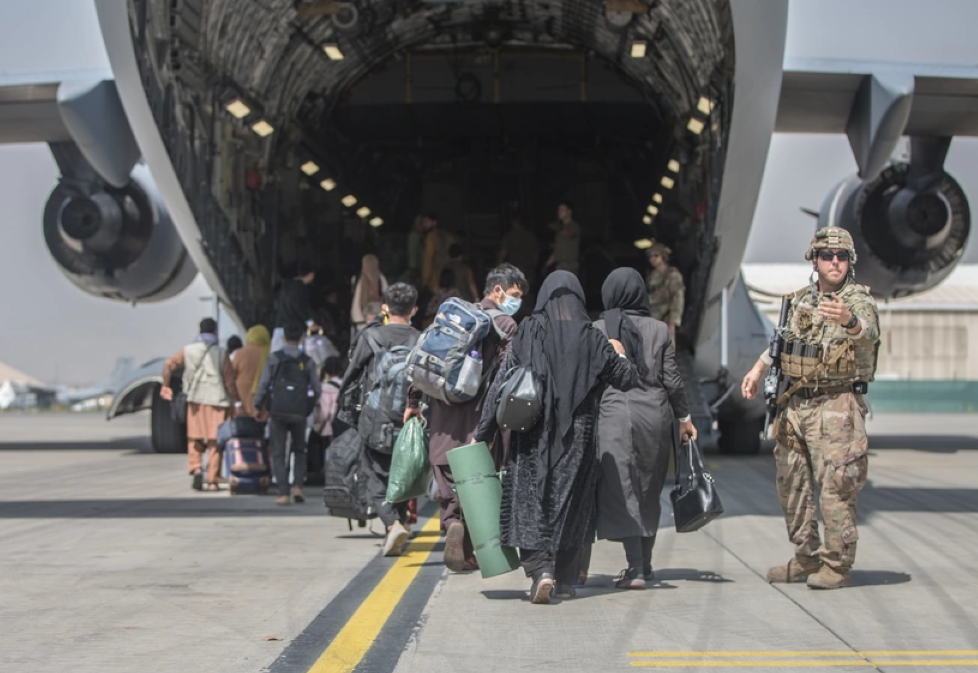
On September 23, the DHS Office of Inspector General (OIG) — the department’s internal watchdog — issued a report captioned “Adjudication Errors in Operation Allies Welcome Asylum Files Risked Missing Derogatory Information”. “Operation Allies Welcome” (OAW) was the Biden administration’s sunny euphemism for its hectic resettlement of approximately 97,000 Afghan nationals in the United States in the wake of the U.S. military’s calamitous withdrawal from the country Al Qaeda used as its base while planning September 11th. Once they arrived, those aliens became eligible to seek asylum — including with USCIS — and OIG identified errors in 40 percent of a sample of asylum files that agency had completed. This stat is extremely concerning, but USCIS doesn’t bear all the blame — a Democrat-controlled Congress, the courts, and the last administration (especially) did plenty to make it happen.
Operation Allies Refuge and OAW
As my colleague Nayla Rush explained in September 2021, “the United States evacuated 124,000 people out of Afghanistan during Operation Allies Refuge (July 14 through August 31). We don’t know exactly who was on those planes and, by all accounts, neither do U.S. officials.”
She continued:
Secretary of State Antony Blinken explained the evacuation process to the press on September 3. He said the first priority was to get people out of there, and figure out later on exactly who’s who:
And given the premium that we put on getting people out as quickly and as safely as possible … then really digging into exactly which categories they may fit into. Were they locally employed staff? Were they SIVs, Afghans at risk, potential P-1 or P-2 [refugees], parolees, et cetera? All of that work now is what we’re doing.
Perhaps the then-secretary could have asked someone at State’s Foggy Bottom (an apt location if there ever was one) headquarters to brief him on a commonly used relocation tactic for “getting people out” of areas of conflict “as quickly and as safely as possible” known as “refugee camps”, but it’s likely too late to un-ring the Operation Allies Refuge bell.
The OIG Sample of OAW Affirmative Asylum Claims
In any event, Operation Allies Refuge led directly to OAW, the resettlement of the roughly 97,000 evacuees who were Afghan nationals in this country.
Under section 208(a)(1) of the Immigration and Nationality Act (INA), “Any alien ... physically present in the United States or who arrives in the United States ... irrespective of such alien's status, may apply for asylum,” and thousands of the Afghans resettled under OAW filed what’s known as “affirmative asylum” applications with USCIS.
As an aside, it’s called affirmative asylum to distinguish it from the “defensive asylum” claims that are filed by aliens in removal proceedings with the immigration courts.
OIG reports that USCIS has adjudicated more than 13,500 affirmative asylum applications, from which that office pulled a statistical sample of 678 applications for review, essentially 5 percent of the total.
The Screening Process
Affirmative asylum applications are screened, reviewed, and adjudicated by asylum officers (AOs) in USCIS’s Refugees, Asylum, and International Operations Directorate (RAIO) to determine whether the applicants are who they say they are, are telling the truth, are eligible for asylum, aren’t barred from receiving that protection (on criminal or national security grounds, for example), and merit protection in the exercise of discretion.
Part of that process requires checking the applicant’s name, date of birth, and aliases against information contained in a number of systems, including CBP’s TECS (“the principal system used by officers at the border to assist with screening and determinations regarding admissibility of arriving persons”), the National Crime Information Center (NCIC, “a computerized database of documented criminal justice information”), and the FBI’s Name Check.
In addition, biometrics from affirmative asylum applicants are run through a number of databases, including the FBI’s fingerprint check system, DHS’s Automated Biometric Identification System (IDENT, a department-wide “system for storage and processing of biometric and associated biographic information for national security; law enforcement; immigration and border management; [and] intelligence”), and the Department of War’s Automated Biographic Identification System (ABIS, which includes information “collected during military operations” ).
As OIG explained, AOs use:
Global, the Asylum Division’s case management system, to identify and review certain biographic and biometric securing check information. Global indicates whether a security check resulted in no match or a potential match (indicated as a “hit” or “no hit” for some checks) to a record, which includes information that may warrant further investigation and clarification. If the information matches and is derogatory (i.e., national security concerns, criminal convictions, and other misconduct), it may lead to an unfavorable asylum decision by USCIS.
AOs must then review the results to determine whether there’s a match between the alien and the record, assess the effects of that match on the claim, and document the results and resolution of the match on what’s referred to as the “multiple systems check document” (MSCD).
The Errors Identified by OIG
The OIG “reviewed all documents available to the AO at the time of adjudication related to four general categories: (1) aliases, (2) security checks, (3) resolution of potentially derogatory records, and (4) overall documentation”, and identified errors in 269 (40 percent) of the USCIS files it reviewed.
Aliases
The most common error it found, in 169 (25 percent) of the total files reviewed, had to do with AOs’ failures to enter aliases into Global.
Interestingly, while most (107) files had one missed alias, 62 of them had two or more missed aliases, three had seven missed aliases, and one file had 12 missed aliases — raising the obvious question of why any alien brought to the United States would be using so many different names.
Even stranger is the fact that one file OIG reviewed involved an alien with 124 different aliases, which helps to explain why the watchdog concluded that AOs working on short timelines “may be unable to entirely avoid missed aliases”.
Missing Documentation
The next most common error (in 96 files, 14 percent of the total) related to documentation errors, including “missing required paperwork or incomplete MSCDs” (primarily the latter).
As OIG noted, many of those documentation errors may be considered “inconsequential beyond inconvenience because the information is generally available in another location”, but two involved “documentation required when an AO identifies evidence that an applicant may be subject to” Terrorism-Related Inadmissibility Grounds, or “TRIG”.
Apparently (and somewhat concerningly), some TRIGs are subject to “exemptions”, and the AO “must complete the TRIG exemption worksheet to recommend either granting or denying the exemption”.
That recommendation is then subject to two layers of review, and in one of those two instances of error, the AO did a TRIG analysis but failed to include the worksheet, and while the other had a worksheet that was signed by the two higher-ups, those officials never checked the “box indicating whether they approved or disapproved the AO’s analysis”.
I am not clear as to why any “Terrorism-Related Inadmissibility Ground” should not result in a dispositive denial, but if there are going to be exemptions, there should be extensive review and that review should be clearly documented.
Incomplete Resolution of Hits
The third most common error, identified by OIG in 45 of the files reviewed (7 percent of the total), had to do with “incomplete resolution of potential matches to derogatory records”, including 23 errors related to ABIS checks, four related to FBI fingerprint checks, 13 “related to resolving potential matches to NCIC records”, and five involving TECS records.
As OIG explained:
When an AO submits applicant information for security checks, the process may identify a potential match between that information and a derogatory record. For potential biographic matches, the AO must first determine whether there is an actual match between the applicant and the subject of the record. If the AO determines there is an actual match between the applicant and the security checks record, he or she must assess whether the information in the record is derogatory, affecting the applicant’s eligibility for asylum.
Remember, ABIS is a War Department repository, and potential ABIS hits are sent to CBP to determine whether there is derogatory information that relates to the applicant.
Thereafter, and in addition to considering that CBP determination, the AO must also “review all ABIS records associated with the applicant and determine the impact of the information on asylum eligibility”. In all 23 files identified, the AO failed to “include ABIS details in the” alien file (“A-file”), though according to the report, “many ABIS records were non-derogatory”.
Notably, but more generally, OIG explained that:
The steps to resolve potential matches can be lengthy and depend on the security check the AO is performing. For one file within our sample, the TECS/NCIC security checks for an applicant with a common name returned more than 1,500 potential match results. The AO must review each result to determine whether there is an actual match between the applicant and the subject of the record, and then resolve any matches as required.
Missing Results of Security Checks
Finally, OIG “identified 23 files (3 percent) with missing security checks results, all of which related to either FBI Name Check or TECS, potentially missing matches between the applicant and a derogatory record in one of the systems”.
A slight majority (57 percent) of those errors related to FBI Name Check, and as the report notes, unlike TECS checks (which Global automatically initiates), “AOs must manually initiate the FBI Name Check search for certain aliases within Global”. That sounds like a database issue for USCIS to address.
Nearly all (90 percent) of the TECS errors, on the other hand, involved cases USCIS had administratively closed, which OIG explained can occur “for various reasons”, including when an alien withdraws his application; “or the component identifies a conflict of jurisdictional authority (e.g., applicant is in removal proceedings)”; or when the applicant abandons the asylum application.
“When USCIS administratively closes an application,” the report noted, “in certain cases the AO must still complete the TECS security checks on the primary name and document results of these checks on the MSCD.”
That makes sense because: (1) few aliens without status just walk away from their asylum applications, which makes the ones who do suspect; and (2) if the alien is in removal proceedings, the immigration judge and ICE attorney may want to know what the TECS check revealed.
AOs Don’t Bear All the Blame — Far From It
While AOs plainly bear primary blame for the errors identified in the OIG report, there are plenty of other culpable parties who did their fair share to create and exacerbate this mess.
First and foremost, of course, is the Biden administration, which chose to bring about 97,000 largely unscreened Afghans from a chaotic and insecure war zone to the United States, where section 208(a)(1) of the INA guaranteed some, most, or all of them the opportunity to file asylum applications with USCIS, an already overwhelmed agency.
Then there’s Congress, which in section 2502(c) of the Afghanistan Supplemental Appropriations Act, 2022, required AOs to interview OAW Afghans who filed asylum applications “not later than 45 days after the date on which the application is filed”, and to issue a “final administrative adjudication on the asylum application within 150 days” of the date of filing, absent “exceptional circumstances”.
Given that the statutory standard for final adjudication of asylum claims in section 208(d)(5)(A) of the INA is 180 days (“in the absence of exceptional circumstances”, which are the norm) and given that the U.S. government — and thus by definition USCIS — knew very little about any of those OAW aliens, that is a recklessly short deadline that calls into question what the legislative branch was thinking.
Which brings me to the third branch, the judiciary, with massive assistance from the Biden DOJ.
In April 2023, a complaint was filed in the U.S. District Court for the Northern District of California (N.D. Cal.) in Ahmed v. DHS, challenging what counsel termed “the systematic failure of” DHS and USCIS “to adjudicate the asylum applications filed by seven plaintiffs, and thousands of other asylum applicants like them, within the 150-day deadline set by Congress”.
On September 6, 2023, Judge Jon Tigar of the N.D. Cal. approved a class action settlement between the Ahmed plaintiffs and Biden’s Department of Justice, under which (inter alia) USCIS was required to “adjudicate at least 90% of Afghan asylum applications, that were filed on or after February 2, 2024, no later than 150 days after the date of filing”.
Note that DHS OIG only undertook this investigation because it had “received complaints from USCIS employees expressing concerns about the effect of the Ahmed v. DHS settlement agreement ... on the asylum adjudication process due to the shortened timeframe for adjudication”.
Ironically, however, OIG concluded that “the percentage of files with errors post-settlement agreement was smaller than the percentage pre-settlement agreement”.
Cascading Errors
What happens when the U.S. government hurriedly evacuates thousands of unknown Afghans from a chaotic war zone and then Congress and the courts force USCIS asylum officers to adjudicate their asylum applications on insanely short timelines? DHS OIG answered that question for you: a “40 percent error rate in the adjudication of their asylum files”.