

As the 25th anniversary of the September 11, 2001, attacks approaches, some may wonder if increased vetting or possible distrust of Muslims in the United States caused fewer people from the Islamic world to immigrate here. An analysis of Census Bureau data shows that the immigrant population (also called the foreign-born) from predominantly Muslim countries has more than doubled since 2001.1 Not all immigrants from these countries are Muslims. (The Census Bureau does not ask about religion.) Nevertheless, the data indicate that the U.S. did not fundamentally change immigration policy after September 11th, nor does the desire of many people in the Muslim world to settle here seem to have changed much. As a result, the number of immigrants from these countries has soared.
Download Data Here
Key Findings:
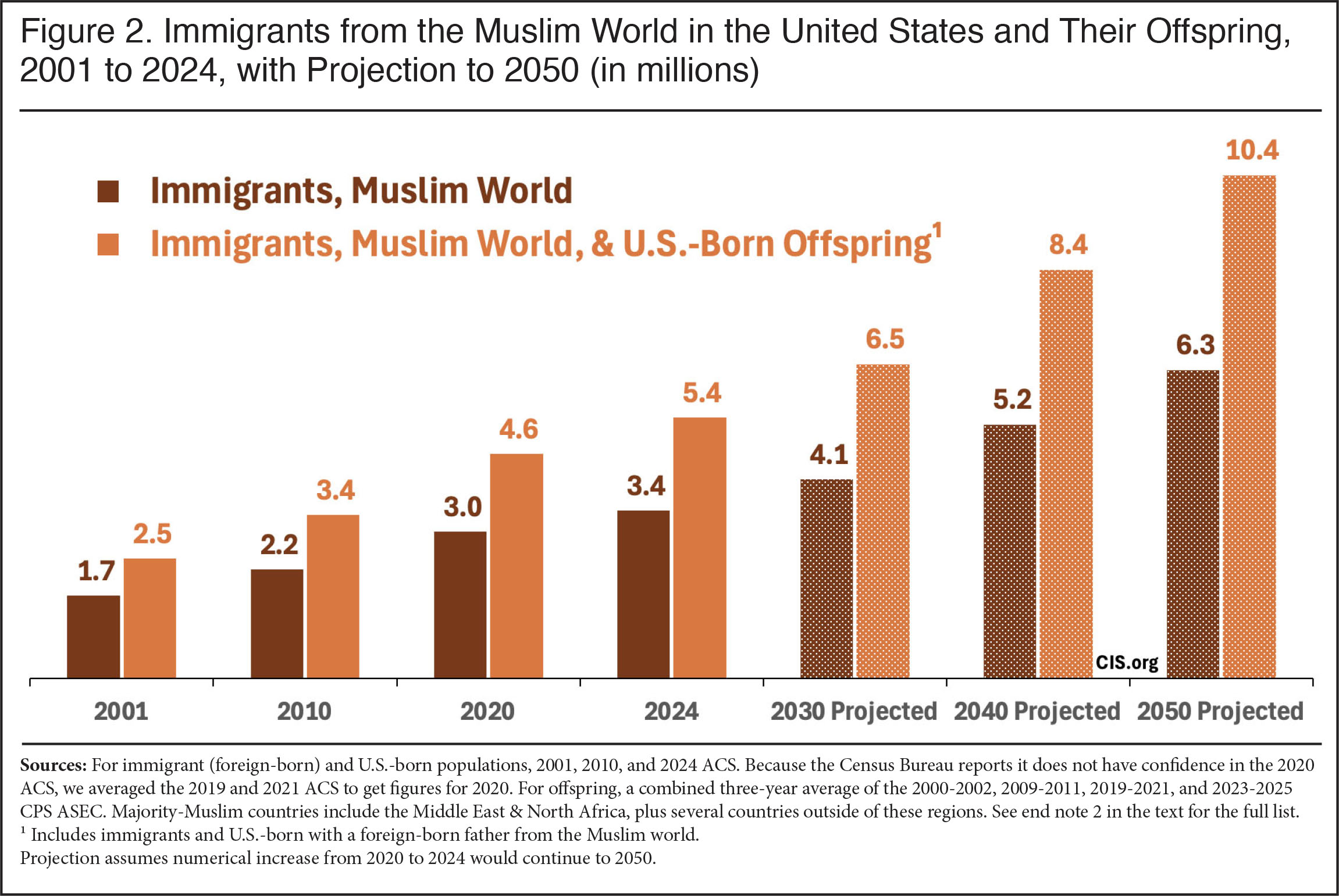
- The number of immigrants — including naturalized citizens, legal permanent residents, long-term temporary visitors, and illegal immigrants — from the Muslim world increased from 1.7 million in 2001 to 3.4 million in 2024. This represents the net increase — new arrivals minus emigration and natural mortality.2
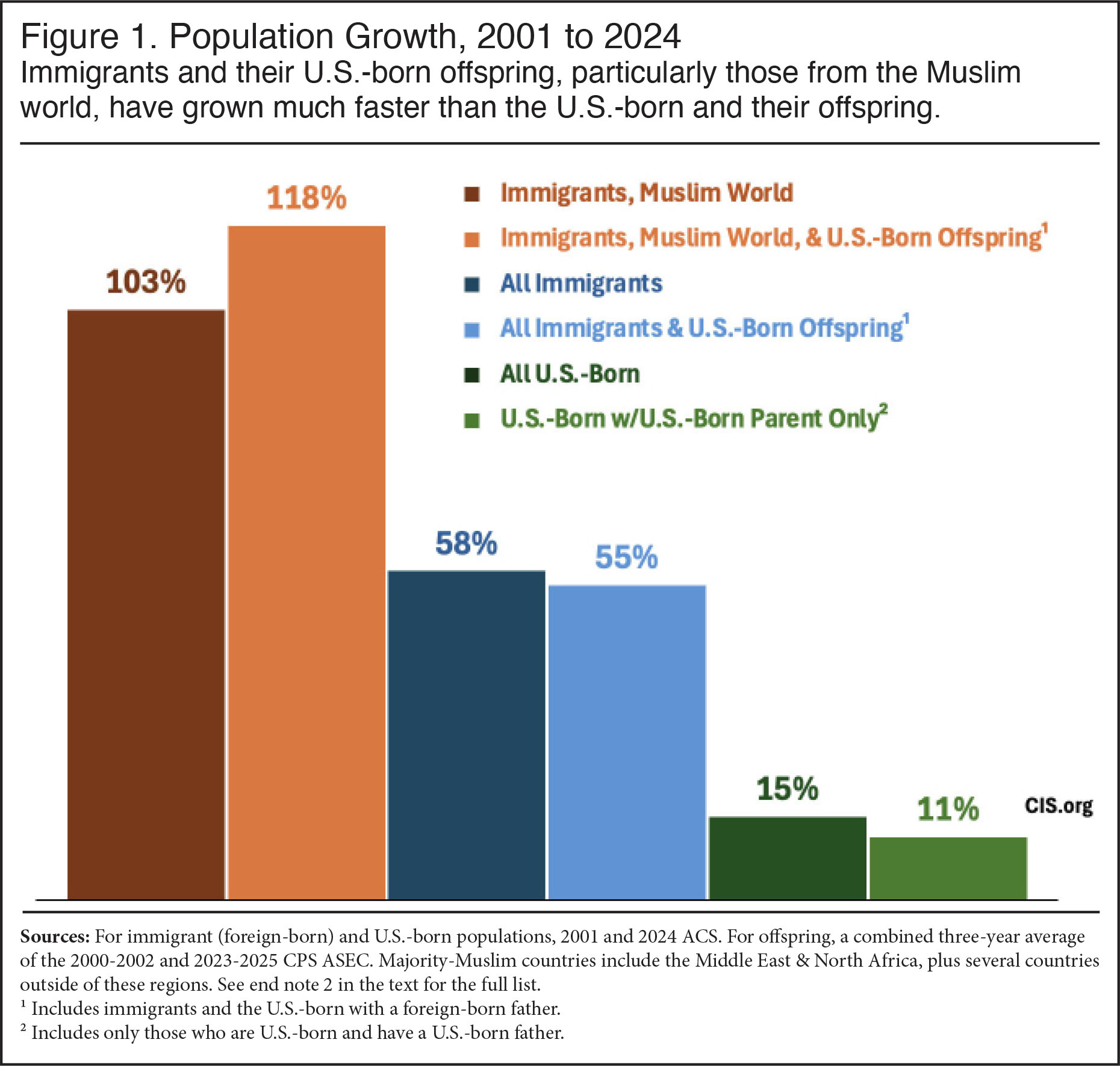
- Immigrants from predominantly Muslim countries increased by 103 percent from 2001 to 2024. This is much faster than the growth in the overall foreign-born population (58 percent) and is nearly seven times faster than for the overall U.S.-born population. (See Figure 1.)
- The decision to admit large numbers of people from Afghanistan after the U.S. withdrawal caused the population of Afghan immigrants to nearly double from 2020 to 2024, but Afghans accounted for only a quarter of the total increase from the Islamic world over this time period.
- Prior research indicates that 10 to 20 percent of immigrants from majority-Muslim countries may be illegal immigrants — lower than the 25 to 30 percent share for the overall foreign-born.3 The rapid increase in immigrants from the Islamic world overwhelmingly reflects legal immigration policies.
- Many top immigrant-sending countries in the Muslim world have hostile relations with the United States or struggle with powerful terrorist movements. From 2001 to 2024, the immigrant population increased by 202,000 (476 percent) for Afghanistan, 201,000 (93 percent) for Pakistan, 119,000 (41 percent) for Iran, 65,000 (109 percent) for Syria, 66,000 (416 percent) for Yemen, and 45,000 (87 percent) for Somalia.
- In addition to immigrants from majority-Muslim countries, there are 1.9 million U.S.-born individuals with parent(s) from such countries. The total number of immigrants from the Muslim world plus their U.S.-born offspring was 5.4 million in 2024, compared to 2.5 million in 2001 — a 118 percent increase.4
- Assuming that recent trends continue, the number of immigrants from majority-Muslim countries and their U.S.-born offspring will nearly double to 10.4 million by 2050.5 (See Figure 2.)
 |
 |
End Notes
1 The data for the foreign-born population come primarily from the public-use files of the American Community Survey (ACS). We use this data because the ACS is a large survey that allows us to examine the population of immigrants from the Muslim world. When looking at the U.S.-born sons and daughters (adult and minor) — referred to here as “offspring” — we use the Current Population Survey Annual Social and Economic Supplement (CPS ASEC), which asks about the birthplace of parents.
The foreign-born in Census Bureau data are all those who were not U.S. citizens at birth. In U.S. immigration law, the term “immigrant” means all those inspected and admitted as lawful permanent residents (green card holders). In this analysis, we use the term in the non-technical sense to mean all those who were not U.S. citizens at birth. We also use foreign-born and immigrant interchangeably in this report.
2 The countries and regions identified in the 2024 ACS for which there are data in the public-use file are Pakistan, Iran, Bangladesh, Afghanistan, Egypt, Syria, Morocco, Jordan, Yemen, Turkey, Iraq, Somalia, Bosnia, Lebanon, Uzbekistan, Saudi Arabia, Malaysia, Indonesia, United Arab Emirates (UAE), Kazakhstan, Algeria, Sudan, Azerbaijan, Kuwait, Libya, Kirghizia, and “North Africa not specified.” Data is available for some smaller sending countries (Kazakhstan, Libya, the UAE) only in later years, though the catch-all category of “North Africa not specified” is available in 2010 and 2024, and the category “Southwest Asia not specified elsewhere and not specified” is available in 2001.
3 To the best of our knowledge, there has not been a comprehensive estimate of illegal immigrants from the Muslim world. Based on an earlier estimate from the INS, the Center for Immigration Studies had estimated about 10 percent of immigrants from the “Middle East” may have been illegal. Our definition of the Middle East overlapped a great deal with the Muslim world but did not include all Muslim countries. In its 2008 estimate of illegal immigrants, Pew Research also stated that “less than 2%” of the 11.9 million illegal immigrants in the country at that time were from the “Middle East”. This would put the number at roughly 240,000, equal to 10 to 15 percent of immigrants from majority-Muslim countries back then based on the ACS.
In 2024, the Center for Migration Studies estimated, based on the ACS, that there were 91,000 illegal immigrants from Afghanistan, 42,000 from Bangladesh, and 43,000 from Pakistan. These were the only majority-Muslim countries for which they published specific estimates. Using the ACS as the denominator would put the percentage of illegal immigrants at 12 and 10 percent for Bangladesh and Pakistan, respectively, and 37 percent for Afghanistan. The share of Afghan immigrants who are illegal immigrants has likely declined as some of those admitted right after the fall of the Taliban have been granted legal status.
Our January 2025 estimate of illegal immigrants found 15.4 million in the public-use January CPS, equal to 29 percent of the total foreign-born in the data. Estimates by the Migration Policy Institute and the Center for Migration Studies also indicate that illegal immigrants are likely 25 to 30 percent of the total foreign-born.
4 The ACS does not ask respondents where their parents were born, but the CPS ASEC does. We use a combined three-year sample of the 2000 to 2002 CPS ASEC and a three-year sample of the 2023 to 2025 CPS ASEC to estimate the number of U.S.-born sons and daughters (adult and minor) of immigrant fathers in 2001 and 2024.
Most of the countries for which there are data in the 2024 ACS (see end note 2) are found in the 2023 to 2025 CPS ASEC for father’s birthplace. Some countries are not available for father’s place of birth in the 2000 to 2002 CPS ASEC; however, there are the catch-all categories of “North Africa not specified” and “Middle East not specified” in the earlier CPS ASEC data. Counting those born to immigrant fathers includes those with foreign-born fathers and those with two foreign-born parents. However, if only the mother is foreign-born, then the person is not included. Counting the offspring of the foreign-born and U.S.-born based on the nativity of the father avoids doubling counting.
5 The projection shown in Figure 2 assumes that the pace of numerical increase from 2020 to 2024 will continue in a linear fashion through 2050. Projections always involve significant uncertainty. But given the chain migration features of current U.S. immigration policy, as the number of immigrants from a country or region grows, it tends to draw in more people from the immigrants’ homelands. Absent a change in policy, it is reasonable to assume a steady increase in the number of immigrants from the Muslim world.
Births to immigrants present a more difficult question. Our prior analysis found that immigrants from this part of the world tend to have relatively higher fertility. However, fertility is generally declining among both immigrants and the U.S.-born, making future immigrant fertility uncertain. These projections do not include the grandchildren of immigrants from predominately Muslim countries, which will be significant by 2050. Further, by projecting the number based on the numerical increase from 2020 to 2024, we are using a very conservative estimate of future growth. If we assume the same percentage increase as in the last four years, then the projected populations of immigrants and their children in the coming decades would be much larger.