

In a previous posting we focused on the slowdown in the growth in the foreign foreign-born population in the new American Community Survey (ACS) from 2024 to 2025, and compared the ACS to what other Census Bureau surveys showed. This post takes the analysis one step further and calculates Net International Migration (NIM), the difference between the number coming versus leaving the U.S., based on the new data. The just released ACS shows net migration was only roughly half what the Census had estimated for 2025. It seems almost certain the Census Bureau will have to revise downward significantly its prior estimate of NIM for 2025 when its next series of population estimates are released later this year or early next year.
What the new ACS shows about NIM:
- The ACS measures the population at mid-year (July). After growing by 2.4 million between 2023 and 2024, the 174,000 increase in the foreign-born population from 2024 to 2025 reflects a dramatic slowdown in immigration.2
- NIM is also measured by the Census Bureau from the middle of each year. NIM can be estimated by adding the change in the size of the foreign-born population and factoring in mortality.
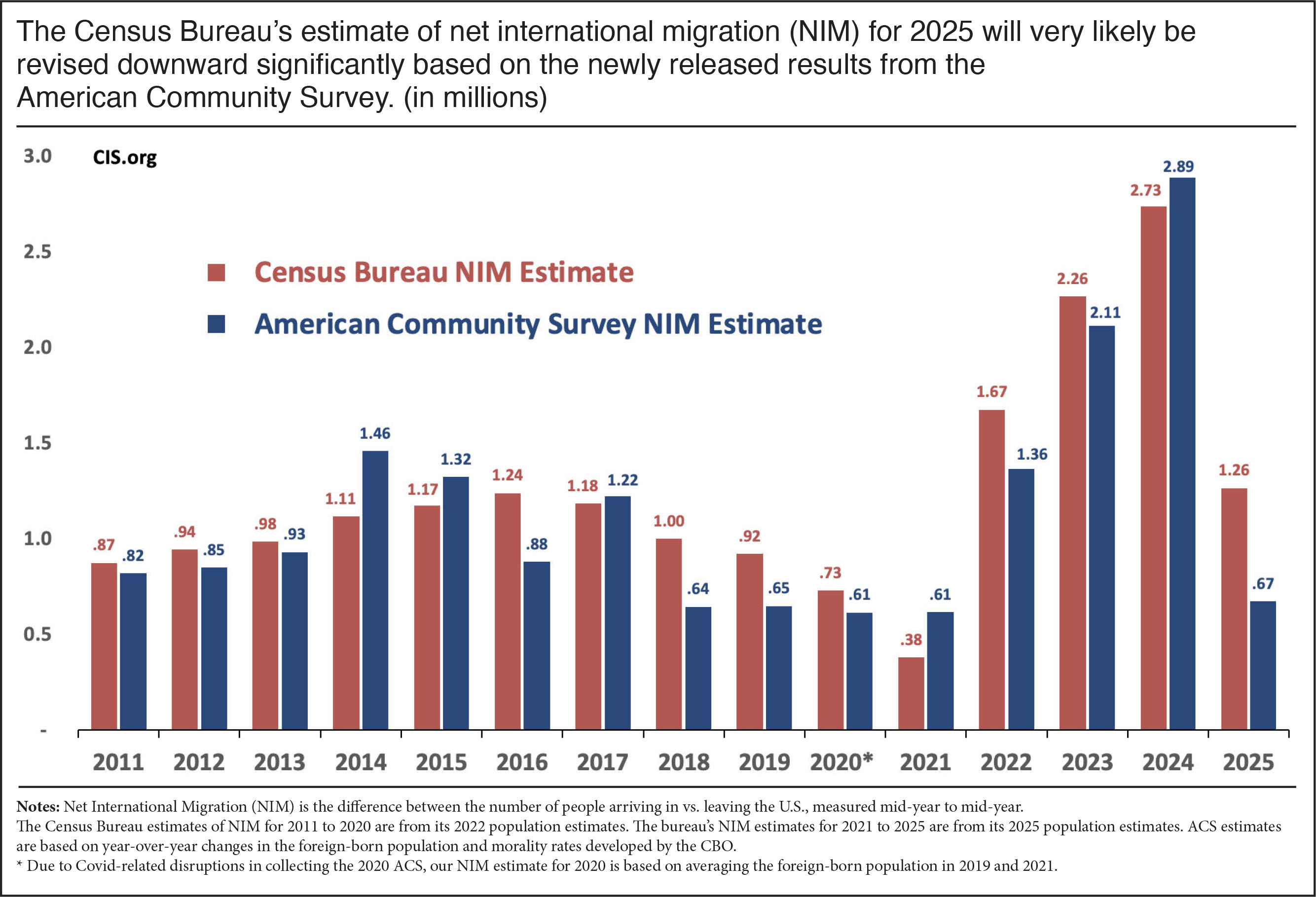
- The new American Community Survey (ACS) indicates that NIM was 670,000 between mid-2024 and mid-2025, down 75 percent from the 2.7 million the Census Bureau estimated for 2023 to 2024.3
- Policy changes by the Biden administration at the end of 2024 and further tightening by the Trump administration in 2025 significantly reduced NIM, undermining the argument that immigration is largely drive by factors outside of the government’s control, such as economics.4
- Our ACS-based estimate of 670,000 for NIM from 2024 to 2025 is roughly half the 1.26 million the Census Bureau had previously estimated. The Census Bureau NIM estimate was based on data released before the new ACS data was available. The bureau will almost certainly have to significantly revise downward their prior estimate of NIM.5
- The figure below compares the ACS-based estimate of NIM to those of the Census Bureau for 2011 to 2025.6
- Accurately estimating net migration is important in part because it is used to create the population estimate used by the Census Bureau. Governments and businesses use this data for planning, and the estimates are also used to weight multiple government surveys that measure employment, use of social services, crime victimization, and other characteristics.
 |
End Notes
1 Assumes a 90 percent confidence level.
2 These figures come from Data.census.gov.
3 The Census Bureau measures NIM from the middle of each year to the middle of the next year, not by calendar year. The ACS also reflects the population in the middle of each year, making it ideal for estimating net migration. A standard way of estimating net migration is to take the difference between the size of the foreign-born population year over year and then adding in the expected number of deaths among the existing foreign-born population based on their demographic characteristics. For example, to estimate NIM from 2024 to 2025 we take the growth in the foreign-born population (174,000) based on the ACS. The Congressional Budget Office (CBO) estimates a death rate for the foreign-born of just under 10 per thousand. Using the CBO estimated death rate and assuming linear growth in the size of the foreign-born population from 2024 to 2025 would put the number of deaths at 496,000 for the 2024 to 2025 period. Adding 496,000 to 174,000 creates an estimated NIM of 670,000 from mid-2024 to mid-2025. We are not entirely certain about the CBO’s estimated death rate for the foreign-born. We have previously estimated a somewhat lower death rate of 7.63 per thousand. If we use that estimate, we get NIM of 558,000. If this lower estimate is correct, then the Census Bureau’s NIM estimate is off by an even more significant amount.
4 A good example of the often-made argument that immigration is not really controllable by the governments was a 2023 article by David Bier in the New York Times entitled “Biden Can’t Stop Immigration Time to Embrace It”.
In a prior analysis, we discussed at length the factors that have led to the extraordinary increase in immigration, including public statements and policy changes by the Biden administration, such as ending the Migrant Protection Protocols, Title 42, Asylum Cooperative Agreements with Central American countries, and the decision to release people encountered at the border and to not use detention and expedited removal. The Trump administration implemented new policies or reinstated others that have contributed significantly to curtailing illegal immigration, particularly at the southern border. These include termination of the CBP One app, cancellation of the widespread granting of parole, ending the CHNV program, reinstatement of the Migrant Protection Protocols, expanded border infrastructure, and increased manpower devoted to enforcement.
5 The Census Bureau revises its population estimates for prior years with the release of its population estimates each year, including their estimates of NIM. Sometimes they have even gone back and revised NIM estimates for multiple years significantly, as they did for every year from 2010 to 2020 when they released their 2022 population estimates. When the 2026 population estimates are released, there will likely be a significant downward revision in the NIM estimate for 2025. The only possible reason not to revise NIM downward significantly for 2025, given the small increase in the foreign-born population between 2024 and 2025, is if the bureau believes the foreign-born figure for 2025 reflects a decline in the willingness of immigrants to participate in the ACS or to identify as foreign-born, rather than an actual slowdown in net migration.
6 The Census Bureau’s estimates for NIM for 2011 to 2020 are from its Vintage 2022 population estimates. Its estimates for 2021 to 2025 are from its Vintage 2025 Population estimate.