

Although the new American Community Survey (ACS) shows that growth in the foreign-born or immigrant population (legal and illegal) slowed from 2024 to 2025, the survey still shows that the immigrant population in the United States grew dramatically faster than the U.S.-born population in recent years, particularly for some countries. Moreover, the increase for many countries was far more dramatic. Of course, the increases do not represent the number of new arrivals; rather, they represent the net increase in the total population from other countries — newcomers minus deaths and outmigration. The actual number of new arrivals must therefore be larger.
Download Detailed Excel File Here
Growth by sending country and region:
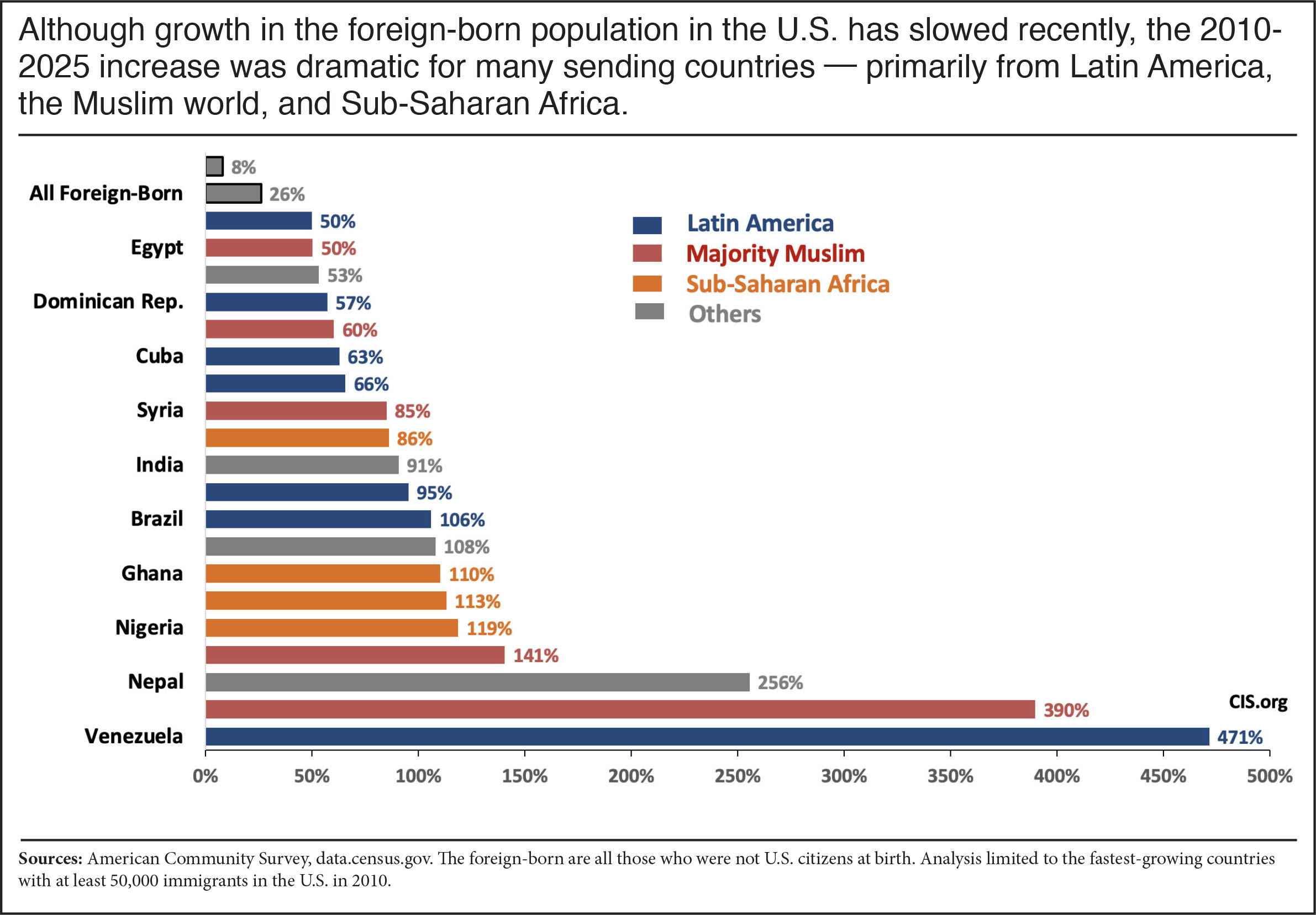
- Between 2021 and 2025, the foreign-born population grew nearly seven times faster (11.4 percent) than the U.S.-born population (1.7 percent). Over the longer period from 2010 to 2025, the foreign-born population grew more than three times faster than the U.S.-born population — 8.2 percent vs. 26.2 percent.1
- The largest percentage increases among immigrants in just the four years from 2021 to 2025 were for those from Afghanistan, up 116 percent; Venezuela, up 93 percent; Colombia, up 45 percent; Nepal, up 42 percent; Cuba, up 41 percent; Ecuador, up 38 percent; Ghana, up 33 percent; Peru, up 32 percent; Bangladesh, up 29 percent; and Ukraine, up 26 percent.2
- Taking a longer view, the largest percentage increases in immigrants in the U.S. from 2010 to 2025 were for Venezuela, up 471 percent; Afghanistan, up 390 percent; Nepal, up 256 percent; Bangladesh, up 141 percent; Nigeria, up 119 percent; Kenya, up 113 percent; Ghana, up 110 percent; Burma, up 108 percent; and Brazil, up 106 percent.
- The largest numerical increases among immigrants in just the four years from 2021 to 2025 were for those from India, up 687,000; Cuba, up 520,000; Venezuela, up 507,000; Colombia, up 388,000; China, up 308,000; the Philippines, up 254,000; Ecuador, up 183,000; Peru, up 144,000; and Afghanistan, up 143,000.
- The largest numerical increases in immigrants in the U.S. from 2010 to 2025, were for India, up 1.62 million; China, up 896,000; Venezuela, up 868,000; Cuba, up 694,000; Colombia, up 607,000; the Dominican Republic, up 504,000; the Philippines, up 459,000; Guatemala, up 406,000; Brazil, up 360,000; and Honduras, up 343,000.
- By sending-regions, the largest percentage increases in immigrants in the United States in the four years from 2021 to 2025 were those from South America, up 40 percent; the Indian Sub-continent, up 27 percent; the Caribbean and Sub-Saharan Africa, both up 18 percent; and Central America, up 12 percent.
- Sending-regions with the largest percentage increases in immigrants over the longer period from 2010 to 2025 are those from the Indian Sub-continent, up 96 percent; Sub-Saharan Africa, up 93 percent; South America, up 87 percent; the Middle East, up 54 percent; and the Caribbean, up 43 percent.
- Sending-regions with the largest numerical increases from 2010 to 2025 are those from South America, up 2.4 million; the Indian sub-continent, up 2.3 million; East Asia, up 1.8 million; the Caribbean, up 1.6 million; and Central America, up 1.2 million.
 |
End Notes
1 This and all subsequent figures discussed are from the American Community Survey found at data.census.gov, except for the 2020 data because it was not released by the Census Bureau and the 2000 data because it was unavailable. The data for 2020 is from the public-use ACS and the data for 2000 is from the public-use census.
2 This and all subsequent analysis are limited to countries with at least 50,000 immigrants living in the United States in 2021 or 2010.