

A persistently frustrating aspect of the debate over high-skill immigration is the disconnect between rhetoric and policy. Advocates will often speak of Einsteins and von Brauns but then support policies that bring in ordinary college graduates instead. Elon Musk, for example, recently praised the H-1B program while also claiming to want only “the top ~0.1% of engineering talent”. The former does not produce the latter.
In case there are lingering doubts about this distinction, my colleague John Miano recently posted an analysis of H-1B wage data obtained by Bloomberg News. He shows that H-1B recipients are generally paid at the lower end of the wage distribution for a given occupation and location. His tables offer some very specific illustrations. In Portland, Intel pays H-1B materials engineers from India about $20,000 less than U.S. materials engineers. In San Jose, Google pays H-1B software developers from China about $55,000 less than U.S. software developers. The examples go on and on. (The linked post is part of a larger report that will be published soon.)
Now, wages and skills are not always perfectly linked. One could imagine H-1B recipients suffering a wage penalty because they have limited bargaining power. However, it is difficult to reconcile being the “best and brightest” with receiving below-average wages in a given occupation and location. The simplest explanation is that H-1B recipients are not the best and brightest.
A recent Trump administration policy imposing a $100,000 H-1B visa fee caused even the Chamber of Commerce to admit this reality. As my colleague George Fishman points out, the Chamber’s court filing against that policy declares that “employers need not show that their prospective [H-1B] workers are the best of the best, but merely highly skilled”, and that imposing a best-and-brightest requirement “undercuts the very existence of the program”.
The business lobby’s admission is consistent with past academic research. According to an analysis in the Journal of Political Economy, firms that win the H-1B visa lottery experience an increase in innovation that is “insignificant and at most modest” compared with firms that lose. In addition, although not about H-1Bs specifically, my own peer-reviewed work has found that the lower wages paid to workers with foreign degrees are due in large part to lower measured skills.
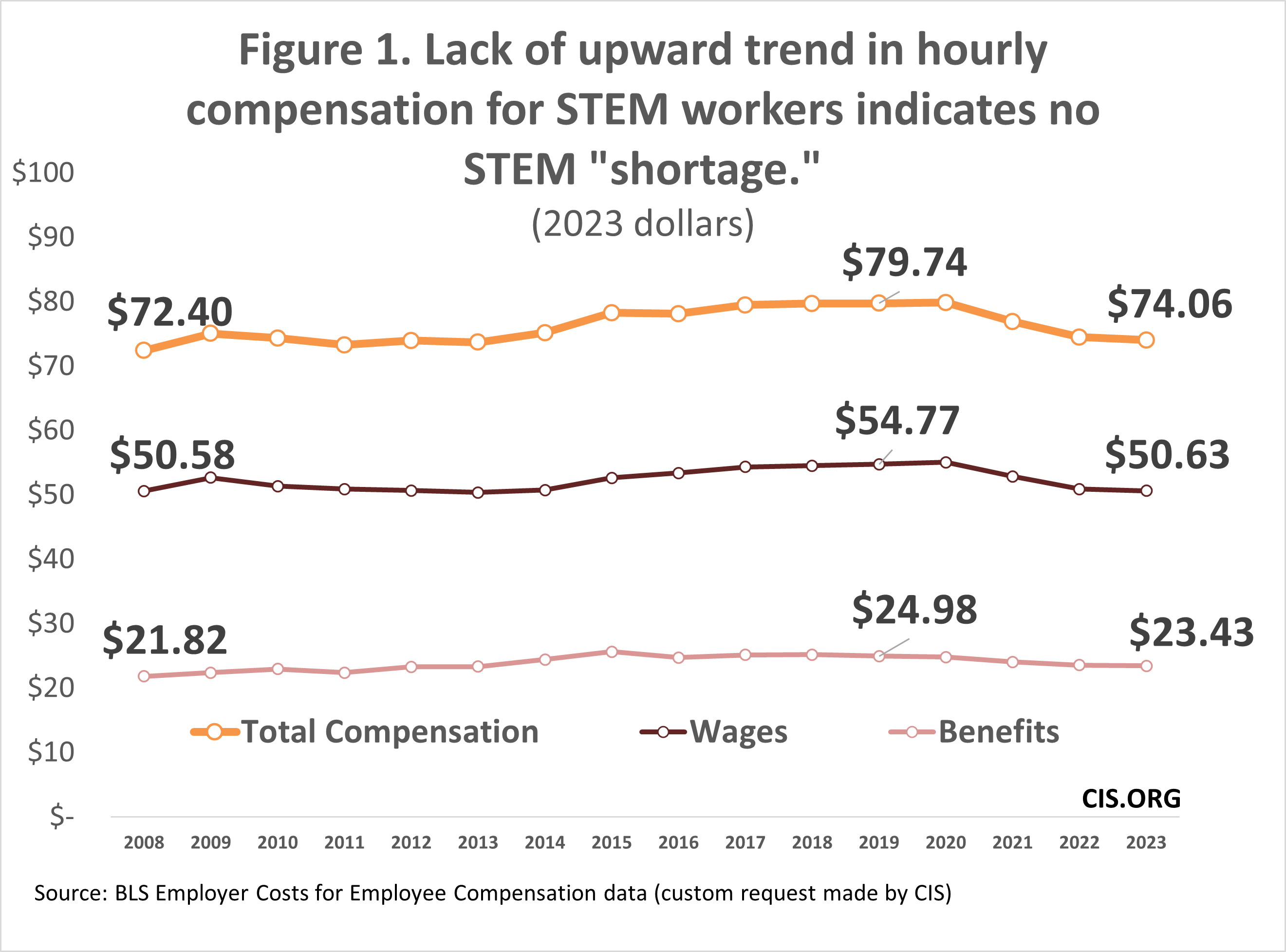
Few people would oppose the admission of genuine Einsteins, but offering new visas to more than 100,000 ordinary college graduates each year stretches the definition of “high skill”. Perhaps employers value the H-1B program less for the rare talent and innovation it supposedly brings and more for its help avoiding the STEM wage increases that might otherwise be necessary to recruit American workers. As the figure below shows, STEM compensation in the U.S. has been flat for many years, despite advocates’ incessant claims of “shortages” that require ever more immigration. Rather than accept such dubious claims, Americans should press for reforms that match the “best and brightest” rhetoric with actual policy.
 |