
Summary
- President Trump recently signed an executive order directing federal agencies to take action against employers who have laid off American workers and replaced them with cheaper foreign workers through the H-1B visa program. I have concluded that the H-1B program’s enforcement mechanisms provide the Trump administration with little recourse against these employers — because Congress in 1998 gave most employers a green light to engage in such abusive practices.
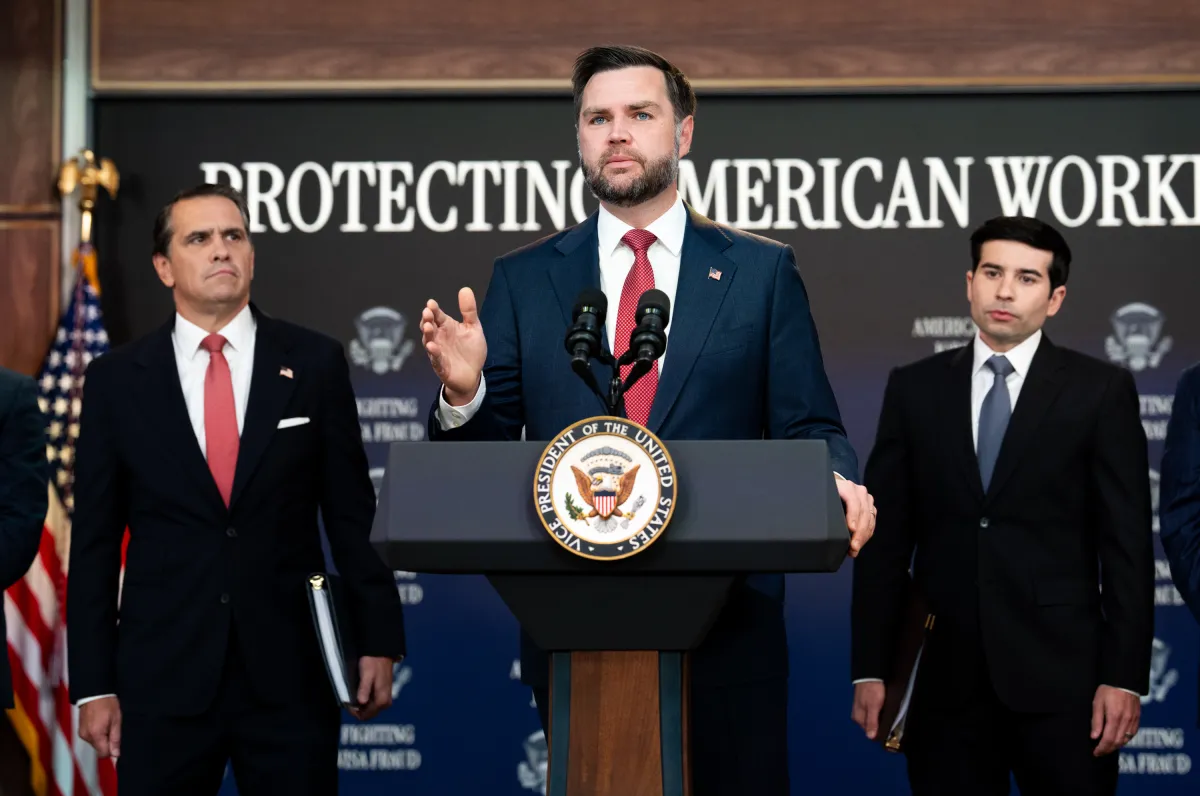
- On October 8, Vice President Vance announced that companies including Microsoft, Adobe, Cognizant, Tata, Wipro, and Infosys will be suspended from being able to sponsor (petition for) aliens for employment-based green cards as a consequence of their petitioning for large numbers of H-1B foreign workers while at the same time laying off large numbers of American workers (or facilitating their clients’ ability to do so). U.S. Secretary of Labor Keith Sonderling proclaimed “We are cutting off the head of the snake”.
Employers who want to sponsor foreign workers for the approximately 80,000 second- and third-preference employment-based green cards available each year must generally successfully complete the labor certification process by demonstrating to the U.S. Department of Labor that there are not sufficient American workers able, willing, qualified, and available and that the employment of the alien will not adversely affect the wages and working conditions of similar American workers.
What the administration is suspending is the ability of the specified companies to seek labor certification, and thus their ability to petition for green cards for foreign workers.
But can the administration deny employers the ability to petition for green cards for foreign workers based on their abuse of the H-1B program?
In order for an employer to complete a labor certification, the first key question is whether there are not sufficient workers able, willing, qualified, and available at the time of application for a visa and admission to the U.S., not whether there were not sufficient workers able, willing, qualified, and available at the time of the employer’s layoff of American workers. The second key question is whether the employment of the alien will not adversely affect the wages and working conditions of workers in the U.S., not whether the employment of the alien had not adversely affected the wages and working conditions of workers at the time of the employer’s layoff of American workers.
Thus, an employer’s previous H-1B facilitated layoffs are water under the bridge, except that labor certification regulations do require an employer that has laid off workers in the area of intended employment and in a relevant occupation within the prior six months to document that it has notified and considered all of the potentially qualified laid off workers of the job for which the alien is sought.
The only circumstance in which H-1B-facilitated layoffs of American workers could trigger a labor certification suspension is if the employer had engaged in fraud or willful misrepresentation regarding this regulatory requirement. But the only reason an employer would have to do so would be to avoid the measly requirement that it notify laid off American workers of the job opportunity.
Thus, it is not apparent how the Department of Labor can suspend (or debar) employers based on the vast majority of H-1B facilitated layoffs.
- The disgraceful practice of employers laying off American workers and replacing them with cheaper H-1B foreign workers has been ongoing for decades. Unfortunately, this practice usually does not constitute a violation of the H-1B program’s rules, but is fully consistent with — even contemplated by — the rules. What is required is congressional action. If past is prologue, I am not holding my breath.
Introduction
I have recently written about President Trump’s executive order directing federal agencies to take action against employers laying off American workers and replacing them with cheaper foreign labor through the H-1B visa program. I concluded that there was little that the Trump administration could do through the H-1B program’s enforcement mechanisms — as in 1998, Congress ignominiously gave most employers the green light to engage in abuse.
On October 8, Vice President Vance announced that as a consequence of companies including Microsoft, Adobe, Cognizant, Wipro, Tata, and Infosys petitioning for large numbers of H-1B foreign workers while at the same time laying off large numbers of American workers (or facilitating their clients’ ability to do so), these companies would no longer be allowed to sponsor aliens for employment-based immigrant visas (lawful permanent residence). This targeting of access to green cards rather than H-1B visas themselves is seeming acknowledgment of my conclusion regarding the H-1B program.
But do the employment-based green card statutory provisions and regulations themselves provide a basis for the Trump administration to penalize employers who have abused the H-1B program? That is the question I will address.
H-1Bs and Layoffs
In his EO, President Trump emphasized that “[m]any employers have laid off large numbers of highly skilled American workers, only to promptly hire large numbers of H-1B workers who are often lower-skilled and lower-paid” and that “Employers have even forced laid off American workers to train their foreign replacements.”
As I have written, such H-1B-facilitated layoffs have occurred with depressing regularity since I began working for the House Judiciary Committee in 1995:
- In 1995, Clinton administration Secretary of Labor Robert Reich stated that “We have seen numerous instances in which American businesses have brought in foreign skilled workers [through the H-1B program] after having laid off skilled American workers, simply because they can get the foreign workers more cheaply.”
- In 1996, the House Judiciary Committee concluded that “in many instances American employees are being fired and replaced with H–1Bs at lower wages”.
- In 1998, the House Judiciary Committee noted that “Numerous articles in major newspapers have documented employers laying off American workers and replacing them with H–1B aliens,” reporting that “employers [are] actually firing American workers and going to H–1B ‘job shops’ for their replacements” and that “[w]ell-known employers have been cited for this abuse”.
- In 2015, Julia Preston reported in the New York Times that:
Last year, Southern California Edison began 540 technology layoffs while hiring two Indian outsourcing firms for much of the work. Three Americans who had lost jobs told Senate lawmakers that many of those being laid off had to teach immigrants to perform their functions.
Among 350 tech workers laid off in 2013 after a merger at Northeast Utilities, an East Coast power company, many had trained H-1B immigrants to do their jobs, several of those workers reported confidentially to lawmakers.
- In 2016, Patrick Thibodeau reported in Computerworld that “Between 200 and 300 Disney IT workers were laid off in January 2015. Some of the workers had to train their foreign replacements — workers on H-1B visas — as a condition of severance.”
- In 2020, the Department of Homeland Security (DHS) stated that “U.S. companies such as The Walt Disney Company, Hewlett-Packard, University of California San Francisco, Southern California Edison, Qualcomm, and Toys ‘R’ Us have reportedly laid off their qualified U.S. workers and replaced them with H-1B workers.”
Vice President Vance’s Press Conference: the H-1B Program vs. American Workers
On October 8, Vice President J.D. Vance held a press conference along with Secretary of Labor Keith Sonderling, Attorney General Todd Blanche, Labor Department Inspector General Anthony D’Esposito, Deputy White House Chief of Staff Stephen Miller, and Co-chair of the White House Task Force to Eliminate Fraud, Andrew Ferguson.
Microsoft
Vice President Vance contended that “There has been no company in the United States, unfortunately, that has abused th[e H-1B program] more than Microsoft.”. (See video beginning at 2:49.) He announced that “Our message to Microsoft is you’re a great American company but you’ve got to hire great American workers. You cannot lay off American workers and then replace them with foreign indentured servants.” (See video beginning at 4:12.)
Layoffs
Vice President Vance stated that:
I’m sure everyone here understands the game that is being played. You bring in indentured servants from outside the country, you lay off American workers, and if you’re a corporation, you make a ton of money by undercutting the wages of American workers, replacing them with people frankly who shouldn’t be in the United States of America to begin with. This is a terribly pernicious system, it’s gone on for too long. [See video beginning at 5:54.]
Stephen Miller added in stark terms that:
What we don’t do and can’t do is crush and kill the dreams of millions of young children in middle school and high school who want that first step on the ladder but are unable to get it or midcareer workers who dedicate their lives to a company and are given two weeks’ notice just because someone else somewhere in the world is willing to do the job 20 percent, 30 percent, 40 percent, 50 percent cheaper than they are. [See video beginning at 17:39.]
Undercutting the Wages of American Workers
Vice President Vance contended that “If you’re working [on] an H-1B visa … you’re earning $20,000 less than an American citizen hired in the same position. If you are brought in by one of these foreign outsourcing firms, you’re making $48,000 less than an American citizen in a similar position.” (See video beginning at 5:36.)
The vice president’s data broadly tracks with what I found when I compared the salaries employers pay H-1B workers in computer-related occupations with the salaries of software developers nationwide. For H-1B petitions approved in 2023, I found that petitioning employers promised to pay new H-1B workers in computer-related occupations a salary averaging $99,000 — $33,270 (25 percent) less than the average software developer’s salary of $132,270.
As to wages, § 212 of the Immigration and Nationality Act (INA) provides that:
The employer … is offering and will offer during the period of authorized employment to … H–1B nonimmigrant[s] wages that are at least … the actual wage level paid by the employer to all other individuals with similar experience and qualifications for the specific employment in question, or … the prevailing wage level for the occupational classification in the area of employment, whichever is greater. [Emphasis added.]
As to calculating the prevailing wage, § 212 provides that “Where the Secretary of Labor uses, or makes available to employers, a governmental survey to determine the prevailing wage, such survey shall provide at least 4 levels of wages commensurate with experience, education, and the level of supervision.” DOL sets forth four levels — “entry”, “qualified”, “experienced”, and “fully competent”, with level 1 is set at the 17th percentile of wages for the relevant occupation in the area of employment, level 2 at the 34th percentile, level 3 at the 50th percentile, and level 4 at the 67th percentile.
In 2021, Ron Hira, associate professor of political science at Howard University, testified before the Immigration and Citizenship Subcommittee of the House Judiciary Committee that level 1 and 2 salaries “are significantly lower than the local median salaries surveyed for occupations … typically 20 to 40 percent lower than the median” and that “H-1B employers can reap significant savings by selecting one of the two lowest wage levels.” Hira noted that “Major U.S.-based technology firms that hire H-1B workers directly … had significant shares of their certified H-1B positions assigned as Level 1 or Level 2,” with Microsoft assigning at least three-fourths of its H-1B positions as Level 1 or Level 2 in 2019. DHS found that in FYs 2018-19, approximately 85 percent of “H-1B petitions for which wage levels were reported were for level I and II wages.”
As the late Norman Matloff, professor of computer science at the University of California at Davis, had long explained, employers are attracted to “lower wages generally paid to younger workers (whether domestic or foreign)” and “In many cases, when employers exhaust the supply of younger American workers, they turn to hiring younger, cheaper H-1Bs in lieu of older, more expensive Americans.”
The “Best and the Brightest”?
Vice President Vance proclaimed that “We cannot allow visa programs that were designed to ensure that American corporations had access to the best and the brightest to use them to undercut the wages of American workers.” (See video beginning at 7:40.) He also noted that “if you’re bringing in an accountant who’s making $40,000 a year and you use that foreign indentured servant … to replace an American worker who is making $70,000 a year, you’re not bringing in a genius to build a great American corporation” (see video beginning at 8:06). Further, “The fact that they are undercutting wages of American workers is a big tell that they don’t have a hyper-specialized skill.” (See video beginning at 39:56.)
As I have written, H-1B advocates have long proclaimed that the program provides American companies crucial access to “the best and the brightest” foreign workers. Advocates make this claim in the context of lobbying for higher H-1B visa quotas and to counter longstanding concerns about the H-1B program’s negative impact on American workers.
But most H-1B workers are far from “the best and the brightest”, which the U.S. Chamber of Commerce (CoC) actually admitted last year. Last October 16, the CoC published “H-1B Visas: What You Need to Know”, stating that “Retaining the best and brightest, many of whom trained in highly respected U.S. universities, will help America innovate and compete globally, and that leads to more growth and high paying jobs for all Americans.” But on the same day, the CoC announced the “fil[ing of] a legal challenge to the [Trump] administration’s $100,000 fee on H-1B visa petitions”, its complaint contending that Congress never intended the H-1B program to be for the “best and brightest”. The complaint stated that President Trump’s proclamation establishing the fee was “aimed at reducing the pool of H-1B applicants to ‘the best of the best’”, which “is flatly contrary to Congress’s directives”, for “By congressional design, employers need not show that their prospective [H-1B] workers are the best of the best, but merely highly skilled.” Thus, the CoC proclaimed that “the imposition of such a ‘best of the best’ requirement on the H-1B program would trample Congress’s duly enacted policy choices” and would “undercut[] the very existence of the [H-1B] program”.
Why would the CoC publicly admit as much and undermine a decades-long advocacy effort? I presume that the CoC’s lawyers concluded that the abandonment of “the best and the brightest” claims would strengthen its legal argument that the $100,000 fee is unlawful. Or maybe the CoC just didn’t think that anyone would ever bother reading its court filings.
Is It Fraud or Is It Abuse?
Vice President Vance bluntly told Microsoft and other corporate abusers to “stop defrauding the American worker” (see video beginning at 35:30), that “you are committing fraud against the American people and against this visa program” (see video beginning at 8:21). The vice president elaborated that:
We’re finally cutting down on the fraud that’s depriving [American workers] of good wages and good jobs. This program has been defrauded for generations in the United States of America. [See video beginning at 35:42.]
The nature of the fraud is fundamentally that when you apply for these visa programs you make a couple of certifications. One of these certifications is that the person you are bringing in has a hyper-specialized, hyper-capable skill set and that’s clearly not the case when you are just replacing one American worker with a foreign indentured servant and undercutting their wages in the process. … The fraud is they are making representations when applying for the program that are fundamentally illegitimate and therefore ultimately illegal. [See video beginning at 42:29.]
Labor Secretary Sonderling added that “[T]he pipeline of systemic fraud … has flooded our country with foreign labor at the expense of American workers. … [p]romoting foreign workers that have lied about their qualifications to take jobs from our beloved American workers. … Employers have enabled this pipeline through fraud.” (See video beginning at 9:38.)
Attorney General Blanche stated that “[T]here are criminal laws that make a lot of this conduct not only illegal but a violation of criminal laws.” (See video beginning at 33:48.)
And Stephen Miller stated that:
What the task force and its partners in law enforcement have uncovered is systemic immigration fraud that violates the laws and statutes of the United States to undercut American workers and labor. The H-1B program and the PERM program that is attached to it have explicit statutory commands that must be followed. It requires individuals for example to have a unique highly specializd occupation as one example. And yet in case after case after case we see individuals that are being brought into the country for skills that are not specialized, that are not unique, and that are not skilled, doing work currently being done by American workers but at vastly lower pay. … You remember in 2015 when President Trump first campaigned for President, he had at his rallies American workers in good paying middle-class jobs with pensions who were laid off and forced to train their foreign replacements as a condition of their severance, a phenomenon that is widespread and well documented. … [T]his kind of unlawful conduct has been exposed, detailed, [and] documented. [See video beginning at 15:29.]
As Vice President Vance stated, what Microsoft and other corporate malefactors have done is indeed pernicious. But is it fraud or is it abuse? I would define H-1B fraud as actions an employer takes deliberately flouting its legal obligations under the H-1B program. I would define H-1B abuse as actions an employer takes that do not necessarily violate of the program’s requirements, but that are taken completely without regard to the deleterious consequences for American society. The vast majority of the actions taken by Microsoft and other employers that were highlighted in the press conference were abuses rather than fraud.
What difference does it make whether H-1B employers acted fraudulently or merely abusively? Either way, American workers were laid off and replaced with foreign workers on U.S. soil. Isn’t this just a matter of semantics? It matters because the ability of the executive branch to curtail the behavior hinges on the behavior amounting to fraud — actions taken in violation of federal law. Congress, of course, can turn abuse into fraud by passing legislation making abusive behavior unlawful. But as I have discussed elsewhere and will discuss in an abbreviated fashion here, Congress has simply abrogated its responsibility in the case of the H-1B program.
Specialty Occupations
What does the H-1B program actually mean by “specialty occupation”? Section 101 of the INA provides that the H-1B program is for foreign workers “coming temporarily to the United States to perform services … in a specialty occupation”, which according to § 214 of the INA is an occupation requiring “theoretical and practical application of a body of highly specialized knowledge” and “attainment of a bachelor’s or higher degree in the specific specialty (or its equivalent) as a minimum for entry into the occupation”.
Keep in mind that, as the U.S. Government Accountability Office explained in 2011:
The original H-visa program, established … in 1952, authorized visas for aliens ... who were of distinguished merit and ability, and were coming to the United States to perform temporary service of an exceptional nature requiring such merit and ability. However, in 1990, ... the original language was replaced with language authorizing H-1B visas for aliens coming temporarily to the United States to perform services in a “specialty occupation.”
The GAO concluded Congress’s modification of the program in 1990 “increased the pool of eligible workers to include a wider range of skill levels” — a euphemism for lowering the minimally sufficient skill level. More bluntly, Congress dumbed down the H-1B visa program in 1990.
Section 214 provides that while a prospective alien generally must have completed the relevant degree, an alien can alternately 1) have experience in the specialty equivalent to the completion of such degree and recognition of expertise in the specialty through progressively responsible positions relating to the specialty, or 2) full state licensure to practice in the occupation (if such licensure is required to practice in the occupation).
But in order to qualify as a specialty occupation, the job the prospective H-1B worker will perform doesn’t necessarily have to require even the “equivalent” of a bachelor’s degree, for 8 C.F.R. § 214.2 provides that “[t]o qualify as a specialty occupation, the position must meet one of the following criteria”:
(1) A baccalaureate or higher degree or its equivalent is normally the minimum requirement for entry into the particular position;
(2) The degree requirement is common to the industry in parallel positions among similar organizations or, in the alternative, an employer may show that its particular position is so complex or unique that it can be performed only by an individual with a degree;
(3) The employer normally requires a degree or its equivalent for the position; or
(4) The nature of the specific duties are so specialized and complex that knowledge required to perform the duties is usually associated with the attainment of a baccalaureate or higher degree. [Emphasis added.]
Section 214.2 also notes that qualifying occupations cover “fields of human endeavor including, but not limited to, architecture, engineering, mathematics, physical sciences, social sciences, medicine and health, education, business specialties, accounting, law, theology, and the arts”. Thompson Reuters’s “H-1B Handbook” advises employers that:
The requirement that an H-1B position be in a specialty occupation can be easily met in most cases because the position involved has already clearly been held to be in a profession (which is the definitional equivalent of a specialty occupation). In those cases, the employer need to do little to document the nature of the position.1
The “H-1B Handbook” explains that “[t]his rule of thumb” applies to engineers, accountants, lawyers/foreign law advisors, scientists, librarians, psychologists, financial analysts, systems analysts/engineers, architects, teachers/professors, journalists/editors, technical publications writers, management consultants and market research analysts.
So what it boils down to is that a job qualifies as an H-1B “specialty occupation” if a bachelor’s degree — or its “equivalent” — is normally, usually, or commonly required for the occupation, or if at least the particular employer requires it for the occupation.
Layoff of American Workers
The H-1B program does contain a layoff prohibition of sorts. Section 212 of the INA requires a petitioning employer to attest (promise, with potential penalty for noncompliance) that it:
did not … and will not displace a United States worker employed by the employer [lay off the U.S. worker from a job that involves essentially the same responsibilities as the job the H-1B worker will perform if the prospective H-1B worker has substantially equivalent qualifications and experience as the U.S. worker and will perform the job in the same area of employment as the U.S. worker] within the period beginning 90 days before and ending 90 days after the date of filing of any [H-1B] visa petition supported by the [labor condition] application[, and]
will not place the [H-1B worker] with another employer … where—
(i) the [H-1B worker] performs duties in whole or in part at one or more worksites owned, operated, or controlled by such other employer; and
(ii) there are indicia of an employment relationship between the [H-1B worker] and such other employer;
unless the employer has inquired of the other employer as to whether, and has no knowledge that, within the period beginning 90 days before and ending 90 days after the date of the placement … with the other employer, the other employer has displaced or intends to displace a United States worker employed by the other employer.
However, § 214.2 allows employers to file H-1B petitions as early as “6 months before the date of actual need for the [H-1B worker’s] services”. As a foreign worker can work for an employer in H-1B status for six years or more, the layoff protection expires long before most employers have ceased to employ the H-1B workers, allowing ample opportunity for the employer to lay off equivalent American workers.
More fundamentally, the layoff protection only applies to a vanishingly small proportion of H-1B employers. First, § 212 provides that the protection only applies to “an H-1B-dependent employer [whose H-1B workers generally account for at least 15 percent of its full-time equivalent employees]” or by an employer “that has been found … to have committed a willful failure or misrepresentation regarding the H-1B program during the 5-year period preceding the filing of the application”.
Second, even for H-1B dependent employers, the layoff protection does not apply to an American worker replaced by an “exempt” H-1B worker, one who either is paid a wage of at least $60,000 a year or who “has attained a master’s or higher degree (or its equivalent) in a specialty related to the intended employment”. Currently, $60,000 is far less than the median wage in relevant occupations. According to the Bureau of Labor Statistics, in 2025 the median annual wage for a software developer was $135,980 ($82,460 for workers paid at the 10th percentile and $214,670 for those paid at the 90th percentile). Further, the large majority of H-1B workers have master’s or higher degrees. U.S. Citizenship and Immigration Services (USCIS) reports that 69 percent of alien beneficiaries of H-1B petitions approved in FY 2025 had master’s or higher degrees. And many master’s degree programs, both in the U.S. and overseas, are of dubious quality.
In 2017, Edward Hugler, the Trump administration’s acting secretary of Labor, responded to a letter sent by Sen. Charles Grassley (R-Iowa) and other U.S. senators following the airing of a CBS News “60 Minutes” segment containing interviews with American workers who had been replaced by H-1B workers. The senators’ letter inquired as to whether “an investigation into the companies highlighted … and their abuse of the H-1B visa program [had] been initiated”, whether “a review of [DOL] policies and procedures … that allows for this kind abuse has been initiated”, what “loopholes and ambiguities … can be fixed by regulation or other executive action”, and “[w]hat steps” were being taken “to initiate necessary administrative action to fix the worst abuses in the H-1B visa program”.
In his response, Acting Secretary Hugler explained that federal law “only prohibits H-1B dependent employers from displacing U.S. workers employed by the secondary entity within the statutorily set period, and further that “a dependent employer may displace U.S. workers employed by the secondary entity regardless of the timing of the H-1B worker’s placement, provided the H-1B replacement … will receive at least $60,000 per year or has attained a relevant master’s degree”. Acting Secretary Hugler concluded, as he had no choice but to do, that “This limitation will have to be carefully considered in determining whether reasonable cause exists for an investigation.”
Recruitment of American Workers
Vice President Vance stated that “The H-1B visa program is meant to allow companies to bring in really the best of the best from outside the United States of America for positions that are completely impossible to fill with American workers.” (See video beginning at 1:19.)
Section 212 of the INA contains a recruitment requirement for American workers — of sorts. It requires a petitioning employer to attest that it:
has taken good faith steps to recruit, in the United States using procedures that meet industry-wide standards and offering compensation that is at least as great as that required to be offered to H–1B [workers]… United States workers for the job for which the [H-1B worker] is … sought; and … has offered the job to any United States worker who applies and is equally or better qualified for the job for which the [H-1B worker] … is … sought.
However, this recruitment requirement applies only to the same vanishingly small proportion of H-1B employers as does the layoff protection.
Further, as I have written, in August a Department of Justice (DOJ) administrative law judge ruled that an employer can advertise for a job proclaiming “No U.S. Citizens Need Apply” without giving citizen job-seekers a cause of action under a federal law (INA § 274B) specifically designed to prevent employers from discriminating against them.2 Attorney General Blanche had a specific time frame within which he could have chosen to review the decision for possible reversal or modification, but he apparently declined to do so.
Congress
Vice President Vance on a number of occasions in the press conference urged the U.S. Congress to reform the H-1B program, as when he stated that “If you want the H-1B program to stop being used to defraud the American taxpayer and to undercut the wages of American workers, get to work and we will help you.” (See video beginning at 8:45.)
Unfortunately, almost three decades ago Congress refused to do so and has failed to do so ever since. And that is why the layoff protection and recruitment requirements for American workers apply to only a tiny proportion of H-1B employers.
On May 20, 1998, the House Judiciary Committee approved by a vote of 23-4 legislation by then Immigration and Claims Subcommittee Chairman Lamar Smith (R-Texas) that would have established the no layoff and recruitment of American workers attestations for all H-1B employers. The committee handily defeated by a vote of 7-24 an amendment to strike these requirements in their entireties.
But two days earlier, the U.S. Senate had passed Sen. Spence Abrahams’s (R-Mich.) H-1B legislation, which contained no such requirements. The Senate Judiciary Committee had earlier defeated on a party-line vote of 10-8 an amendment in the nature of a substitute offered by Sens. Ted Kennedy (D-Mass.) and Diane Feinstein (D-Calif.) containing layoff and recruitment of U.S. worker provisions. The Senate Judiciary Committee report proclaimed that “there is no evidence that H-1B visas are in fact being used” to “lay[] off an American worker in order to hire an H-1B worker with the same skills at a lower salary”. The Congressional Quarterly Almanac reported that the attestations “were met with something close to revulsion by Smith’s Republican colleagues in the Senate”.
What happened next? Robert Pear reported in the New York Times on July 24, 1998, that “the [Senate-passed] legislation bogged down in the House, prompting Speaker Newt Gingrich [R-Ga.] and other Republican leaders, from both chambers, to meet this week and help work out a compromise”. That’s one way of putting it, “help work out a compromise”. Gingrich — who proclaimed during a 2025 PBS interview that “I am totally for H-1B visas” and “I think you have to almost be willfully rejecting the modern world to be against them” (see video beginning at 13:44) — and House Majority Leader Dick Armey (R-Texas) set up negotiations between Smith and Sens. Abraham and Phil Gramm (R-Texas). The outcome was a forgone conclusion — Smith would have to reach a “compromise” that protected not American workers but Silicon Valley. The “compromise” resulted in the attestations only applying to the vanishingly small proportion of H-1B employers that remain unaltered to this day.
When the compromise was brought to the House floor, an amendment embodying Smith’s bill as it had been reported by the Judiciary Committee was defeated by a vote of 177-242. The House then approved the compromise by a vote of 288-133 and it was signed into law by President Clinton as part of Public Law 105–277.
Vice President Vance’s Press Conference: What Can the Administration Do?
Vice President Vance stated at the press conference that:
We have tools in the administration to make th[e H-1B] program work better for the American people. … [W]e going to do everything we can … to ensure the program works as it was designed to. [See video beginning at 8:39.]
[T]here are things within our authority under the law, our regulatory authority … to fix this problem and that is exactly what we are going to do. [See video beginning at 6:22.]
Vance announced that:
Thanks to an ongoing investigation, we have decided to suspend the PERM program for Microsoft, which means they will no longer be able to … take those H-1Bs and apply for permanent residence status within the United States of America. [See video beginning at 3:34.]
The suspension of PERM is going to last as long as it needs to. We have a number of tools to suspend it indefinitely, but we actually want these companies to change their behavior, improve their behavior and actually get better. That is the goal here. We are not punishing them to punish them. We’re punishing them because we want them to change their behavior. [See video beginning at 35:08.]
Secretary of Labor Sonderling elaborated that:
[T]he fraud doesn’t end with getting the job. That job becomes a pathway for foreign workers and their families to stay in America permanently and eventually becoming U.S. citizens. … These jobs that were stolen from them should have gone and will now go to Americans first — not foreigners and especially not foreign fraudsters. … [W]e are cutting off the head of the snake. The companies that have enabled this abuse for decades, due to ongoing criminal investigations led by the Department of Labor’s Inspector General. … I am hereby suspending from the permanent labor certification program some of the largest IT outsourcing firms in the world. Cognizant, Infosys, Tata, Wipro, HCL and Cap Gemini. And also due to multiple active federal investigations, the Department of Labor is suspending Microsoft and Adobe from the program. … We will not accept any new or process any pending permanent labor certification applications involving these companies. … Our historic action is the first critical step to stop the fraud and the abuse and ensure these programs never come at the expense of the American worker. … We are ending the fraud that has fueled reliance on foreign labor. [See video beginning at 10:10.]
Attorney General Blanche added that:
The Department of Justice … is actively investigating companies that do this, that favor foreign workers over the American people. … If a company, even Microsoft or Adobe or any other, discriminates against an American worker in favor of someone on the other side of the world, that company has violated the trust of the federal government and the American people and will be investigated. [See video beginning at 13:34.]
What Can the Administration Do: Employment-Based Green Cards and Labor Certification (PERM)
What exactly are labor certification and PERM?
Section 203 of the INA generally makes available 40,400 employment-based second preference immigrant visas a year so that employers can petition for aliens who are “members of the professions holding advanced degrees or their equivalent”, or “who because of their exceptional ability in the sciences, arts, or business, will substantially benefit prospectively the national economy, cultural or educational interests, or welfare of the United States”, and makes available 40,400 employment-based third preference immigrant visas so that employers can petition for aliens who have “baccalaureate degrees and who are members of the professions” or who “are capable … of performing skilled labor (requiring at least 2 years training or experience), not of a temporary or seasonal nature, for which qualified workers are not available in the United States” (including up to 10,000 unskilled workers).
In order to petition for these aliens, employers usually have to first successfully obtain “labor certification”. Section 212 of the INA provides that:
Any alien who seeks to enter the United States for the purpose of performing skilled or unskilled labor is inadmissible, unless the Secretary of Labor has determined … that—
(I) there are not sufficient workers who are able, willing, qualified (or equally qualified in the case of an alien [who is a member of the teaching profession, or has exceptional ability in the sciences or the arts]) and available at the time of application for a visa and admission to the United States and at the place where the alien is to perform such skilled or unskilled labor, and
(II) the employment of such alien will not adversely affect the wages and working conditions of workers in the United States similarly employed.
Section 203 does provide for a “national interest waiver” of the labor certification requirement for the second preference category. The secretary of Homeland Security “may, when … deem[ing] it to be in the national interest, waive the requirements … that an alien’s services in the sciences, arts, professions, or business be sought by an employer in the United States”. As USCIS explains, “for the second preference category, an immigrant petition may request a waiver of the job offer, and thus the labor certification requirement, because it is in the national interest of the United States”.
How does labor certification work? William Kandel, specialist in immigration policy for the Congressional Research Service, explained in 2023 that DOL “implements this process through the Program Electronic Review Management (PERM) labor certification process”, which involves three steps: “[1] obtain a prevailing wage determination … , typically from DOL; [2] attempt to recruit U.S. workers for the position (labor market test); and [3] submit the PERM application to DOL.” (Emphasis in original.)
As to the first step, Kandel explained that:
[T]o comply with the INA’s mandate that the hiring of a foreign worker would not adversely affect the wages of comparatively employed U.S. workers, employers must offer to the foreign worker a wage that is at least as much as the prevailing wage, defined as the average wage paid to similarly employed workers in that occupation in the area of intended employment. [Emphasis in original.]
As to the second step:
[T]o test the U.S. labor market for willing, available, and qualified U.S. workers, employers must attest that they met mandatory recruitment requirements, including placing a job order for 30 days with a state workforce agency in the employment location, and advertising the job in an appropriate newspaper or journal. For some occupations, employers must take other documented recruiting steps.
As to the third step: “[T]he employer must [then] submit the PERM application to DOL. … If DOL certifies the application, the labor certification portion of the immigration process is concluded. If DOL denies it, the employer may appeal.”
Labor certification does not really work, in the sense that it provides little real protection to American workers. This reality is well exemplified by a 2007 video produced by the Pittsburgh law firm of Cohen & Grigsby. On June 21, 2007, Sen. Grassley and Rep. Smith, then the ranking Republican on the House Judiciary Committee, sent a letter to Cohen & Grigsby stating:
[In a] video produced by your firm … Lawrence Lebowitz, director of marketing for your firm clearly states that an employer’s goal [in getting through the PERM process] is “to meet the requirements as inexpensively as possible, keeping in mind our goal. And our goal is clearly not to find a qualified and interested U.S. worker. [See Lou Dobbs Tonight broadcast beginning at 0:45.] In a sense that sounds funny, but it’s what we’re trying to do here.”
The video made by your firm advises potential employers that they can fulfill … PERM certification requirements by advertising the position in places where they will not find the most qualified applicants. Your firm asserts that an employer can advertise in regional publications with limited circulation, while internally listing the job for a foreign worker.
When applications are received, firm members Jennifer Pack and Jennifer Barton tell employers how they can disqualify U.S. applicants based on their resume or by personal interview when the resume lists all requirements of the job posting. Very qualified applicants are brought in for an interview for the sole purpose of finding a basis to disqualify them. Why does your firm undermine the recruitment effort by coaching potential employers to “find a legal basis to disqualify Americans” to hire a foreign worker?
The one real benefit the PERM process provides is that by making employers expend money and time, they are required to demonstrate a level of commitment to particular alien workers (hopefully because of their superlative job skills). Kandel explained that “Obtaining a PWD [prevailing wage determination] typically requires about six months and recruitment at least two months. Submitting a PERM application to DOL currently requires 9 to 10 months. Thus, employers can expect to require at least 17 months to conclude the process.”
According to My Visa Jobs, in FY 2025, Microsoft filed 3,153 PERM applications (No. 1 out of the top 400 employers), Wipro filed 521 (No. 20), Tata Consultancy Services filed 513 (No. 21), Adobe filed 466 (No. 23), Capgemini America filed 361 (No. 32), and HCL filed 323 (No. 37). Neither Infosys nor Cognizant were in the top 400.
PERM Suspension
Recall that Secretary of Labor Sonderling announced that he was suspending from access to the PERM process Microsoft, Adobe, Cognizant, Infosys, Tata, Wipro, HCL, and Capgemini. 20 C.F.R. § 656.31 provides that:
If [DOL] learns an employer … is involved in possible fraud or willful misrepresentation in connection with the permanent labor certification program, [DOL] will refer the matter to [DOJ], [DHS], or other government entity, as appropriate, for investigation. … In these cases, or if [DOL] learns an employer … is under investigation by [DOJ, DHS] or other government entity for possible fraud or willful misrepresentation … [DOL] may suspend processing of any permanent labor certification application involving such employer … until completion of any investigation and/or judicial proceedings. [Emphasis added throughout.]
If [DOL] learns that an employer … is named in a criminal indictment or information in connection with the permanent labor certification program, the processing of applications related to that employer … may be suspended until the judicial process is completed.
And recall that Vice President Vance stated that “[t]he suspension of PERM is going to last as long as it needs to” and that “We have a number of tools to suspend it indefinitely.” Section 656.31 provides that:
A suspension … may last initially for up to 180 days. No later than 180 days after the suspension began, if no criminal indictment or information has been issued, or judicial proceedings have not been concluded, the National Certifying Officer may resume processing some or all of the applications, or may extend the suspension in processing until completion of any investigation and/or judicial proceedings. [Emphasis added.]
The regulation then provides that:
If an employer … is acquitted of fraud or willful misrepresentation charges, or if such criminal charges are withdrawn or otherwise fail to result in a finding of fraud or willful misrepresentation, the Certifying Officer shall decide each pending permanent labor certification application related to that employer … on the merits of the application. [Emphasis added.]
It also provides that:
If an employer … is found to have committed fraud or willful misrepresentation involving the permanent labor certification program, whether by a court, [DOS] or DHS … or through other proceedings:
(1) Any suspension of processing of pending applications related to that employer, attorney, or agent will terminate.
(2) The Certifying Officer will decide each such application on its merits. [Emphasis added.]
So, what is the point of suspension if an employer found to have committed fraud or willful misrepresentation still get to have its PERM applications decided on the merits? Presumably because of the possibility of criminal penalties and because of the possibility of debarment.
PERM Debarment
More severe than suspension is debarment. Section 656.31 provides that:
No later than six years after the date of filing of the labor certification application that is the basis for the finding, or, if such basis requires a pattern or practice … no later than six years after the date of filing of the last labor certification application which constitutes a part of the pattern or practice, [DOL] may issue to an employer … a Notice of Debarment from the permanent labor certification program for a reasonable period of no more than three years, based upon any action that was prohibited at the time the action occurred, upon determining the employer … has participated in or facilitated one or more of the following:
(i) The sale, barter, or purchase of permanent labor applications or certifications, or any other action prohibited under § 656.12;
(ii) The willful provision or willful assistance in the provision of false or inaccurate information in applying for permanent labor certification;
(iii) A pattern or practice of a failure to comply with the terms of the Form ETA 9089 [Application for Permanent Employment Certification] … ;
(iv) A pattern or practice of failure to comply in the audit process pursuant to § 656.20;
(v) A pattern or practice of failure to comply in the supervised recruitment process pursuant to § 656.21; or
(vi) Conduct resulting in a determination by a court, DHS or the Department of State [DOS] of fraud or willful misrepresentation involving a permanent labor certification application.
DOL created debarment in a final rule promulgated in 2007. On February 13, 2006, DOL’s Employment and Training Administration (ETA) published a proposed rule explaining that it was “proposing enforcement mechanisms, including debarment with appeal rights, to protect the integrity of the permanent labor certification program and deter individuals or entities from engaging in prohibited transactions or abusing the labor certification process”. ETA elaborated that:
[DOL] proposes to create a debarment mechanism, with appeal rights … to deter individuals or entities from engaging in fraudulent permanent labor certification activities, prohibited transactions, or otherwise abusing the permanent labor certification process. [DOL] acknowledges that not all debarment triggers should be treated equally, and will therefore take steps to ensure any debarment is reasonable and proportionate to the improper activity. Debarment from the program is a necessary and reasonable mechanism to enforce permanent labor certification requirements and statutory objectives.
The final rule, promulgated on May 17, 2007, noted that “[a]t the time of the [May 6, 2002, PERM proposed rule], some commenters recommended enhancing program integrity by establishing … debarment procedures for employers that engage in fraudulent labor certification activities, prohibited transactions, or otherwise abuse the permanent certification process” and it explained that “[the December 27, 2004, PERM final rule] changed … the operation of the permanent labor certification program. … [E]mployers may [now] attest to compliance with requirements to recruit U.S. workers rather than engaging in all cases in supervised, post-filing recruitment.” Thus, the 2007 final rule concluded that “A system of attestation and audit, relying heavily on the veracity of employer submissions, requires a system for ‘effective enforcement.’”
The 2007 final rule further stated that:
Given the breadth and increased sophistication of the immigration fraud that has been identified in the recent past, [DOL] needs added flexibility to respond to potential improprieties in labor certification filings.
In the [2006 proposed rule] to this rulemaking, [DOL] proposed establishing debarment procedures as an important part of efforts to avoid fraud, enhance and protect program integrity, and protect U.S. workers.
In order to encourage compliance, the regulatory scheme for PERM relies on attestations, audits and, through this Final Rule, the remedial measure[] … of debarment proceedings to assure compliance.
[DOL] has instituted a public debarment mechanism to effectively deter individuals or entities from engaging in fraudulent permanent labor certification activities or prohibited transactions.
The final rule predicted hopefully that “debarring unscrupulous employers … who willfully or repeatedly violate program requirements will prevent such conduct in the future”.
Section 656.31 provides that:
The Notice of Debarment shall be in writing; shall state the reason for the debarment finding, including a detailed explanation of how the employer … has participated in or facilitated one or more of the actions listed in paragraphs (i)-(v) … ; shall state the start date and term of the debarment; and shall identify appeal opportunities under § 656.26.
As to appeals, § 656.26 provides that “if a debarment is issued … a request for review of the … debarment may be made to the Board of Alien Labor Certification Appeals [BALCA] by the employer … by making a request for such an administrative review” and that “[i]n the case of a finding of debarment, receipt by [DOL] of a request for review, if made in accordance with this section, shall stay the debarment until such time as the review has been completed and a decision rendered thereon” (Emphasis added).
Criminal Penalties
The 2007 final rule noted that:
To knowingly and willfully furnish any false information in the preparation of … Form ETA 9089[] or … and any supporting documentation, or to aid, abet, or counsel another to do so is a Federal offense, punishable by fine or imprisonment up to five years, or both under 18 U.S.C. 2 and 1001. Other penalties apply as well to fraud or misuse of ETA immigration documents and to perjury with respect to such documents under 18 U.S.C. 1546 and 1621.
Can Employers Be Suspended or Debarred from PERM Based on H-1B-Facilitated Layoffs of American Workers?
If an employer lays off American workers and replaces them with foreign H-1B workers — whether in compliance with or in violation of the rules of the H-1B program — can DOL suspend or debar the employer from accessing the PERM process and thus prevent it from petitioning for aliens for immigrant visas — whether those aliens are the replacement H-1Bs themselves, other H-1Bs, or non-H-1B aliens?
Keep in mind that under § 212, the first key question is whether there are not sufficient workers able, willing, qualified, and available at the time of application for visa and admission to the U.S., not whether there were not sufficient workers able, willing, qualified, and available at the time of the employer’s layoff of American workers. The second key question is whether the employment of the alien will not adversely affect the wages and working conditions of workers in the U.S., not whether the employment of the alien had not adversely affected the wages and working conditions of workers at the time of the employer’s layoff of American workers.
Thus, under § 212, it generally does not matter for labor certification purposes whether the employer has previously laid off American workers. That is water under the bridge. The only context in which it matters is set forth at 20 C.F.R § 656.17:
If there has been a layoff by the employer applicant in the area of intended employment within 6 months of filing an application involving the occupation for which [labor] certification is sought or in a related occupation, the employer must document it has notified and considered all potentially qualified laid off (employer applicant) U.S. workers of the job opportunity involved in the application and the results of the notification and consideration.
The 2002 PERM proposed rule explained that this provision was added because the then “current regulations do not specifically require employers to consider potentially qualified U.S. workers who may have been laid off within a reasonably contemporaneous period of time of the filing of the labor certification application by the employer”. The only reference to layoffs in the Form ETA 9089 follows from this regulatory provision. The form asks the employer whether it “had a layoff in the occupation involved in this application or in a related occupation within the 6 months immediately preceding the filing of this application in the area of intended employment”.
So, prior layoffs only matter to the extent that the employer seeking labor certification needs to document that it has “notified and considered” all potentially qualified U.S. workers it had laid off in a relevant occupation in the prior six months. And the only consequence an employer faces for not admitting to prior layoffs is this need to notify and consider, which is why the Form ETA 9089’s instructions ask the employer to “explain briefly the nature of the layoff specifying the job title(s), job location(s), and the number of employees laid off” and “how the laid off employees were notified of the job opportunity listed in this application”.
Further, the layoffs encompassed by this notify-and-consider requirement have no necessary connection with the sort of layoffs prohibited (rarely) by the H-1B program. The layoffs of relevance for labor certification could involve an employer who has never used the H-1B program or who while using the program was not subject to its no-layoff attestation. Or they could involve an employer who was subject to the H-1B program’s attestation but 1) was paying its H-1Bs at least $60,000 a year; 2) whose H-1B workers had master’s or higher degrees; 3) whose H-1B workers did not have “equivalent qualifications and experience as the U.S. worker[s it laid off]”; or 4) whose layoffs occurred outside § 656.17’s six-month time frame.
The only circumstance in which H-1B-facilitated layoffs of American workers could trigger a PERM suspension is if the layoffs fit within the parameters of § 656.17 and the Form ETA 9089 and the employer decides to engage in fraud or willful misrepresentation regarding the layoffs. But the only reason an employer would have to do so would be to avoid the paltry requirement that it merely notify the American workers it laid off of the job opportunity listed in the PERM application.
As to debarment, could the layoffs result in the employer willfully providing false or inaccurate information in applying for labor certification, engaging in fraud or willful misrepresentation, or engaging in a pattern or practice of a failure to comply with the terms of Form ETA 9089? As with suspension, it is possible but only if the layoffs fit within the parameters of § 656.17 and Form ETA 9089. And, as with suspension, the only reason an employer would have to do so would be to avoid the meager notification requirement.
Thus, it is not immediately apparent how DOL can suspend or debar employers based on the vast majority of H-1B-facilitated layoffs.
Now, it is true that DOL can, under the regulations, suspend an employer who it learns is under investigation by another government entity for possible fraud or willful misrepresentation, and that it can extend any suspension “until completion of any investigation and/or judicial proceedings”. But I would imagine that if DOL cannot demonstrate a potential violation of § 656.17 or .31, or if DOL or another federal entity were to delay completion of an investigation with the goal of simply lengthening an ongoing suspension, the employer could persuade a federal court to intervene.
Of course, it is also possible that the investigations referred to in Vice President Vance’s press conference are into matters other than H-1B-facilitated layoffs and could potentially justify suspension or debarment.
Conclusion
The disgraceful practice of employers laying off American workers and replacing them with cheaper H-1B foreign workers has been ongoing for decades. Unfortunately, it usually does not constitute a violation of the H-1B program’s rules, but is fully consistent with — even contemplated by — the rules.
Whether the Department of Labor can suspend (or debar) an employer from the labor certification process, and thus prevent it from sponsoring foreign workers for employment-based green cards, as a consequence of having engaged in such abusive layoffs, it is highly doubtful except in the most unusual of circumstances.
What is required is congressional action. If past is prologue, I am not holding my breath.
End Notes
1 Austin Fragomen, Jr., Careen Shannon, and Daniel Montalvo, The Immigration Law Library: H-1B Handbook, Toronto, Canada: Thomson Reuters, 2018 at § 1:26.
2 US Tech Workers v. Boston Consulting Group, Inc., OCAHO No. 2024B00040 (August 12, 2026).