
Listen to "How Many Illegal Aliens Are There?" on Spreaker.

Summary
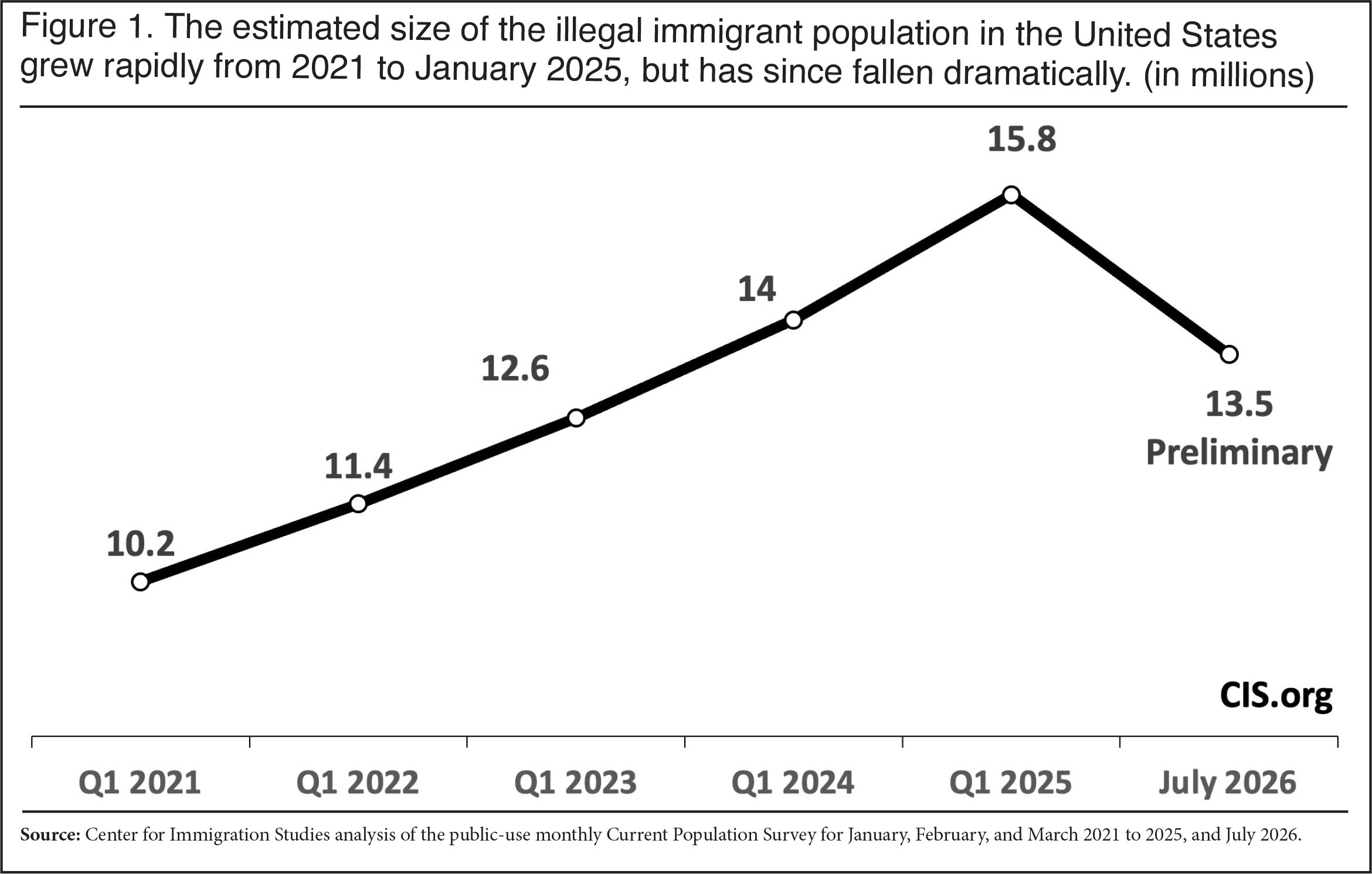
Based on Census Bureau data, we estimate that 13.5 million illegal immigrants live in the U.S. as of July 2026, down from 15.8 million when President Trump began his second term in January 2025. The mistaken belief that the illegal population actually numbers 20-30 million probably stems from underestimating the scale of associated legal immigration, including birthright citizens. By contrast, claims that there are 100-plus million illegal immigrants have no basis in reality.
Counting Illegal Immigrants
The Center’s latest report on the size of the overall foreign-born population includes a section on counting illegal immigrants. In brief, we use the Census Bureau’s Current Population Survey (CPS) to first estimate the legal immigrant population that arrived in 1980 or later, allowing for deaths and outmigration, and then subtract this estimate from the foreign-born population in the survey. (Those who arrived before 1980 are almost certainly not here illegally.) We define illegal immigrants as all foreign-born residents who are not naturalized citizens, permanent residents, or temporary visa-holders. Following convention, we include those with some temporary protections from deportation, such as parolees and asylum applicants, as illegal immigrants.
Based on prior trends and the limited administrative data available, we estimate that the post-1980 legal immigrant population was 31.6 million in July 2026. Subtracting this number from the 44.7 million post-1980 immigrants in the July CPS produces an estimate of 13.1 million illegal immigrants in the data. A standard adjustment for undercount puts the total illegal immigrant population at 13.5 million in July 2026. As Figure 1 shows, this marks an extraordinary decline of 2.3 million, or 14.6 percent, in the illegal immigrant population since January 2025.
>
 |
Some Interpretive Caveats
The decline of 2.3 million is a net change, meaning it is the difference between new illegal immigrants entering the population and existing illegal immigrants leaving. The decline does not imply that new illegal border-crossings and visa overstayers have dropped to zero. Furthermore, our estimates are inherently imprecise. The CPS itself experiences sampling variability month to month. Counting illegal immigrants — who are not directly identified in the data — requires some simplifying assumptions that add even more uncertainty. That said, one should not confuse imprecision with ignorance. Defensible methodological choices might move the number by a million or two, but the range of plausible estimates is still tightly bounded — at least relative to the numbers we discuss below.
Estimates of 20-30 Million Are Too High
Skeptics sometimes argue that the illegal immigrant population is actually in the 20-30 million range. Their case was bolstered by a 2018 journal article arguing for 22 million, which we critiqued at the time. The commentators’ and the paper’s numbers do not align with other demographic indicators. If there were 10 million extra illegal immigrants in the U.S. — mostly from Latin America, ages 18 to 40, and roughly 45 percent female — they would account for approximately 200,000 births each year. Where are these births or corresponding school enrollments in administrative records? “People leave footprints,” one organization has noted, and millions of illegal immigrants cannot be hidden from American life.
To be fair, the mistaken belief that there are 20-30 million illegal immigrants in the country is understandable in terms of broader population impact. If we take the actual illegal immigrant population and add their estimated five to six million minor children who received birthright citizenship, the sum would be around 20 million. Then add in U.S.-born sons and daughters of illegal immigrants who are now adults to increase that number by several more million. The amnesty granted by the 1986 Immigration Reform and Control Act (IRCA) also legalized nearly three million people, and millions of other former illegal immigrants have received legal status in recent decades through asylum grants, marriages to Americans, visa-lottery wins, and so on. Putting these numbers together, the total population of illegal immigrants, their offspring, and former illegal immigrants could easily amount to 30 million.
It is therefore quite reasonable to count 30 million people whose presence is connected in some way to past illegal immigration. What is wrong is the belief that all — or even most — of those 30 million are here illegally. It is legal immigration policy that has allowed the numbers to expand well beyond an initial illegal flow. As we have argued for years, legal and illegal immigration are inexorably linked.
Estimate of 100-Plus Million Is Unserious
Recently, former U.S. Border Patrol officer Greg Bovino has alleged that there are 100 million or more illegal immigrants in the U.S. Unlike the 20-30 million claim, which can understandably stem from mistaking legal immigration for illegal, 100-plus million has no basis in reality. The combined populations of California, Texas, and Florida total less than 100 million. It should go without saying that a group of that size cannot hide in the shadows. Furthermore, the entire foreign-born population (legal and illegal) in the CPS numbers about 50 million. The idea that Census Bureau surveys — including even the full-count decennial Census — could repeatedly miss two-thirds of the foreign-born population defies common sense.
In justifying 100 million, Bovino contrasts ongoing illegal immigration since the 1990s with what he describes as the Pew Research Center’s “consistent” estimate of 12 to 15 million illegal immigrants. How, he asks, could we have so much illegal immigration decade after decade without the number going up? In fact, Pew’s estimate did rise, from 3.5 million in 1990 to 12.2 million in 2007. It was only after 2007 that the number stopped rising and even declined somewhat prior to the Biden surge in 2021.
Of course, illegal immigration did not end during the 2007-2021 period. As we alluded to earlier, the illegal immigrant population is in a constant state of churn. The flow of new illegal border-crossers and visa overstayers adds to the population each year, but deportations, voluntary departures, natural mortality, and legalizations subtract from the population each year as well. Before 2007, new entrants to the illegal population vastly exceeded exits, leading to a rapid increase in the overall stock. Between 2007 and 2021, however, entrances and exits were close to equal, causing the total illegal immigrant stock to be roughly stable.
Bovino also speaks of large reductions in commute times and school enrollments after ICE operations in Charlotte and elsewhere. It is unclear how accurate or generalizable these measurements are. But just as importantly, we do not know whether people who stop commuting to work or attending school are actually here illegally. For one thing, we estimate that three-quarters of school-age children in households headed by illegal immigrants are birthright citizens. When counting illegal immigrants, it is important not to confuse them with their citizen children or with other relatives who may have legal status.
Conclusion
Advocates sometimes debate the policy implications of having an illegal immigrant population that is far larger than conventional estimates. We have little interest in that thought experiment. Inflated population counts are simply not supported by the data. As of July 2026, the most reasonable estimate is that illegal immigrants number about 13.5 million — a size that happens to be plenty large enough to justify continued public concern.