
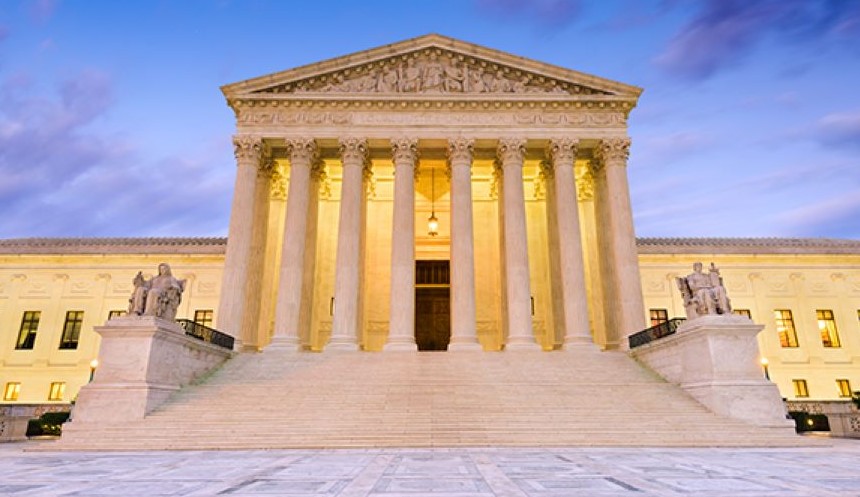
The Supreme Court has granted a DOJ petition for writ of certiorari by agreeing to review an April opinion from the U.S. Court of Appeals for the Second Circuit in Rhoney v. Barbosa da Cunha, wherein a three-judge circuit panel affirmed a lower-court order holding that section 235(b)(2)(A) of the Immigration and Nationality Act (INA) does not deny release on bond to illegal migrants who evaded apprehension at the border and settled in the United States. In other words, after thousands of lower court decisions, the justices will finally decide whether the Trump II “mass detention” policy complies with the law as Congress wrote it more than 30 years ago — which it almost definitely does.
Congress Changes the Law in 1996
In 1996, Congress rewrote a key provision in the INA that governs how immigration officers are to inspect, expel, deport, and (most importantly for this matter) detain or release aliens who arrive in this country.
Specifically, the Illegal Immigration Reform and Immigrant Responsibility Act (IIRIRA), enacted that year, amended (among other provisions) the “inspection protocol” in section 235 of the INA, which governs the process by which aliens are inspected for admission to this country.
Prior to that amendment, an alien who entered illegally, “free from official restraint”, was placed into “deportation proceedings” in which the alien received “greater procedural and substantive rights” — including to ask for bond from an immigration judge (IJ) — than aliens stopped during illegal entry or at the ports, who were placed into “exclusion proceedings” and received only those rights Congress had expressly given them.
Most significantly for this case, those aliens sent to exclusion proceedings could not ask an IJ for release on bond. Their only route out of detention was to ask the then-Immigration and Naturalization Service (INS) for “parole” in the exercise of the agency’s discretion, and then only for “emergent reasons or for reasons deemed strictly in the public interest”.
IIRIRA tightened those parole standards, replaced exclusion and deportation proceedings with unified “removal proceedings” for both deportable and inadmissible aliens in section 240 of the INA, and — most importantly — required that aliens who haven’t been admitted be detained, pending either “expedited removal” under section 235(b)(1) of the INA or section 240 “regular removal” proceedings before an IJ.
The key was “admission”, and under those amendments, every alien “present in the United States who has not been admitted or who arrives in the United States” is deemed “an applicant for admission”, including those who illegally bypassed inspection at the ports and proceeded surreptitiously into the interior, and who therefore came without any intention of seeking legal “admission”.
Pursuant to the IIRIRA changes to section 235, applicants for admission are subject to inspection by immigration officers wherever they are found: by CBP officers at the ports; by Border Patrol agents after crossing improperly between the ports; or by ICE in the interior of the country, regardless of how long they have been here.
Various Administrations Ignore the Detention Change
The language in the INA will be key to the justices’ final decision, and as amended by IIRIRA, section 235(b)(2)(A) of the INA states:
Subject to subparagraphs (B) and (C), in the case of an alien who is an applicant for admission, if the examining immigration officer determines that an alien seeking admission is not clearly and beyond a doubt entitled to be admitted, the alien shall be detained for a [removal] proceeding under [section 240 of the INA].
Subparagraph (B) is a special provision that excludes inadmissible crewmen and stowaways (who are not eligible for removal proceedings) and aliens subject to expedited removal (who have their own paths to removal proceedings and their own detention mandates under section 235(b)(1) of the INA).
Given that Congress has “plenary power” to set immigration rules, and the Constitution’s “take care” clause requires the executive branch to carry out its mandates, that should have settled whether applicants for admission are eligible for release on bond, and yet every prior administration refused to enforce the detention mandate in section 235(b)(2)(A) by reading it out of the statute.
Specifically, both INS (and then DHS) and DOJ (which oversees the IJs) continued to follow earlier policies that allowed applicants for admission first encountered in the interior to seek release on bond under the general arrest and release authority in section 236(a) of the INA (which applies to other aliens facing removal) throughout the Clinton, George W. Bush, Obama, Trump I, and Biden administrations.
The Clinton INS and DOJ, were pretty upfront about it, proclaiming in the March 1997 interim rule implementing IIRIRA that: “Despite being applicants for admission, aliens who are present without having been admitted or paroled (formerly referred to as aliens who entered without inspection) will be eligible for bond and bond redetermination.”
Enter the Tacoma IJs — And Trump II
It wasn’t until 2023 — during the Biden administration — that IJs in Tacoma, Wash., looked at the statute anew and concluded that illegal entrants were “applicants for admission” and thus barred from receiving bond under section 235(b)(2)(A) of the INA.
Their intransigence is clear from the habeas petition in Rodriguez Vasquez v. Bostock, which was filed in March 2025 by an alien with the U.S. District Court for the Western District of Washington detained within the jurisdiction of the Tacoma Immigration Court, seeking release on bond the IJs there had denied.
Four months after that petition was filed, as the Washington Post reported in May 2026:
ICE announced a major change that mirrors the Tacoma judges’ view, stating that immigrants who have been in the U.S. for years are “applicants for admission” if they didn’t enter the U.S. legally and, as a result, were subject to mandatory detention.
That’s what I refer to as the Trump II “mass detention policy”, and more than a few aliens held by ICE under that policy sought release on appeal from the Board of Immigration Appeals (BIA), the DOJ administrative tribunal that reviews immigration determinations.
In its September 2025 opinion in Matter of Yajure Hurtado, however, the BIA concluded ICE was correct and that section 235(b)(2)(A) of the INA barred immigration judges from ordering the release on bond of applicants for admission.
Habeas Petitions Skyrocket — and Courts React
DHS detentions without bond quickly expanded thereafter, and because they were unable to seek bond from IJs and the BIA, tens of thousands of those detained aliens filed habeas petitions seeking release in U.S. district courts nationwide, nearly all alleging the Trump II policy misreads the statute.
And hundreds of federal judges have agreed: The New York Times reported on October 1 that “More than 500 district court judges and four of six federal appeals courts to consider the issue have rejected the administration’s new detention rule and its interpretation of the immigration law at issue.”
One of the two holdouts is the Fifth Circuit and not only has that court held that the detention policy shift “better honor[ed] the predominant goal in the enactment of IIRIRA” than prior administrations’ interpretations of section 235(b)(2)(A) of the INA, but it also later concluded the Trump II policy doesn’t violate aliens’ Fifth Amendment Due Process rights.
On to SCOTUS
Needless to say, however, the Second Circuit was one of the four federal appellate courts to reject the new policy, and in Barbosa da Cuhna, it concluded that the detention mandate in section 235(b)(2)(A) only applies to “those noncitizens who present themselves at a port of entry for admission, or who cross the physical border into the United States but are apprehended at the ‘threshold of initial entry’”.
“Even assuming arguendo that ambiguity existed in” that provision, the Second Circuit continued, “the fact that the Executive Branch has for nearly three decades acted inconsistently with the newfound interpretation strongly counsels against adopting it”.
In other words, if serial administrations ignore a congressional mandate long enough, it will go away, at least under the court’s reasoning.
Finally, the Second Circuit concluded that “even if the statutory language was ambiguous, we would reach the same conclusion under the doctrine of constitutional avoidance”, that is to avoid a finding that Congress had written a statute that violated the Fifth Amendment.
Note that counsel for the alien there sent a letter to the Supreme Court on September 25, asking that if the justices did grant certiorari in Barbosa da Cuhna and in the first Fifth Circuit case (Buenrostro-Mendez v. Blanche) that they do so “only on the statutory issue presented”, essentially asking them to skip the constitutional issue — for now, at least.
Consistent with that request, the justices have affirmed that the only question at issue in its review of the Second Circuit’s opinion in Barbosa da Cuhna is whether section 235(b)(2)(A) of the INA “mandates the detention pending removal proceedings of aliens who, like respondent, are present in the United States without having been admitted”.
If the justices answer that question in the affirmative, you can expect thousands of new habeas petitions from illegal entrants of long residence in this country, claiming Congress unconstitutionally deprived them of their rights when it changed the law in 1996 — in most cases, decades before they crossed the border illegally. The constitutional question would then presumably work its way back up to the high court — unless the next administration abandoned the policy before the cases got that far.
More than 30 years after Congress mandated the detention of “applicants for admission” — aliens present without being admitted to this country — we’ll finally find out whether that mandate applies only to illegal migrants stopped on their way in, or to everyone who crossed the border illegally. You can thank Trump II and four IJs in Tacoma for making it happen.