
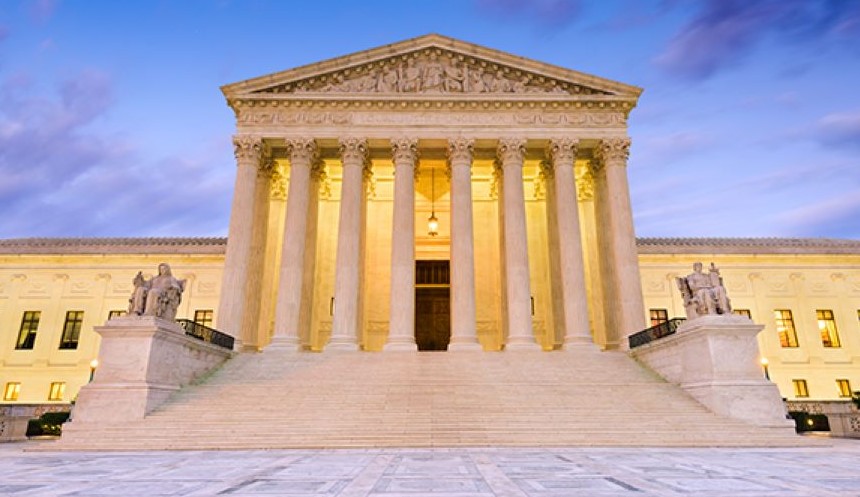
As I’ve reported, the Supreme Court issued two immigration-related opinions on June 25: Mullin v. Doe, restricting aliens’ ability to challenge terminations of Temporary Protected Status (TPS) designations in federal court; and Mullin v. Al Otro Lado, finding that an alien on the threshold of the United States has not “arrived in” this country and thus has no right to be allowed to enter to apply for asylum. While Doe drew much attention (and criticism), Al Otro Lado has largely been ignored. It deserves greater interest, however, because it reaffirms the fact that ours is a sovereign nation, and the U.S. government is allowed to use force to keep aliens out, even if they come seeking asylum.
Background
Section 208(a)(1) of the Immigration and Nationality Act (INA) states:
Any alien who is physically present in the United States or who arrives in the United States (whether or not at a designated port of arrival and including an alien who is brought to the United States after having been interdicted in international or United States waters), irrespective of such alien's status, may apply for asylum. [Emphasis added.]
At issue in Al Otro Lado was whether migrants stopped by CBP from entering while they’re on the Mexican side of the Southwest border are “arriving in the United States” such that they must be allowed in to seek asylum, and the reason that question was asked has to do with a port-security practice that began under the Obama administration.
In 2016, large numbers of aliens began approaching the Southwest border ports seeking entry to apply for asylum, even though they lacked the necessary passports and/or visas to be admitted to the United States.
That quickly became a problem for DHS, because section 235 of the INA requires CBP officers at the ports to inspect all aliens as “applicants for admission”, even if they lack proper admission documents.
While applicants for admission without documents are subject to “expedited removal”, meaning CBP can exclude them without first obtaining a removal order from an immigration judge (IJ), if those aliens claim a fear of persecution or torture, or request asylum directly (these aliens’ intent), CBP must refer them to USCIS asylum officers for “credible fear” interviews.
Aliens in expedited removal who receive “positive” credible fear determinations are placed into removal proceedings before IJs, and nearly 40 percent of aliens CBP encountered at the Southwest border in FY 2016 and subjected to expedited removal — more than 94,000 in total — claimed a fear of harm and more than 76,000 received positive fear determinations, even though less than 7 percent ultimately were granted asylum.
To close that “backdoor” to illegal entry for aliens without documents, CBP officers began standing at the international boundary line and “metering” them, that is, turning them back before they could reach the port, requiring them join a queue on the Mexican side of the border and await their turns to be processed at the port.
In 2018, Trump I formalized that metering policy in a memo that, as DOJ explained, “stated that CBP officers ‘may elect to meter the flow of travelers’ when appropriate to ensure ‘security,’ ‘safe and sanitary conditions,’ and ‘orderly processing’”.
The Trump I memo “acknowledged, however, that ‘once a traveler is in the United States, he or she must be fully processed’”.
Al Otro Lado
That metering guidance was rescinded by the Biden administration in November 2021, but not until after Al Otro Lado, an immigrant advocacy group, and 13 asylum seekers filed a complaint with the U.S. District Court for the Central District of California challenging the practice.
They alleged CBP had “systematically violated U.S. law and binding international human rights law by refusing to allow individuals ... who present themselves at” ports along the Southwest border “and assert their intention to apply for asylum or a fear of returning to their home countries — to seek protection in the United States”’.
In late October 2024 — days before the presidential election — a divided three-judge panel of the Ninth Circuit issued an opinion in the case, barring metering.
The two-judge majority concluded an alien “arrives in” the United States for asylum purposes if the alien is stopped on the other side of the border, even though, as Judge Ryan Nelson explained in his dissent, such an interpretation “ignores a common-sense understanding of the English language” (among other issues he had with the majority).
DOJ filed a petition for writ of certiorari in the case, asking the Supreme Court to review that circuit court decision, and on June 25 (as noted), the justices issued their opinion.
Justice Alito wrote the opinion for a six-justice majority, and cut to the chase in his opening paragraph:
This case presents a straightforward question: whether an alien who seeks to enter the United States from Mexico “arrives in the United States” when he or she is still in Mexico. In the decision below, the United States Court of Appeals for the Ninth Circuit answered “yes.” That is wrong. In ordinary speech, no one would say that a person “arrives in” a place — for example, a house, a city, or a country — before the person enters that place. The context in which the phrase “arrives in the United States” is used in the immigration statutes at issue here supports an ordinary-meaning reading. So does the presumption against extraterritoriality. We therefore reverse.
Putting the Asylum Cart Before the Enforcement Horse
One reason so little attention has been paid to this case is that the issue was so straightforward to the point of “bordering” on the banal: Has an alien who has not yet “entered” the United States nonetheless “arrived in” this country?
The answer is plainly “no”, as no one can be said to have “arrived at” any destination before he or she gets there.
Implicitly, however, the majority opinion answered a larger question that was hotly debated under Biden and continued until Justice Alito issued his opinion: What obligation does section 208(a)(1) impose on DHS to allow illegal aliens into the United States, and consequently what force can immigration officers use to keep “asylum seekers” from entering the United States illegally?
This issued is illustrated by two border incidents that were a very big deal during the last administration: destruction by Biden’s CBP of concertina-wire barriers Texas installed on the banks of the Rio Grande to deter migrants from entering illegally in 2023; and alleged “whipping” of illegal migrants by mounted Border Patrol agents in that river during a migrant surge into Del Rio, Texas, in September 2021.
In the concertina-wire case, the Biden administration claimed it was obligated to destroy the fencing because migrants, having reached the U.S. side of the Rio Grande, were “present” in the United States and therefore DHS had let them in to inspect them as “applicants for admission” under section 235 of the INA (and release them).
The “whipping” allegations, meanwhile, were referred to CBP’s Office of Professional Responsibility (OPR), and while that office determined in July 2022 that no migrants had ever been “whipped”, OPR nonetheless referred the agents for prosecution (which the U.S. Attorney’s Office declined to take up).
Here’s why OPR claims it referred those agents: “During this incident, instead of processing migrants for admission or directing them to an area where thousands of individuals already awaited, multiple mounted BPAs used force, or threats of force, to coerce or compel individuals to return to Mexico.”
In other words, the Biden administration truly believed that the one agency of the federal government dedicated to the mission of keeping aliens from entering the United States illegally couldn’t use force to accomplish that goal.
In essence, the Biden administration put “the asylum cart in front of the enforcement horse”, concluding section 208 of the INA required CBP to usher aliens who made it to the threshold of the United States the rest of the way in and couldn’t use force of any kind to keep them out. In Al Otro Lado, the justices explained how wrong that conclusion was, and in so doing, reasserted our status as a sovereign nation.