
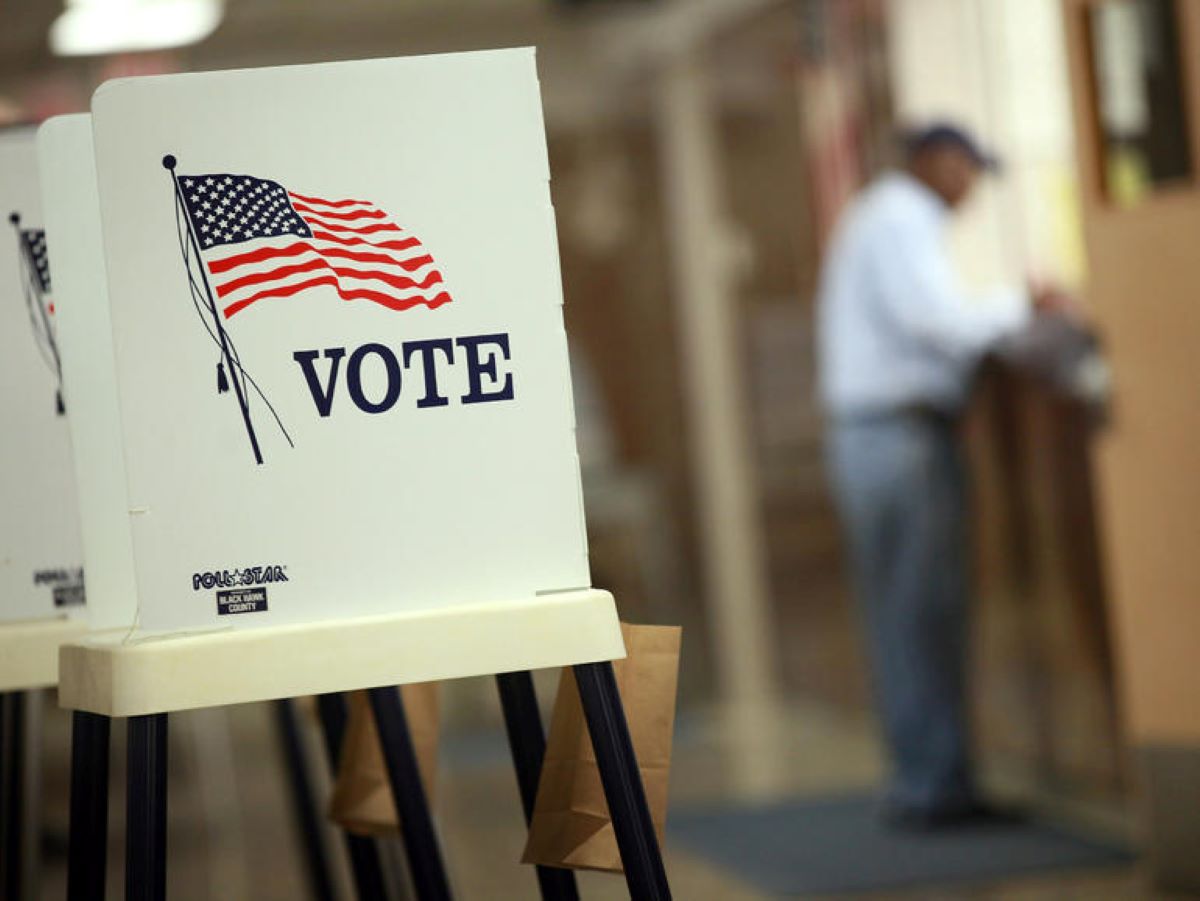
The Board of Immigration Appeals (BIA) – the administrative tribunal at DOJ that reviews immigration decisions – recently issued an opinion in Matter of Lopez Rico, ordering an erstwhile lawful permanent resident who admitted that he voted in the 2012 presidential election removed and denying his application for cancellation. That thing that purportedly never happens just cost this alien his green card, and the Board suggests the immigration judge could have given the illegal voting factor more adverse weight than he did.
Omar Elidoro Lopez Rico
The respondent, Omar Elidoro Lopez Rico, is a Mexican national who entered the United States in February 2001 as a lawful permanent resident, i.e., a “green card” holder.
Nearly 14 years later, in February 2015, he submitted a Form N-400, Application for Naturalization with USCIS, and in that application and a June 2015 Record of Sworn Statement he also provided the agency, he admitted that he had voted in Stanislaus County, Calif., in the 2012 presidential election.
Nearly a year later, DHS issued him a Notice to Appear (“NTA”, the charging document in removal proceedings), charging Lopez Rico with removability under section 237(a)(6) of the Immigration and Nationality Act (INA), as an alien who “has voted in violation of any Federal, State, or local constitutional provision, statute, ordinance, or regulation”, as well as under section 237(a)(3)(D) of the INA as “alien who . . . has falsely represented, himself to be a citizen of the United States for any purpose or benefit” under the INA “or any Federal or State law”.
For reasons that are unclear, the immigration judge initially terminated the case, and DHS appealed. The Board sustained the government’s appeal and remanded the case back to the immigration court.
The immigration judge thereafter sustained the illegal voting removal charge, and as relief from removal, Lopez Rico filed a Form EOIR-42A, seeking cancellation of removal for certain permanent residents under section 240A(a) of the INA.
The immigration judge denied that application, and ordered the alien removed. Lopez Rico appealed to the BIA.
Removability for Unlawful Voting
Note that no conviction is required to find that an alien is removable under section 237(a)(6) of the INA, and it does not appear Lopez Rico has been charged, let alone convicted, for that offense.
To exercise the franchise in California, a would-be voter must be: (1) “a United States citizen and a resident of California”; (2) “18 years old or older on Election Day”; (3) “not currently serving a state or federal prison term for the conviction of a felony”; and (4) “not currently found mentally incompetent to vote by a court”.
In San Francisco, alien “parents or guardians with at least one minor child living in the city” can vote in elections for the San Francisco Unified School District Board of Education. Across the bay, Oakland (which is in Alameda County) passed a similar ballot measure in November 2022, but it has not yet been implemented.
Stanislaus County (home to Modesto) has no similar law, but regardless it is illegal for anyone who cannot satisfy those four requirements above to vote in a statewide or federal election in the Golden State.
Despite that, it does not appear that alien voting is a crime under California state law, though under section 18560(a) of the state’s Elections Code, it is a felony to fraudulently vote or fraudulently attempt to vote in an election there if you are not entitled to do so.
“Fraud”, however, requires an intentional mental state, and Lopez Rico wasn’t convicted under that law and contended “he did not understand he was ineligible to vote”, and thus there is no evidence of record that he engaged in willful fraud to do so.
Therefore, he contended, the immigration judge erred in concluding that he was removable as charged.
The problem is that voting as an alien in a federal election is expressly a federal crime, under 18 U.S.C. § 611, subject to a handful of exceptions that did not apply to Lopez Rico’s case.
Congress added that provision to the federal criminal code in 1996, in response to concerns that aliens had voted illegally in the past and should be deterred from doing so in future elections.
Consequently, organizations like the National Immigration Forum contend that current White House and congressional proposals “to ban noncitizen voting seeks to solve a problem that does not exist”, but it plainly existed post-1996 in Mr. Lopez Rico’s case.
In any event, the BIA concluded in its 2015 opinion in Matter of Fitzpatrick (another alien voting case that never happens, though this time it occurred in November 2006) that 18 U.S.C. § 611 is a “general intent statute”, and consequently an alien who violates it is removable under section 237(a)(6) of the INA, “regardless of whether the alien knew that he or she was committing an unlawful act by voting”.
Accordingly, the Board concluded, Lopez Rico was removable as charged.
42A Cancellation
Cancellation of removal under section 240A(a) of the INA is also known as “42A cancellation” based on its application number, and to be granted it an alien must show that he: (1) has been an LPR “for not less than 5 years”; (2) “has resided in the United States continuously for 7 years after having been admitted in any status”; and (3) “has not been convicted of any aggravated felony”.
Aliens granted 42A cancellation essentially have their removability wiped away and get to keep their green cards.
The only conviction Lopez Rico has on his record is a 2016 conviction for driving under the influence (“DUI”), which is not an aggravated felony as defined in section 101(a)(43) of the INA.
That said, he had a more recent, second arrest on a DUI-related charge in 2024, which he claims remains pending.
There are two important things to note. First, the applicant bears the burden of proving he is eligible under the statute to receive 42A cancellation and second, he also bears the burden of proving he merits that relief in the exercise of the attorney general’s discretion, which the head of DOJ has delegated down to the immigration judge.
The problem is that when the immigration judge gave Lopez Rico “repeated opportunities to explain the circumstances surrounding his 2016 DUI conviction and subsequent 2024 DUI-related arrest” – both of which are “directly relevant to the discretionary inquiry” – the alien “invoked the privilege against self-incrimination under the Fifth Amendment and declined to answer material questions”.
That’s Lopez Rico’s constitutional right, but immigration proceedings are civil, not criminal, in nature, and precedent has long established (since 1923) that immigration adjudicators may draw adverse inferences from the silence of aliens who refuse to answer their questions, especially (since 1977) when those questions are relevant to their applications for discretionary relief.
“In this regard,” the BIA concluded:
the Immigration Judge found that the respondent’s refusal to provide material testimony left the court without any meaningful explanation as to the underlying conduct and circumstances that led to the respondent’s 2016 conviction and 2024 arrest, and properly drew an adverse inference against the respondent due to this resulting evidentiary gap.
The Board also rejected Lopez Rico’s contention that the immigration judge “afforded excessive weight to his unlawful voting violation”, concluding that the court below properly weighed that factor and his contentions with respect thereto and the other mitigating factors the alien offered in his case in reaching its decision.
In fact, the BIA concluded the court could have given the unlawful voting factor more adverse effect than it ultimately did, “given the seriousness Congress attached to such conduct and the governmental interests it implicates”.
How widespread is alien voting? Given the secrecy that surrounds ballots and the unwillingness of states to share their voter information with the federal government, there’s no way to know for sure. That said, this case calls into question the claim that alien voting is “a problem that does not exist” – and it’s an issue the BIA takes very seriously.