
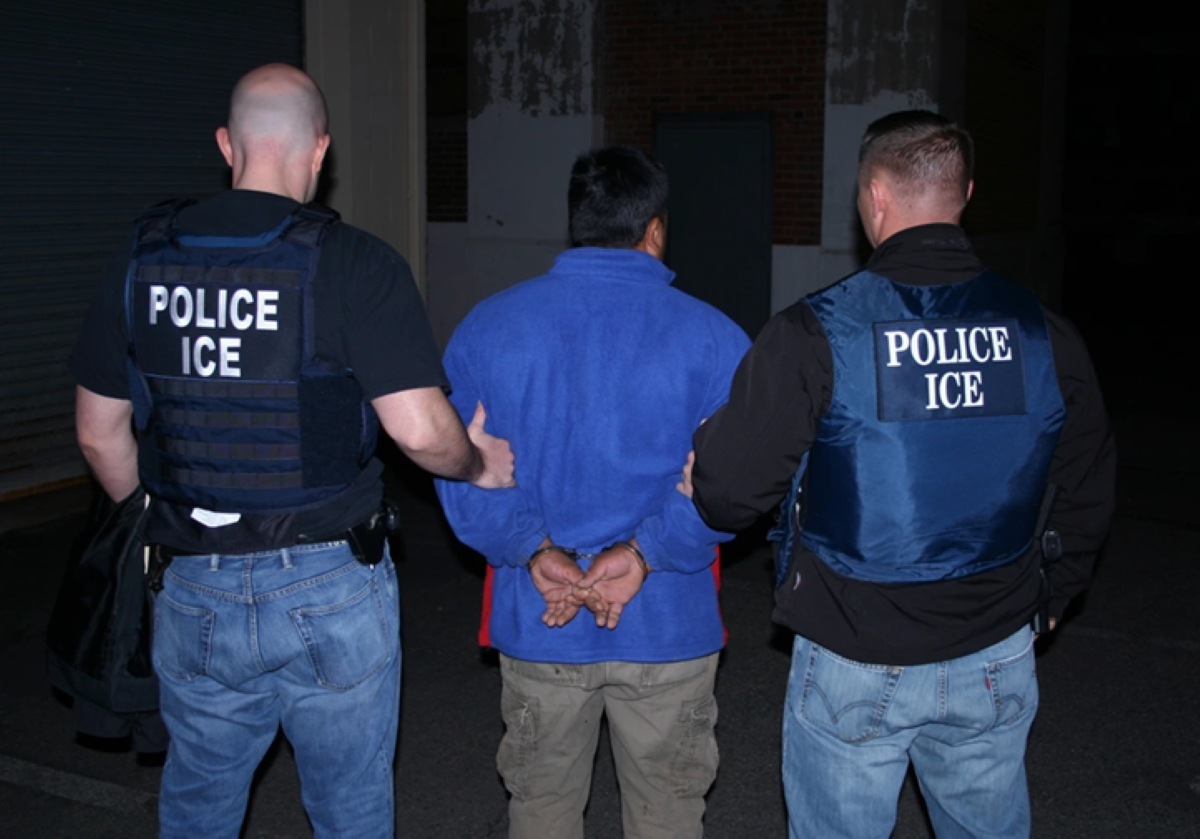
DHS claimed this week that New York has refused to honor more than 16,000 ICE detainers asking the Empire State to turn criminal aliens in its custody over to the agency for removal since the start of the second Trump administration. Tune out claims that Trump II is snatching up “otherwise law-abiding” aliens: the logical reason for this “sanctuary” intransigence is that, traditionally, the vast majority of ICE interior arrests have been “custodial” ones, from jails, detention facilities, and prisons — except, ironically, under the Biden administration. So, New York politicos who don’t think anyone should be deported, even public safety threats, are keeping ICE officers out of their prisons and jails. Here are the facts.
“Interior Arrests”
As I’ve explained in the past, two key metrics define DHS’s effectiveness in reducing the unauthorized alien population: ICE arrests of removable aliens living here (“interior arrests”); and its deportations of aliens found in the interior of the United States (as opposed to illegal migrants apprehended by CBP at the border), known as “interior removals”.
Why are those the “key” metrics? Because border enforcement is reactive, driven by migrants trying to enter illegally, but immigration enforcement in the interior is proactive — it represents how effective immigration officers in ICE’s Enforcement and Removal Operations (ERO) directorate have been in arresting and deporting removable aliens who are already here.
While ICE has claimed its officers broke all-time monthly interior arrest records in July (50,208) and again in August (50,925), both it and DHS have — to my frustration — failed to produce hard statistics that can be analyzed to both confirm and analyze those claims.
For the time being, I’ll accept ICE’s claims at face value, while still adhering to what President Reagan insisted was an old Russian proverb: doveryai, no proveryai, “trust, but verify”.
The Two Types of Interior Arrests
Interior arrests can be further broken down into two categories: “at-large arrests” and “custodial arrests”.
At-large arrests are exactly what they sound like, with ICE officers taking aliens into custody on the streets, in their cars, or (with proper permission or warrants) at their homes or worksites.
Nearly every arrest the public sees on the news and on social media is a street arrest, which is why many in the public believe (and most demagogues argue) they’re the only arrests immigration officers are currently making.
But they’re not, and if immigration officers are following traditional enforcement schemes, street arrests are just a fraction of ICE’s current interior efforts.
How ICE Finds Criminal Aliens
Custodial arrests, by contrast, occur when ICE “arrests” an alien already in the custody of another law enforcement agency (LEA) — be it from the U.S. Bureau of Prisons (BOP) system, U.S. Marshals’ custody, or a state or local jail, prison, or detention center — who is being held on criminal, non-immigration grounds.
As the Transactional Records Access Clearinghouse (TRAC) notes: “The principal program using this approach is known as the Secure Communities ... program.”
ICE described Secure Communities as a “simple and commonsense way to carry out ICE's enforcement priorities for those aliens detained in the custody of another law enforcement agency”, and here’s how the agency explained the process:
For decades, local jurisdictions have shared the fingerprints of individuals arrested and/or booked into custody with the FBI to see if those individuals have a criminal record and outstanding warrants. Under Secure Communities, the FBI automatically sends the fingerprints to DHS to check against its immigration databases. If these checks reveal that an individual is unlawfully present in the United States or otherwise removable, ICE takes enforcement action.
The use of the past tense was intentional, because the Secure Communities moniker has apparently either been retired or fallen into disuse (it was often politically contentious), but regardless the same basic process still applies.
Once the FBI sends DHS fingerprints of LEA arrestees, they’re accessed in real time by employees at ICE’s Law Enforcement Support Center (“LESC”, in Vermont) for an alienage determination and once it’s determined the arrestee is an alien, to the agency’s Pacific Enforcement Response Center (“PERC”, in California) and forwarded to ERO field offices for action.
LESC also fields state and local LEAs’ Immigration Alien Queries (IAQs), and from there “connects ICE duty officers and agents to law enforcement agencies for real-time response”.
Of course, those are not the only ways ICE finds suspected criminal aliens, especially given Trump II’s expansion of ICE’s “287(g) Program”.
As per ICE, that program allows the agency to “partner with state, local, and tribal law enforcement agencies to identify and remove criminal aliens who are amenable to removal from the United States” pursuant to three different 287(g) models it operates:
The Jail Enforcement Model allows designated immigration officers to identify and process removable aliens who have pending or active criminal charges.
The Task Force Model, [which allows] designated immigration officers to enforce limited immigration authority while performing routine police duties or as an active participant in an ICE-led task force.
The Warrant Service Officer Model [which] allows designated immigration officers to serve and execute administrative warrants on aliens in their custody.
Finally, some state and local detention facilities that don’t participate in 287(g) nonetheless allow ICE officers inside to find possible alien criminals, and then there’s the old-fashion method of checking local newspapers and TV news to find wanted aliens.
“New York has Refused to Honor More Than 16,000 ICE Detainers”
From there, ICE issues immigration detainers to state and local LEAs asking them to give ERO officers a heads up before releasing known or suspected criminal aliens or to hold those aliens for up to the congressionally authorized 48 hours past the time of release for ICE pick-up.
Which brings me to DHS’s October 12 presser, “DHS Releases New Data Revealing that New York has Refused to Honor More Than 16,000 ICE Detainers”.
According to the department, “New York sanctuary politicians” refused to honor 16,070 detainers since the start of Trump II for aliens with “52,503 total criminal charges and convictions”, including homicide (131), kidnapping (132), sexual offenses (1,017), robberies (1,776), and assaults (9,502).
While it’s possible in this day and age that politicians could be running for office on a “we need more murderers and sex offenders on our streets” platform, a quick check hasn’t uncovered any in New York. So what gives?
Interior Enforcement Since 2016
The logical conclusion is that New York “public servants” are so incensed by immigration enforcement they want to use their good offices to end it, and if you wanted to shut down ICE, not honoring ERO’s detainers for criminal aliens would be the best way to do it: For the better part of two decades, jails and prisons are where most ICE interior arrests — not just of criminal aliens, most interior arrests — have occurred.
Here are the stats.
According to TRAC, of the 2.086 million-plus ICE interior arrests of aliens between FY 2009 and the third quarter of FY 2018 (June 2018), nearly 1.427 million (68.4 percent of the total) were in federal (255,000), state (158,885), or local incarceration (1,012,823), with an additional 143,787 coming via 287(g) partnerships (6.9 percent).
In other words, more than 75 percent of all ICE interior arrests during that period were custodial.
The rest of the interior arrests over that nearly 10-year period (just over 515,500) were at-large arrests or arrests from “a miscellaneous combination of other sources”.
USA Facts picks it up from there, reporting that of the 143,100 ICE interior arrests in FY 2019, again, 75 percent (nearly 107,450) were custodial arrests, and the rest were at-large arrests.
And according to that same site, of the 103,600 ICE interior arrests in FY 2020 — the first partial fiscal year of the Covid-19 pandemic, when immigration detention space was limited — almost 80,000 were custodial arrests (76.9 percent of the total), and just fewer than 24,000 were at large.
In FY 2021, as the pandemic was winding down but also the first partial fiscal year under Biden, interior arrests fell to fewer than 74,080, but only 65 percent of them (48,087) were custodial arrests.
Again, ICE policies implemented by President Biden and his DHS Secretary, Alejandro Mayorkas, were not entirely to blame for the decline in both the number and percentage of ICE interior arrests that occurred in some other LEA’s custody, but FY 2021 set a trend that continued into the Biden administration.
That’s because while ICE interior arrests rebounded to 142,750 in FY 2022, about 57,400 of them (40.2 percent of the total) were custodial arrests, with the remaining 85,343 being at-large arrests.
That wasn’t a total outlier by Biden standards, either, because of the 170,590 reported interior ICE arrests in FY 2023, fewer than 79,100 of them (46.4 percent) were custodial arrests and the rest — roughly 91,500 or 53.6 percent of the total — were at-large arrests.
ICE interior arrests declined to 113,430 in FY 2024, but the percentage of custodial arrests was closer to more traditional levels. In the last full fiscal of the Biden administration, according to USA Facts, 70.7 percent of ICE interior arrests (80,188) were custodial arrests and the rest (33,242) were at-large.
DHS Is Often Its Own Worst Enemy
From a public opinion view, DHS under Trump II has often been its own worst enemy, and Exhibit A is its failure to publish statistics on the number of ICE’s interior arrests since FY 2025 — and in particular the number of interior arrests of criminal aliens that occurred in some other LEA’s custody.
DHS has those figures, and by withholding them implicitly signals it has something to hide. It doesn’t.
A Harvard/Harris poll of U.S. voters at the end of September reveals that “deporting immigrants who are here illegally and have committed crimes” is Trump’s second most popular policy (only behind lowering prescription prices), favored by 77 percent of the electorate, including 69 percent of Democrats.
The department should publish all of ICE’s arrest and removal figures and let Americans know how many dangerous aliens immigration officers have arrested, and in particular how many it took directly from some other law enforcement agency’s custody, detained, and deported — and then how many detainers sanctuaries declined.
The only reason criminals end up in state or local custody is because authorities there concluded they were too dangerous to allow back on the streets. So if sanctuaries concluded at some point that their criminal aliens posed too big a risk to roam free, why should they now be allowed to remain in this country?
It’s true that sanctuaries only protect criminal aliens, but it’s better for DHS to show how corrosive their policies are to both public safety and the credibility of our immigration system. The story is simple: When ICE officers can go into state and local jails, that’s where they focus their enforcement efforts — except, curiously, under the Biden administration. Somebody should ask Alejandro Mayorkas about that.