
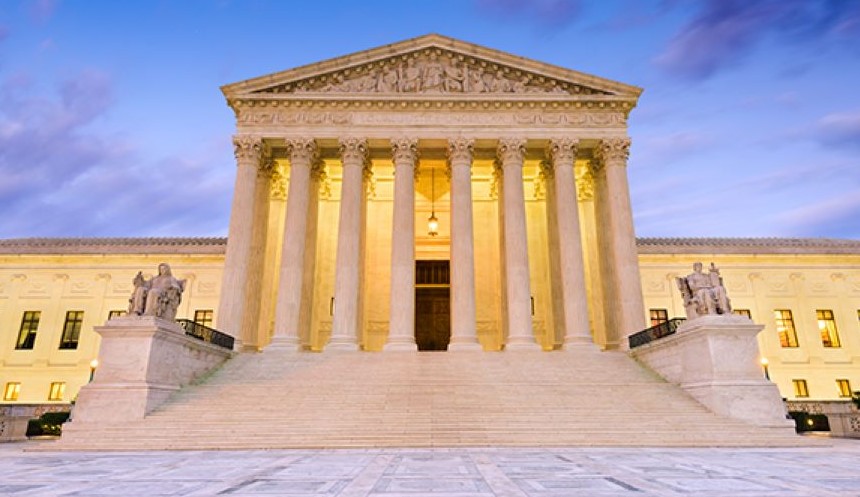
The Supreme Court issued four opinions on June 25: one on firearms in Hawaii; one on the weed-killer Roundup; and two on immigration. The second immigration case, Mullin v. Doe (the “TPS case”) is a clear win for a Trump administration that is attempting to unwind past uses (or “abuses”, depending on your take) of Temporary Protected Status (TPS). The first immigration case, Mullin v. Al Otro Lado, is more a victory for the English language and common sense.
Al Otro Lado
At issue in Al Otro Lado was whether a migrant CBP stops on the Mexican side of the Southwest border is “arriving in the United States” such that the alien must be allowed in to seek asylum.
Section 208 of the Immigration and Nationality Act (INA) is the U.S. asylum statute, and paragraph (a)(1) therein states, in pertinent part:
Any alien who is physically present in the United States or who arrives in the United States (whether or not at a designated port of arrival and including an alien who is brought to the United States after having been interdicted in international or United States waters), irrespective of such alien's status, may apply for asylum. [Emphasis added.]
In 2016, under the Obama administration, large numbers of aliens seeking asylum under that provision appeared at the Southwestern ports of entry even though they lacked proper admission documents, such as passports, visas, or Border Crossing Cards.
That was an issue, because even if an alien lacks admission documents, section 235 of the INA requires CBP officers at the ports of entry to inspect those “applicants for admission” and to detain them during that inspection process.
Such applicants for admission are subject to “expedited removal” under section 235(b)(1) of the INA, meaning CBP could exclude them without first obtaining a removal order from an immigration judge, but if those aliens claimed a fear of persecution or torture, or requested asylum directly (their intention), that provision requires CBP to refer them to a USCIS asylum officer for a “credible fear” interview.
Again, however, section 235(b)(1) requires CBP to detain those aliens during the credible fear process as well, and the Southwestern ports have long lacked sufficient detention space to hold inadmissible aliens for extended periods.
In response, Obama’s CBP adopted a process called “metering”, under which CBP officers would stand at the borderline, turn applicants back before they could approach the ports, and require them to join a queue on the Mexican side of the border and await their turns to be processed at the port.
In 2018, DHS under Trump I formalized that metering policy by issuing a memorandum that, as DOJ described it, “stated that CBP officers ‘may elect to meter the flow of travelers’ when appropriate to ensure ‘security,’ ‘safe and sanitary conditions,’ and ‘orderly processing’”.
The Trump memo “acknowledged, however, that ‘once a traveler is in the United States, he or she must be fully processed’”.
The Trump I metering guidance was rescinded by the Biden administration in November 2021, four years after Al Otro Lado, an immigrant advocacy group, and 13 asylum seekers filed a complaint with the U.S. District Court for the Central District of California challenging the policy.
It alleged that CBP had “systematically violated U.S. law and binding international human rights law by refusing to allow individuals ... who present themselves at” ports of entry “along the U.S.-Mexico border and assert their intention to apply for asylum or a fear of returning to their home countries — to seek protection in the United States”’.
On October 23, 2024 — less than two weeks before the presidential election in which Donald Trump defeated Kamala Harris — a divided three-judge panel of the Ninth Circuit issued an opinion in the case.
The Ninth Circuit majority concluded an alien “arrives in” the United States for asylum purposes if the alien is stopped on the other side of the border, while knocking on the metaphorical door and demanding to be let in.
After that opinion was issued, the circuit court took a number of subsequent actions (sua sponte consideration whether to reconsider the matter en banc, which the Ninth Circuit ultimately rejected, and a May amendment of the opinion and a denial of DOJ’s request for rehearing), which led to DOJ’s July 1, 2025, timely filing of its petition for writ of certiorari with the Supreme Court.
Justice Alito wrote the opinion for a six-justice majority (Justice Thomas wrote a separate concurrence, with Justice Sotomayor dissenting joined by Justices Kagan and Jackson, and Justice Jackson writing a separate dissent) and his opening paragraph tells you everything you need to know about the rest of the opinion:
This case presents a straightforward question: whether an alien who seeks to enter the United States from Mexico “arrives in the United States” when he or she is still in Mexico. In the decision below, the United States Court of Appeals for the Ninth Circuit answered “yes.” That is wrong. In ordinary speech, no one would say that a person “arrives in” a place — for example, a house, a city, or a country — before the person enters that place. The context in which the phrase “arrives in the United States” is used in the immigration statutes at issue here supports an ordinary-meaning reading. So does the presumption against extraterritoriality. We therefore reverse.
Note that this case also involved an interpretation of section 235(a) of the INA, the opening subsection of Congress’s rules for how CBP (both CBP officers in the agency’s Office of Field Operations, “OFO”, at the ports and Border Patrol agents between the ports) are to “inspect” alien “applicants for admission” to decide whether they should be admitted, removed, or held for removal proceedings.
It states:
An alien present in the United States who has not been admitted or who arrives in the United States (whether or not at a designated port of arrival and including an alien who is brought to the United States after having been interdicted in international or United States waters) shall be deemed for purposes of this chapter an applicant for admission. [Emphasis added.]
Same verbiage as section 208(a), and same interpretation from the Court. Score one for the English language.
Doe
The second case, Doe, also involves consideration of a separate case, Trump v. Miot, which the Court consolidated because they involve the same issue: whether TPS beneficiaries (from Syria and Haiti, respectively) who are challenging termination of TPS designations for those countries are entitled to court orders postponing their terminations pending litigation.
By way of background, section 302 of the Immigration Act of 1990 (IMMACT 90) added a new section 244, “Temporary Protected Status”, to the INA. It codified in statute prior ad hoc administrative policies that allowed aliens from certain countries to remain here due to issues they may face back home.
As USCIS explains, pursuant to that provision:
The Secretary of Homeland Security may designate a foreign country for TPS due to conditions in the country that temporarily prevent the country's nationals from returning safely, or in certain circumstances, where the country is unable to handle the return of its nationals adequately. USCIS may grant TPS to eligible nationals of certain countries (or parts of countries), who are already in the United States. Eligible individuals without nationality who last resided in the designated country may also be granted TPS.
A country may be designated for TPS due to “ongoing armed conflict”, “environmental disaster”, or some similar “extraordinary and temporary condition”, and while a designation is in effect, an alien granted TPS status cannot be removed and may be granted work and travel authorization.
The Trump II administration has been attempting to roll back many TPS designations (particularly ones that have been in place for years), but has been repeatedly stymied by the courts, as I explained in depth in March, including the Second Circuit (Doe) and the D.C. Circuit (Miot).
Those challenges have come despite the fact that section 244(b)(5)(A) of the INA clearly states that: “There is no judicial review of any determination of [the Secretary of Homeland Security] with respect to the designation, or termination or extension of a designation, of a foreign state”.
The Supreme Court’s opinion was again a 6-3 split (with Justice Kagan writing a dissent which Justices Sotomayor and Jackson joined). The chief justice joined Justice Alito’s majority opinion in full, as did Justices Thomas and Kavanaugh, while Justices Gorsuch and Barrett joined that opinion in part and Justice Thomas wrote a separate concurrence.
In that opinion, it’s the second and third paragraphs that explain it all:
The TPS statute plainly bars consideration of respondents’ non-constitutional claims. It allows “no judicial review of any determination ... with respect to the ... termination” of a TPS designation. The term “determination” can be used to describe either an individual decision or the whole process leading to a final decision, and under either understanding of the term, [section 244(b)(5)(A) of the INA] squarely bars all of respondents’ non-constitutional claims.
The sole constitutional claim before us will likely fail. Citing statements made by President Trump and former Secretary of Homeland Security Kristi Noem, one set of respondents advances an equal protection claim that Haiti’s TPS designation was terminated because of the racial makeup of that country’s population. But, ironically, one of respondents’ other arguments undermines the equal protection claim by offering a strong, race-neutral explanation for Haiti’s termination: namely, that the current administration, which has terminated every TPS designation that has come up for renewal, simply opposes the TPS program, at least as it has been implemented in the past.
Specifically, lower courts had concluded that while that section 244(b)(5)(A) bar precluded judicial review of the substance of the DHS secretary’s determination, they were still allowed to consider the process by which the secretary arrived at the decision — and found that the process was essentially perfunctory.
The majority rejected that interpretation, distinguishing other precedential opinions in other contexts that found such procedural reviews to be appropriate — hence the conclusion that the review-stripping provision “squarely bars all of respondents’ non-constitutional claims”.
It likely didn’t help that in issuing their decisions the lower courts ignored earlier clear signals from the justices (who twice stayed lower court actions in one case on TPS for Venezuela) or the intemperance of the language some lower courts used (with one criticizing the secretary for “taking a hatchet to the TPS system”).
Pro tip: If you’re a jurist concluding you found bias in a facially anodyne policy, don’t show bias yourself when rejecting it.
NPR contends that the Court in Miot “gave the Trump administration the green light to begin mass deportations of people who have been living and working legally in the United States for years, some even decades”, and that’s more or less true.
But that doesn’t mean lower courts won’t try to impede that process: They’ve sped through SCOTUS yellow lights before and may find this opinion isn’t so red that it counsels against hitting the accelerator.
The INA Means What It Says
The element that ties these two cases together is simple: Congress meant what it said in the INA, whether it’s the point (or more precisely the place) a foreign national becomes an “alien” eligible to apply for asylum, or the authority of the judicial branch to review executive-branch decisions. Both favor Trump II, but one is a clear victory for the English language — and common sense.
On immigration, only the “birthright citizenship” case remains to be decided this Supreme Court session. The verbiage there isn’t quite so straightforward, but expect it to be the last opinion this year until the justices reconvene in October.