
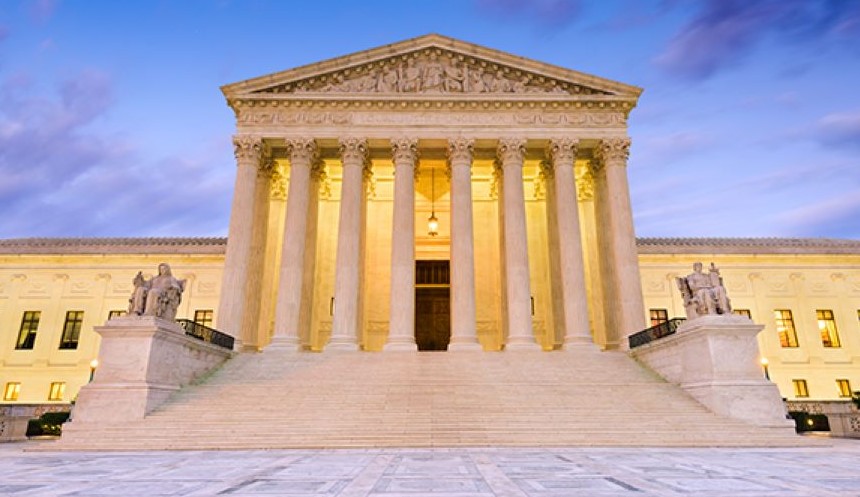
On Wednesday, the Supreme Court heard oral arguments in Trump v. Barbara, better known as the “birthright citizenship” case. U.S. Solicitor General John Sauer had a tough row to hoe in defending the administration’s position before the justices, but ultimately it may not matter much.
A Truncated Background
When the U.S. Constitution was ratified, Article I, sec. 8, cl. 4 gave Congress the authority “To establish an uniform Rule of Naturalization”, which in also turn gave the legislative branch — not the executive or the judiciary — “plenary power” to make laws for the admission, exclusion, and deportation of aliens.
Simply put, you can’t have a uniform rule governing which aliens can naturalize — that is be transformed into citizens — without rules governing which aliens are allowed in, and which must leave.
The parameters of U.S. citizenship, on the other hand, are set forth in the first sentence of section 1 of the 14th Amendment to the Constitution, which states: “All persons born or naturalized in the United States, and subject to the jurisdiction thereof, are citizens of the United States and of the State wherein they reside.”
The 14th Amendment wasn’t ratified until July 1868, prior to which, with a big exception, citizenship was determined according to English common law principles grounded in feudalism, pursuant to which “all free persons born within a state or nation were citizens thereof”.
That exception was the Supreme Court’s 1857 opinion in Dred Scott v. Sandford.
Scott, the plaintiff, had been an enslaved person in Missouri but later lived in Illinois (a “free” state) and in a part of the then-Wisconsin Territory where slavery was outlawed by the Missouri Compromise of 1820. He sued seeking his freedom, claiming that he became free as a matter of law as soon as he went north of the Show-Me State.
Chief Justice Roger Taney, for the majority, concluded that “neither the class of persons who had been imported as slaves, nor their descendants, whether they had become free or not, were ... acknowledged as a part of the people” under the Declaration of Independence or in “the legislation and histories of the times”. Therefore, Scott couldn’t sue in a federal court, and his case was dismissed.
To overrule Dred Scott, Congress passed — over the veto of then President Andrew Johnson, the Civil Rights Act of 1866, which stated that “all persons born in the United States and not subject to any foreign power, excluding Indians not taxed, are hereby declared to be citizens of the United States”.
To ensure a future legislature couldn’t rescind that act to deprive freedmen of citizenship, Congress made that status more permanent by enshrining it in the Constitution, hence the passage of the 14th Amendment, which was ratified on July 9, 1868.
In its 1898 opinion in U.S. v. Wong Kim Ark — the leading case interpreting the 14th Amendment — the Supreme Court made clear that a person born in San Francisco to Chinese national parents who were lawful, domiciled residents of this country was a U.S. citizen at birth, but it also concluded in dicta that all other children born to alien parents were citizens as well, with only limited exceptions for those in Indian tribes and children of foreign diplomats, as well as babies born in areas of foreign occupation and on “foreign public ships”.
In its brief in this case, however, the government argued that the current understanding of birthright citizenship under the 14th Amendment as applying to all children born here with the exceptions in the Wong dicta is of more recent vintage, dating back to the Franklin Roosevelt administration, and that FDR had it wrong.
“Protecting the Meaning and Value of American Citizenship”
President Trump forced a reevaluation of that question in January 2025, when he issued Executive Order (EO) 14160, “Protecting the Meaning and Value of American Citizenship”.
That EO declared that certain “categories of individuals will no longer be considered to be born ‘subject to the jurisdiction’ of the United States and therefore will no longer be U.S. citizens at birth”.
Those categories are children born to mothers who were “unlawfully present” or whose presence was “lawful but temporary” and fathers who weren’t either U.S. citizens or lawful permanent residents (i.e., “green card holders”).
Note that the EO is purely prospective, in that it only covers children born after the effective date of the order, February 20, 2025 (now delayed indefinitely pending the Supreme Court’s decision). Nobody born before that date would lose citizenship, but those born after would not receive it.
Is the Second Clause of the 14th Amendment Vague?
This case really comes down to two questions, the first of which is whether the second clause in section 1 of the 14th Amendment, again, “subject to the jurisdiction thereof”, is vague and therefore subject to interpretation.
Cecillia Wang of the ACLU, arguing for respondents who are attempting to strike down EO 14160, argued that it isn’t vague and that the exceptions identified by the majority in Wong in dicta are the only ones envisioned by the drafters and ratifiers of the 14th Amendment.
Sauer, arguing for the government, contended it wasn’t quite that clear cut, and asserted that the key beneficiaries of the amendment were children born to parents who were lawfully “domiciled” in this country, and not to those here illegally or in temporary nonimmigrant status (“sojourners”).
Wang claimed the inclusionary language used in second clause of section 1 of the 14th Amendment was identical to the exclusionary terms in the 1866 Civil Rights Act, again “not subject to any foreign power, excluding Indians not taxed”, and moreover that they were commonly understood at the time of ratification as identical to the exceptions identified in Wong.
All of that said, it appears that at least six of the justices (the Republican appointees) and possibly Justice Kagan believed that the term “subject to the jurisdiction thereof” is vague and subject to interpretation.
Who Gets to Interpret the Vague Phrase?
If the justices conclude that the second clause of section 1 of the 14th Amendment is vague, the question becomes which branch of the government is allowed to interpret it, and what guidance they will use in doing so.
One answer — and perhaps the most logical — is that the courts are the ones to suss through the vagueness, so it’s possible the justices will conclude that their forebears in Wong were correct in their interpretation and leave it at that.
The second is that Congress can interpret it, and to a degree the legislative branch already has in section 301(a) of the Immigration and Nationality Act (INA), which states: “The following shall be nationals and citizens of the United States at birth: (a) a person born in the United States, and subject to the jurisdiction thereof”.
“But wait”, you may say, “that’s just a copy and paste of the 14th Amendment”.
And, you’d be right, but that section of the INA was passed after what the solicitor general contended was an erroneous interpretation of the birthright citizenship clause by the FDR administration had taken root, and a few justices were curious as to whether section 301(a) therefore wasn’t a tacit endorsement of that position.
If Congress could interpret birthright citizenship once, the logic would run, it could narrow it in future legislation to exclude the children of illegal aliens and temporary “sojourners”, and in that regard I will note that section 5 of the 14th Amendment states: “The Congress shall have power to enforce, by appropriate legislation, the provisions of this article.”
That said, any future law interpreting the 14th Amendment would be subject to legal challenges, putting the ball back in the Court’s court.
The third conclusion would be that both the amendment and section 301 are vague, and therefore the executive branch could interpret each either by regulation or in an executive action, like EO 14160.
That’s possible, I assume, though none of the justices appeared to be veering that way based on their questioning. And of course, children denied citizenship by one president could always receive it from a future president.
One Big Question for Law Geeks Only
One big question the Court could resolve if it wanted to punt these other questions down the road is how the 14th Amendment should be interpreted.
The Wong Court relied heavily on the English common law as it existed at the time of the founding, that is “the principles and history of which were familiarly known to the framers of the Constitution”, and in the case of nationality, those principles were steeped in the history of feudalism.
This is best demonstrated by the following passage in the majority’s opinion in Wong:
The fundamental principle of the common law with regard to English nationality was birth within the allegiance, also called "ligealty," "obedience," "faith," or "power" of the King. The principle embraced all persons born within the King's allegiance and subject to his protection. Such allegiance and protection were mutual — as expressed in the maxim protectio trahit subjectionem, et subjectio protectionem — and were not restricted to natural-born subjects and naturalized subjects, or to those who had taken an oath of allegiance, but were predicable of aliens in amity so long as they were within the kingdom. Children, born in England, of such aliens were therefore natural-born subjects.
You sort of expect them to end with a lusty “huzzah”, but if your Latin is rusty, here’s how Black’s Law Dictionary translates that foreign phrase: “Protection draws with it subjection, and subjection protection.”
In other words, you subject yourself to the king who shelters you, and the king’s shelter in turn requires you to give your fealty to the king. Voila, citizenship!
If that sounds a little too peasanty for small-r republican sensibilities, it didn’t sit much better with the dissent in Wong, which argued “there is nothing to show that, in the matter of nationality” the framers of the Constitution “intended to adhere to principles derived from regal government, which they had just assisted in overthrowing”.
Consequently, the government in Barbara has argued instead that the framers had intended for the 14th Amendment to be interpreted under what it termed an “American citizenship law” that was “influenced by the law of nations”, and not the English common law.
The government continued:
Someone acquires birthright citizenship under that American understanding only if he is “completely subject to the United States’ political jurisdiction,” “not merely subject to it in some respect or degree.” In other words, a person becomes a citizen by birth only if he is subject to “that full and complete jurisdiction to which citizens generally are subject.” [Cleaned up.]
Even if a majority of the justices don’t buy all of Sauer’s arguments, perhaps they’ll conclude that principles of “ligealty” are an unfit basis for determining naturalization in this country, especially since the British themselves largely abandoned them 45 years ago.
Trump Likely Wins Either Way
Regardless of how the justices ultimately rule — and expect this opinion to be among the last the Court drops just prior to July 4 as it quickly runs away until October — Trump will likely be a political winner.
If the opinion allows Trump to limit birthright citizenship for the children of illegal aliens and nonimmigrants, it’s plainly a big win on a hotly contested issue.
If, however, the opinion follows Wong or holds only Congress can limit birthright citizenship, Trump could argue that he now must double down on removing all those here unlawfully before taxpayers find themselves on the hook caring for those aliens’ future “citizen” children.
Birth “tourism” is generally held in low regard because it is easily understood as abusive of the inherent generosity of our immigration laws.
And if that’s true, the fact that unauthorized aliens would now be free have all the “citizen” children they want here — often if not usually at government expense — whom the rest of the citizenry must then pay to feed and house isn’t much better and is arguably worse.
True, that’s the current rule, but a new decision to that effect would foist it anew upon the public and force voters to focus on it before the midterms.
Besides, since Aeschylus first picked up a pen, every “hero” has needed a “nemesis”, and an unelected judiciary that relies on dusty feudalistic principles to turn the United States into the world’s unwilling nursery is the perfect foil for the populist Trump.
It’s tough to glean much from Supreme Court arguments, especially when the subject is as seemingly simple yet theoretically arcane as birthright citizenship. What is clear, however, is that Congress in 1868 could have made the justices’ job a lot easier if they had just told us what “subject to the jurisdiction” of the United States means.