
As I recently reported, tens of thousands of migrants — mostly Moroccan males — poured into the Spanish African exclave of Ceuta on July 30, triggering one of the largest “European” migrant crises in months. More than 70 are reported dead and the official one-day total of illegal entrants has jumped to 69,000, but because there was no forward passage to Europe itself, most who survived the journey have returned home, even as various parties have begun pointing fingers to assign blame for the “Ceuta surge”.
The July 8 Opinion and the Spanish Amnesty
As I noted on July 31, those migrants had plenty of incentives to try to enter the European Union — economic opportunities key among them — but the basic reason why those migrants came now has to do with two recent developments in Spain.
The first is an amnesty, finalized in April, that offers long-term residency benefits to illegal aliens in Spain as of January 1 and who had resided in that country for at least five months as of that date.
Spanish authorities expected a half-million applicants for that “legalization” plan but had received more than one million applications as of early July, at which point nearly 610,000 applicants had been approved for benefits.
Nothing sends a clearer signal to would-be migrants that a country isn’t serious about its immigration laws than an amnesty (which is why few politicos, regardless of nation, have the temerity to use the term) and the prospect of a European Union (EU) work permit, regardless of how remote, likely seemed too tempting for many to pass up.
The other reason has to do with a July 8 opinion handed down by Spain’s Supreme Court, holding that that a “hot returns” policy (“devoluciones en caliente”) under that country’s 2015 Organic Law on Public Security did not apply to aliens encountered at the perimeters of Spain’s maritime boundaries — only to aliens stopped by “containment elements” (“physical obstacles designed to prevent entry”).
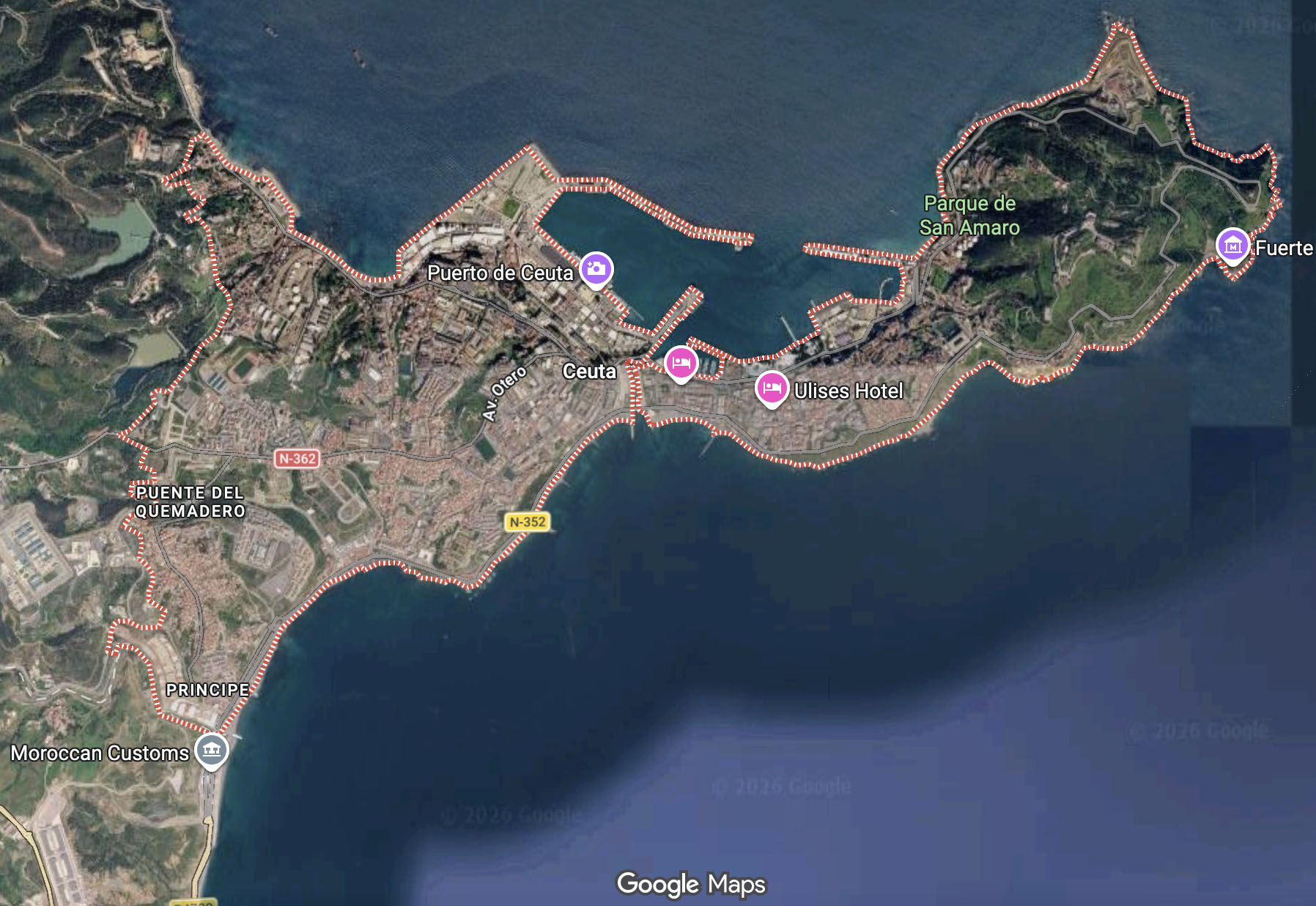
Consequently, Ceuta’s beaches (the exclave sits on the south side of the Mediterranean, across from the Straits of Gibraltar) were fair game for migrants seeking to enter Spain, and the entry point they chose to use.
Why Now, and Why All at Once?
That nonetheless begs the question of why 69,500 migrants opted to pour into a city of about 83,000 residents, over a one-day period, last Thursday.
Initial reports indicated that they arrived after being told the border with Ceuta was now open, which is not a far stretch from what the Spanish Supreme Court had held in early July, but not quite the truth either.
Some blamed the Moroccan government, with suggestions that officials there wanted to ramp up diplomatic pressure on Spain, given Madrid’s recent outreach to neighboring Algeria, Rabat’s regional foe.
As the Wall Street Journal reported on August 1:
The mass crossing came just 10 days after Spanish Prime Minister Pedro Sánchez visited Algeria, in a visit aimed at improving relations between the two countries after Spain in 2022 ended decades of neutrality and effectively backed Morocco’s plans for resolving [Western Sahara’s] status.
Moussa Bourekba, a research fellow at the Barcelona Centre for International Affairs, said the visit to Algeria likely angered Morocco. The neighboring countries have long competed for influence across the Maghreb, the North African region encompassing Morocco, Algeria, Tunisia, Libya and Mauritania.
“If, as a country, you establish a favorable relationship with Morocco, you will almost automatically provoke Algeria’s discontent, and vice versa,” he said.
Juan Ángel Soto Gómez made similar points in a series of tweets he published on July 30, tying the Ceuta surge to the larger issue of “weaponized migration” that began with the Mariel boat crisis in 1980, when tens of thousands of dissidents and criminals were shipped out by Cuban “President” Fidel Castro and sent to south Florida, to the last Ceuta surge in 2021, when 10,000 came:
Ceuta has been breached. Around 20,000 people in a matter of hours. The city president has declared an absolute humanitarian and social emergency. Madrid is sending the army. Nine dead.
I wrote about precisely this mechanism last month for @hu_conservative print edition. 🧵 pic.twitter.com/ESat9p2Na4— Juan Ángel Soto Gómez (@JuanASotoG) July 30, 2026
Zineb Riboua, a research fellow with the Hudson Institute’s Center for Peace and Security in the Middle East, offered a different take in her analysis, “What Really Happened in Ceuta”, in the Free Press on August 2, however.
Noting that “Morocco is a semi-constitutional monarchy led by a king, who governs alongside an elected parliament where Islamist, secular, and nationalist parties compete for political influence”, Riboua argues that the Ceuta surge “appears to be a product primarily of online coordination via Facebook groups”, not an organized effort by the Moroccan government, per se.
“In fact,” she explains, “Moroccan security forces reportedly tried to push back the migrants, while the government suspended train services to help stem the flow,” which should “come as no surprise” given Morocco has nothing to gain from an insecure border (it has its own immigration issues) and plenty on the line vis-à-vis cooperation from Spain.
Simply put, she contends, “Morocco’s economic future depends on deeper integration with Europe, not confrontation with its closest European neighbor.”
“But, of course,” Riboua continues:
Islamist voices are now accusing the Moroccan government of orchestrating the entire episode. This narrative has been fueled by the migrants themselves, who said in interviews that police waved them through. Meanwhile, commentators and officials in Spain have amplified the claim by saying that the Moroccan government may be acting at the behest of Israel to disrupt Spain. The timing is not a coincidence: Morocco’s general elections are set for September 23, and border chaos, magnified on social media, can destabilize incumbents. In fact, the Moroccan Ministry of the Interior has officially confirmed the existence of an online campaign encouraging people to attempt to reach Ceuta.
Even in the Maghreb, it appears, all politics is local — assuming Riboua is correct.
Getting While the Getting Is Good
In the final analysis, the very fact that nearly 70,000 migrants landed illegally in a single day on the beaches of Ceuta will likely be the key takeaway from the incident.
European leaders who had hoped to tamp down voters’ concerns about illegal migration now have fresh images to deal with, a headache best summarized by a breathless August 3 CNN World headline, “The fallout from the Ceuta border rush shows extreme, populist views are now mainstream”.
Logically, if a view is both “populist” and “mainstream”, it cannot be “extreme”, but in this case the views in question have to do with the rights of individual nations to both have borders and defend them, which in certain quarters is likely extreme regardless of how popular a contention it is.
In that vein, President Trump offered his own take on the Ceuta surge during a press conference at Camp David on Friday:
You know, I saw Spain yesterday, and I watched the catastrophe that took place. It looks like an invasion of a country by hundreds of thousands of people. And that same thing is going to happen to us if the Republicans don't get elected. ... Except worse, much bigger, much easier to get into. ... But we have the safest border in the world. If we're not in office, our country will be invaded at levels that made Spain look small time.
More will come out about why 69,000 migrants descended on Ceuta last Thursday: the social media planning; various governments’ involvement (or lack thereof); the role smugglers played; and the political backlash. At base, those migrants plainly came because they decided to “get while the getting was good” — only to discover too late the rewards weren’t worth the risks.