
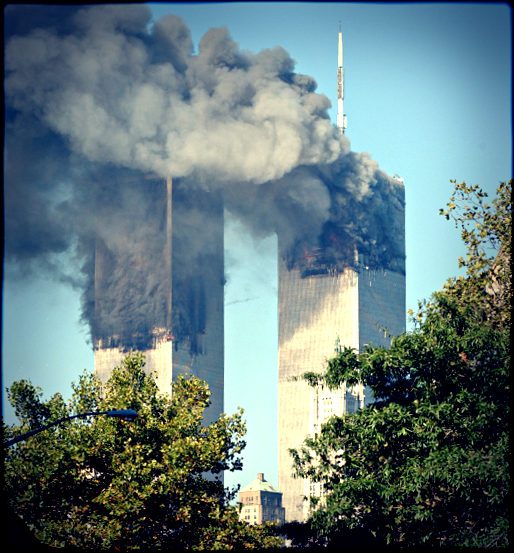
From “Black Monday” to Pearl Harbor and the Cuban Missile Crisis, there have been many brutal days in American history, but I had the good fortune to have been born after most of them. History caught up with me and others in my generation on September 11, 2001 — a day elected officials and others vowed to “never forget”, and yet a date that got memory-holed for the better part of the last administration. That left the current, second Trump administration playing catch-up in its efforts to ensure the terror attacks of that day are never again repeated in any of our lifetimes.
The Clear-Blue Tuesday
Ask anyone near New York, Pennsylvania, or Washington, D.C., that Tuesday morning, and they will usually remember the same thing: It started out as a beautiful day, with clear skies, low humidity, and temperatures in the 60s.
It all changed quickly between 8:46 AM EDT — when American Airlines Flight 11 crashed into the North Tower of the World Trade Center and 10:02 AM, when United Flight 93 plummeted into an empty field in Shanksville, Pa. In less than two hours, 2,977 innocents were dead and the United States — and the Free World — was at war against an unknown enemy.
I was in my House Judiciary Committee office at the Rayburn House Office Building that day, in a position I’d taken just six weeks before, as the oversight counsel for immigration.
I took that job in late July 2001 after leaving the National Security Law Division at the then-Immigration and Naturalization Service’s (INS’s) General Counsel’s Office, the legal section of the nation’s then-sole immigration agency responsible for deporting spies, persecutors — and terrorists.
No one in their right mind leaves the security of a career position in the general counsel’s office of a major agency for the uncertain prospects (and poor pay) of a congressional committee assignment without their reasons, and I had mine: I could see that some terrorist attack was on the horizon and thought I could do more to prevent it in a place with (curiously) much less bureaucracy.
Not that I was alone. Chapter 8 of the 9/11 Commission Report is titled “The System Was Blinking Red”, and it begins: “As 2001 began, counterterrorism officials were receiving frequent but fragmentary reports about threats. Indeed, there appeared to be possible threats almost everywhere the United States had interests — including at home.”
Hindsight is 20/20, of course, but once the congressional office buildings were evacuated and I stood amidst the chaos of the Capitol complex (with police officers in open vehicles calmly screaming, “Run, run, a plane is on its way!”), everybody realized what I already suspected; the only question was who planned it and who carried it out.
Who Planned It, and Who Carried It Out
The government quickly resolved the answers to those questions: 19 alien terrorists, acting at the direction of Saudi national Osama bin Laden, the leader of al Qaeda (“the base”) and following a plan concocted by his loyal lieutenant, Kuwaiti-born and U.S.-educated Khalid Sheikh Mohammed, hijacked and crashed the four planes involved in those attacks by weaponizing our immigration system against itself.
As my colleague Steven Camarota detailed in his landmark report, “The Open Door: How Militant Islamic Terrorists Entered the United States, 1993-2001”, all 19 hijackers tread paths blazed by prior terrorists.
Sixteen came on B-2 tourist visas, two arrived on B-1 business visas, and one (Saudi national Hani Hanjour, hijacker-pilot of American Airlines Flight 77, which crashed into the Pentagon) was admitted on a student visa to study at a language school he never attended.
Two of the 16, Marwan al-Shehhi (a national of the United Arab Emirates) and Egyptian national Mohamed Atta, piloted the two hijacked planes that were crashed into the Twin Towers after INS approved their provisional student visas to attend a U.S. flight school. Hanjour had already gone to flight school in the United States during a prior visit, while Lebanese national Ziah Jarrah — who was at the controls of Flight 93 — also did flight training in the United States.
The Response
As soon as the government figured out how the 19 hijackers entered and remained in the United States, Congress set about plugging the gaps they exploited in our immigration system.
The Homeland Security Act of 2002 (HSA) abolished the INS, separated its immigration adjudications and enforcement duties into separate agencies (resulting in the establishment of USCIS, ICE, and CBP), and placed those new components in the newly established Department of Homeland Security.
The Intelligence Reform and Terrorism Prevention Act of 2004 (IRTPA) increased ICE and Border Patrol staffing, expanded alien detention, required in-person interviews for all visa applicants aged 14 to 79, provided document-authentication technology, and required the State Department and DHS to use it at all U.S. consulates and ports of entry, and enhanced alien-smuggling penalties.
The REAL ID Act of 2005 reformed asylum, expanded the definition of “terrorist activity”, stripped federal courts of jurisdiction over some immigration claims, gave the DHS secretary the authority to waive legal requirements to install border infrastructure, and — most notably — tightened standards for the issuance of U.S. drivers’ licenses and ID cards, which the 19 hijackers had used to board their flights.
And the Secure Fence Act of 2006 mandated the construction of roads, sensors, and fencing along the border and required the DHS secretary to attain “operational control” over “over the entire international land and maritime borders of the United States” — that is, to prevent all illegal entries into this country.
The Biden Administration
The George W. Bush, Obama, and Trump I administrations generally attempted to implement most of the mandates and requirements in HSA, IRPTA, and Secure Fence by tightening consular visa issuance processes, building approximately 750 miles of border fencing, expanding staffing of the immigration-enforcement components, and implementing policies focused on deterring aliens from entering illegally.
And then, on January 20, 2021, Joe Biden took office and things quickly changed.
On his first day, Biden “paused” infrastructure construction projects at the Southwest border Congress had already funded, and thereafter DHS only built new roads, installed new sensors, and erected new fencing sporadically (and reluctantly).
The Biden administration also forced ICE officers to operate under onerous and senseless “priorities” that were implemented first on Inauguration Day by then-acting DHS Secretary David Pekoske (who, in addition, tried to also bar nearly all deportations during Biden’s first 100 days) and then by Pekoske’s permanent replacement, Secretary Alejandro Mayorkas.
Then, in late 2021, the Biden administration evacuated some 80,000 largely unknown and unvetted nationals of Afghanistan — erstwhile home to al-Qaeda and the sanctuary for bin Laden and Mohammed as they planned the September 11th attacks — to the United States following our military’s disastrous withdrawal from Kabul.
Moreover, any policy of deterring of illegal migration was also abandoned by Mayorkas in favor of providing what he termed “safe, orderly, and legal pathways” for aliens “to be able to access our legal system” — that is, to apply for asylum after they were released from custody, regardless of whether they were seeking humanitarian protections or even claimed fear of persecution or torture.
Finally, and consistent with the dictum that “hypocrisy is the tribute that vice pays to virtue”, Mayorkas serially claimed he had “operational control” of the border as required under the Secure Fence Act when CBP’s encounter and release statistics plainly showed otherwise.
Trump’s Return
Those claims and what congressional prosecutors termed the secretary’s “repeated[] violat[ion of] laws enacted by Congress regarding immigration and border security” led the GOP-controlled House to impeach Mayorkas in February 2024, charges that were ultimately dispensed with without a trial in the Democrat-controlled Senate two months later.
Biden and Mayorkas’s irresponsible stewardship of immigration and the border did have more lasting impacts, however.
First, in January 2025 Congress passed the Laken Riley Act, to plug the loopholes the duo had exploited to usher some six million aliens with no proper documents and no right to enter the country into the United States.
Second, and as importantly, American voters concerned about the fiscal and national-security impacts of mass illegal migration voted to return Donald Trump to the White House after a four-year hiatus.
Trump restarted the Biden-impeded border infrastructure projects almost immediately upon his return, and since January 2025, DHS has added more than 200 miles of Southwest border barriers, as well as new roads, lighting, cameras, and sensors along the boundary.
Together with his CBP Commissioner, Rodney Scott, Trump also implemented policies that have slowed illegal entries to a crawl, while reversing Biden-era “catch-and-release” policies for illegal migrants and detaining inadmissible “applicants for admission” in accordance with Congress’s mandates.
Further, Trump and his “Border Czar”, Tom Homan, quickly reversed the Mayorkas enforcement restrictions that had been placed on ICE, resulting in a new monthly record for alien arrests (nearly 51,000) in August.
Of course, those arrests followed tens of thousands of Border Patrol releases of illegal migrants every month under Biden between March 2021 (26,000-plus) through June 2024 (27,810), with a record in December 2023 (nearly 192,000), so Homan and ICE still have a lot of work left to do.
Trump and Secretary of State Marco Rubio have also tightened visa-issuance processes abroad, and froze visa issuances in 75 countries — including “countries of concern” like Syria, Iran, Afghanistan, and Libya — before a federal judge lifted those restrictions in late August (the administration has reportedly instituted a short-term global “pause” on all visa adjudications to train consular officers on issuance processes in its stead).
Moreover, in place of open-ended “duration of status” admissions that foreign students (like Hanjour) and exchange visitors traditionally received when they entered the United States, Trump II will now limit such periods of lawful stays to four years, beginning on September 15.
Finally, on May 7, 2025 — two decades to the day after the passage of REAL ID — Trump’s Transportation Security Administration began requiring anyone seeking to board a domestic flight or enter a federal facility to provide a driver’s license or identification card that complied with that law.
Like It or Not
Whether alien advocates and many in the media like it or not, the immigration policies of Trump II are much more faithful to the letter and spirit of the laws Congress passed in response to the terror attacks of September 11, 2001, than the Biden administration’s ever were. That’s a good thing, because we’ve all suffered enough that day for 2,977 (innocent) lifetimes.