
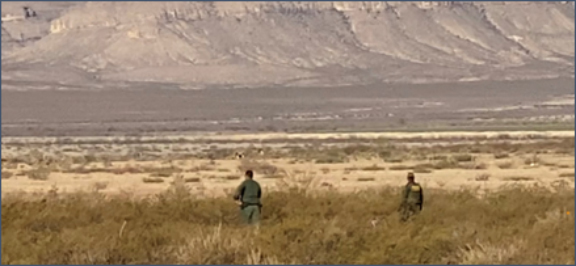
Border Patrol agents searching for an immigrant group face typically daunting odds in Big Bend Sector. Photo by Todd Bensman.
Congress has made clear it wants DHS to do whatever it takes to stop the flow of illegal migrants and drugs along the Southwest border, but as I reported on October 13, Judge Kathleen Cardone of the U.S. District Court for the Western District of Texas (W.D. Texas) granted a preliminary injunction blocking the department from building barriers “or related infrastructure” and engaging “in any construction or ground disturbing activities” in Border Patrol’s Big Bend, Texas, sector “until and unless” the department complies “with all applicable laws”. On October 21, DOJ asked the Supreme Court to stay and reverse her order, and ideally the justices will rule quickly — drugs are pouring in there, and the court-ordered suspension is costing taxpayers an estimated $460,000 per day.
Big Bend Sector
The U.S. Border Patrol operates across 20 separate sectors in the continental United States and Puerto Rico, and nine have jurisdiction over the 1,954-mile Southwest border with Mexico.
Of those nine, Texas’s Big Bend sector — between the Lone Star State’s Del Rio and El Paso sectors — is responsible for the longest stretch, “517 miles of river front along the Rio Grande River” or more than one-quarter of the U.S.-Mexico line.
It’s also, as I noted in that earlier piece, “among the most desolate of sectors, with a few small towns” and “the remote and border-adjacent Big Bend National Park (BBNP)”, as well as Texas’s Big Bend Ranch State Park (BBRSP).
CBP’s “Smart Wall” webpage includes a map of the various infrastructure the agency has installed — and plans to install — along the Southwest border, broken down into places where there is a “Bollard Barrier System”, a “Vehicle Barrier System”, and a “Technology & Patrol Road (No Wall)”, among others.
Click on Big Bend sector and you will see that the big red line denoting the Bollard Barrier System that runs southeast of El Paso County stops at the BBRSP (west of the BBNP) and doesn’t pick up heading east again until it starts at the town of Del Rio, more than 100 miles away.
There are no barriers planned along the border in the BBRSP, and only short, sporadic portions of Vehicle Barrier System slated along the river in the BBNP. The rest, extending northeast from the national park as the river heads toward Del Rio, is “Technology & Patrol Road”, with no “wall” at all.
CBP is plainly touchy about its plans for that section of the Big Bend sector, explicitly noting on the Smart Wall website that it:
is not planning to construct 30-foot-high, steel bollard barrier in Big Bend National Park, Big Bend Ranch State Park, or the Black Gap Wildlife Management Area. Instead, CBP will use technology like cameras and sensors. In limited areas, it will use low-profile, vehicle barriers. Placed strategically, these will work with natural barriers to further restrict illegal vehicle access in these areas.
“Additionally,” CBP notes that it and the National Park Service “have been identifying cultural, historical, and biological resources in the park that have the potential to be affected by the planned project” and “are working together to find ways to avoid or minimize impacts to these resources.”
Friends of the Ruidosa Church v. Mullin
The plaintiffs in this case, Friends of the Ruidosa Church v. Mullin, either aren’t buying it or aren’t satisfied with the efforts CBP is making to preserve the area — depending on how you read the amended complaint they filed in the W.D. Texas on June 11.
They complain that what they describe as DHS’s “substantial Project” there “will result in numerous adverse impacts on cultural, recreational, wildlife, and environmental resources”, and want work stopped “until and unless” the department complies with the National Environmental Policy Act (NEPA) “and all other laws that would” normally apply to such an undertaking.
Congress’s Grants of Waiver Authority for DHS Border Construction
At first blush, that may sound reasonable. Federal and state statutes normally bar actions that would “result in adverse impacts on cultural, recreational, wildlife, and environmental resources”, at least “until and unless” the requirements therein have been satisfied.
The problem facing the plaintiffs is that starting with the Illegal Immigration Reform and Immigrant Responsibility Act of 1996 (IIRIRA), Congress has given the attorney general (AG), and now his successor in border enforcement, the secretary of Homeland Security, sweeping authority to waive those federal and state statutes to construct infrastructure at the nation’s borders.
Section 102(a) of IIRIRA directed the AG and the then-Immigration and Naturalization Service (INS) to “take such actions as may be necessary to install additional physical barriers and roads in the vicinity of the United States border to deter illegal crossings in areas of high illegal entry into the United States”, while section 102(b) required INS to complete specified projects in particular areas.
In addition, section 102(c) of that act waived NEPA and the Endangered Species Act (ESA) “to the extent” the AG “determines necessary to ensure expeditious construction of the barriers and roads under this section”.
More than eight years later, after INS was abolished and the newly created DHS was assigned its immigration-enforcement responsibilities, Congress realized that only allowing the DHS secretary to waive NEPA and ESA was insufficient to guarantee border construction could proceed freely without outside interference and expanded that IIRIRA waiver authority in the REAL ID Act of 2005.
Section 102 of REAL ID amended IIRIRA to grant the secretary “authority to waive all legal requirements” he, in his “sole discretion, determines necessary to ensure expeditious construction of the barriers and roads” required under that prior provision, “[n]otwithstanding any other provision of law” (emphasis added).
In addition — and critical to this case — REAL ID amended section 102(c) of IIRIRA to provide that: (1) only federal courts could hear challenges to DHS IIRIRA waivers; (2) only constitutional — not statutory — challenges could be brought; and (3) any “judgment, decree, or order of the district court may be reviewed only upon petition for a writ of certiorari to the Supreme Court of the United States”, cutting off an additional layer of circuit court review to save time.
Congress continued this border barrier theme in section 2 of the Secure Fence Act of 2006 (SFA).
SFA directed DHS to “take all actions the Secretary determines necessary and appropriate to achieve and maintain operational control over the entire international land and maritime borders of the United States”, defined therein as “the prevention of all unlawful entries into the United States, including entries by terrorists, other unlawful aliens, instruments of terrorism, narcotics, and other contraband”.
Included in the “actions” available to the secretary to comply with that mandate was authority to erect “physical infrastructure enhancements to prevent unlawful entry by aliens into the United States ... such as additional checkpoints, all weather access roads, and vehicle barriers”.
Judge Cardone’s Preliminary Injunction and Memorandum
After all that, one could reasonably presume most challenges to IIRIRA secretarial waivers premised on “cultural, recreational, wildlife, and environmental” concerns wouldn’t stand a chance of making it out of district court.
Judge Cardone saw it differently, however. Let me explain.
Prior to CBP commencing work in the areas at issue in Friends of Ruidosa Church, the “DHS secretary” issued two determinations — one on February 17 and the other on May 15 — that portions of Big Bend sector were “area[s] of high illegal entry” and that therefore there was “an acute and immediate need to construct additional physical barriers and roads” in those areas.
“DHS secretary” is in quotation marks because the first determination was made by then-DHS Secretary Kristi Noem and the second by her successor, Markwayne Mullin, and in each instance they waived “certain laws, regulations, and other legal requirements in order to ensure the expeditious construction of barriers and roads” in the specified areas, including NEPA and the ESA.
Among other claims, the plaintiffs alleged that those waivers were improper because:
Congress directed border construction only “in areas of high illegal entry,” and the Big Bend Sector cannot be described as such. Spanning over a quarter of the entire U.S.-Mexico border, in fiscal year 2025 the Big Bend Sector accounted for just 1.3% of total apprehensions at the border. This makes the Big Bend Sector the lowest area of illegal entry across the entire southern border.
After briefing was completed, Judge Cardone on October 2 granted a preliminary injunction that included the restrictions on DHS’s border infrastructure projects in the Big Bend section I referenced at the outset.
Her order explained:
The Court finds that Plaintiffs are likely to succeed on the merits of at least one of the claims in suit, that there is a likelihood that they will suffer serious, irreparable harm without an injunction, and that the balance of the equities and the public interest weigh in their favor. [Emphasis added.]
The problem is she didn’t identify which one of the five “claims in suit” that plaintiffs had brought opposing the secretary’s waivers justified her order, and wouldn’t until 12 days later, when she issued her Memorandum Opinion in the case to clarify her conclusion.
Major Questions Doctrine
In that opinion, Judge Cardone concluded she had “jurisdiction to consider Plaintiffs’ major questions doctrine claim because it alleges a Constitutional violation”, and held that she had enjoined further construction in the affected areas in Big Bend sector because the plaintiffs had shown they were likely to succeed on their claim that the secretary’s waivers violated that doctrine.
In essence, the W.D. Texas agreed with the plaintiffs that DHS had failed to show that Big Bend sector was an “area of high illegal entry into the United States” as defined in section 102(a) of IIRIRA, and therefore the secretary lacked the authority to issue waivers under section 102(c)(1) of that act.
As noted, however, section 102(c)(2) of IIRIRA, as amended by the REAL ID Act, limits federal court review of such waivers, and in particular states that, “A cause of action or claim” challenging such a waiver “may only be brought alleging a violation of the Constitution of the United States”.
Consequently, the validity of Judge Cardone’s opinion rests first on whether the “major questions doctrine” is a constitutional challenge, and then only if it is found to be a constitutional challenge on whether the secretary properly concluded that Big Bend sector was an “area of high illegal entry”.
Or, as DOJ framed it in its October 21 application for a stay with the Supreme Court:
On the merits, the sole basis for this injunction was the district court’s belief that the Secretary lacked “clear congressional authorization,” supposedly required by the major-questions doctrine, to issue the waivers. In the court’s view, the waivers exceeded the Secretary’s authority under IIRIRA to construct barriers and issue waivers for areas of “high illegal entry,” because the number of illegal-alien apprehensions in Big Bend is comparatively lower than in other sectors of the border.
That is exactly the kind of claim that Congress denied district courts jurisdiction to entertain. [Citations omitted.]
The Legal Information Institute describes the major questions doctrine as “a structural principle of administrative law that restricts federal agencies from interpreting statutes and asserting broad policymaking powers of great economic or political significance without a clear congressional mandate” (emphasis added).
But as DOJ argued, “claims that an agency exceeded its statutory authority are not constitutional claims” (emphasis added).
Then, there is the factual question of whether the affected areas in Big Bend sector could properly be considered “areas of high illegal entry”, such that a waiver would be appropriate.
On that point, DOJ contended that:
between fiscal years 2021 and 2025, CBP apprehended over 89,000 aliens attempting to enter [in Big Bend sector] — and those are just the aliens who were detected. CBP seized enormous amounts of fentanyl, heroin, methamphetamine, cocaine, and marijuana — and seizures have only grown in fiscal year 2026. The Sinaloa and Juarez cartels operate south of this sector across the Mexico border and seek to exploit any vulnerabilities in United States border protection to traffic humans, drugs, and weapons across the border and infiltrate the United States. Moreover, leaving a 300-plus-mile gap in border defenses would act as a dangerous magnet for cartels and other bad actors to exploit as other routes close off.
More precisely, DOJ explained that Border Patrol “seized over 87,574 pounds of marijuana, over 867 pounds of cocaine, over 1,156 pounds of methamphetamine, over 12 pounds of heroin, and over 94 pounds of fentanyl” in Big Bend sector during that four-year period.
“Even the lowest rates of entry along the southern border,” DOJ contended, “are extraordinarily ‘high’ in both an absolute and an historical sense, given the massive scale of illegal entries in recent years”.
The Urgency
Worse, as per DOJ, “the quantity of illegal drugs seized in the Big Bend Sector in fiscal year 2026 surpassed the annual totals for each of the previous three fiscal years”, which isn’t a surprise given the cartel activity on the other side of the Rio Grande and the extent to which CBP has tightened the border elsewhere.
Those facts, coupled with CBP estimates that the “suspension costs” due to Judge Cardone’s injunction “will total over $460,000 per day” according to DOJ, militate in favor of the justices ruling on the department’s request for a stay as quickly as possible.
And the Justice Department is hoping that the ultimate ruling from the Court is to treat its application as a petition for a writ of certiorari — not just to stay the W.D. Texas’s injunction pending further action below — and to grant that petition and summarily reverse Judge Cardone.
“Summarily reversing the district court’s order in this case”, DOJ explained, “will prevent other courts from repeating its errors and entertaining statutory challenges to Section 102(c) waivers that they lack jurisdiction to consider”.
Clear Signal
Congress has already sent a clear signal that it wants DHS to attain operational control of the Southwest border and prevent all illegal entries of drugs and migrants — and it expects the secretary to do what it takes to get that done. Respectfully, if Congress wanted judges to decide what is and isn’t an “area of high illegal entry”, it wouldn’t have limited judicial review.