
Advocates on the libertarian and pro-business right often claim that cultural change caused by immigration is temporary. They insist that today’s immigrants will eventually melt into the broader cultural mainstream, becoming just as American as people whose families have been here for generations. There are many reasons to be skeptical of that claim, but perhaps the most obvious one is the experience of Miami, Fla.
Writing about Miami back in 2004, the political scientist Samuel Huntington noted that over a period of only about 30 years, “Spanish speakers, overwhelmingly Cuban, established their dominance in virtually every aspect of the city’s life and fundamentally changed its ethnic composition, its culture, its politics, and its language.” Miami became “the capital of Latin America”, a magnet for Spanish-speaking immigrants throughout the Western hemisphere. According to Huntington, “they brought into existence an enclave city [not just neighborhood] with its own cultural community and economy, in which assimilation and Americanization were unnecessary and in some measure undesired” (emphasis added).
Miami surely did not appear to be on the path of assimilation at the time Huntington was writing. Has much changed since then? My interest in this question was renewed by the recent World Baseball Classic, in which Venezuela defeated the United States in the championship game. It was a close contest, but Team Venezuela had the benefit of home-field advantage. Encouraged by the Venezuelan players, the boisterous crowd chanted “¡ponche!” (Spanish for strike-out) when the American hitters were on the verge of striking out. After the game, a wild celebration ensued in the stadium and on the streets.
The game was not played in Caracas, however. It was played in Miami. The Americans, competing in an ostensibly American city, were clearly the visitors. If assimilation is actually proceeding apace, then at what point will crowds in Miami start rooting for the American team again?
The fans’ use of Spanish chants is unsurprising. Huntington observed that a shared language is one of the strongest ethno-cultural unifiers. For most residents of Miami at the time he was writing, that unifying language was Spanish. Now, over two decades later in Miami, Spanish is even more dominant.
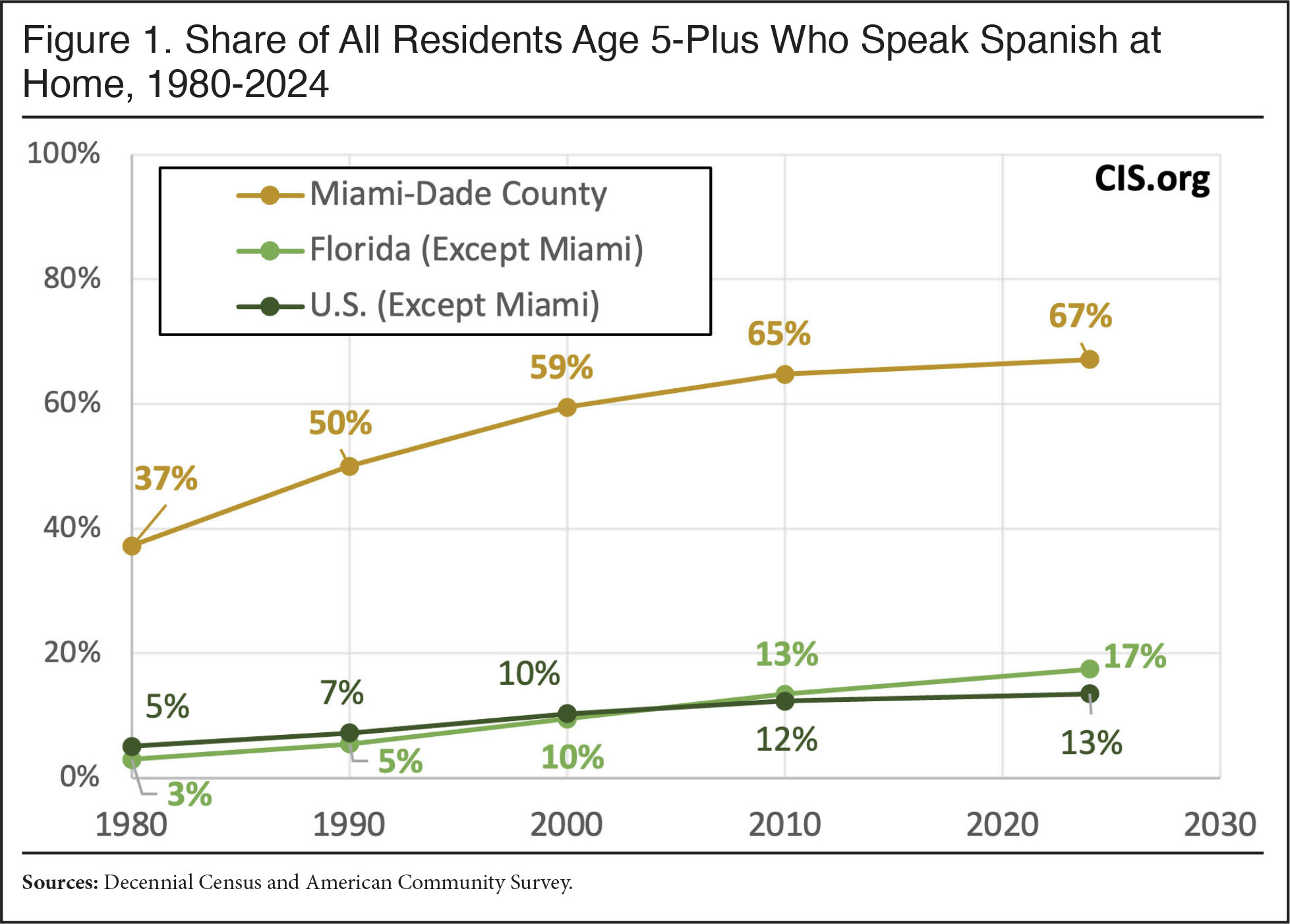
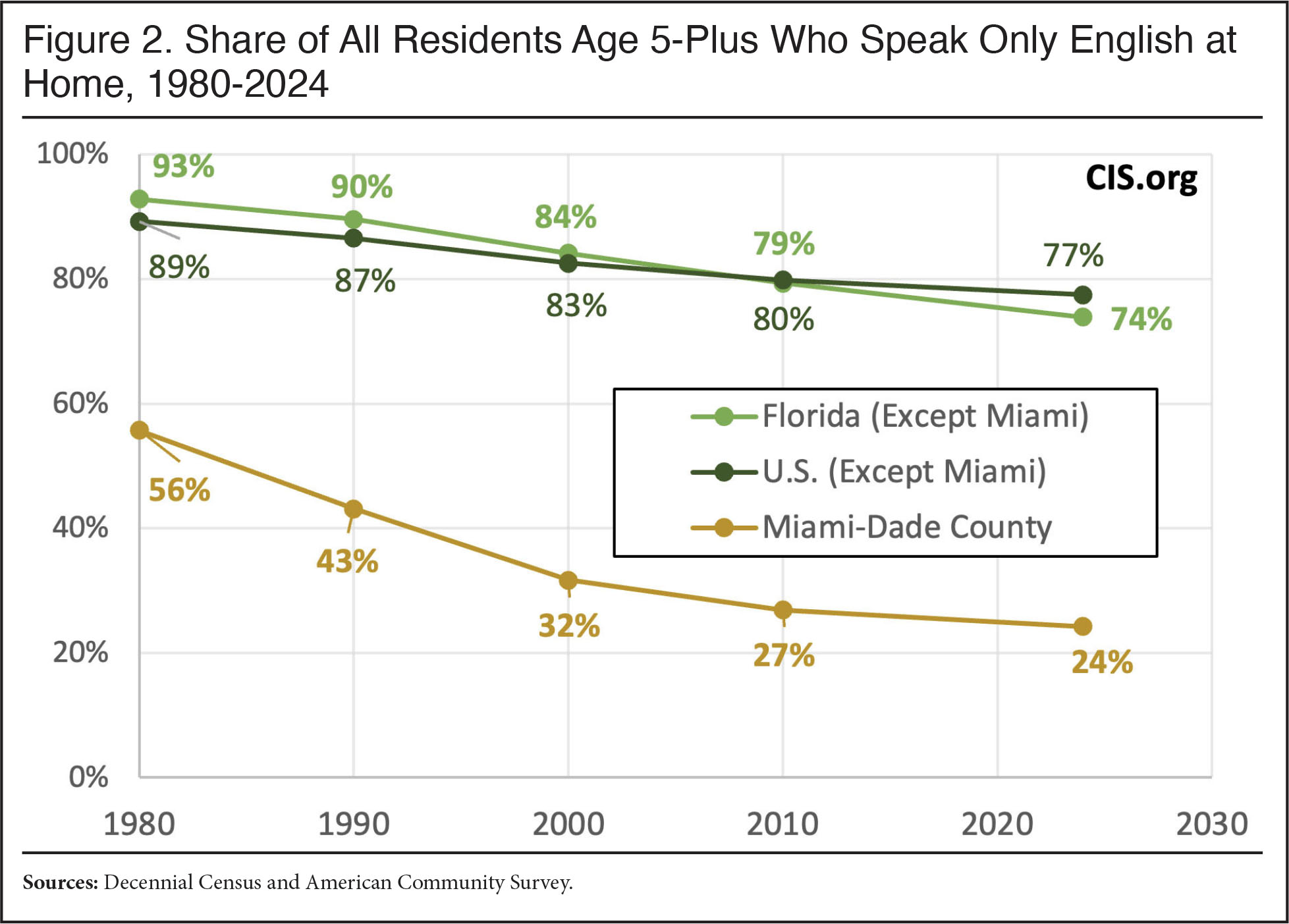
Figure 1 shows that the share of Miami-Dade County residents who spoke Spanish at home rose from 37 percent to 59 percent between 1980 and 2000. Rather than start to decline, as the assimilation model might predict, it continued rising all the way to 67 percent by 2024. At the same time, Miami-Dade residents who speak only English at home declined to 24 percent in 2024, according to Figure 2.
 |
 |
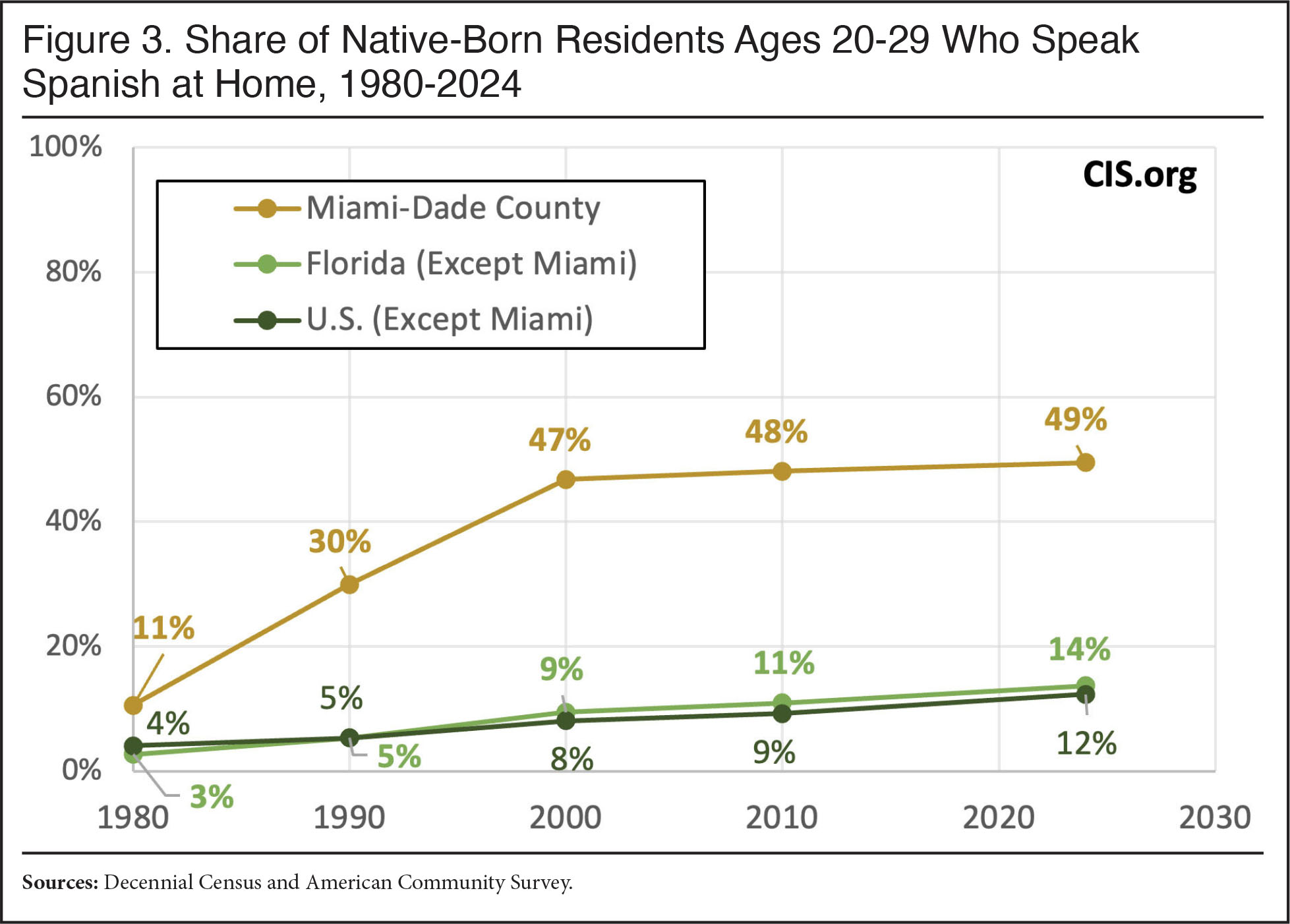
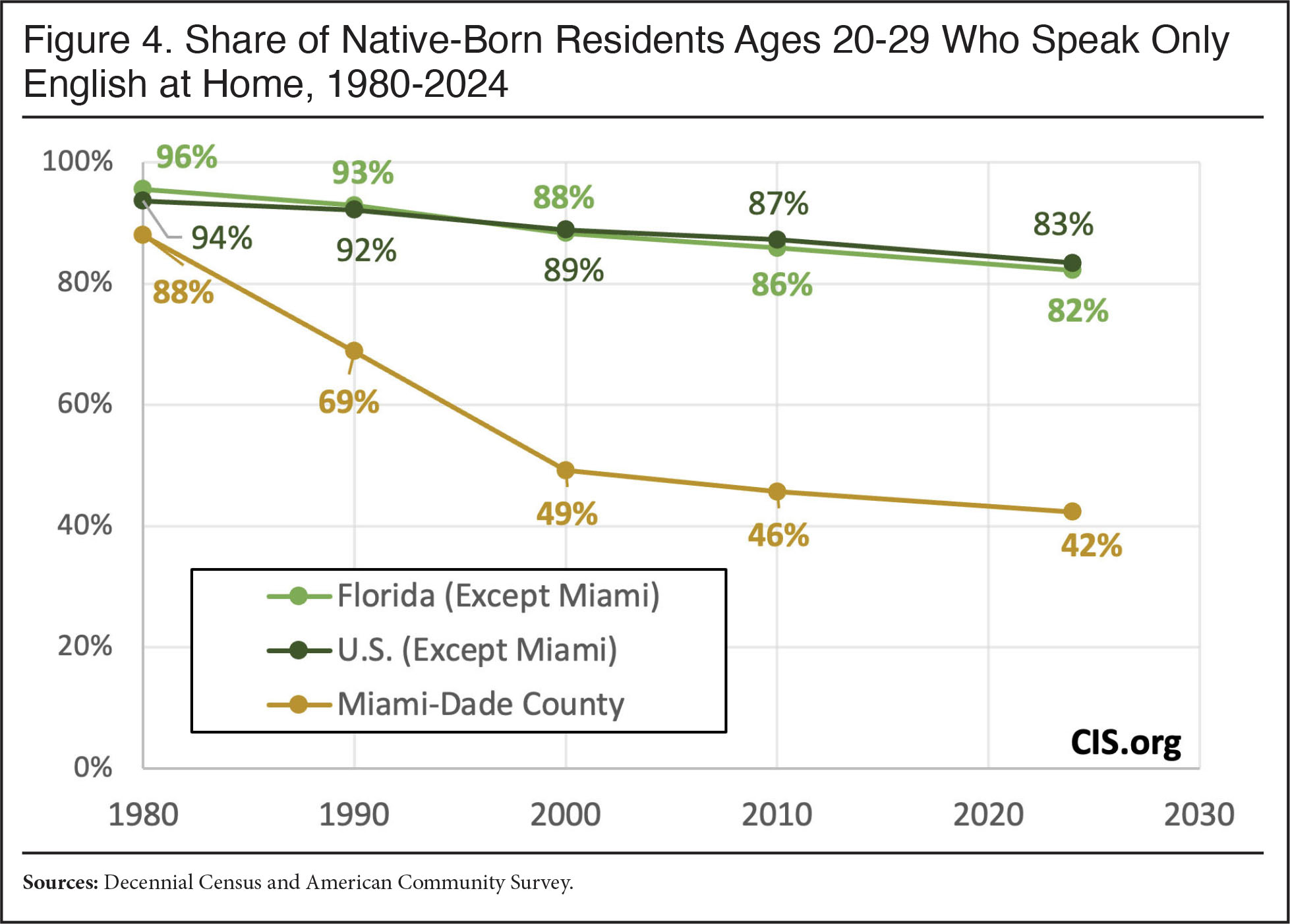
Perhaps the continuing rise of Spanish in Miami is due to new immigration disguising the assimilation of the second generation? To test that, Figures 3 and 4 limit the analysis to native-born residents ages 20-29. The percentages who speak Spanish at home are lower in Figure 3 than in Figure 1, but they still trend in the wrong direction for assimilation.
 |
 |
The best we can say is that the increase in the share of native-born 20-somethings who speak Spanish at home has slowed since its rapid 1980-2000 rise. Decline back to pre-immigration levels, which the assimilation model predicts, has apparently not even started. With 49 percent of this group speaking Spanish at home, it seems almost silly to predict that the share will fall again to, say, the 11 percent of 1980 anytime soon.
Furthermore, one reason that the Spanish increase has slowed is that other foreign languages are also taking root among native-born 20-somethings in Miami. Figure 4 shows that the share speaking only English at home has continued to fall since 2000, from 49 percent to 42 percent in 2024.
Huntington depicted Miami as a cautionary tale, warning that other parts of the U.S. could also be remade by mass immigration. All of the figures above show that the rest of Florida, and, indeed, the rest of the United States are also trending toward more Spanish at home and less English-only.
Immigration advocates may respond that concentrations of foreign languages in the United States are unobjectionable as long as the speakers also know English. It is true that almost all native-born Americans, even in Miami, say that they can speak English. (Some appear to exaggerate their literacy, however.) The trouble is that multilingualism can still cause cultural fragmentation. As I discussed in a 2017 article, Spanish speakers in the U.S. participate in a whole landscape of news, entertainment, and politics that is inaccessible and often not even known to non-Spanish speakers. That’s not a recipe for national cohesion, especially in an era when Americans are already sharply divided over cultural issues.
Researchers have found that multilingualism in a society is associated with “lower levels of social trust, fewer memberships in social organizations, and deteriorated social norms and structures”. Perhaps not coincidentally, mass immigration to Miami triggered a mass exodus of non-Hispanics from the city in the 1980s and 1990s. A 1993 newspaper article tells some revealing anecdotes:
The 1980 census found that Hispanics made up 35.7 percent of [Miami-]Dade County's 1,625,781 population. Signs started to appear in store windows that said: "We hablo Espanol."
"We thought it would be polite for us to learn a little Spanish, so we could talk to these poor refugees," said Chuck Gnaegy, a writer who lives next door to a Hispanic family in Coconut Grove. "Nobody knew."
Now, signs are beginning to appear in Miami stores that say: "We speak English."
You still see the old Miamians, trapped in crowded elevators and grocery lines, blank looks on their faces as rapid-fire Spanish whirls over their heads like tracer bullets. “I think that's what bothered me more than anything else," said Fritz Alders, who recently moved to Vero Beach after 52 years in Miami. “I felt squeezed, and I guess I resented it.”
…
Edward Killeen, who found paradise here in 1962, is leaving. It is not bias, not racism that drives him, he said. It is that he has become a foreigner here. A retired sea captain, he wants to believe he is welcome, wanted. "You ask yourself, ‘Who is the outsider here?'” he said. “And the answer is: I am.”
Methodological Note
The figures above are intended to reflect the language preferences of Miami-Dade County (formerly called Dade County) since 1980. However, identifying the county in public-use microdata can be challenging. Between 1980 and 2010, the Miami metropolitan statistical area (MSA) was coterminous with the county, and so I used MSA data from IPUMS for that time period. (IPUMS is able to identify the Miami MSA with an error rate of 1 percent or less in each data set I used.) By 2024, however, the Miami MSA had been expanded to include additional counties. To isolate Miami-Dade, I pieced together all 25 smaller areas known as PUMAs that make up the county. Because one of the 25 PUMAs overlaps with nearby Monroe county, I dropped it from the analysis. Including it makes no meaningful difference in the results.