
In a post last week, I discussed how immigration has fundamentally changed Miami. The mass migration of Cubans, followed by immigration from other Western hemisphere countries, transformed a small, unremarkable American city into a Spanish-speaking “capital of Latin America”. Today, two-thirds of Miami residents speak Spanish at home, including half of native-born residents in their 20s. Immigration advocates on the libertarian and pro-business right argue that assimilation is inevitable, but it has been anything but inevitable in Miami. The experience shows that cultural change caused by immigration is not necessarily temporary.
Here I expand on the original post, structuring the discussion around a few critical reactions on X.
Speaking whatever at home is fine - as long as people know how to speak English
— angrybirds_245 (@angrybirds_245) May 1, 2026
Several commenters argued that it’s fine for Spanish to be the dominant language in Miami because almost all of the city’s native-born residents say they also speak English. However, as I noted in the original piece, accessory English ability will not protect against cultural bifurcation. Spanish speakers participate in a whole media and political landscape that is inaccessible to non-Spanish speakers. I discussed some examples in a 2017 article for The American Conservative:
Signs of linguistic division in the U.S. are already evident, starting with the media. In the first week of the 2016 May “sweeps” period, the top 10 television shows for the nation as a whole were: NCIS, The Big Bang Theory, NCIS: New Orleans, Dancing with the Stars, The Good Wife, Blue Bloods, Madam Secretary, The Voice, Empire, and 60 Minutes. In Hispanic households, shows broadcast by Univision and Telemundo occupied every slot of the top 10: Nuestra Belleza, El Hotel de Los Secretos, Un Camino Hacia el Destino, El Señor de Los Cielos, Yago, Caso Cerrado, La Voz Kids, Sueño de Amor, Crónicas de Sábado, and Eva la Trailera.
Non-Hispanics in the U.S. are unlikely to have heard of any of those Univision and Telemundo shows, nor are they generally aware of other Spanish-language media that are massively popular among Hispanic Americans. Consider the example of Jenni Rivera. The singer born and raised in California was a superstar, having sold over 1 million albums in the U.S. alone. Yet when she died tragically in a plane crash, most Americans had never heard of her. The reason? She sang her songs in Spanish, so almost all of her fans were Hispanic. In admitting that his newspaper had never once mentioned Jenni Rivera’s name before her death, a writer for the Washington Post lamented that “it’s possible to live in parallel Americas, with the larger part only dimly aware of the enormous things happening in the other one.”
As for politics,
we often hear of “dog whistles” and “coded language” that politicians use to appeal to a particular interest group without alienating the general electorate. In the U.S. today, Spanish is the ultimate “code” for speaking to Hispanics about immigration and other issues on which non-Hispanics may have opposing views.
An egregious example occurred [in 2016], when Arizona Sen. John McCain put two very different immigration positions on his campaign website. The Spanish version of his site touted his work on behalf of “immigration reform that is humane and sensible to the needs of the immigrant community,” including his leadership on the Schumer-Rubio amnesty bill from 2013. The English text on McCain’s site, however, featured tough talk on border enforcement exclusively. No mention of amnesty. No mention of the “needs of the immigrant community.”
A related controversy arose during the Republican presidential primaries, when Ted Cruz implied that Marco Rubio spoke more favorably of amnesty on Spanish-language Univision than he did on English-language media. “First of all, I don’t know how he knows what I said on Univision because he doesn’t speak Spanish,” Rubio replied, unintentionally highlighting the problem with conducting a campaign in two languages.
Bilingual kids have a more developed brain, just saying.
— Iguana - MAGA - Pureblood (@eleph80) April 30, 2026
A related defense of Miami is that bilingualism makes people smarter. This view had some empirical support initially, but the effect has failed to replicate in large samples. Consider a revealing meta-analysis published in Psychological Bulletin. The authors compared effect sizes across 152 studies of bilingualism and found that the smallest sample sizes tended to produce the most positive cognitive effects. This is classic evidence of publication bias, whereby shaky studies are more likely to be published if they produce results that go in a favored direction. After correction for publication bias, the observed effects of bilingualism on cognitive function were basically zero.
Tragically, immigrants turned Miami into a thriving capital of international business, instead of a decaying nativist shithole pic.twitter.com/XmzYkUjUse
— L'homme à la Floridienne (@dekabri91046268) April 30, 2026
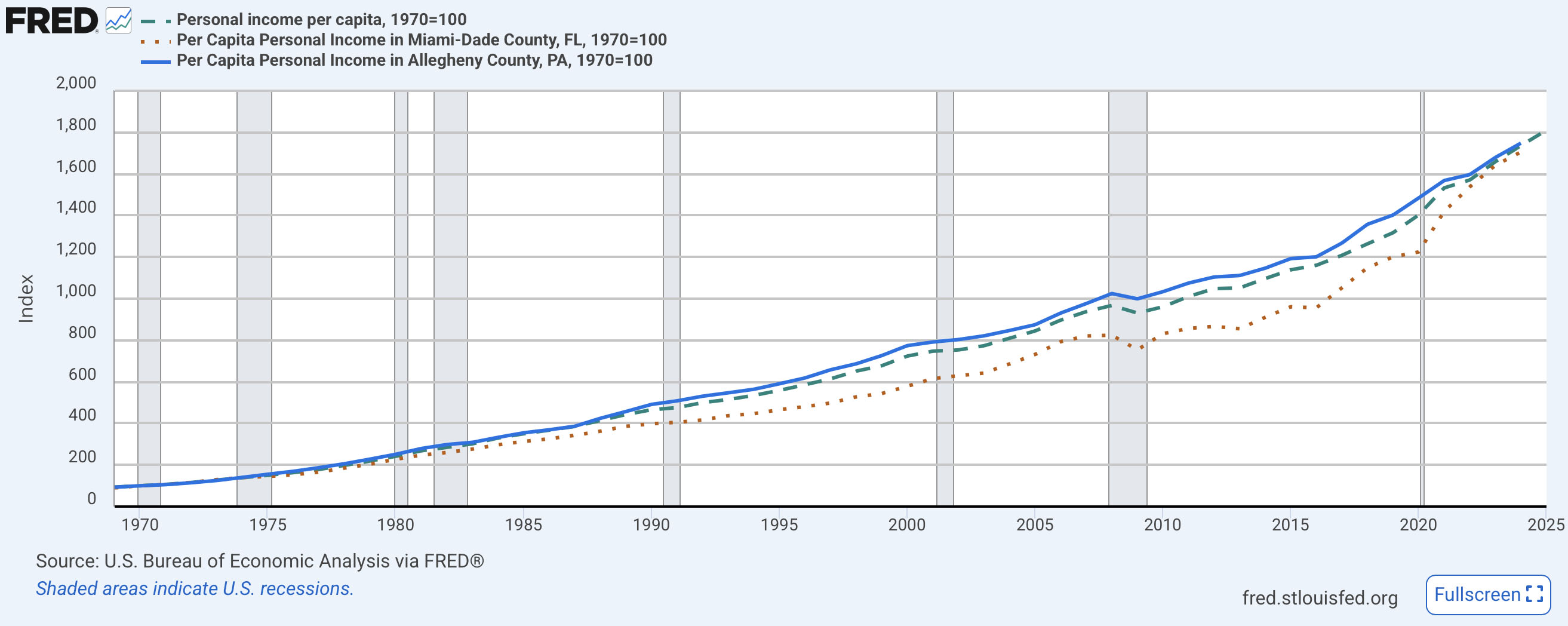
Immigration-driven population growth has undoubtedly enlarged Miami’s economy. However, it is important to distinguish between GDP, which is the total size of the economy, and per capita GDP, which is a measure of productivity. A larger population will always raise GDP simply because there are more people working, but the benefits accrue largely to those new workers rather than to natives. Raising living standards for natives generally requires raising their average income, but income growth since 1970 in Miami has been unexceptional compared to the U.S. as a whole. In fact, Miami-Dade County has generally trailed the low-immigration Allegheny County (Pittsburgh) area.
 |
Whatever positive economic impact that immigrants produced in Miami was clearly not enough to prevent an outmigration of native-born Americans from the city in the 1980s and 1990s. In my original piece, I discussed how cultural alienation was a major factor influencing the exodus. Another factor may have been wage competition. A burgeoning literature shows that immigrants can discourage natives from remaining in (or moving to) places with abrupt increases in the labor supply. For example, a 2021 study in the Journal of Human Capital revisited the famous “Mariel boatlift”, which brought a sudden influx of immigrants to Miami. Wages initially declined in Miami due to the increase in available workers, but the labor market soon returned to equilibrium, leading some analysts to conclude that any wage impact of immigration is short-lived. However, this study found that about half of the adaptation was due to low-skill workers moving away from (or declining to move to) Miami.
* * *
In short, it is difficult to dismiss the transformation of Miami as unproblematic. The persistent dominance of Latin American culture in the city falsifies the claim that assimilation always follows immigration. Knowledge of English among Spanish-dominant speakers does not produce smarter students or prevent cultural fragmentation. Finally, economic benefits flowing to natives because of the transformation appear to be minimal overall.