

On the last day of its term, the Supreme Court ruled in Trump v. Barbara that the 14th Amendment guarantees citizenship to U.S.-born children of illegal immigrants and temporary visitors, with very limited exceptions. Despite the ensuing debates over birthright citizenship, few commentators have profiled “Barbara” or noted that she was suing in part to secure welfare benefits for her child. Her case illustrates how illegal immigrants make extensive use of the welfare system. (Parolees like “Barbara” have some limited protections from deportation. However, because they still have no visa and are legally inadmissible, the convention is to categorize them as illegal immigrants, as I do in this article.)
Those curious about Barbara’s identity will find almost nothing informative in the 194 pages of opinion produced by the Supreme Court. Turning instead to the case documents from the lower court, we learn Barbara is the pseudonym of a Honduran national who, along with her husband and three children, entered the U.S. without a valid visa in 2024. Like millions of migrants during the Biden years, she and her family were “paroled” into the country pending an asylum application. Barbara became pregnant with her fourth child shortly after arriving.
Although she has no visa and could be deported when her parole expires, Barbara clearly intends to stay. “Our family has built a life here,” she attests. “We attend a local church. My children go to school here. We have a lot of family close by, like my father, cousin, and cousin’s family.” She says that failure to grant her future child citizenship would place her family “at risk of separation”.
As a representative of the class suing the Trump administration, Barbara says she wants her unborn child to receive all the benefits of citizenship. In a supplemental declaration, she is explicit about what some of those benefits are:
My child who is due in October will, if acknowledged to be a U.S. citizen, be eligible for Supplemental Nutrition Assistance Program (SNAP), Medicaid, and other benefits for which citizens are eligible. My husband and I do not have work authorization right now, so we live off of what little we have saved and family help. Given these financial constraints, the Executive Order threatens my child’s access to nutrition and healthcare services. Our family may be forced to make awful decisions, such as whether to forgo necessary medical care for our infant child, to divert money that is essential for food and shelter to cover our infant child’s medical expenses, or both. [Emphasis added.]
Although the district judge ultimately granted class-certification only to the children themselves, he acknowledged Barbara’s interest in collecting means-tested benefits. He later noted, “Doubtless the parents of such children would suffer harms following from the denial of United States citizenship to their children, including, but likely not limited to, those detailed in the complaint.”
There is an important lesson here. The oft-heard claim that “illegal immigrants cannot access welfare” is simply wrong. As Barbara’s case illustrates, illegal immigration is deeply interwoven with welfare benefits in several ways. First, given the dire economic circumstances Barbara describes, one can fairly ask why she became pregnant again. Although it’s possible this particular pregnancy was unintended, many illegal immigrants in her position could take taxpayer support into account when deciding on future childbearing.
Second, Barbara was suing to actually increase her access to welfare, not to become eligible for the first time. Even if her child did not become a citizen, she would have been entitled to emergency Medicaid for the birth, the WIC nutrition program for her and her child, and free school breakfast and lunch when the child is older. Birthright citizenship would allow Barbara to apply on behalf of her child for additional benefits — full Medicaid coverage for the child, food stamps (SNAP), housing subsidies, and possibly even cash assistance depending on state rules.
Third, welfare earmarked for a child clearly benefits the parent. Although immigration advocates often try to characterize the benefits received by the U.S.-born children of immigrants as only natives (and not immigrants) using welfare, the truth is that parents have a legal responsibility to provide for their children’s basic needs. When taxpayers step in as providers, that frees up money in the parents’ budget. Barbara was clear about this in her declaration when she warned that her family will have to “divert money” if they do not receive the expected level of welfare for their child. The fact that Barbara was willing to cite loss of projected welfare benefits as a reason she should be a class representative proves what most people already understand, which is that immigrant parents who seek welfare to support their children are themselves the recipients of welfare.
Comparisons of immigrant and native welfare use should reflect that reality by analyzing data at the level of the household — i.e., parents, children, and other residents counted together — rather than at the individual level. The analysis below helps quantify the difference.
Figure 1 comes directly from an earlier CIS report. It shows that 61 percent of households headed by an illegal immigrant use at least one welfare program, compared to 51 percent of legal-immigrant households and 37 percent of native households. Consistent with Barbara’s experience, illegal-immigrant households are especially likely to receive food benefits and Medicaid relative to native households.
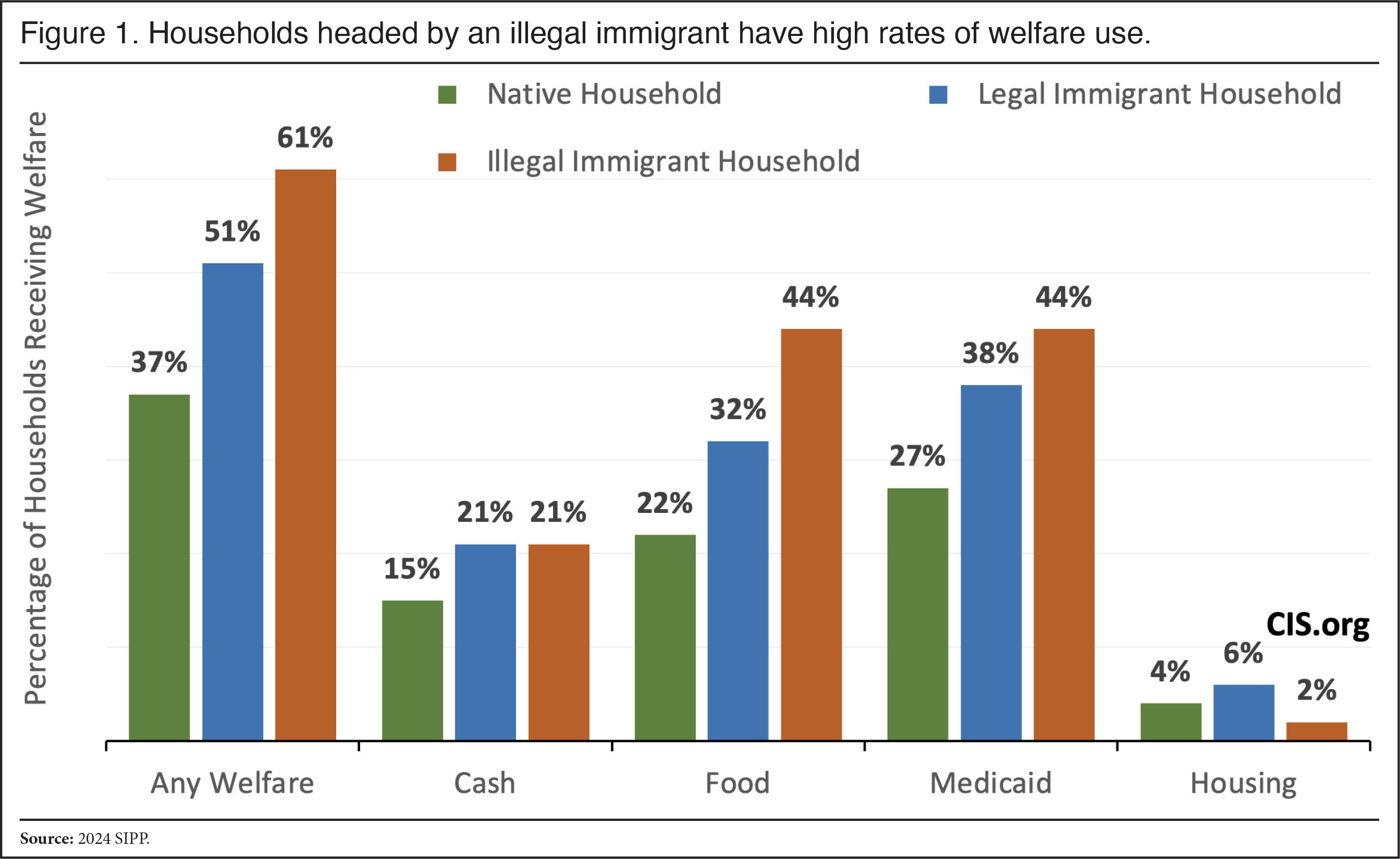 |
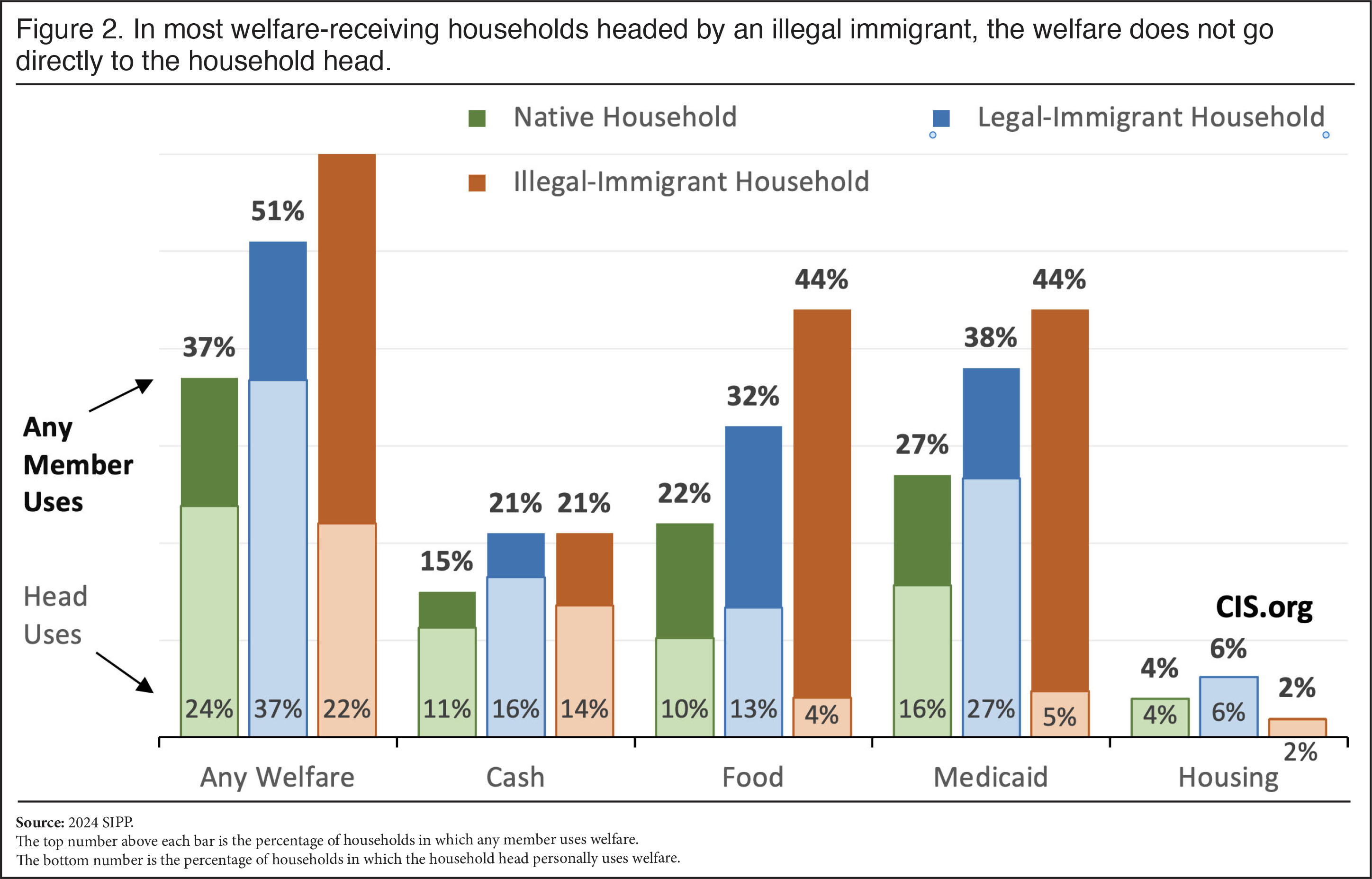
Figure 2 provides the same household statistics as Figure 1, but it adds additional information about household heads specifically. While 61 percent of households headed by an illegal immigrant receive welfare, just 22 percent of illegal-immigrant heads personally receive welfare themselves. Other members of their households, who are often citizens or legal permanent residents, make up the difference. The head vs. household distinction is especially noticeable with Medicaid, as just 5 percent of illegal-immigrant household heads receive Medicaid — typically in emergency situations — but receipt by other household members pushes the rate up to 44 percent. Since so many of the welfare beneficiaries in illegal-immigrant households are U.S. citizens by birth, new laws cannot exclude illegal immigrants like “Barbara” from benefiting as well.
 |
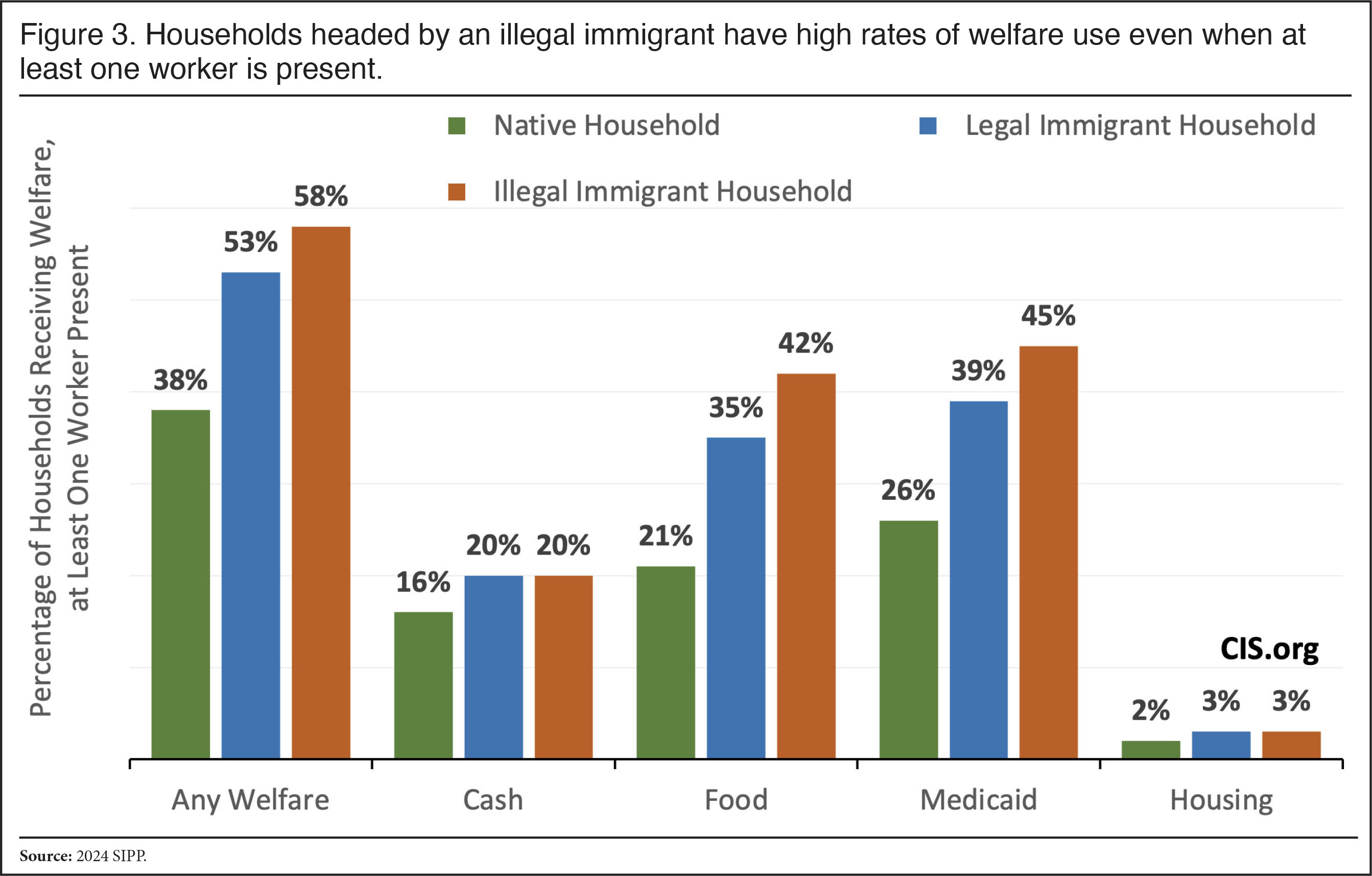
Finally, high illegal-immigrant welfare use is not due to a lack of work opportunities. Although Barbara attested she and her husband do not have work authorization, many illegal immigrants obviously work without it. Figure 3 shows that limiting the welfare analysis to households that contain at least one worker hardly changes the percentages at all. As the previous CIS report explained, the economic challenge for illegal immigrants is not a lack of work; rather, it is the low level of education that they bring into a modern, first-world economy. Their average earnings are consequently too low for self-sufficiency.
 |
It’s unfortunate that the Supreme Court has cemented birthright citizenship into law. By reinforcing the link between illegal immigration and welfare receipt, however, the ruling should serve as additional motivation to enforce our immigration laws. After all, the most effective way to reduce illegal immigrant access to welfare is to reduce illegal immigration in the first place.