
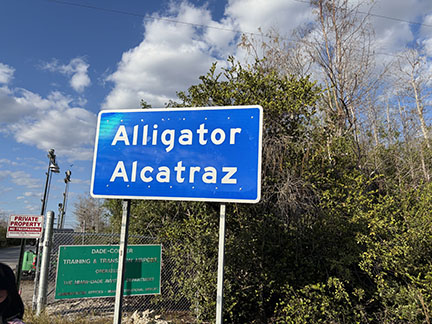
A divided three-judge panel of the U.S. Court of Appeals for the Eleventh Circuit issued an opinion this week in Friends of the Everglades v. Sec. of Homeland Security, vacating an injunction that had, among other things, barred DHS from holding aliens at “Alligator Alcatraz” (formally the “South Florida Soft-Sided Facility South”). In doing so, the court refreshingly held that the Immigration and Nationality Act (INA) means what it says when it comes to the jurisdiction of inferior federal courts.
The Fight Over Alligator Alcatraz
My colleague Marguerite Telford recently visited the facility in the Florida Everglades, and as she explained:
The facility was built quickly — construction began in June 2025, and the first detainees arrived that July. It is soft-sided, meaning tent-like, but it is not makeshift. It currently houses just over 1,000 adult males, though it has held as many as 2,500.
Keep that timing in mind as I explain that on June 27, 2025, two non-profits — Friends of the Everglades and the Center for Biological Diversity — filed a complaint in the U.S. District Court for the Southern District of Florida (S.D. Fla.) seeking inter alia to “enjoin any further pre-construction activities, construction, conversion, or use of the” site of the facility, claiming its construction violated two federal statutes.
The two statutes in question were the National Environmental Protection Act (NEPA), which “requires federal agencies to assess the environmental effects of their proposed actions prior to making decisions” and the Administrative Procedure Act (APA), which governs federal agency rulemaking.
On July 14, the Miccosukee Tribe of Indians of Florida filed a Motion to Intervene on the side of the plaintiffs in the case, contending they “have lived in and cared for the land” where the facility is sited “since time immemorial”.
Speedy litigation followed, and on August 21, 2025, the S.D. Fla. judge assigned to the case, Kathleen Williams (appointed by President Obama), issued an Omnibus Order halting further construction on the facility and barring the state of Florida and DHS from “bringing any additional persons onto the ... site who were not already being detained at the site at the time”.
Florida appealed, and on September 4, 2025, a divided three-judge 11th Circuit panel stayed Judge Williams’ preliminary injunction pending resolution of the state’s appeal of the preliminary injunction.
The APA and NEPA Claims
More pleadings were filed before the 11th Circuit after the case was assigned to a different three-judge panel of the circuit court to review the appeal. On April 21 that panel issued its opinion.
That 38-page decision is evenly split in terms of length, with a 19-page majority opinion authored by Chief Judge William Pryor (nominated to the court by President George W. Bush) joined by Judge Andrew Brasher (a Trump appointee), and Judge Nancy Abudu (placed on the court by President Biden) writing a 19-page dissent.
The majority concluded that the plaintiffs failed to demonstrate a “major federal action” in the construction of Alligator Alcatraz necessary for a NEPA claim, which the court concluded would have required them to “prove both that the facility was federally funded and that it was subject to federal control” (which it wasn’t).
They also failed to show that there was a “final agency action” for purposes of the APA, the majority held.
The INA Injunction Bar
“Even if the environmentalists and Tribe were likely to succeed on their claim”, Judge Pryor explained, the court would nonetheless vacate that portion of Judge Willams’s order that had kept DHS from “bringing any additional persons onto the ... site who were not already being detained” at Alligator Alcatraz, due to restrictions on district court injunctions in the INA.
Under section 242(f)(1) of the INA, “no court (other than the Supreme Court) shall have jurisdiction or authority to enjoin or restrain the operation of” the act that governs (again, among other things) the detention of aliens “other than with respect to the application of such provisions to an individual alien against whom proceedings under such part have been initiated”.
The problem, the majority explained, is that section 236(a) of the INA expressly allows the DHS secretary to “arrest and detain aliens pending removal proceedings”, while under section 241(a)(2), the secretary “must detain” an alien ordered removed “pending removal”. (Emphasis in court original.)
In addition, Congress in section 241(g)(1) of the INA requires the secretary to “arrange for appropriate places of detention for aliens detained pending removal or a decision on removal”.
“An injunction that prevents” the secretary “from detaining aliens in a place of his choosing ‘enjoins or restrains the operations’” of sections 236(a) and 241(g)(1) of the INA, the majority held, running afoul of the jurisdictional bar in section 242(f)(1) of the INA and leaving the 11th Circuit “no choice but to vacate th[e] portion of the injunction” that prevented DHS from sending additional aliens to Alligator Alcatraz.
The circuit court remanded the case back to Judge Williams “for further proceedings”, not least of which is to determine whether the S.D. Fla. is even the proper venue to hear the plaintiffs’ claims (a different issue for another day).
DeSantis Claps Back
One complaint lobbed at many lower court orders restraining Trump II immigration actions is that (as here) they have been issued in apparent contravention of restrictions Congress has placed on those courts’ authority in section 242 of the INA.
In that vein, Florida Gov. Ron DeSantis (R) issued two tweets following the issuance of the 11th Circuit’s opinion:
Yet another example a leftist district court judge getting reversed on appeal.
Rinse and repeat. pic.twitter.com/m4EXgr8xVP— Ron DeSantis (@RonDeSantis) April 21, 2026
And:
The goal is to throw sand in the gears. Plus, they could end up with a liberal appellate panel and then we have to wait for SCOTUS to correct.
I don’t think there is any shame. They are doing their best to serve the left’s agenda. https://t.co/nUKgGQr4g8— Ron DeSantis (@RonDeSantis) April 22, 2026
DeSantis is more charitable in that tweet than many others who support enforcement would have been, but then he’s spent nearly eight years in Tallahassee after six in the U.S. House of Representatives, and he is familiar with the game by now.
Trump first came to office without direct experience in federal politics, and during his first term didn’t give his immigration policies enough time for to percolate through the courts. He’s learned his lesson, which is why he was hot out of the gate on his second go-round, and why decisions like this are now going in his favor.