
On August 6, the White House issued a “fact sheet”, “President Donald J. Trump Ends Birth Tourism and Protects the Meaning and Value of American Citizenship”, announcing two new executive orders (EOs): one “non-exhaustively identifying certain categories of children of aliens. . . not entitled to birthright citizenship ... consistent with” Supreme Court precedent; and the other “to halt the practice of birth tourism”. To paraphrase Antony in Shakespeare’s Julius Caesar: “Cry ‘Havoc!’ and let slip the dogs of law”.
“Continuing to Protect the Meaning and Value of American Citizenship”
The first EO, “Continuing to Protect the Meaning and Value of American Citizenship”, is a take on EO 14160, “Protecting the Meaning and Value of American Citizenship", which was struck down by the Supreme Court on a 6-3 (or 5-4, depending on your take on Justice Kavanaugh’s concurrence) vote by the Supreme Court in Trump v. Barbara.
EO 14160 declared that certain “categories of individuals will no longer be considered to be born ‘subject to the jurisdiction’ of the United States and therefore will no longer be U.S. citizens at birth” under the first section of the 14th Amendment.
Those categories were children born to mothers “unlawfully present” or whose presence was “lawful but temporary” (i.e., “nonimmigrants”) and fathers who weren’t either U.S. citizens or lawful permanent residents (i.e., “green card holders”).
Plainly chastened by the justices’ rebuke, this new EO is more modest, barring federal agencies from issuing documents (like passports or Social Security cards) recognizing the U.S. citizenship of the children of specified aliens, including: (1) “enemy aliens” under specified federal statutes and prior EOs; (2) “foreign government employees”; and (3) “birth tourists”.
An additional exception (4) applies to children “born in a territory or territorial waters of the United States where citizenship is not conferred by Federal statute”.
That one appears to only cover kids who enter the world in American Samoa and Swains Island, U.S. possessions where the natives are “nationals” but not “citizens” of the United States under section 308 of the Immigration and Nationality Act (INA).
“Ending Birth Tourism”
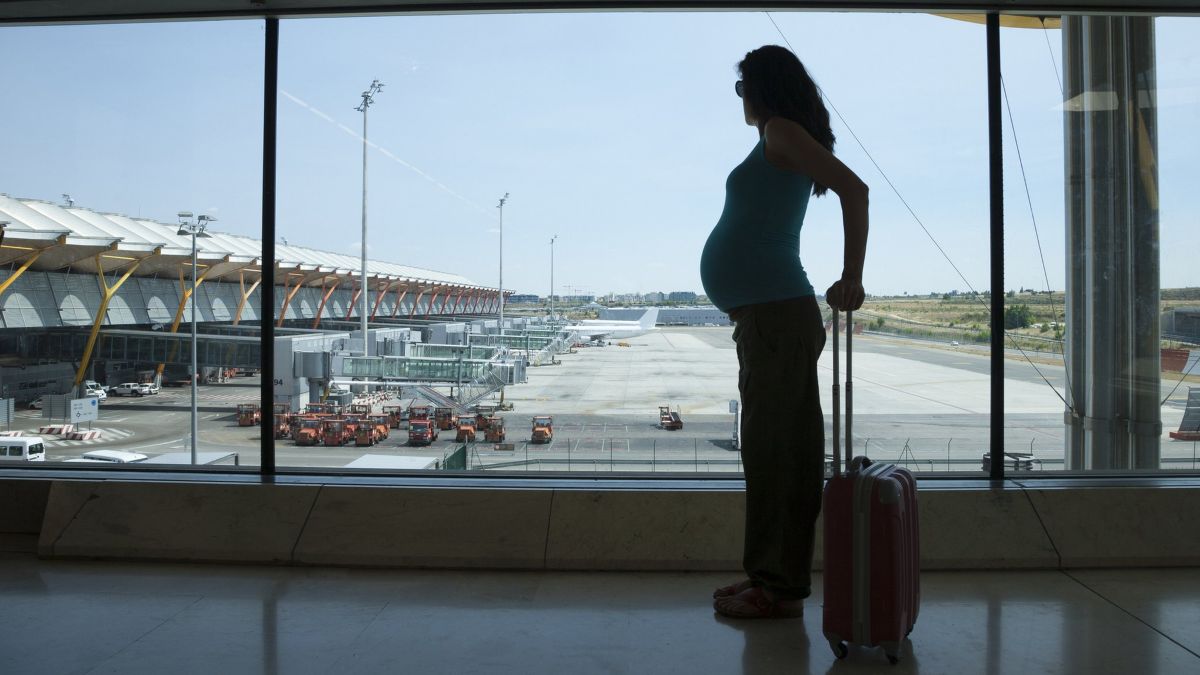
The other EO, “Ending Birth Tourism”, directs DHS and the Department of State to use their statutory authorities “to ensure that nonimmigrant visa classifications are used only for their lawful and intended purposes, and to prevent the exploitation of those classifications by persons engaging in birth tourism”.
It defines that latter term as:
(a) the entry of any foreign national into the United States via a nonimmigrant visa for the purpose of giving birth on American soil; or (b) any effort by any foreign national to facilitate the entry of any foreign national into the United States via a nonimmigrant visa for the purpose of giving birth on American soil.
As I’ve reported, U.S. attorneys were given marching orders by DOJ the day the Supreme Court issued its opinion in Barbara to criminally prosecute parents who engage in birth tourism under federal fraud and money laundering statutes, so either the White House thinks DHS and DOS are slacking or it wants a full-court federal press to prevent nonimmigrants from exploiting the Court’s (lavish) definition of birthright citizenship in the 14th amendment.
My father advised me to never ask any woman if she is pregnant, but you can expect State’s consular officers abroad and CBP officers at the ports to ignore his wise counsel and start asking some hard-hitting questions when confronted with a would-be “temporary traveler” of child-bearing age.
Perhaps DHS and DOS will also consider limiting the issuance of nonimmigrant H-4 visas (for the spouses of H-1B, H-2A, H-2B, and H-3 nonimmigrant visa holders), L-2 visas (for spouses of L-1 nonimmigrant intracompany transferees), F-2 and M-2 visas (for the spouses of F-1 academic or M-1 vocational nonimmigrant students, respectively), and J-2 visas (for spouses of J-1 nonimmigrant exchange visitors).
While I believe in the sanctity of marriage, it never made any sense, given the accepted interpretation of birthright citizenship before and after Barbara, to allow nonimmigrants on potentially long-duration visas like those to bring their spouses along, particularly given that the whole point of nonimmigrant status is that you have a domicile abroad you purportedly have no intention of abandoning.
If “home is where the heart is”, the place my wife lives and my child is born is home, even if my kid’s passport doesn’t match mine.
Cue the Lawsuits
While it’s long been accepted that the U.S.-born children of fully accredited diplomats with immunity aren’t citizens at birth, the first EO goes way beyond those restrictions to sweep in children of any alien employee working here in his or her country’s “foreign embassy or consulate” as well as the children of aliens employed in the United States “by a foreign government in an official capacity”.
Moreover, while “the children of alien enemies, born during and within their hostile occupation” of the United States were not deemed citizens even under the Supreme Court’s 1898 opinion in U.S. v. Wong Kim Ark (the precursor to Barbara), the validity of the first EO’s expansion of that concept to the offspring of other “alien enemies” (such as cartel members) would require new interpretations of the terms “invasion” and “occupation”.
A Fight the President Almost Definitely Wants
Trump’s political enemies quickly attacked the president’s latest efforts to roll back birthright citizenship, so you might as well cue up the lawsuits now.
They are fights the White House would probably relish, because they’re ones the president is inviting.
Trump and aides likely can’t wait for the arrival of the first Tren de Aragua parent, demanding food stamps and Medicaid (“Barbara’s” own claim, as the Center’s Jason Richwine recently revealed) for his little bundle of joy, or for the third secretary in charge of “economic matters” (wink-wink) at some hostile government’s UN legation to file the paperwork for his kid’s U.S. passport.
Many Americans know the Supreme Court’s birthright opinion will lead to absurd outcomes in extremis. If the administration plays its cards right (a big “if”), its latest birthright orders will invite some unpopular challenges — and may prompt the justices to pare down their sweeping Barbara order.