
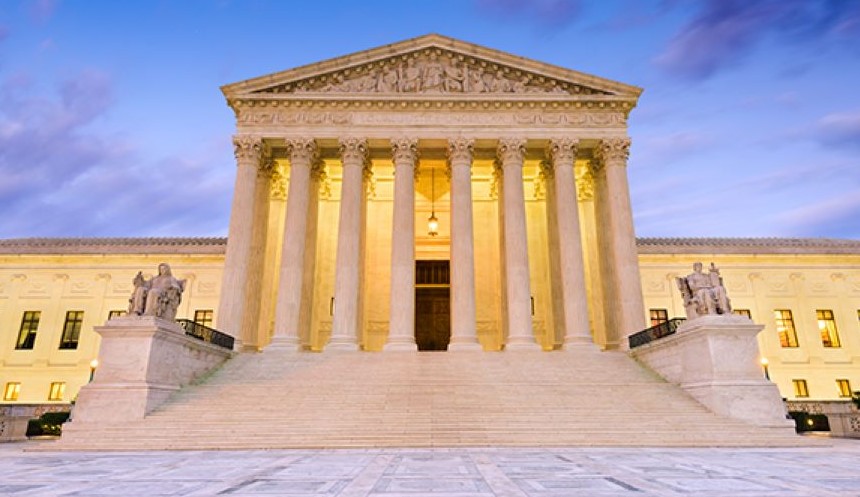
On June 30, the Supreme Court issued its long-awaited opinion in Trump v. Barbara, concluding that all children born in the United States — with only limited exceptions — are U.S. citizens. The president will likely be displeased with the 5-4 (or 6-3, depending how you look at it) outcome, in which a majority of the justices affirmed a late 19th century precedent that took an expansive view of the citizenship clause. Expect enforcement advocates to light a fire under the administration to deport those here illegally before they can accrue what are referred to in immigration as “equities” (more commonly known as “kids”).
Setting the Stage
The term “citizen” appears 11 times in the original seven articles of the U.S. Constitution: once each in the qualifications to be a representative or a senator; twice in the qualifications for the presidency (“No Person except a natural born Citizen, or a Citizen of the United States, at the time of the Adoption of this Constitution, shall be eligible to the Office of President”); five times in the “case or controversy” clause defining federal court jurisdiction; and twice in the “privileges and immunities” clause that bars discrimination between the states.
Curiously, however, those seven articles never define what a “citizen” is.
The closest they come is in “the naturalization clause”, Article I, sec. 8, cl. 4, giving Congress power “To establish an uniform Rule of Naturalization”. In turn, it gave the legislative branch — not the executive or the judiciary — “plenary power” to make laws for the admission, exclusion, and deportation of aliens.
Simply put, you can’t have a uniform rule governing which aliens can naturalize — that is be transformed into citizens — without rules governing which aliens are allowed in, and which must leave.
The parameters of U.S. citizenship, on the other hand, are set forth in the “citizenship clause”, section 1 of the 14th Amendment, which states: “All persons born or naturalized in the United States, and subject to the jurisdiction thereof, are citizens of the United States and of the State wherein they reside.”
The citizenship clause wasn’t ratified until July 1868, prior to which, with a big exception, citizenship was determined according to English common law principles grounded in feudalism, pursuant to which “all free persons born within a state or nation were citizens thereof”.
Dred Scott
That exception was the Supreme Court’s 1857 opinion in Dred Scott v. Sandford.
Scott, the plaintiff, had been an enslaved person in Missouri but later lived in Illinois (a “free” state) and in a part of the then-Wisconsin Territory where slavery was outlawed by the Missouri Compromise of 1820. He sued seeking his freedom, claiming that he became free as a matter of law as soon as he went north.
Chief Justice Roger Taney, for the majority, concluded that “neither the class of persons who had been imported as slaves, nor their descendants, whether they had become free or not, were ... acknowledged as a part of the people” under the Declaration of Independence or in “the legislation and histories of the times”. Therefore, Scott couldn’t sue in a federal court, and his case was dismissed.
To overrule Dred Scott, Congress passed — over the veto of Democrat President Andrew Johnson, the Civil Rights Act of 1866, which stated that “all persons born in the United States and not subject to any foreign power, excluding Indians not taxed, are hereby declared to be citizens of the United States”.
The 14th Amendment Citizenship Clause and Wong Kim Ark
Concerned about Johnson’s veto and to ensure future legislatures couldn’t deprive freedmen of the citizenship it granted them in that act, Congress decided to make their citizenship more permanent by codifying it in the Constitution, leading to the passage of the 14th Amendment, ratified on July 9, 1868.
In its 1898 opinion in U.S. v. Wong Kim Ark — the leading case interpreting the 14th Amendment until today — the Supreme Court made clear that a person born in San Francisco to Chinese national parents who were lawful, domiciled residents of this country was a U.S. citizen at birth, but it also concluded in dicta that all other children born to alien parents were citizens as well, with only limited exceptions for those in Indian tribes, children of foreign diplomats, and babies born in areas of foreign occupation and on “foreign public ships”.
In its brief in Barbara, however, the government argued that the current understanding of birthright citizenship under the 14th Amendment as applying to all children born here with the exceptions in the Wong dicta is of more recent vintage, dating back to the Franklin Roosevelt administration, and that FDR had it wrong.
“Protecting the Meaning and Value of American Citizenship”
President Trump forced a reevaluation of that question in January 2025, when he issued Executive Order (EO) 14160, “Protecting the Meaning and Value of American Citizenship”.
That EO declared that certain “categories of individuals will no longer be considered to be born ‘subject to the jurisdiction’ of the United States and therefore will no longer be U.S. citizens at birth”.
Those categories are children born to mothers who were “unlawfully present” or whose presence was “lawful but temporary” and fathers who weren’t either U.S. citizens or lawful permanent residents (i.e., “green card holders”).
Note that the EO was purely prospective, only covering children born after the order’s effective date of February 20, 2025 (now delayed indefinitely pending the Supreme Court’s decision). Nobody born before that date would lose citizenship, but those born after who did not qualify for citizenship under the EO would not receive it.
Barbara v. Trump, and Vice Versa
That EO has been subject to various injunctions and therefore has never taken effect.
Despite that fact, the Supreme Court has already used one of those cases, Trump v. CASA, to restrict lower courts’ use of so-called “universal injunctions”, which they had regularly used in recent years to bar actions in federal districts far removed from the one issuing the order.
On December 5, however, the Court agreed to tackle the issue head-on, granting certiorari in Trump v. Barbara.
The case is out of the U.S. District Court for the District of New Hampshire (D. N.H.), and on July 10, a D. N.H. judge issued a preliminary injunction barring the application of EO 14160 to a preliminary class of individuals born in this country who would not be considered U.S. citizens under that order.
At issue in this particular case was eligibility for means-tested public benefits.
The government asked the Supreme Court to consider the injunction in Barbara “before judgment”, that is without asking the First Circuit to weigh in first, and the justices agreed.
The sole question presented in Barbara was whether EO 14160 “complies on its face with the Citizenship Clause”, “and with” section 301(a) of the Immigration and Nationality Act (INA), “which codifies that Clause” (and mirrors it).
The government argued that the 14th Amendment citizenship clause:
does not, however, grant citizenship to the children of temporary visitors or illegal aliens. The plain text of the Clause, its original understanding and history, and this Court’s cases confirm that the Clause extends to children who are “completely subject” to the “political jurisdiction” of the United States, meaning that they owe “direct and immediate allegiance” to the Nation and may claim its protection.
On April 1, the Court heard oral arguments in the case, with justices across the dais peppering U.S. Solicitor General John Sauer (DOJ’s top appellate lawyer) with questions about the government’s arguments and citations, while largely leaving respondents’ attorney, Cecillia Wang of the ACLU, unscathed.
The Opinion
That oral argument was a harbinger of the June 30 majority opinion by Chief Justice John Roberts, which Justices Sotomayor, Kagan, Barrett, and Jackson joined. Justice Kavanaugh concurred in that opinion in part and dissented in part, joined in part by Justice Sotomayor; Justice Thomas wrote a dissent that Justice Gorsuch joined; and Justices Alito and Gorsuch each filed separate dissents.
Overly simplistically, the majority concluded that the citizenship clause was to be interpreted under the English common law principles that the majority in Wong had followed, not under one premised on the concepts of legal “domicile” of the child’s parents that Sauer was promoting at the oral argument and in his briefs.
The latter would have barred the children of “sojourners” — nonimmigrants present here legally but temporarily — from citizenship, as well as the offspring of those here unlawfully.
Under the common-law rule, however, only “children of foreign sovereigns or their ministers, or born on foreign public ships, or of enemies within and during a hostile occupation of part of our territory”, plus those “born in the ‘alien nations’ of Indian tribes”, were exempted, and inasmuch as children “born in the ‘alien nations’ of Indian tribes” were granted citizenship by statute in the Indian Citizenship Act of 1924, only the other three narrow exceptions remain.
By the way, when I alluded to the fact this opinion could be considered either 6-3 or 5-4, it’s because Justice Kavanaugh concluded the EO contravened section 301 of the INA and would “unless and until” Congress passed a law narrowing birthright citizenship.
Consequently, he would have preferred passing on the constitutional questions (which he viewed as less settled than the majority concluded), potentially leaving a crack for legislative action on birthright citizenship.
Expect a Backlash
Given that the majority affirmed that expansive common law rule adopted in Wong in Barbara, enforcement advocates — both within the administration and without — are unlikely to be pleased with the outcome.
Not only can U.S.-citizen children petition for green cards for their parents once they become adults (the driving force behind so-called “birth tourism”), but such children are also considered “equities” when the immigration courts weigh whether to grant relief in the exercise of discretion.
Given that most immigration applications — including for asylum, adjustment of status, and both forms of cancellation of removal under section 240A of the INA — are discretionary, aliens unlawfully present or seeking a more permanent residence will now have an incentive to have as many children as possible, and the taxpayer will foot the bill for many of those births.
Consequently, expect a backlash to this opinion from immigration hawks, demanding that Trump’s DHS expand deportations of all of those here illegally to “beat the baby clock”, and clamoring for tighter standards on nonimmigrant visas to ensure that as few foreign nationals are able to make it here exclusively to give birth to U.S. citizens.
Regardless, It Was Going to Get Political
The chief justice wants to get the federal courts out of politics, and deciding a contentious question like birthright citizenship based on ancient English common-law principles and a late 19th century precedent was likely the safest way to achieve that goal (not that I am casting aspersions on the Court’s reasoning).
Regardless of how the Supreme Court ultimately ruled in Barbara, however, the consequences of the decision were going to be political, even if the way the justices decided it wasn’t.
The president’s critics will argue he lost big time, and it’d be difficult for even the most pollyannish Trump supporter to disagree.
That said, Trump won a second term on voters’ concerns over the fiscal and societal implications of the illegal population that mushroomed under Biden and the border Biden’s DHS allowed to devolve into chaos.
With the border now historically secure, Trump’s immigration agenda largely hinges on deportations — an issue that just gained new salience with the Court’s last opinion of its term finding that all children born here, regardless of their parents’ status, are — with only narrow exceptions — U.S. citizens. Cue the backlash.