
Summary
The number of Afghan immigrants in the U.S. now exceeds 230,000, having doubled between 2020 and 2024. The rapid influx has raised concerns about the economic and cultural impacts on American communities. This report analyzes those impacts using the 2024 American Community Survey and related data sets. Among the findings:
- About 43 percent of children in Afghan immigrant homes in the U.S. live in poverty, compared to 13 percent of children in native-headed homes.
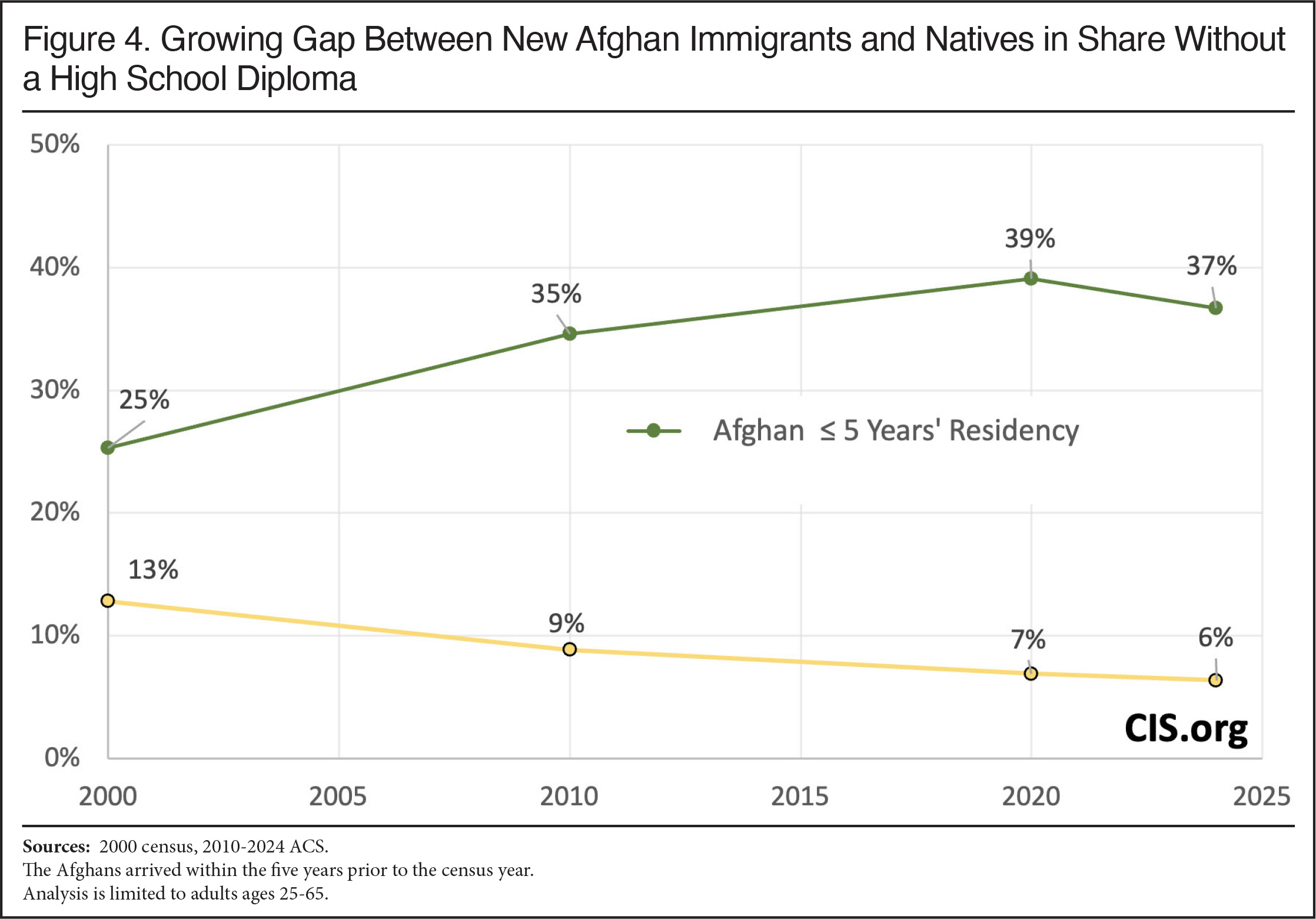
- The educational disparity between natives and new Afghan immigrants has been growing. In 2000, new Afghan immigrants were twice as likely as native adults to lack a high school diploma. Today, new Afghan immigrants are six times as likely.
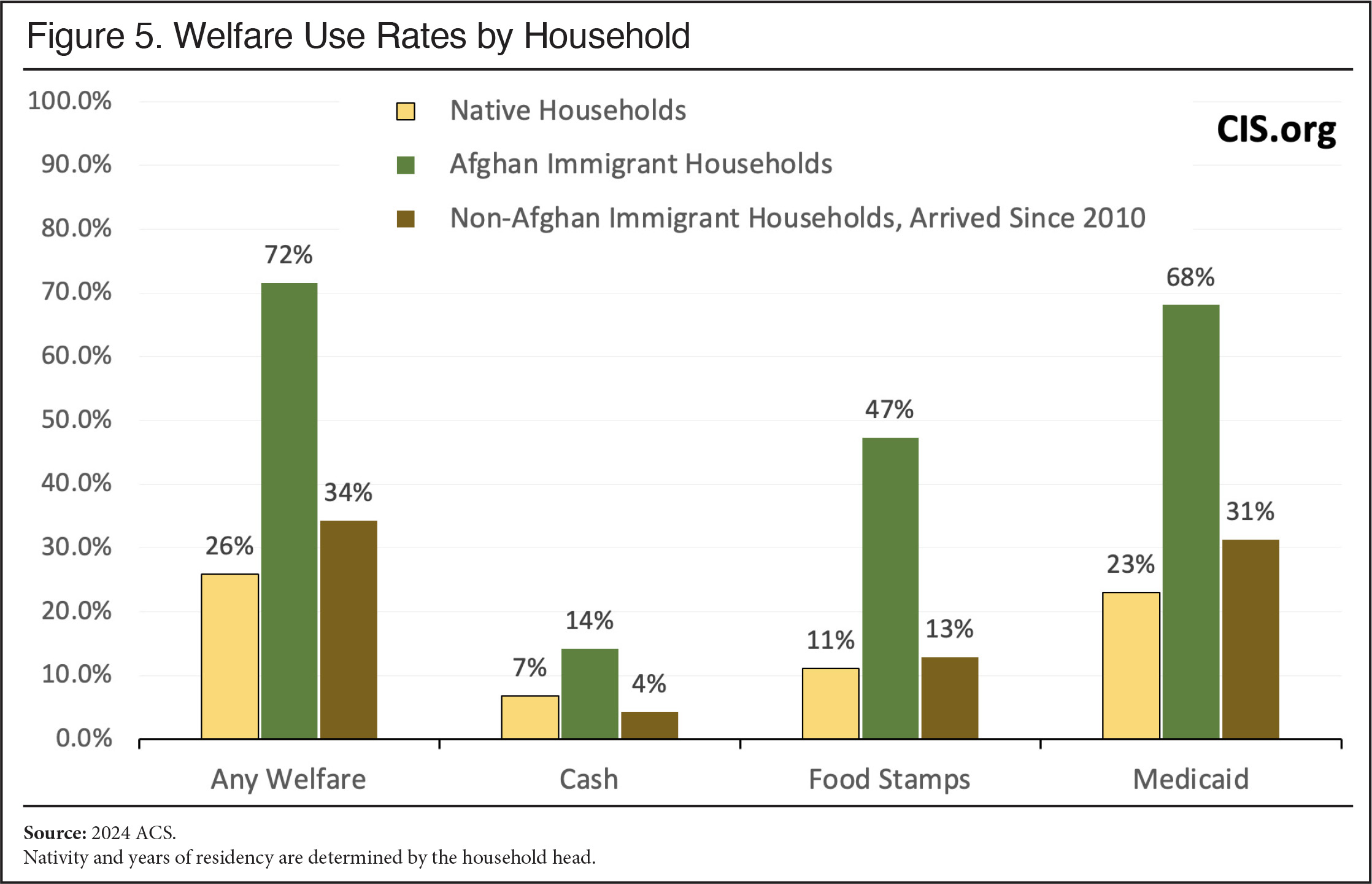
- About 47 percent of Afghan immigrant-headed households in the U.S. receive food stamps, and 68 percent have at least one member on Medicaid. The comparable figures for native households are 11 percent and 23 percent.
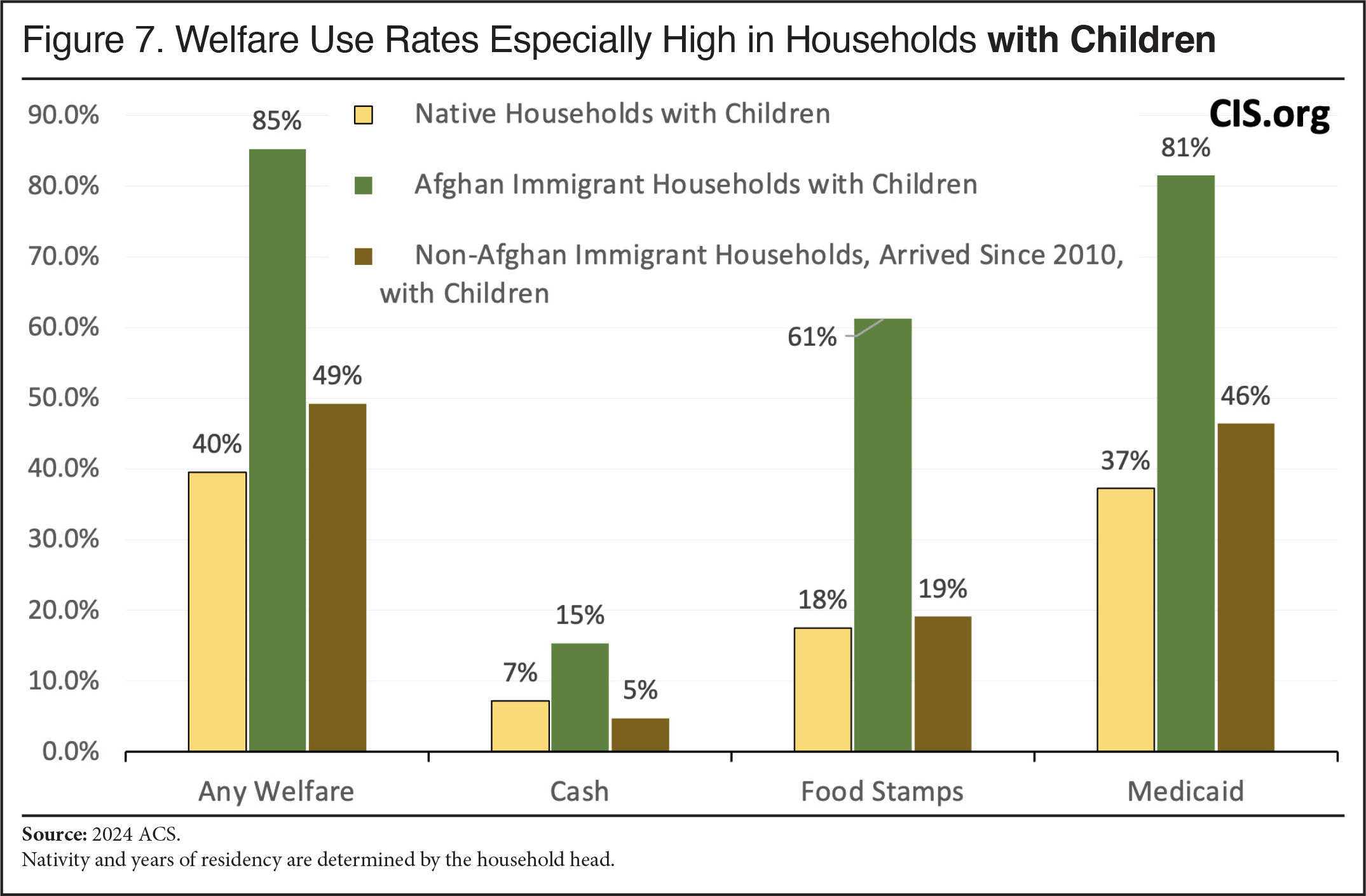
- The vast majority of Afghan immigrant households with children (85 percent) receive cash welfare, food stamps, or Medicaid.
- Afghan immigrants come from one of the most fundamentalist Islamic countries in the world. In Afghanistan, survey data indicate that 85 percent of Muslims support stoning as a punishment for adultery, 61 percent wish to apply Sharia law to non-Muslims, and 60 percent endorse “honor killings” of unchaste family members.
- Recent Afghan immigrants have been involved in plotting or executing terrorist attacks against Americans.
Detailed Results
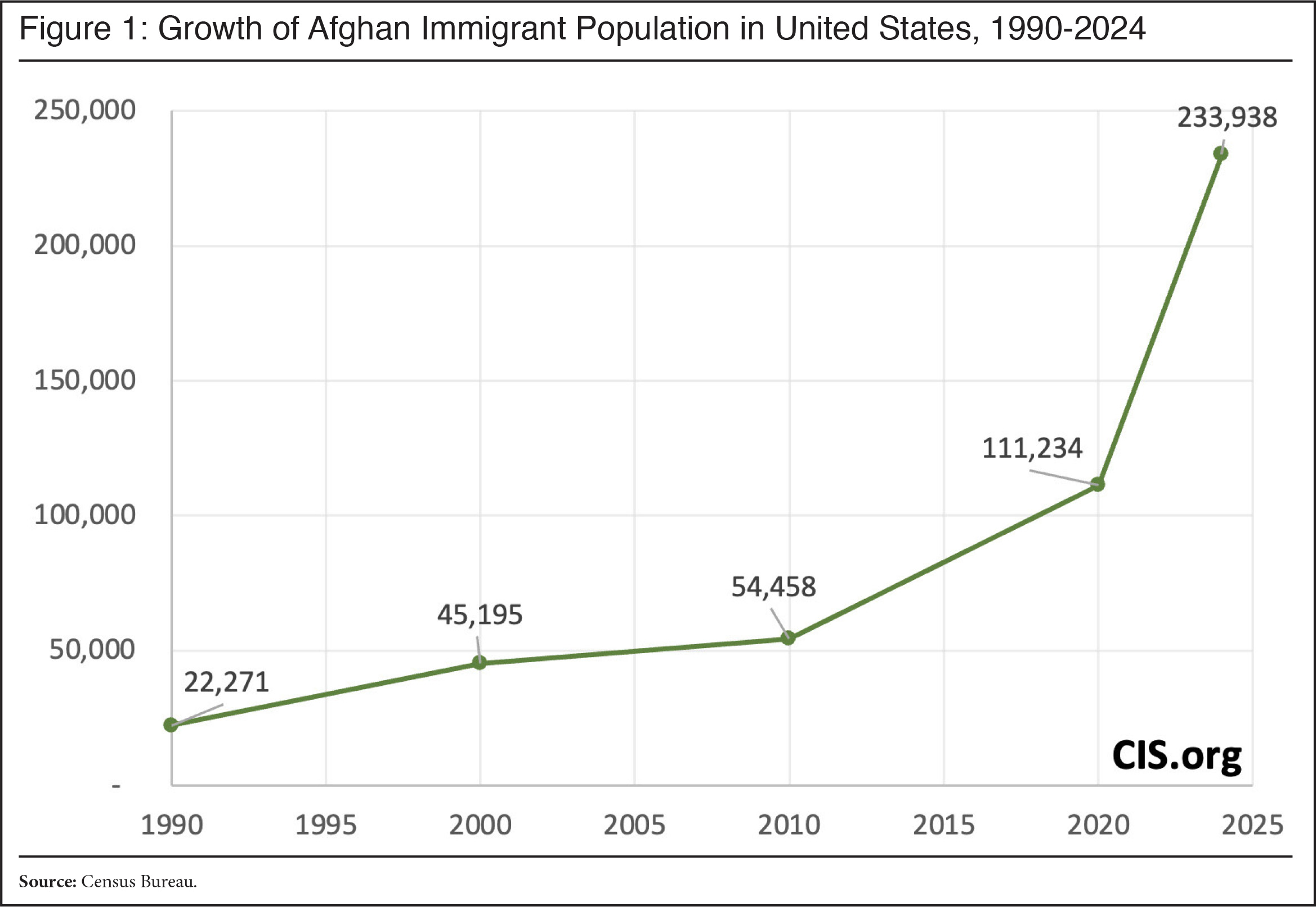
The impact of any immigrant group depends first and foremost on its size. As Figure 1 indicates, there were only about 22,000 Afghan immigrants in the U.S. in 1990. However, their population doubled by the year 2000, doubled again over the next two decades, and doubled a third time during the four years of the Biden surge. That last surge is particularly notable. About 111,000 Afghan immigrants lived in the U.S. in 2020, but the number rose to 234,000 in 2024, in the wake of the 2021 American evacuation of Afghanistan.1
 |
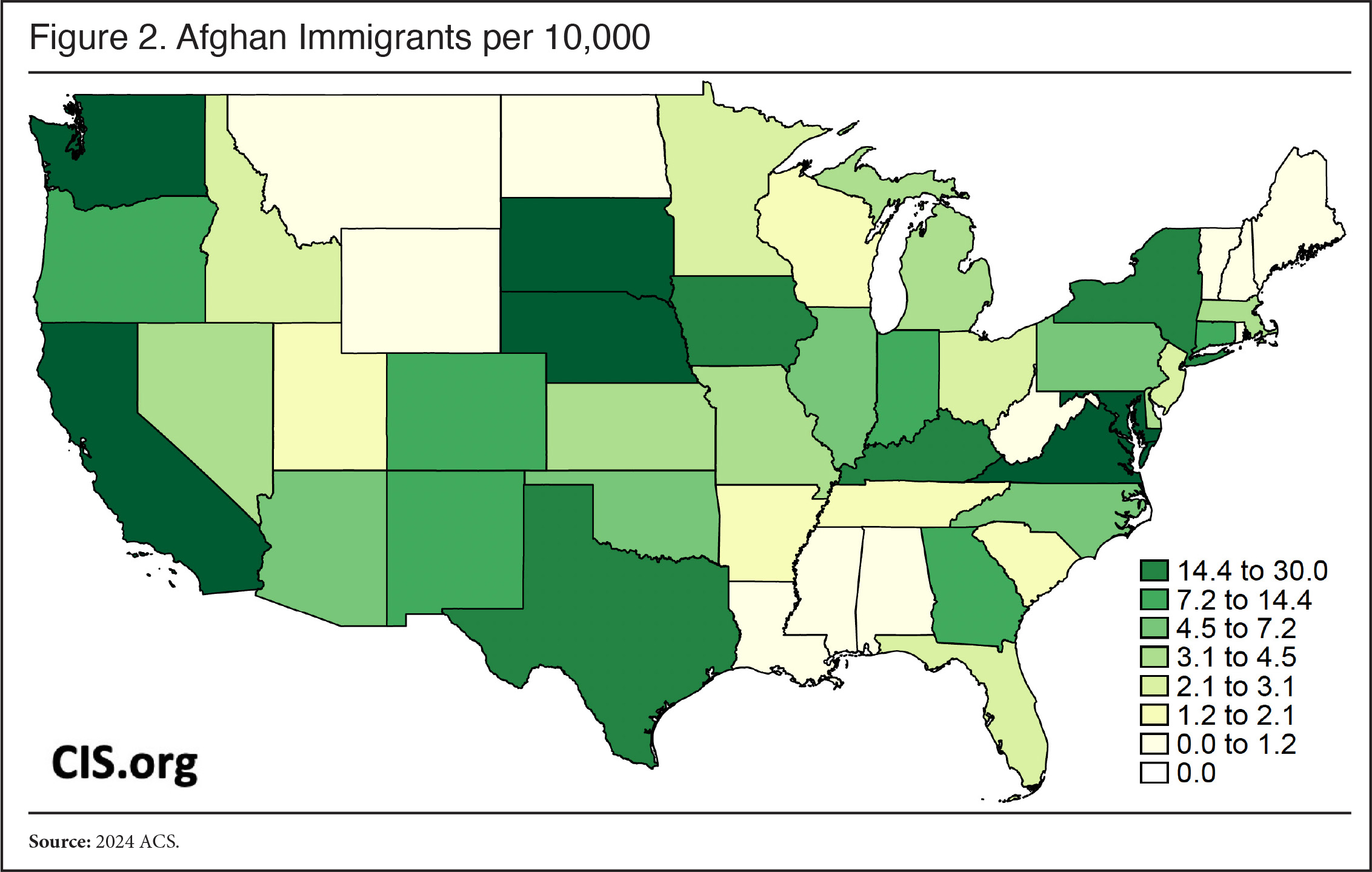
Although many Afghan immigrants live in traditional immigrant destinations, such as California and the states of the D.C. metro area, others have settled in the heartland. Figure 2 shows that Nebraska and South Dakota are among the five states with the highest concentrations of Afghan immigrants.
 |
The influx of Afghan immigrants, particularly to parts of the U.S. unaccustomed to rapid demographic change, has raised concerns about economic and cultural effects on the communities in which they now reside. To analyze those effects, this report uses the 2024 American Community Survey (ACS) public-use microdata file, supplemented by opinion polling and other demographic data where indicated.
Poverty. Figure 3 shows that 29 percent of adult Afghan immigrants in the U.S. live below the official poverty line, compared to just 9 percent of adult natives. Even more concerning is the status of Afghan children. About 43 percent of children in Afghan immigrant homes live in poverty, compared to 13 percent of children in native-headed homes.2
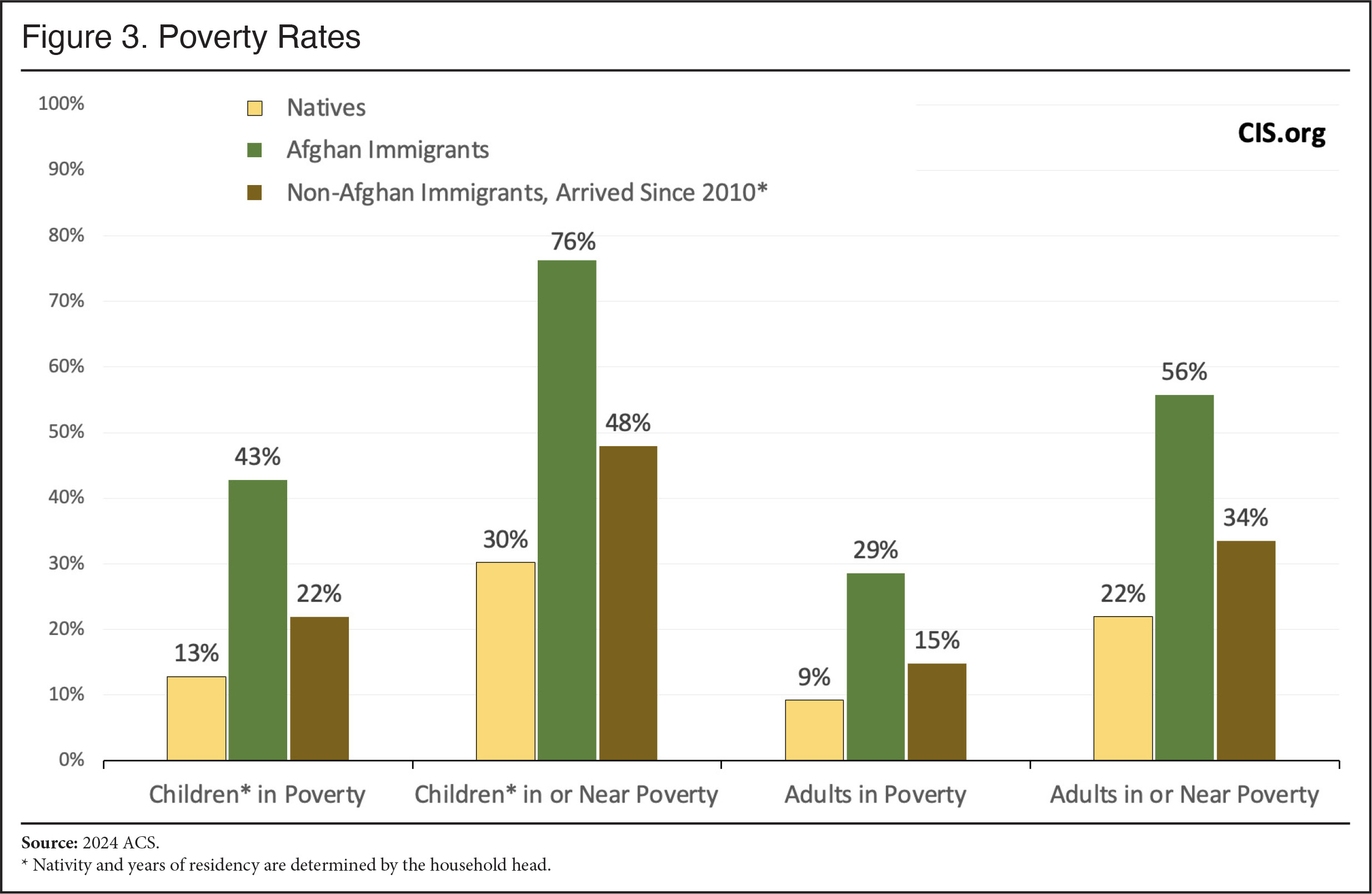 |
Of course, Afghans are not the only group of recent immigrants who are struggling economically. As the brown bars in Figure 3 indicate, non-Afghan immigrants who arrived since 2010 also have poverty rates that exceed the native averages. However, poverty among Afghan immigrants is especially high.
Among the strongest predictors of poverty are low education and lack of English-language ability. Table 1 shows that Afghan immigrants experience both of these problems at dramatically higher rates than natives. While virtually all natives speak English very well, 57 percent of working-age Afghan immigrants report that they do not. Meanwhile, 30 percent of working-age Afghan immigrants have no high school diploma, compared to 7 percent of natives.
Table 1. Rates of Poverty-Related Problems Among U.S. Natives and Afghan Immigrants | ||||
| Category | Problem | Rate Among Natives | Rate Among Afghan Immigrants | Rate Among Non-Afghan Immigrants Who Arrived Since 2010 |
| Working-Age Adults | No high school diploma | 7.1% | 29.8% | 18.5% |
| Working-Age Adults | Speaks English less than very well | 1.7% | 56.9% | 52.6% |
| Working-Age Men | Without a job1 | 22.7% | 16.3% | 17.1% |
| Working-Age Adults | Without a job1 | 24.9% | 37.4% | 26.8% |
| Households2 | Overcrowded conditions | 2.2% | 39.2% | 14.3% |
| Households2 | No adult speaks English very well | 0.7% | 32.9% | 33.5% |
Source: 2024 ACS. | ||||
One consequence of poverty is that it may degrade public health. Authorities have identified household overcrowding as a major contributor to the spread of communicable diseases, including Covid-19.3 As Table 1 shows, 39 percent of Afghan immigrant households are overcrowded, compared to only 2 percent of native households.
The cause of Afghan poverty is not a failure of Afghan men to find work. Table 1 compares the rates of working-age (18-64) men who are “without a job,” meaning either unemployed (not working but looking for work) or not in the labor force (neither working nor looking for work). The jobless rate is 23 percent for native men but just 16 percent for Afghan immigrant men.
Although many Afghan immigrant men have found jobs, their skills in the modern American economy are often not sufficient to raise their families out of poverty or avoid welfare dependence (as discussed below). Furthermore, the apparent reluctance of Afghan immigrant women to enter the labor force offsets the benefit of a high work rate among Afghan men. When working-age men and women are considered together, the jobless rate for all Afghan immigrants is 37 percent, which is higher than all natives (25 percent).
The skill level of individual Afghan immigrants should rise as they gain more experience in the U.S. However, adaptation by existing immigrants is counterbalanced by newer waves of immigrants who have lower initial skill levels than the earlier waves. Figure 4 shows that in 2000 the share of recent Afghan immigrants who lacked a high school diploma was double that of natives. By 2024 it was six-fold greater.
 |
The tendency for the skill level of new immigrants from a given country to decline as the number of immigrants from that country increases has been documented in the academic literature.4 It is a natural result of the most educated residents of a country having the means to emigrate first, which then establishes a path that their less-educated countrymen can follow. In the specific case of Afghanistan, the disorganized evacuation in 2021 brought to the U.S. not just allies and interpreters, but also many ordinary Afghans who were not associated with the U.S. government or its contractors.5
Welfare. The U.S. has an extensive welfare system targeted at low-income working families. Afghans in the U.S. are therefore likely to be major consumers of means-tested anti-poverty benefits, which Figure 5 confirms. While 11 percent of native households in the U.S. receive food stamps, 47 percent of Afghan immigrant households do. The disparity is even greater for medical care, with over two-thirds of Afghan households receiving Medicaid.6 Altogether, 72 percent of Afghan households receive cash, food stamps, or Medicaid from the taxpayers, compared to 26 percent of native households.7 Non-Afghan immigrant households also consume welfare at a higher rate than natives, but not nearly to the extent that Afghans do.
 |
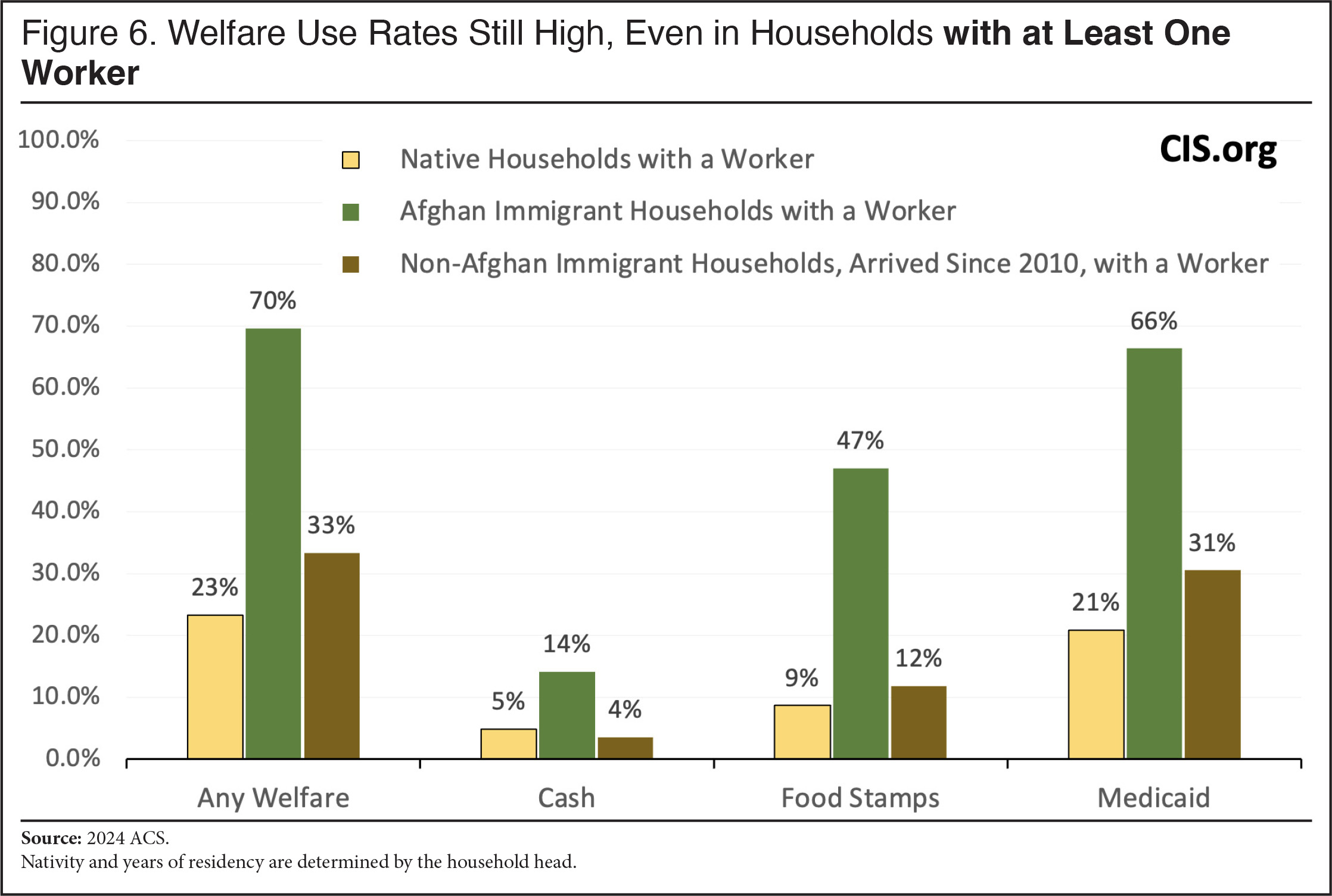
How can Afghan immigrant households consume so much welfare, given that Afghan men have a high rate of work? It is a common misconception that welfare mainly constitutes cash payments in lieu of work. Most means-tested anti-poverty programs, such as food stamps and Medicaid, are very much available to low-income workers. In fact, welfare and work tend to go together in modern America. Figure 6 makes this point clear. When limiting the analysis to households with at least one worker, welfare rates are only marginally lower than in Figure 5.
 |
Households with children are especially likely to use welfare. Figure 7 shows that even native-headed households with children consume Medicaid at a high rate of 37 percent. The contrast with Afghans remains striking, however, as the vast majority (81 percent) of Afghan households with children are on Medicaid.
 |
Welfare use rates among Afghan immigrants are so high that one may wonder whether they are engaged in the kind of fraud that has recently embroiled the Somali immigrant community.8 Census data cannot speak directly to that question. However, as a recent CIS report on Somali immigrants pointed out, any immigrant group with a such a high share in or near poverty will legally qualify for extensive means-tested aid, either directly for themselves or indirectly through their U.S.-born dependents.9 In other words, fraud need not be involved at all in order for Afghan welfare use to be high. As a policy matter, the way to reduce immigrant consumption of welfare is not simply to crack down on fraud, but to reduce the number of new arrivals who have the low earnings power characteristic of Afghans.
Culture. Afghan immigration poses cultural as well as economic challenges. As Minnesota’s experience with Somalis has shown, some immigrant groups struggle to blend into the social fabric. In fact, a large body of academic literature shows that certain cultural traits that immigrants bring to their new countries tend to persist — not only within the lifetimes of the immigrants themselves, but even over multiple generations.10
Afghan immigrants are especially likely to present assimilation challenges. Unlike immigrants who arrive through selective channels, such as skill-based visas, humanitarian immigrants from developing countries often have personal values and outlooks more typical of their compatriots back home.
To the extent that Afghans in the U.S. hold views similar to Afghans in Afghanistan, the World Values Survey (WVS) can help illustrate them. The WVS did not conduct interviews in Afghanistan. However, it did interview surrounding countries with ethnic groups that overlap with those in Afghanistan. By taking the WVS responses of Pashtuns in Pakistan, Tajiks in Tajikistan, and Uzbeks in Tajikistan and Kyrgyzstan, and then weighting them to reflect the ethnic composition of Afghanistan, Figure 8 provides a reasonable approximation of what the average Afghan believes compared to the average American.
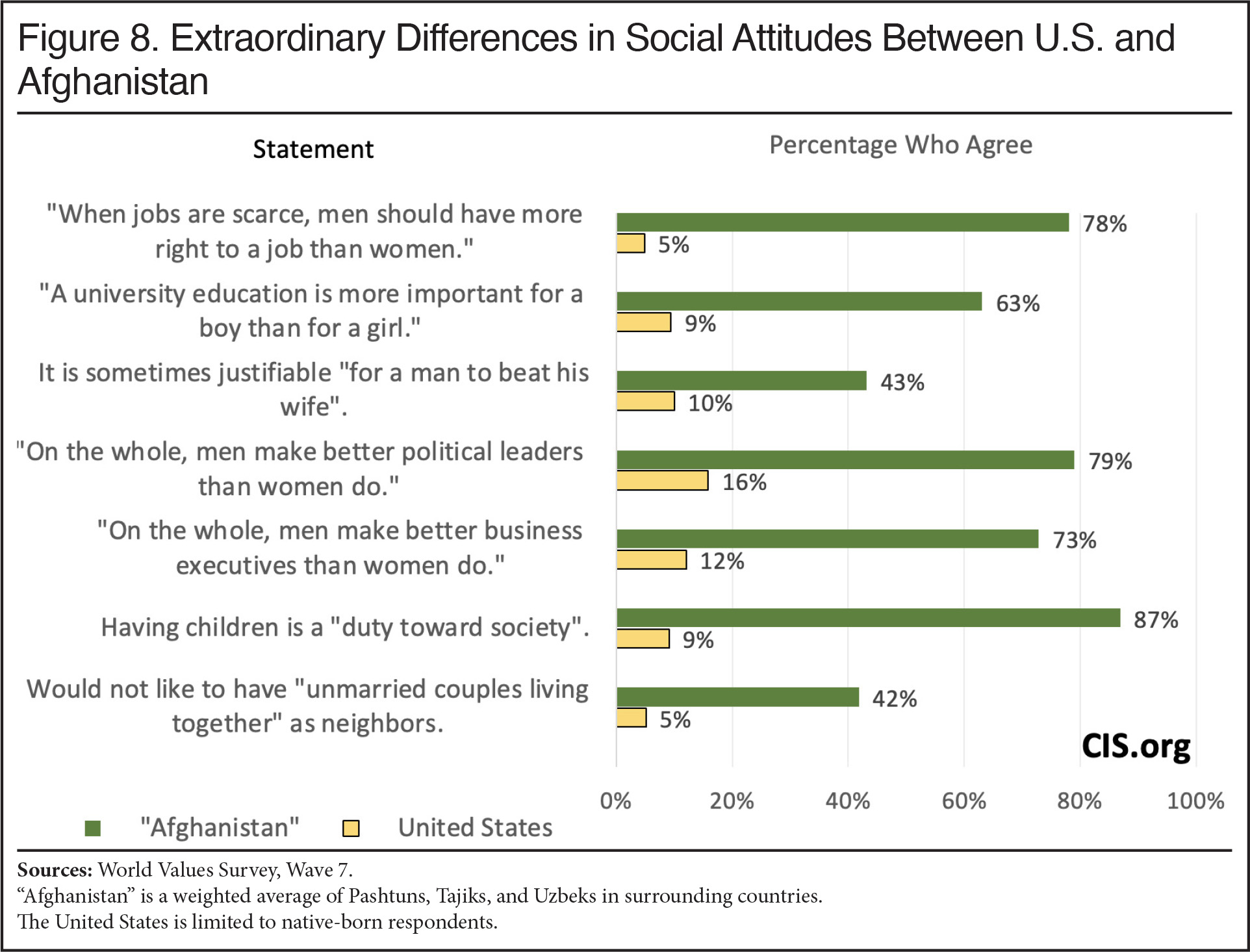 |
The statements listed above were selected to reflect views on women and gender roles, since those topics are often the focus of Western human rights groups. Clearly, the gaps between the U.S. and Afghanistan are quite large. Even one of the smaller gaps is jarring — proportionally four times as many Afghans as Americans believe that wife-beating is sometimes justifiable.
The WVS questions are designed to be asked of societies across the globe. To examine issues specific to Muslim countries in the developing world, the Pew Research Center’s global survey of Muslims is more useful.11 Conducted between 2008 and 2012, the Pew survey included Afghanistan’s Muslims, who of course constitute virtually all of the country’s population. Table 2 summarizes the percentage of Muslim Afghans who agree with various statements, along with Afghanistan’s rank among the countries surveyed. A rank of 1 indicates the highest percentage of agreement with each statement. (The survey covered Muslims in 39 countries overall, but individual questions usually had fewer than 39 responding countries.)
Table 2. Views in Afghanistan Regarding Islam | ||
| Statement | Share of Muslim Afghans Who Agree | Afghanistan Country Rank1 |
| Make Sharia the Law of the Land | 99% | 1 |
| … should include stoning as punishment for adultery | 85% | 2 |
| ...should include death penalty for leaving Islam | 79% | 3 |
| ...should also apply to non-Muslims | 61% | 3 |
| : | : | : |
| Prefer a Strong Leader Over Democracy | 51% | 4 |
| Islamic Political Parties Better than Other Parties | 54% | 3 |
| Suicide Bombing Sometimes Justified | 39% | 2 |
| Honor Killings2 Sometimes Justified | 60% | 2 |
| Wife Must Always Obey Husband | 94% | 2 |
Source: Pew Research Center, "The World's Muslims". | ||
Responses given by Afghans were among the most extreme in Pew’s survey. For example, on the question of making Sharia the law of the land, Afghanistan at 99 percent outpaced second-place Iraq by eight percentage points. In addition, only Pakistan (89 percent) was more amenable to stoning adulterers than Afghanistan (85 percent). Although Afghanistan’s support for suicide bombings may seem relatively low at 39 percent, it was second only to the Palestinian territories at 40 percent.
Needless to say, Afghans generally have very different cultural preferences than Americans, and conflict is likely as their numbers here grow. Culture clashes can manifest in many ways, such as residential segregation, persistent socioeconomic disparities, proliferation of foreign languages, and a whole series of smaller alterations to the daily life of a community.
The most severe manifestation would be anti-American crimes committed by Afghan nationals. Unfortunately, it appears that some have already occurred. In October 2024, Oklahoma resident Nasir Ahmad Tawhedi was charged with attempting to aid ISIS in an Election Day terrorist attack.12 In November 2025, Washington state resident Rahmanullah Lakanwal drove to Washington, D.C., and shot two members of the National Guard, killing one and severely wounding the other.13 In December 2025, the Department of Justice (DOJ) charged Texas resident Mohammad Dawood Alokozay with threatening a suicide attack against Americans.14 That same month, the DOJ released a list of another half-dozen Afghan nationals whom ICE had recently arrested for violent crimes.15 One can hope these are isolated incidents, but the experience of Europe, where Afghan refugees appear to have very high crime rates, suggests a disturbing pattern.16
Conclusion
Due to low levels of education and poor English ability, Afghan immigrant poverty rates are much higher than those of natives and of non-Afghan immigrants. Consequently, the large majority of Afghan immigrant households use welfare, despite a relatively high rate of work among Afghan men. Furthermore, Afghan immigrants come from a country that has one of the world’s deepest commitments to Islamic fundamentalism — a place where 85 percent of Muslims endorse stoning as a punishment for adultery, for example. The culture clash may have been a motivation for multiple terrorist attacks or attempted attacks by Afghan immigrants here in the U.S.
With the foreign-born share of the population having reached a record 15.8 percent in January 2025, the sheer number of newcomers presents economic and cultural challenges for the U.S.17 Those challenges can be exacerbated by Afghans and similar immigrant groups whose backgrounds make it especially difficult for them to adapt to life in the U.S.
To avoid these problems in the future, the U.S. may wish to consider resettling displaced peoples with their ethnic brethren in nearby countries, such as Pakistan and Tajikistan in the case of Afghans. Not only would this approach minimize the cultural conflict, it could also be a more efficient use of resources, since the same funds supporting one refugee in a First World society such as the U.S. could potentially support many more in developing countries.18
Appendix
Table 3. Sample Sizes | |||
| Category | Natives | Afghan Immigrants | Non-Afghan Immigrants Who Arrived Since 2010 |
| Adults (Age 18+) | 2,219,129 | 1,391 | 115,309 |
| Children* (Age<18) | 508,155 | 1,081 | 35,217 |
| Working-Age Adults (Ages 18-64) | 1,664,800 | 1,269 | 113,988 |
| Working-Age Men (Ages 18-64) | 835,530 | 650 | 55,708 |
| Households* | 1,168,412 | 608 | 42,941 |
| Households* with a Worker | 801,843 | 543 | 39,344 |
| Households* with Children | 276,922 | 377 | 19,818 |
Source: 2024 ACS. | |||
End Notes
1 Because the bulk of Afghan immigration has occurred so recently, most people of Afghan ancestry in the U.S. are foreign-born. Establishing a precise figure for the foreign-born share is difficult, however. The ACS shows an (implausibly) small number of U.S.-born individuals who claim Afghan ancestry, implying that Afghan immigrants constitute 95 percent of all people of Afghan ancestry in the U.S. Analysis of the Current Population Survey, which asks not about ancestry but about parental birthplace, suggests the foreign-born share of the Afghan-ancestry U.S. population is closer to 75 percent.
2 An Afghan immigrant household is one in which the “head” (or reference person) was born in Afghanistan. The head also determines the years of U.S. residency for the household-level analyses. When measuring child poverty, the Afghan immigrant columns include all the minors who live in a household headed by an Afghan immigrant, regardless of whether the children are themselves foreign-born.
3 A household is overcrowded according to the Census Bureau if, roughly speaking, it has more people than rooms. See Jason Richwine, Steven A. Camarota, and Karen Zeigler, “Household Overcrowding Facilitates the Spread of Covid-19”, Center for Immigration Studies, October 8, 2020.
4 Edward P. Lazear, "Why Are Some Immigrant Groups More Successful Than Others?", Journal of Labor Economics, Vol. 39 (2021), pp. 115-133.
5 Nayla Rush, “Most Evacuated Afghans Were Not ‘Allies’”, Center for Immigration Studies, March 4, 2025.
6 Some Afghans may receive Refugee Medical Assistance, which tends to be recorded as Medicaid in the ACS.
7 In its welfare reports, CIS traditionally includes additional programs, such as subsidized housing, the WIC nutritional program, and the refundable portion of the Earned Income Tax Credit, but they are not available in the ACS.
8 Ernesto Londoño, “How Fraud Swamped the U.S.’s Social Services System on Tim Walz’s Watch”, The New York Times, November 29, 2025.
9 Jason Richwine, “Somali Immigrants in Minnesota”, Center for Immigration Studies, December 10, 2025.
10 Jason Richwine, “Cultural Preference for Redistribution in the United States: An Epidemiological Approach”, Atlantic Economic Journal, Vol. 53 (2025), pp. 231-244.
11 James Bell, “The World’s Muslims: Religion, Politics and Society”, Pew Research Center, April 30, 2013.
12 “Afghan National Arrested for Plotting an Election Day Terrorist Attack in the Name of ISIS”, U.S. Department of Justice, October 8, 2024.
13 “New Federal Charges in Killing of National Guardsman Sarah Beckstrom and Shooting of Guardsman Andrew Wolfe”, U.S. Department of Justice, December 23, 2025.
14 “Afghan Citizen Federally Charged for Posting Threats to Build Bomb and Kill Americans”, U.S. Department of Justice, December 2, 2025.
15 “ICE Arrests Criminal Illegal Aliens from Afghanistan Released Into Our Country by the Biden Administration”, U.S. Department of Justice, December 4, 2025.
16 Cheryl Benard, “I’ve Worked with Refugees for Decades. Europe’s Afghan Crime Wave Is Mind-Boggling”, National Interest, July 12, 2017.
17 Steven A. Camarota and Karen Zeigler, “Foreign-Born Number and Share of U.S. Population at All-Time Highs in January 2025”, Center for Immigration Studies, March 12, 2025.
18 Mark Krikorian, “Whom Should We Take from Afghanistan?”, National Review, August 20, 2021.