
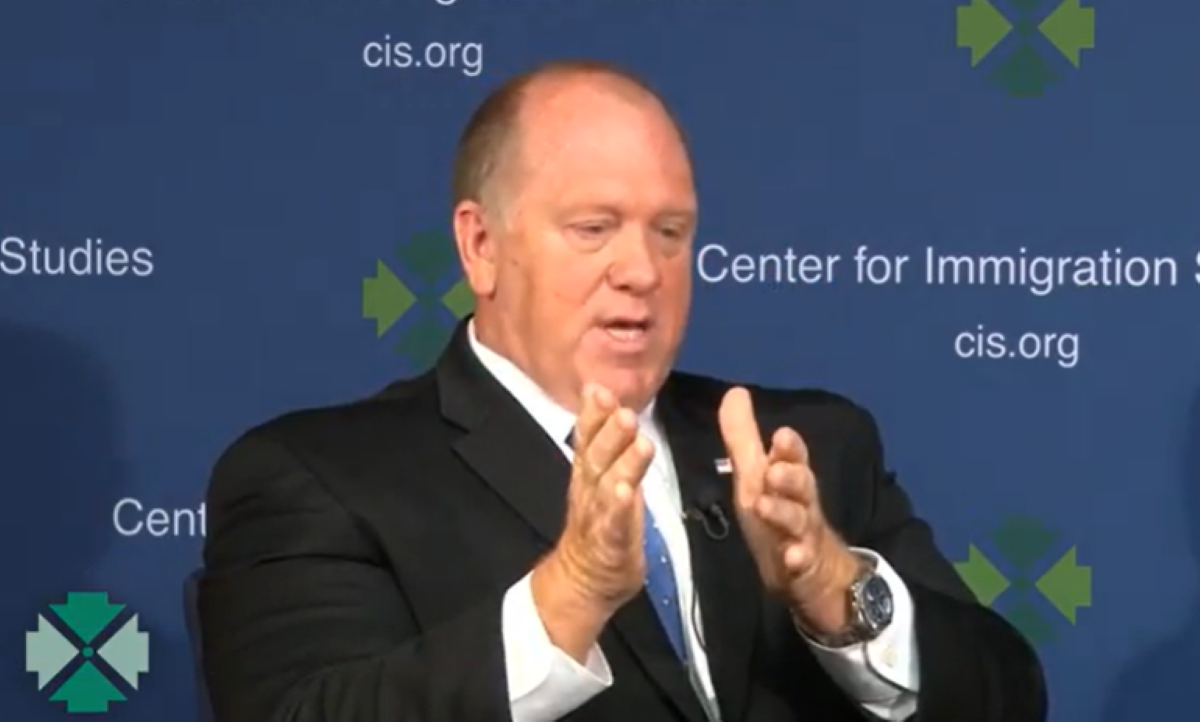
On Monday, President Trump dispatched “border czar” (or “tsar” to the BBC) Tom Homan to oversee what had become an increasingly contentious immigration operation in Minneapolis, Minn. If you’re a baseball fan, you’ve seen this pattern before: In the late innings, with the game tight and tense, the manager calls the bullpen to send the team’s “ace reliever” to the mound to calm things down. The fact that the move has drawn wide acclaim is the only notable part of the switch.
The Minneapolis Timeline
All of this began two weeks after President Trump returned to office, when Minnesota Attorney General Keith Ellison (D) issued an opinion concluding that state and local law enforcement agencies in his jurisdiction were prohibited from “holding someone based on an immigration detainer if the person would otherwise be released from custody”.
In other words, ICE officers could stand at jailhouse doors in Minnesota waiting for criminal aliens to be released, but state and local officials couldn’t retain them for agency pickup.
The problem is that ICE has only a limited number of permanent officers stationed in the Land of 10,000 Lakes, and the state has 11 prisons and prison facilities with various other jails and detention centers spread across its 87 counties where that handful of officers would now be expected to cool their heels.
Next, during his May commencement address at the University of Minnesota Law School Gov. Tim Walz (D) (the Democratic party’s 2024 vice presidential nominee) referred to ICE as “Donald Trump's modern-day Gestapo”, and claimed the agency was:
scooping folks up off the streets. They're in unmarked vans, wearing masks, being shipped off to foreign torture dungeons, no chance to mount a defense, not even a chance to kiss a loved one goodbye, just grabbed up by masked agents, shoved into those vans and disappeared. To be clear, there's no way for us to know whether they were actually criminals or not because they refused to give them a trial.
In late September, DOJ sued Minnesota, the “Twin Cities” of Minneapolis and St. Paul, Hennepin County, and Ellison over their “sanctuary” policies, which the department claimed “interfere with the federal government’s enforcement of its immigration laws”.
As U.S. Attorney General Pam Bondi claimed at the time: “Minnesota officials are jeopardizing the safety of their own citizens by allowing illegal aliens to circumvent the legal process.”
Then, a series of fraud scandals that had been brewing in the state for years involving countless actors, including immigrants, burst into the national spotlight over the late fall, highlighted by the case of one notably bold Minnesota-based nonprofit called “Feeding Our Future”.
Feeding Our Future is alleged to have exploited a Covid-era child nutrition program to steal $250 million in public funds meant to feed needy kids, and as the FBI explained in September 2022:
The charges allege that beginning in early 2020, the organization began recruiting individuals and entities to open fake Federal Child Nutrition Program sites throughout Minnesota. These sites, created and operated by the defendants and others, fraudulently claimed to be serving meals to thousands of children a day within just days or weeks of being formed despite having few — if any — staff and little to no experience serving this volume of meals.
In exchange for sponsoring these sites’ fraudulent participation in the program, Feeding Our Future received more than $18 million in administrative fees it was not entitled to.
For some strange, unknown reason, this scandal largely flew under the national radar when Walz was running for vice president, but by late November 2025, even the New York Times had to admit that “members of the Somali diaspora, a group with growing political power, were largely responsible” for fraud that “swamped Minnesota’s social services system on Tim Walz’s Watch”.
Operation Metro Surge
A combination of the massive welfare fraud alleged in Minnesota and the state’s intransigence over ICE enforcement prompted DHS to launch “Operation Metro Surge” in the Twin Cities and their environs in early December.
By the end of January, some 3,000 ICE and CBP officers and agents were operating in the state, digging into the fraud but more notably arresting aliens (including many serious criminals) in high-profile street operations that drew resistance from “protestors”, more than a few of whom attempted to interpose themselves into immigration arrests.
One of those alleged protestors was Renee Good, a 37-year-old woman shot to death by an ICE officer in Minneapolis during an immigration-enforcement operation on January 7.
Various DHS and state and local Democratic elected officials (including Minneapolis Mayor Jacob Frey (D)) quickly responded with public statements offering their own spin on Good’s death, but as I noted at the time, the one who cautioned patience until an official investigation could be completed was Homan.
The killing — and the various official responses — heightened tensions in Minnesota, and they only got worse on January 15, when an ICE officer shot a Venezuelan migrant after he was allegedly attacked by men with snow shovels.
Three days later, 30 to 40 anti-ICE protestors disrupted Sunday worship services at the Cities Church in St. Paul, allegedly because one of the pastors at the Baptist affiliate is also an ICE official in the state.
Festering Tensions Come to a Head
The festering tensions came to a head, however, on January 24 when 37-year old Alex Pretti was shot by CBP agents during an immigration enforcement operation in Minneapolis.
The president was apparently in the White House, which was experiencing a heavy winter storm that day, and closely following the press reporting on the Pretti shooting.
He called both Walz and Frey on Monday, and on Tuesday vowed: “We’re doing a big investigation. I want to see the investigation. I’m going to be watching over it. I want a very honorable and honest investigation.”
Most importantly, however, the president sent Homan to Minnesota to meet with state and local officials and to oversee ICE enforcement there.
The Czar
Tom Homan is 64, and has spent his adult life in law enforcement, first as a cop in Upstate New York and then, beginning in 1984, as a Border Patrol agent in the former Immigration and Naturalization Service (INS) where he served initially in southern California.
He later became an INS special agent and continued through the ranks.
Under the Obama administration in 2013, he rose to head ICE’s Enforcement and Removal Operations (ERO) directorate, the branch of the agency exclusively tasked with investigating, arresting, detaining, and removing aliens from the United States.
In 2015, Obama awarded Homan the Presidential Rank Award, which was established in 1978 to “recognize a select group of career members of the Senior Executive Service (SES) for exceptional performance over an extended period of time”. Homan received the award for “his exemplary leadership and extensive accomplishments in the area of immigration enforcement”.
He planned to retire when Obama left office, but the incoming President Trump asked him to stay on to serve as acting ICE director; then, at the beginning of his second term the president called Homan back to serve as border czar, a real but unofficial position with a wide portfolio over immigration enforcement.
Law-Enforcement Sense and “Small-P” Political Sensibilities
In the same way that you can’t build a multi-billion-dollar real estate portfolio like Trump’s without an ability to adjust quickly to facts on the ground, you can’t rise from the border to HQ, work with distinction under six presidents, and serve two administrations as diverse as Obama and Trump without having good law-enforcement sense and strong “small-p” political sensibilities.
Homan is both paradigm and paradox, the hard-nosed cop whose eyes moisten over when he talks about the hells suffered by smuggled migrant children. And if your son or daughter was missing or your family threatened, he’d be the officer you’d want to respond to your call, and if he did, you’d get an immediate sense of relief.
Most importantly, he knows that order is the goal of law enforcement, and order has been in short supply in Minnesota of late. Homan acts, not reacts, and would likely be bemused by any suggestion that his latest appointment represents a “retreat” from the president’s stated immigration goals.
The opinions of cosplaying gadflies aside, this is a republic, not a dictatorship, and consequently even the most righteous and logical policy will fail without popular support. There’s a right way and a wrong way to enforce immigration laws, and after four decades plus, Homan knows the difference.
Life isn’t baseball, but there are similarities between “America’s Pastime” and political life. When the game is tense and the outcome uncertain, a smart manager calls the bullpen for a reliever to calm things down. On Monday, Trump tapped his immigration ace, Tom Homan, to take the mound in Minnesota.