
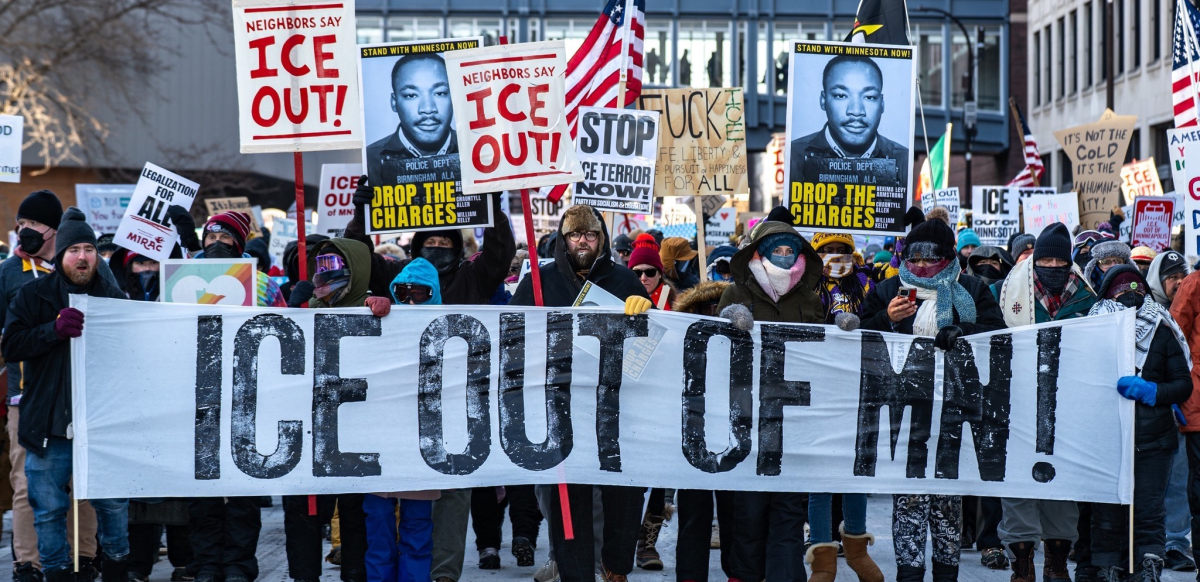
On January 12, the State of Minnesota and the Twin Cities (Minneapolis and St. Paul) filed a lawsuit in the United States District Court for the District of Minnesota asking the court to essentially shut down federal immigration law enforcement in Minnesota and evict DHS law enforcement personnel from the state.
The lawsuit represents overreach on a scale so epic I don’t think even Steven Spielberg, George Lucas, James Cameron, and Peter Jackson combined could bring it to the big screen. I could understand a lawsuit seeking to enjoin allegedly illegal/unconstitutional law enforcement tactics as part of the Department of Homeland Security’s (DHS) “Operation Metro Surge” in Minnesota. Let the state and the Twins make their case in court and we’ll see who prevails. But to ask a federal court to forbid the federal government from enforcing federal immigration law in Minnesota without the express written consent of Minnesota Gov. Tim Walz and Minneapolis Mayor Jacob Frey, well, that takes chutzpah.
But that is indeed the “relief” that Minnesota and the Twins actually sought. Their Complaint for Declaratory and Injunctive Relief (Complaint) asked the court to “Hold unlawful and enjoin [DHS’s] unprecedented surge of … agents in Minnesota or any other similar action in Minnesota, over the objection of the Governor of Minnesota and Mayors of Minneapolis and Saint Paul.” As DHS argued in its Defendants’ Memorandum of Law in Opposition to Plaintiffs’ Motion for Temporary Restraining Order/Preliminary Injunction (Defendants’ Opposition to Plaintiffs’ Motion), “This relief, if granted, would effectively give Minnesota state and local officials veto power over federal immigration enforcement within the borders of Minnesota.” And Minnesota’s and the Twins’ Amended [Proposed] Temporary Restraining Order demanded that “within 3 days, [DHS] must reduce the numbers of officers and agents deployed in Minnesota to the [paltry] levels that existed … prior to the commencement of Operation Metro Surge on December 1, 2025”.
The case was assigned to United States District Judge Katherine Menendez, who was nominated for a district court judgeship by President Joseph Biden and confirmed by the Senate in 2021, after serving as a federal public defender for decades (before becoming a federal magistrate judge). She started out working for the Federal Defender for the District of Minnesota as a “[George] Soros Justice Fellow”. These fellas get to do things like “explore innovative solutions to issues like mass incarceration, the criminalization of immigrants, racial inequalities, and police brutality”. Which party do you think had the home field advantage on this one?
Well, maybe James Cameron could have filmed this after all, for the lawsuit rammed into an ICE-berg and it went down like the Titanic.
Judge Menendez had to, in her words, “decide[] whether to grant the extraordinary remedy of a preliminary injunction halting a federal law enforcement operation based upon the Tenth Amendment”. On January 31, she denied Minnesota’s and the Twin Cities’ request in Minnesota v. Noem, ruling that “Plaintiffs have not met their burden … [and] the[ir] motion is denied.”
I have to hand it to Judge Menendez. She wrote a very brave decision. She took her marching orders not from Antifa “protestors” and advocates for illegal aliens but from the language of federal statutes and decisions regarding the law and the U.S. Constitution by the Eighth Circuit Court of Appeals (which encompasses Minnesota) and the U.S. Supreme Court.
I can assume that Judge Menendez knew the opprobrium she would face in Minnesota for refusing to engage in judicial activism, knew she might be disinvited from more cocktail parties than Minnesota has lakes. As Margery Beck and Jake Offenhartz reported for the Associated Press, her decision did not sit well with nurse Carrie Schmitt-Jost, who proclaimed “Shame on the judge[.] But it won’t stop us.” And it did not sit well with middle school teacher Tucker Johnson, who proclaimed that her decision was “not surprising, but it’s awful”, adding “Our students can’t get an education, because they and their families are too scared to go to school. That’s wrong, no matter what the court says.” A Facebook feed is instructive. One commenter stated “A Biden appointee too. Nice.” Another commented “Coward Kate.” There was one incisive comment on the feed: “Not to kvetch, he said kvetching, but it’s obviously too broad even to a nonlawyer like me. The Feds get to handle, or mishandle, immigration; arguing that they're mishandling it is fine, but arguing that they can't handle it ain't going anywhere.” Not to kvetch, but didn’t I say that in the second paragraph?
Operation Metro Surge
Gov. Tim Walz has labeled “Operation Metro Surge” as “a physical assault”, “an armed force that’s assaulting, that’s killing my constituents, my citizens”. And Mayor Frey confided to the New York Times’ Lulu Garcia-Navarro that “What we have seen feels like an invasion.” Those remarks were echoed in Minnesota’s and the Twins’ Plaintiffs’ Reply Memorandum in Further Support of Their Motion for a Temporary Restraining Order (Plaintiffs’ Reply Memorandum), which called the law enforcement initiative “a coercive invasion of a State” and “an unprecedented and unconstitutional invasion of Minnesota by thousands of heavily armed federal officers”. As I have written, a “federal invasion” of a state — where have we heard that rhetoric before in American history? The brain trust of Minnesota and the Twin Cities are following in the grand tradition of the arch-enemies of Black Americans’ long and tortuous struggle for civil rights, most notably Alabama’s segregationist Gov. George Wallace and the implacable foes of post-Civil War Reconstruction in the defeated Confederacy.
In any event, Minnesota’s and the Twins’ Complaint contended that DHS’s actions “appear designed to provoke community outrage, sow fear, and inflict emotional distress, and they are interfering with the ability of state and local officials to protect and care for their residents”, and their Reply Memorandum bemoaned the fact that they “are suffering more than just a proverbial gun-to-the-head: the federal government has deployed 4,000 agents with actual guns, and those agents are engaged in a pattern of lawlessness, including excessive force, racial profiling, retaliation, and reckless driving, to name a few”.
The Complaint and the plaintiffs’ briefs do refer to the tragic fatal shootings of two protestors in Minneapolis by DHS officers. As I have stated, any potentially unlawful use of force — especially deadly force — by federal law enforcement officers must be fully and fairly investigated and potentially lead to sanctions up to and including criminal prosecution.
But what sort of complaints about “Operation Metro Surge” actually take up the most ink in the Complaint? Let me mention a few.
Most outrageously, DHS personnel have been parking in city-run parking lots in Minneapolis! I am not kidding. The Complaint alleged that “DHS agents can be seen on City property surveillance footage unlawfully loitering in City-owned parking lots” and that “DHS agents commandeered [a] City owned parking lot … without authorization from the City to stage immigration enforcement actions.” What are the consequences of this perfidy? “The presence of DHS agents in these parking lots both practically restricts residents from using the commandeered space for lawful parking, and on information and belief, quells residents’ desire to recreate in City parks and recreation centers.” Further, “DHS consistently has a presence of vehicles and agents in the parking lot of a Karen-owned market in Saint Paul”, and Karens have complained that such parking “interferes with their ability to feel safe to purchase their culturally specific food which in turn harms the revenue of those local businesses”. (The Karen are a minority ethnic group from Burma many of whom have been resettled in the U.S.)
The horror, the horror! As DHS stated in its Defendants’ Opposition to Plaintiffs’ Motion, “Plaintiffs provide no legal authority to support the proposition that federal officers, while enforcing federal law, violate the Tenth Amendment when they temporarily park in city-owned public parking lots.”
What else? The Complaint alleged that the Minnesota Department of Transportation’s (MnDot) “Central Shop” had to “turn[] off its HVAC systems due to DHS’ use of chemical irritants against protestors”! How dare DHS personnel try to protect themselves against protestors trying to illegally impede federal law enforcement efforts, often violently? DHS’s irritating use of irritants left MnDOT “unable to perform work necessary to repair a traffic signal in its usual timeframe, requiring at least one known intersection to remain on a four-way stop setting for hours longer than typical” and “unable to perform scheduled work on snowplow fabrication”.
What else? The Complaint alleged that “Customer-facing businesses … are reporting decreases in revenues of 50-80% because their customer base was not comfortable to patronize the businesses due to the increased immigration enforcement.” Could all this be because much of the customer base of these businesses is not lawfully present in the United States?
What else? The Complaint complained that “DHS agents have been conducting raids at job sites and businesses, detaining and deporting individuals while they perform essential work that directly benefits Plaintiffs’ communities” and “Employees of small businesses … have … been requesting reduced hours or did not feel comfortable coming to work altogether at the risk of being stopped by DHS.” I should remind Minnesota and the Twins that under federal law, it is unlawful for employers “to continue to employ [an] alien … knowing the alien is (or has become) an unauthorized alien with respect to such employment”, with criminal penalties available for employers who “engage[] in a pattern or practice of violations”.
The Complaint complained further that “Not only are employees afraid while at work, which affects their ability to do their jobs effectively, but City employees are afraid to come to work, which has caused staffing shortages and recreation program cancellations.” The knowing employment of unauthorized aliens is still unlawful, even if the employer is Minnesota or the Twins.
What else? In their Plaintiffs’ Memorandum of Law in Support of Motion for Temporary Restraining Order, Minnesota and the Twins stated:
Public schools were forced to cancel school over multiple days for thousands of students due to safety concerns because of Defendants’ “surge” and tactics. … And school leaders say that absenteeism is climbing because families and students are too scared to come to school. These concerns are the predictable result of Defendants’ conduct.
As I have written, it seems pretty clear that certain school districts are acting with the goals of substantially helping illegal aliens to remain in the U.S. and helping prevent their detection by federal law enforcement. These constitute federal felonies for persons “who ... knowing or in reckless disregard of the fact that an alien has come to, entered, or remains in the United States in violation of law, conceals, harbors, or shields from detection, or attempts to conceal, harbor, or shield from detection, such alien in any place”.
What else? The Complaint alleged that “[o]fficers have … responded to multiple incidents to maintain public safety where there is a tense protest situation caused by [DHS’s] aggressive and reckless actions” and “the cumulative psychological impact … may contribute to increased attrition … as officers confront the destabilizing effects of actions by [DHS] on the community they are sworn to protect”. Minneapolis police officers are sworn to protect illegal, criminal, and other removable alien residents of the city from enforcement of federal law?
What else? The Complaint alleged that DHS “agents’ tactics … sap state and local resources when local law enforcement officers are called away from their important work to respond to avoidable incidents Defendants’ agents cause”. By “avoidable incidents”, the Complaint refers to DHS’s temerity in actually enforcing federal law.
The Complaint noted perfunctorily that “impacts … are not limited to noncitizen immigrants [without legal status] staying home due to fears, or noncitizens being removed and therefore unable to patronize or work at businesses”. Not that there’s anything wrong with that, as they do “comprise a small, but important, part of Minnesota’s economic landscape”! It alleged that “native-born citizens, naturalized citizens, and legally present immigrants … also report staying home, fearing … the risk of illegal detainer, arrest, deportation, or other abusive deprivation of rights without due process”. OK, just to humor Minnesota and the Twins, I should perfunctorily note that long-standing Supreme Court precedent provides, as explained by the Court in its 1953 decision in Shaughnessy v. U.S. ex rel. Mezei, that:
[A]liens who have once passed through our gates, even illegally, may be expelled only after proceedings conforming to traditional standards of fairness encompassed in due process of law. ... But an alien on the threshold of initial entry stands on a different footing: “Whatever the procedure authorized by Congress is, it is due process as far as an alien denied entry is concerned.”
Minnesota and the Twins asserted in their Plaintiffs’ Reply Memorandum that DHS does “not contest that [it] ha[s] engaged in a pattern of illegal conduct designed to create a public safety crisis; and do not contest that [it is] creating a public safety crisis”. That is quite a bizarre assertion. As Judge Menendez explained, DHS “do[es] not concede that the federal agents involved in Operation Metro Surge are engaged in brazen lawlessness, but state[s] that ‘the actions of federal officers over the past six weeks match’ the operation’s purpose of ‘enforcement of federal law’”.
Finally, Minnesota and the Twins stated in their Plaintiffs’ Reply Memorandum that “It is as if [DHS] threw a party in Plaintiffs’ home, trashed it, and are now saying: ‘Well, [Minnesota and the Twins] don’t have to clean up the mess ...’ And what a violent, dangerous mess it is that [DHS] ha[s] intentionally created.” (Emphasis in original.) What is this, Risky Business? Tim Walz is channeling Tom Cruise’s iconic character’s father, saying “I don't remember giving permission for a party, Kristi.”
The Empty Lawsuit
DHS argued in its Defendants’ Opposition to Plaintiffs’ Motion that:
If a State’s diversion of resources in response to federal action itself amounted to unconstitutional coercion, the federal government would be paralyzed. Visits by the President and other high-ranking federal officials often result in temporary closure of state-owned roads and divert state law enforcement resources. A federal indictment of a person held in state custody may have the predictable effect of local authorities taking action to facilitate that person’s federal prosecution. But the Tenth Amendment does not give a state or a city a veto power over those federal activities.
DHS then homed in on the Supreme Court’s 2023 decision in United States v. Texas, quoting the Court’s statement that “in our system of dual federal and state sovereignty, federal policies frequently generate indirect effects on state revenues or state spending”. DHS explained that:
Just three years ago, the Supreme Court [in Texas] rejected by an 8-1 vote the reverse of this lawsuit — a suit brought by two states to compel more immigration enforcement. … The states claimed the federal government’s immigration enforcement policy injured them because “they must continue to incarcerate or supply social services such as healthcare and education to noncitizens who should be (but are not being) arrested by the Federal Government.” … That “extraordinarily unusual lawsuit” failed on standing grounds, in part because of the Executive’s substantial enforcement discretion. … If these downstream costs of federal action are insufficient to create standing, they certainly do not constitute an ipso facto violation of the Tenth Amendment. [Emphasis in original.]
Judge Menendez was on the same wavelength:
In United States v. Texas … Texas and Louisiana sued DHS, arguing that DHS was not doing enough to arrest and remove noncitizens from the United States, and in doing so, “impose[d] costs on the States” because they had “to incarcerate or supply social services such as healthcare and education to noncitizens who should be (but are not being) arrested by the Federal Government.”… There, the Supreme Court held that Texas and Louisiana lacked standing to bring those claims, in part, because of the substantial discretion the Executive Branch has over arrest and detention decisions, as well as the absence of “meaningful standards for assessing the propriety of enforcement choices in this area.” … Moreover, the Supreme Court explained that “in our system of dual federal and state sovereignty, federal policies frequently generate indirect effects on state revenues or state spending,” and “when a State asserts, for example, that a federal law has produced only those kinds of indirect effects, the States’ claim for standing can become more attenuated.”
She concluded that “If such downstream costs of Executive Branch enforcement decisions do not constitute an injury in fact sufficient for states to have standing to sue, it seems unlikely that the effect of such costs could form the basis of a Tenth Amendment anticommandeering violation.”
As DHS argued in its Defendants’ Opposition to Plaintiffs’ Motion, Minnesota and the Twins “demand an unprecedented injunction against a federal law-enforcement operation, effectively seeking a state veto over the enforcement of federal law by federal officers” (emphasis in original), a “remarkable request to expel federal law-enforcement from their State”. “Nothing in the Constitution remotely countenances this absurdity.”
Judge Menendez was not keen on granting such an unprecedented injunction. She wrote that:
[E]ntry of a preliminary injunction would require the Court to conclude there is a “fair chance” that the Supreme Court’s limited Tenth Amendment anticommandeering precedent bars federal government action in the unprecedented situation presented in this case. While this alone does not render injunctive relief improper, it weighs heavily against the issuance of an injunction.
And she concluded that:
Plaintiffs ask the Court to extend existing precedent to a new context … namely, to an unprecedented deployment of armed federal immigration officers to aggressively enforce immigration statutes. None of the cases on which they rely have even come close.
[T]he Court finds that Plaintiffs cannot cross the foremost hurdle in their request for an injunction on their Tenth Amendment claims because they have not shown a sufficient likelihood of success on the merits.
Judge Menendez noted that “The Eighth Circuit has recently reiterated that entry of an injunction barring the federal government from enforcing federal law imposes significant harm on the government [citing the circuit’s 2025 decision in Tincher [v. Noem].” She quoted Supreme Court Chief Justice John Roberts, Jr.’s 2012 in-chambers opinion in Maryland v. King: “Any time a state is enjoined by a court from effectuating statutes enacted by representatives of its people, it suffers a form of irreparable injury.” And she noted that DHS “ha[s] presented evidence that entry of the injunction requested by Plaintiffs would harm the federal government’s efforts to enforce federal immigration laws”. Finally, she noted — in the understatement of the year — that “issuing the requested injunctive relief — halting … [O]peration [Metro Surge] entirely — could overstep the judicial role”.
As my colleague Andrew Arthur might say, Judge Menendez’s decision was the judicial equivalent of Minnesota and the Twins being smacked upside the head.
In Part II, I will delve in detail into the legal issues involved in Minnesota v. Noem.