
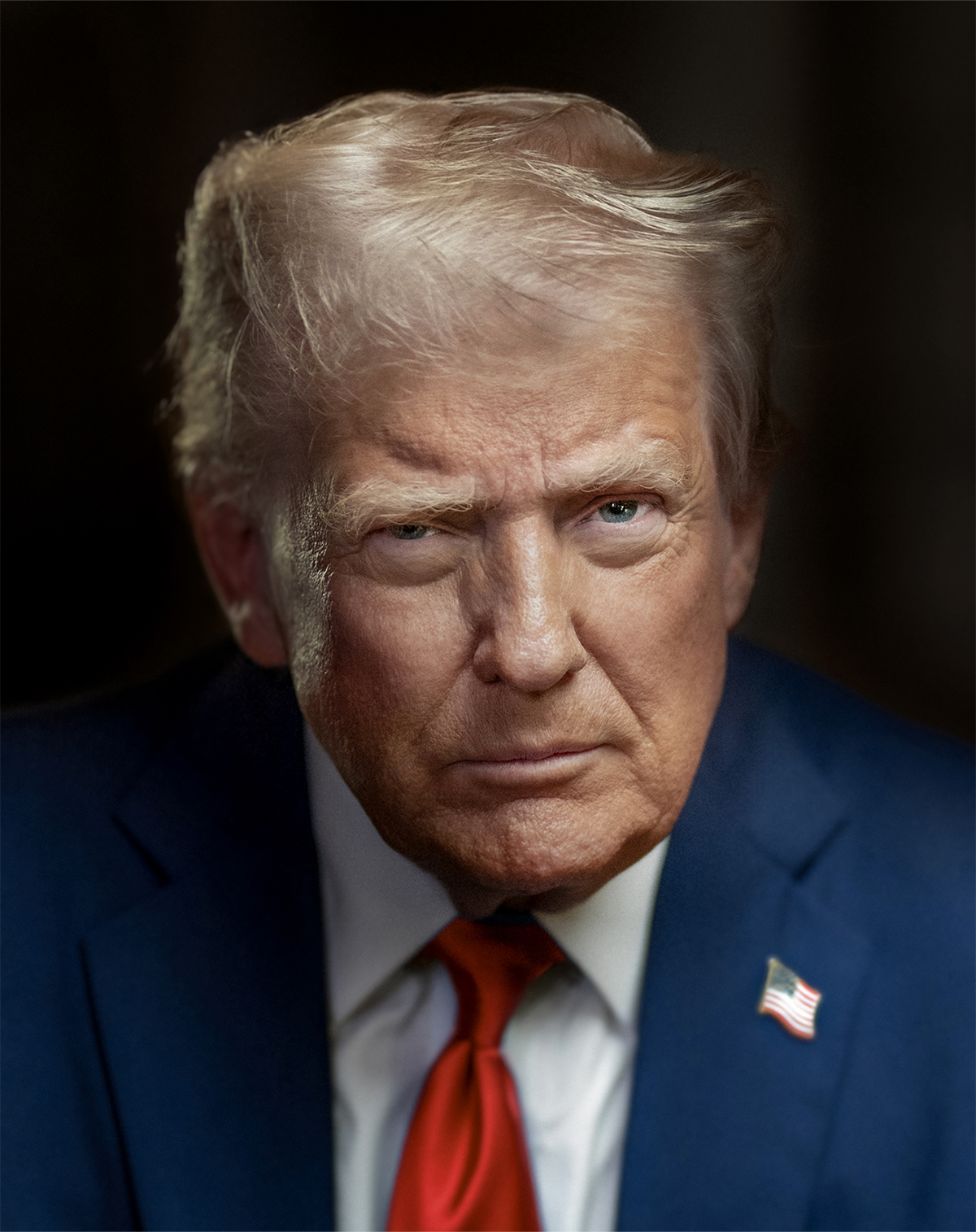
On January 7, the president sat down for a nearly two-hour interview with four reporters from the New York Times: Zolan Kanno-Youngs, Tyler Pager, Katie Rogers, and David E. Sanger. To spare you the trouble of reading all 23,000 words in the transcript of the Trump interview the Times provided, here are the key takeaways on ICE enforcement, worksite investigations, and the ever-dreaded “comprehensive immigration reform” (i.e., amnesty).
On ICE Enforcement
After a discussion of the shooting during an ICE operation earlier that day in Minneapolis, Minn., the following exchange occurred:
David E. Sanger: So is this what your ICE operations —
President Trump: I also think that, including me. I think that things happen because of statements that are made. Horrible statements are made. I watched the one woman screaming, the one woman in the car before she got shot — I heard was unbelievably bad, badly behaved. You’re supposed to listen to law enforcement. You can’t run over policemen, just can’t do that.
Zolan Kanno-Youngs: So just take a step back here, because this — there’s also — it’s more than just this shooting. You’ve also had American citizens that have been wrongfully detained, as well.
President Trump: That’s right, you’ve also had a lot of American citiz- — no.
Zolan Kanno-Youngs: I’m just putting the question to you.
President Trump: No, no, I just wanted to —
Zolan Kanno-Youngs: But are you comfortable with this operation so far? Is this what this operation was supposed to look like?
President Trump: You’ve had many American citizens killed. You’ve had —
Zolan Kanno-Youngs: Is this what this operation was supposed to look like?
President Trump: You have young Miss [Jocelyn] Nungaray killed. You’ve had so many people killed, by people that shouldn’t be in our country. These are criminals at the highest level. These are the worst criminals anywhere in the world. They came from the prisons of Venezuela. They came from the prisons of the Congo. They came from the prisons of many different countries, and Joe Biden, who was the worst president in the history of our country, allowed this to happen. Now I don’t think he had any idea. It’s like you just heard, you know, I mean, there’s not a lot of respect for Joe Biden from other leaders. You just heard that, but —
Zolan Kanno-Youngs: It sounds like you’re comfortable with this operation, all the tactics that ICE agents have used.
President Trump: No, I’m very uncomfortable with everything, I’m very uncomfortable with the fact that 11,888 murderers were allowed into our country. I’m very uncomfortable with the fact that drug dealers, drug lords — that people from mental institutions and people from jails and prisons were allowed into our country.
Zolan Kanno-Youngs: Another ICE case that might go before the court soon is one on — I guess the question would be, do you think ICE should be able to target people based on race and ethnicity alone?
President Trump: No, not based on race or ethnicity, no. No, I would say not. But, and I don’t think they do that. They base it based on records. You know, they find records of people that are murderers, and they try to get them out of our country.
Zolan Kanno-Youngs: There’s been legal challenges that are getting at this question as well.
President Trump: Sure. It’s going to be a legal challenge. Nobody else had a legal challenge, but I do.
Analysis: The Times likely pitched too many strawmen in that passage to tackle them all, but a few merit discussion.
First, the alleged ICE detentions of U.S. citizens, where two points stand out.
The first is that there is a difference, as a matter of law and fact, between “detentions” and “arrests” in the law enforcement context.
As I have explained elsewhere, ICE officers have the same right to engage in conversations with others that the rest of us have.
It’s only when the other person is detained in what’s known as a “Terry stop”, where civilians don’t feel free to leave, that ICE officers must have “reasonable suspicion” that an individual has committed a crime or, in the immigration context, that they may be removable.
If ICE officers make Terry stops without first establishing reasonable suspicion, the detentions violate Fourth amendment standards. That said, such violations — while regrettable — aren’t uncommon in law-enforcement generally, nor unique to ICE. Fortunately, they also are not usually overly intrusive, so most of the time the harm is minimal.
The second point is meant to dispel the commonly held misconception that ICE enforcement authority is limited to aliens.
Section 287(a)(5) of the Immigration and Nationality Act (INA) empowers immigration officers to make arrests for any crime — misdemeanor or felony — committed in their presence, as well as for any felony the officer “has reasonable grounds to believe that the person to be arrested has committed or is committing”.
This is not unique to immigration officers, either: IRS agents and postal inspectors have the same power by statute, as do most other federal officers.
Seriously: If ICE officers were on a hijacked airplane, would you want them to wait until they determined the hijacker was an alien before acting to subdue the malefactor? Federal agents are “force multipliers” for their fellows in law enforcement, as any street cop will tell you, and any elected sheriff who says otherwise is simply exposing his ignorance.
Most egregious, however, is the contention that there’s a pending case that hinges on the issue of whether “ICE should be able to target people based on race and ethnicity alone.”
The reporter appears to be referring to Perdomo v. Noem, a Supreme Court appeal of an order out of the U.S. District Court for the Central District of California (C.D. Calif.).
The C.D. Calif. judge had placed restrictions on four factors immigration officers may not — “alone or in combination” — rely solely upon to form reasonable suspicion: “apparent race or ethnicity”, “Spanish speaking or speaking English with an accent”, “presence at a particular location”, and “the type of work one does”.
In his concurrence to a September order placing that C.D. Calif. order on hold, Justice Kavanaugh noted that, “Under this Court’s precedents, not to mention common sense” the factors identified by the court below “taken together can constitute at least reasonable suspicion of illegal presence in the United States.”
There’s a big difference between saying ICE officers can rely on “race and ethnicity alone” in detaining a suspected alien and saying that it’s one of many factors they may rely on, particularly (as was the case in Perdomo) in an area where most unauthorized individuals share the same ethnicity.
To understand how nonsensical the Times’ defense of the C.D. Calif. order was, however, read the portion of the transcript where the reporters got into an argument with the president of the United States based on a single video of the Minneapolis incident over whether the shooting was justified or not.
None is either an experienced law enforcement officer or an attorney with background in the complex area of “use of force”, and yet each was certain that their collective take was correct.
Shortly thereafter, however, they questioned whether experienced immigration officers can accurately determine whether a suspect is an alien without status in the United States. In reporting as in law enforcement, a little humility goes a long way.
On Worksite Investigations
Zolan Kanno-Youngs: Do you think some industries still need immigrant labor?
President Trump: Yes.
Zolan Kanno-Youngs: Which ones?
President Trump: They need inexpensive — well, there are different things.
David E. Sanger: Do we need people to come in?
President Trump: Just so you understand something: I’m all for people coming into our country through the border legally, if they come in legally. I want them more than they want me and more than they want this country. And if you look at my first term and if you look at this term, I want — we need people. We’re building factories all over the country. We’re build —
Zolan Kanno-Youngs: But you said agriculture and hotels — that you wanted ICE to use common sense against them, right?
President Trump: — but I want them to come in — yeah, respectfully — I want them to come in legally. I want them to use common sense.
Zolan Kanno-Youngs: Have you directed ICE to ease deportations —
President Trump: Yes, I have.
Zolan Kanno-Youngs: — against those industries?
President Trump: Yes, I have.
Zolan Kanno-Youngs: Are there other industries that you’ve directed ICE to ease deportations?
President Trump: Because I watch farmers, and I deal with farmers, and I won 90 percent of the farmers — more than that and they’re great people. And they have great people working for them who have been working for them for 25 years. They are almost like a member of the family, and I don’t want those people thrown out of the country.
Zolan Kanno-Youngs: Are there other industries or companies that you’ve directed ICE to ease deportations on?
David E. Sanger: Well, the South Korean case.
President Trump: Some service industries, some — I’ll give you an example in Georgia, with South Korea. They make batteries. Batteries are very complex, and they’re very dangerous to make, and they make them, and they brought in three or four hundred people who specialize in batteries —
David E. Sanger: And ICE grabbed them all.
President Trump: — and they threw them out. And I was very angry about it. You know why? Because they have to open a factory, and you can’t take a person off the street who’s never seen a battery before and think that they’re going to make highly complex batteries.
David E. Sanger: Any other cases where you have told ICE to back off?
President Trump: I’ll tell you, or no — I’ll tell you what’s, what’s happening. We have not only your basic industries, but we have very complex industries coming in. Chip makers, they’re coming in from Taiwan. Computer makers, they’re coming in from all over the world — South Korea, from all over the world in order to avoid tariffs. I want them to be able to bring in some of their experts to help them open their plants and factories, because if they don’t, it’s not going to be possible for them to make that progress.
Analysis: There are two different questions at issue in that excerpt, one having to do with the need for uniquely high-skilled immigrant labor in certain sectors (like the construction of battery factories) and the other with low-skilled labor involving unauthorized individuals.
The biggest issue with high-skilled immigration is that some employers have used it to bring in so-called “necessary” workers to do jobs “American workers” (both citizens and green card holders) could do, preferring the former because they work more cheaply and are more subject to the employers’ control.
Given that section 212(a)(5)(A)(i) of the INA bars the admission of aliens to perform “skilled or unskilled” labor when there are American workers to do such jobs and the labor of such aliens will “adversely affect the wages and working conditions of workers in the United States similarly employed”, their entry appears to violate the law.
Still, employers keep trying — often successfully — to import cheaper and more pliable skilled labor, but for the first time in a long time interests in this country are pushing back, aided by a soft market for newly minted graduates with often pricy university degrees.
Balancing out the demands of industry with the desire among young voters (and their parents) to land a career is among the more difficult immigration tasks the president is facing, as that excerpt reveals.
More theoretically, Trump faces a similar dilemma when it comes to the large number of unauthorized aliens working at the bottom rungs of the economic ladder.
There’s no question the administration wants to drain the illegal alien pool, and while that’s still wildly popular in the abstract, it often becomes less so in the concrete.
Consider how many times you hear references to the president’s deportation policies when pundits are discussing volatility in the food and construction sectors, and you’ll understand why Trump highlighted them in his response.
Like a physician using methadone to ween a junkie off heroin, the president is trying to take the least disruptive immigration course for the economy. But any enforcement effort will fail without worksite enforcement, including in agriculture and the building trades, and the sooner Trump realizes that, the quicker the unauthorized population will decline.
On “Comprehensive Immigration Reform”
Zolan Kanno-Youngs: Sir, what’s — what’s the future for DACA [Deferred Action for Childhood Arrivals] recipients in your second term?
President Trump: Uh, I’ll let you know in about 12 months from now.
Zolan Kanno-Youngs: Should they feel safe in the country?
President Trump: I’d love — I’d love to be able to do something for them.
Zolan Kanno-Youngs: Should they feel safe? And they’ll be able to stay in the U.S.?
President Trump: Yes, they should feel safe, but I’d like to be able to do something.
Zolan Kanno-Youngs: Can you get — will they get work permits?
President Trump: To be honest, I’d love to be able to create an immigration policy that works for everyone.
Zolan Kanno-Youngs: You — like a comprehensive immigration reform?
President Trump: I would love to do it if it was possible.
David E. Sanger: Is Congress willing to go do that? George [W.] Bush tried.
President Trump: It takes two to tango. If the Democrats would do it, I’d do it. I’d love to have a comprehensive immigration policy, something that really worked. It’s about time for the country to have it.
Tyler Pager: What would that look like?
President Trump: Excuse me?
Tyler Pager: What would a comprehensive immigration policy —
President Trump: I don’t want to go into that because it’s a very — it’s a very ticklish subject. But I believe that there is a plan that can work for everybody. It takes two to tango. The Democrats have to agree. But the Democrats are their own worst enemy. That’s why they’re not sitting in this office. That’s why I am.
Zolan Kanno-Youngs: Would this immigration legislation involve —
President Trump: But I would love to see comprehensive immigration. I would love to see a plan that really worked for everyone.
Zolan Kanno-Youngs: Including pathway to citizenship for those undocumented here?
President Trump: Possibly. Possibly.
Zolan Kanno-Youngs: What would that legislation look like?
President Trump: It’s — it’s — I don’t want to talk about that, but possibly.
Analysis: Of all the statements the president made during that two-hour murder board, this exchange is the one that’s drawn the fewest responses.
Perhaps that’s because the president mentioned a “pathway” for DACA recipients and others in the past, most notably during his 2018 State of the Union (SOTU) address when, as my colleague Jessica Vaughan explained at the time, he “repeated his request that Congress produce a bill that provides an amnesty for 1.8 million illegal aliens with a 10- to 12-year path to citizenship in exchange for some of its border security and immigration enforcement wish list and reductions to chain migration”.
Still, few remember that SOTU amnesty proposal, so perhaps the blasé response has more to do with the fact that both the president’s supporters and his detractors don’t think he’s serious.
I have no idea how earnest Trump’s proposal is, but he’s never shied away from seeking historic (and unlikely) agreements in the past and would likely relish adding “fixed the immigration system” to his list of presidential accomplishments.
If the president is serious about striking a “comprehensive immigration” deal, I’d advise him to proceed with more caution than his fellow Republican, Sen. Jim Lankford (Okla.) demonstrated when he parleyed with Sens. Krysten Sinema (I-Ariz.) and Chris Murphy (D.-Conn.) behind closed doors for months before unveiling the so-called “bipartisan border bill” in early 2024.
Murphy brought Biden’s DHS into the negotiations (and likely a few private immigration proponents to boot), while Lankford attempted to negotiate in good faith with just his staff. It’s a tribute to the Sooner senator’s naiveté (and the text’s complexity) that he still doesn’t realize how bad a deal it was, but then most of the media was right there with him.
Trump would need to come into talks loaded for bear, leaving details for the wonkiest of legislative negotiators. If he’s serious, I’ll give him some names, but Hamas and the mullahs are softies compared to the confederacy of industry and immigration advocates he’d be up against.
That said, people who hate Trump (and they are legion) probably won’t like him any more for promoting even the most lavish of amnesties, while his most-dogged proponents may see any modest proposal as a sell-out.
Thanks to the 22nd Amendment, however, Trump may not be too concerned about short-term politics. He’s a dealmaker, and a picture of House Minority Leader Hakeem Jeffries (D-N.Y.) and Rep. Brandon Gill (R-Texas) together in the Rose Garden would make the Camp David Accords look like a mortgage closing.
* * *
Donald Trump has never been the immigration villain his legion of haters has portrayed him to be, but he’s not afraid to defend his people or his deportation policies, either. If you want to know how the president plans to respond to the millions of aliens here illegally, he’ll tell you, right in the pages of the New York Times.