
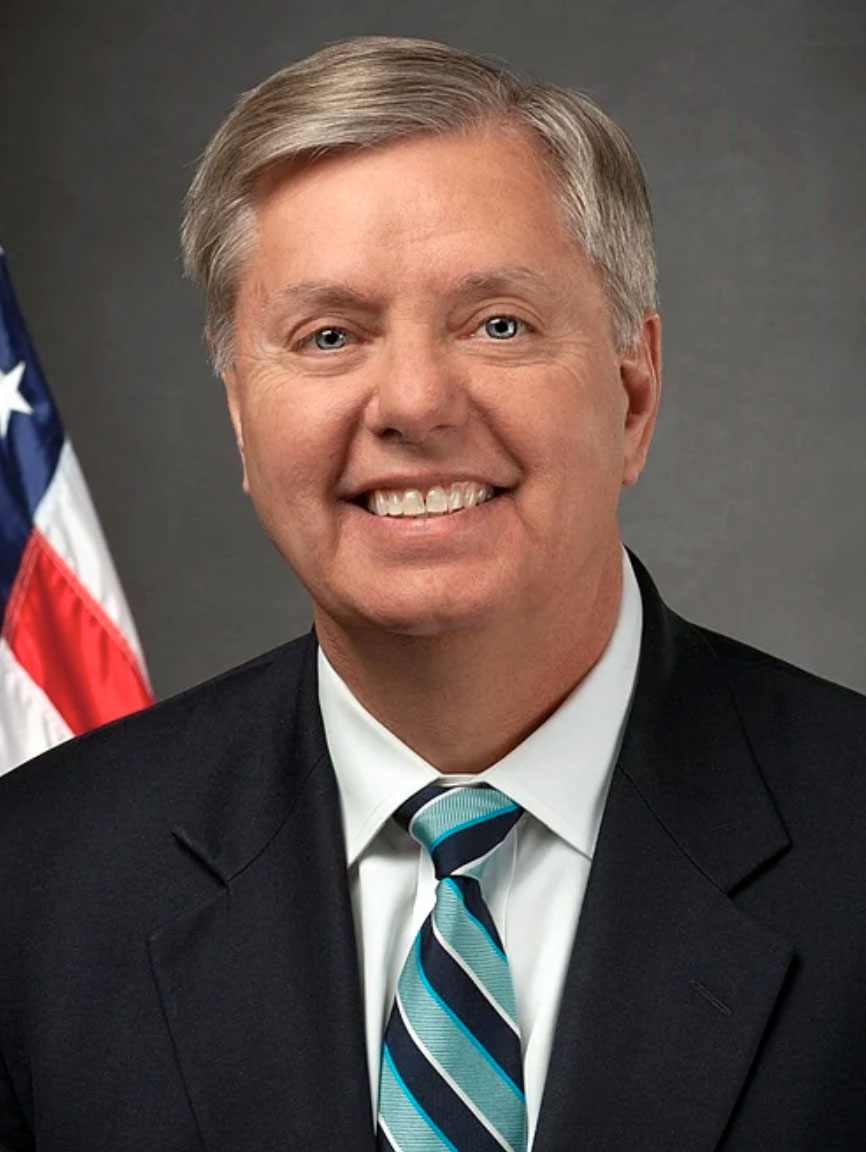
Lindsey Graham
Lindsey Graham (R), the senior senator from South Carolina, passed away unexpectedly in Washington, D.C., Saturday night at the age of 71. The man lauded as a “modern day lion of the Senate” left a unique immigration legacy, and a void larger than his single vote in a body struggling to enact key pieces of the president’s agenda before the congressional midterm elections — and to address the lingering fallout of the Biden years and curb “birth tourism”.
Public Service
The late senator was born in Seneca, S.C., a town in the western part of the Palmetto State with a current population of less than 9,500, not far from Clemson University but not near much else.
After receiving his bachelor’s and law degrees from the University of South Carolina, Graham served in the U.S. Air Force (1982 to 1988), the South Carolina Air National Guard (1989 to 1995), and the reserves (until 2015), eventually being elected to the South Carolina House of Representatives in 1992.
He wasn’t in the state legislature long, joining 51 other new GOP colleagues in the U.S. House of Representatives after Republicans swept the 1994 elections and captured the lower chamber for the first time in four decades behind Newt Gingrich’s “Contract with America”.
When he was sworn in on January 3, 1995, Graham became the first Republican to represent South Carolina’s 3rd congressional district since Reconstruction, with an assignment to the House Committee on the Judiciary.
Graham rose to prominence during his second House term when he was appointed to be a manager of the committee’s impeachment of then-President Bill Clinton in 1998.
He voted to impeach the 42nd president, but although the Senate eventually acquitted Clinton, Graham’s prosecution of the case raised his profile enough to put him in a position to replace long-serving GOP Sen. Strom Thurmond, who retired from the senate at the age of 100 in January 2003 after eight terms.
Graham was unlikely to ever best his predecessor’s tenure in the Senate but was seeking reelection to his own fifth term at the time of his death.
Comprehensive Immigration Reform
While the House Judiciary Committee has jurisdiction over most immigration-related questions, Graham didn’t do much on the issue until he arrived in the Senate.
Aside from an October 2005 statement lauding the passage of the 2006 DHS funding bill (which included “billions of dollars for improved border security through better technology, a larger border control force, and the building of additional physical barriers all of which should contribute to better border security”), the first major immigration-related press release issued by his office is dated March 9, 2006, and headlined “Senate Judiciary Committee Progress on Comprehensive Immigration Reform” in connection with S. 2611, the “Comprehensive Immigration Reform Act of 2006”.
While “comprehensive immigration reform” is almost always a euphemism for amnesty, that release only highlighted the proposal’s expansion of “border security”, through the use of “real” and “virtual” fencing (more the latter than the former).
The “legalization” part of that bill wasn’t mentioned until a release issued later that month, “Senate Judiciary Committee Approves Comprehensive Immigration Reform”, wherein Graham contended that “a process which will make our nation more secure by helping kick out the bad apples, allowing those who wish to work to continue doing so and benefit our national economy” wasn’t an amnesty because it didn’t “grant illegal immigrants an automatic pardon and put [them] on the fast-track to citizenship”.
S. 2611 died in the House, but comprehensive immigration reform cum amnesty was a proposal the senator continued to champion, most notably as one of the “Gang of Eight” credited with drafting 2013’s S.744, the “Border Security, Economic Opportunity, and Immigration Modernization Act”.
That gang was loaded with heavy hitters, including Democrat Sens. Chuck Schumer (N.Y.), Dick Durbin (Ill.), and Robert Menendez (N.J.) as well as Graham’s fellow Republican Sens. John McCain (Ariz.) and Marco Rubio (Fla., Trump’s current secretary of State).
Filling out the eight were Sens. Michael Bennet (D-Colo.) and Jeff Flake (R-Ariz.), who were sort of like the Christian Laettners in the otherwise stellar octet.
As the New York Times has explained, the bill:
revived the idea of pairing border security measures with expanded immigration avenues, subject to meeting trigger thresholds on border security. The bill called for universal adoption of the employment eligibility system, known as E-Verify, to make it more difficult to hire undocumented workers and put most undocumented immigrants in the country on a 13-year pathway to citizenship. It would have awarded visas based on a points system, with about 50 percent based on job skills, and included temporary guest worker programs.
And it was also doomed in the House, where then-Speaker John Boehner (R-Ohio) refused to bring it to the floor in the face of opposition from a majority of the GOP conference that opposed any amnesty.
The DREAM Act(s)
So-called “DREAM Acts” are a more limited amnesty for aliens who have lived in the United States after arriving here as children (usually in the company of their parents and guardians), and they have been fixtures of the immigration debate for nearly a quarter century.
In August 2001, then-Sen. Orrin Hatch (R-Utah) introduced a bipartisan “DREAM Act”, which included 18 cosponsors. That bill would have granted amnesty to aliens unlawfully present for five years who entered under the age of 21, and who met certain work and educational requirements.
The timing could not have been worse, because less than six weeks later, the September 11 attacks dampened Congress’s ardor for legalization of anyone here illegally. Nonetheless, similar “DREAM Acts” were subsequently introduced in later Congresses.
Two bear special note.
In March 2009, Durbin offered up the “DREAM Act of 2009” during the 111th Congress.
At that time, Barack Obama was president, Democrats held an overwhelming majority in the House, and from September 24, 2009 (when Democrat Paul Kirk was appointed to fill the seat of the late Democrat Massachusetts Sen. Ted Kennedy) through February 4, 2010 (when Republican Scott Brown was elected to fill Kennedy’s seat), Democrats held a filibuster-proof majority of 60 seats in the Senate.
Obama’s fellow Democrats could have passed any bill — including and in particular the DREAM Act of 2009 — without any Republican votes. But that bill went nowhere. Cosponsor and then-Senate Judiciary Chairman Pat Leahy (D-Vt.) did not even bring it up in committee.
That said, two Republican senators — Mel Martinez (R-Fla.) and Richard Lugar (R-Ind.) — were cosponsors of the DREAM Act of 2009, so they probably could have blocked a filibuster even during the months Democrats only controlled a measly 59 seats in the upper chamber.
Obama blamed Republicans for the failure to pass a DREAM Act, but the fault was his and congressional Democrats alone — DREAM Act legislation simply was not a priority for a party that held a hammerlock on the legislative process.
Regardless, the failure of this DREAM Act legislation led to a 2012 administrative program called “Deferred Action for Childhood Arrivals” or DACA.
It granted quasi-legal status to aliens who entered the United States while under the age of 16 before June 15, 2007, met certain educational standards, and had not been convicted of certain crimes.
DACA was not created by Congress, or even by executive order or executive action for what that’s worth.
It’s the product of a memo issued by then-DHS Secretary Janet Napolitano on June 15, 2012. In my legal opinion, Napolitano lacked the authority to create DACA, but in any event it set a bad precedent and essentially relieved Congress of any responsibility to take any action with respect to “DREAMers”.
Nonetheless, Sen. Graham consistently supported most DREAM Act legislation, which brings me to the second notable iteration of that proposal, S. 365, the DREAM Act of 2023.
Graham was the only cosponsor of that bill, which was again introduced by Durbin, but it nonetheless didn’t even receive a hearing in the then-Democratic-controlled Senate.
When Durbin once again introduced that act (now S. 3448) in the current, 119th Congress, however, Graham averred he no longer supported it until the damage done to our immigration system during the Biden administration had been addressed, telling one outlet in December 2025: “Yeah, there will be no Dream Act. ... Not until you deal with the millions of people here illegally.”
“When I Am Chairman of the Senate Judiciary Committee Next Year”
Graham continued, explaining why neither such legislation for aliens who arrived as children nor any other form of mass legalization had much hope anytime soon: “One of the consequences of what Biden did by obliterating the borders is [he] made compromise on illegal immigration much more difficult.”
Biden and Graham had served for years in the Senate together, but the latter was a dogged opponent of his erstwhile colleague’s immigration policies once he entered the White House, famously excoriating then-DHS Secretary Alejandro Mayorkas during a March 2023 Senate Judiciary hearing over the threats he unleashed on the American people:
On your watch, Mr. Secretary, we have gone from the lowest illegal crossings in December 2020 to all-time highs with over 2 million last fiscal year. On your watch fentanyl is coming in at a pace we have never seen, more Americans are dying. On your watch, more terrorists on the watch list are coming than any time since we’ve been measuring these things. So I’m trying to get some appreciation from you that things are not going well. Your own Border Patrol chief said we don’t have operational control of the border and I don’t think it’s a definitional problem. I think he’s just being really honest with us. … But we play around with the problems. We don’t address them.
By the end, Graham had gone from amnesty supporter and DREAM Act cosponsor to the key sponsor of the recent ICE and CBP funding bill (S.2, the “Secure America Act”) and a vocal critic of the Supreme Court over its recent “birthright citizenship” opinion, Trump v. Barbara.
One of his last press releases dealt with that decision, and Graham didn’t hide his displeasure with the High Court while at the same time resolving to crack down on “birth tourism”, just one of the perverse incentives the justices had ignored in their opinion:
The United States is one of a handful of countries that allows foreign nationals, regardless of their parents’ legal status, to obtain citizenship simply by virtue of being born on its soil. There are entire industries that cater to families, including those from adversarial nations like China, who come to the U.S. with the sole intention of having their child born here so they automatically become an American citizen because they were born on U.S. soil. Birthright tourism is offensive to me, and it is offensive to the concept of American citizenship.
...
I will continue to push to fix this major pull factor for birth tourism and illegal immigration into the U.S. This would align America with the vast majority of the modern world. When I am chairman of the Senate Judiciary Committee next year, I will make this one of my top priorities.
Lindsey Graham is no longer around to helm Senate Judiciary in the 120th Congress (even assuming the GOP holds the body), so the task of addressing birthright citizenship and fixing the carnage of Biden’s ruinous four years will now fall on less experienced politicians. President Trump has lost a key ally, and regardless of what anyone thinks of the late senator’s earlier positions, America has lost a statesman.