
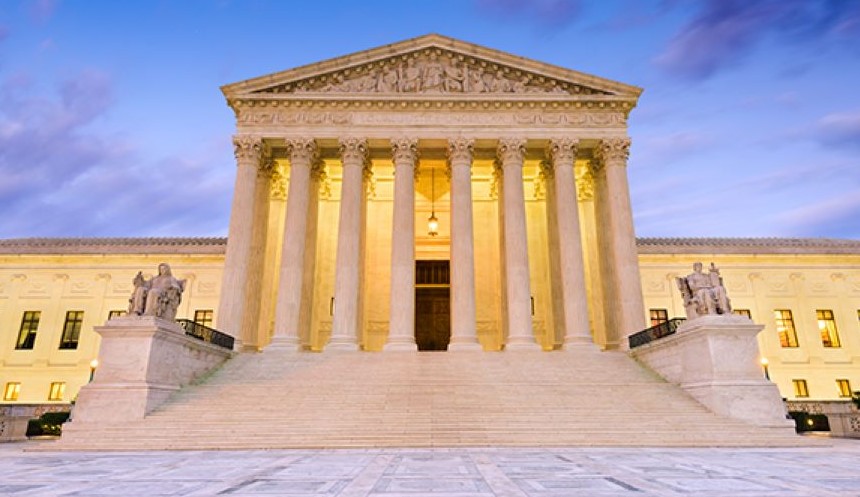
As the Supreme Court’s 2025 session speeds to a close in advance of the July 4th holiday, a number of immigration cases (most notably on “birthright citizenship”) are yet to be decided. On June 23, the justices got the ball rolling when they issueda ruling in Blanche v. Lau, defining the burdens borne by DHS when lawful permanent residents (“LPRs” or colloquially “green card holders”) appear at the ports seeking admission after they have committed criminal acts but before they are formally convicted. Justice Thomas wrote for a 6-3 majority, holding CBP officers don’t bear the onerous duty of concluding that such aliens are seeking admission “by clear and convincing evidence” before paroling them for criminal prosecution.
Muk Choi Lau
Muk Choi Law is a Chinese national who was admitted to the United States as an LPR in 2007 — an important date to keep in mind.
On May 12, 2012, he was charged in state court in New Jersey with “trademark counterfeiting”, arguably a crime involving moral turpitude (CIMT) with potential immigration consequences.
While those charges were pending, Lau left the United States and returned on June 15, 2012, when he was stopped by a CBP officer at John F. Kennedy International Airport (JFK) in New York.
“Because of his pending criminal charge, the officer did not regard Lau as already admitted, but instead as an applicant seeking admission.”
In an instance in which CBP properly used its authority under section 212(d)(5)(A) of the Immigration and Nationality Act (INA) to permit the entry of an alien without formal admission for “significant public benefit” — here, so he could appear at his pending criminal trial — the CBP officer “paroled” Lau into the United States.
Or as Justice Thomas explained:
Parole thus allows the Government to pause the inspection at the border and defer it to a later time without having to detain the alien pending a final admissibility decision, as would otherwise be required. The Government exercised that authority to parole Lau pending the resolution of his criminal case, instead of formally deeming him admitted.
Lau subsequently pled guilty to the state charge in June 2013, and just less than six months later, DHS placed him into removal proceedings and charged him as an applicant for admission who is inadmissible to the United States under section 212(a)(2)(A)(i)(I) of the INA.
That provision renders an alien inadmissible to the United States if the alien has been “convicted of, or admits having committed, or who admits committing acts which constitute the essential elements of” a CIMT.
“Admission” as Defined in Section 101(a)(13) of the INA
Section 101(a)(13)(a) of the INA defines the term “admission” (one key issue in this case) as “the lawful entry of [an] alien into the United States after inspection and authorization by an immigration officer”.
There are two important exceptions to that admission rule, both of which played a role in Lau’s case.
First, under section 101(a)(13)(B), an alien paroled into this country has not been “admitted”, consistent with language in the parole statute, section 212(d)(5)(A) of the INA, itself.
Second, under subparagraph (C) of section 101(a)(13) of the act, green card holders are not considered to be seeking admission when they return to the United States unless they: (1) abandoned their LPR status; (2) have been absent for more than 180 days (with exceptions); (3) “engaged in illegal activity” outside the United States; (4) departed while in removal proceedings; or (5) are attempting to enter illegally, “at a time or place other than as designated by immigration officers” and haven’t been admitted after inspection.
Or (6): they “committed an offense identified in section 212(a)(2)” of the INA — including a CIMT — “unless since such offense the alien has been granted relief”.
The Government’s Burdens in Removal Proceedings under Section 240 of the INA
As noted, DHS placed Lau into removal proceedings after his conviction, and those proceedings are governed by the rules established by Congress in section 240 of the INA.
That provision applies different burdens of proof on the government and on the alien (formally: “the respondent”) in removal proceedings depending on whether the alien is charged with inadmissibility under section 212(a) of the INA as an alien who has not been admitted to the United States or alternatively is charged with deportability after admission under section 237(a) of the INA.
Pursuant to section 240(c)(2) of the INA, applicants for admission charged with inadmissibility bear the burden of proving “clearly and beyond doubt” they are “entitled to be admitted” and aren’t inadmissible under section 212 of the INA.
Section 240(c)(3)(A) of the INA, however, puts the burden on the government to establish “by clear and convincing evidence that, in the case of an alien who has been admitted to the United States, the alien is deportable” under section 237 of the INA.
As a (crucial) aside, there is also a CIMT ground of deportability for aliens who have been admitted to the United States (section 237(a)(2)(A)(i)(I) of the INA), but it only renders green card holders deportable if they have been “convicted of a crime involving moral turpitude committed within five years after the date of admission”.
Lau’s 2013 conviction, however, was entered more than five years after he was first admitted with a green card to the United States, and therefore if he wasn’t “seeking admission” when he showed up at JFK after returning from abroad in June 2012, he wouldn’t be removable.
Enter the Second Circuit
The immigration judge found Lau removable as charged as an alien who hadn’t been admitted and who had been convicted of a CIMT, and the Board of Immigration Appeals (BIA) — the administrative tribunal in DOJ that reviews immigration decisions — dismissed his appeal.
Lau then filed a petition for review with the U.S. Court of Appeals for the Second Circuit, and in March 2025, the circuit court vacated the IJ’s removal order.
The Second Circuit concluded that the CBP officer at JFK “improperly classified” Lau as an applicant for admission who required parole when he arrived, finding it wasn’t enough for the officer to have determined that Lau had been charged with a CIMT in state court in New Jersey — the officer needed “clear and convincing evidence” he was inadmissible based on that crime under the BIA’s 2011 opinion in Matter of Rivens.
Matter of Rivens was a burden of proof case interpreting section 240(c) of the INA (see the “crucial aside” above) wherein the Board held that in removal proceedings involving a green card holder charged with inadmissibility under section 212 of the INA, the government bears the burden by “clear and convincing evidence” that one of the six exceptions to the section 101(a)(13)(C) rule that LPRs aren’t usually seeking admission when they appear at the ports applies.
The circuit court, however, rejected the BIA’s subsequent 2012 opinion in Matter of Valenzuela-Felix.
The Board there considered nearly identical facts as in Lau’s case (an LPR charged with a crime who then departed, returned, was paroled, was convicted, and was charged with inadmissibility under section 212) in reversing the immigration judge’s decision that Valenzuela-Felix should have been charged under section 237 with deportability instead.
The BIA in Matter of Valenzuela-Felix concluded that DHS “need not have all the evidence to sustain its burden of proving that the alien is an applicant for admission” when it paroles an LPR for prosecution, “but may ordinarily rely on the results of a subsequent prosecution to meet that burden in later removal proceedings” instead.
Lau v. Blanche
Which brings me to the Court’s June 23 opinion in Lau, where the majority refused to extend the “clear and convincing evidence” burden in Matter of Rivens to quickie determinations made by what they termed “border officers” who are confronted with LPRs like Lau returning to face criminal charges that would make them potentially inadmissible, reversing the Second Circuit’s judgment.
This is likely one of the easiest Supreme Court opinions to summarize.
Basically, Justice Thomas explained, reading the definition of admission in section 101(a)(13) together with the grounds of inadmissibility in section 212(a) of the INA, if an LPR has committed a CIMT, “he may be regarded as seeking admission. And, because he is seeking admission, he may be charged” under section 212, including for a CIMT.
Treating the Second Circuit as a slightly dim pupil, the majority broke this analysis further down into two steps: “While only commission of the crime is required at step one” (to show that the alien could be regarded as seeking admission), a “conviction” or the alien’s confession to committing the offense “is required at step two to show that the alien seeking to be admitted is inadmissible” (cleaned up).
The government satisfied both steps in Lau’s case, even though he didn’t admit he’d committed a CIMT when he was stopped at JFK and wasn’t convicted until after he was paroled.
The majority rejected the Second Circuit’s conclusion that DHS (here the CBP or “border” officer) was required to prove that Lau was inadmissible by clear and convincing evidence at the time he sought reentry at JFK — that’s a burden that doesn’t exist in the INA, and as noted it was only one the BIA in Matter of Rivens imposed on the government in subsequent removal proceedings.
Note that the majority didn’t exactly endorse the BIA’s holding in Matter of Valenzuela-Felix and remanded the case to the Second Circuit to consider whether Lau’s conviction is a CIMT (which that court passed on deciding), so this case is far from over on at least that second point, and the BIA may want to explain its earlier reasoning on the burdens on DHS when faced with returning criminal LPRs a little better in a future opinion.
The Supreme Court’s opinion is dispositive on one crucial issue: The INA doesn’t impose a burden on CBP officers at the ports, “entrusted with making quick judgments on the spot”, to find by clear and convincing evidence that green card holders returning to face criminal charges are seeking admission before paroling them. That’s an issue best left to the courts, and CBP has enough to do already.