
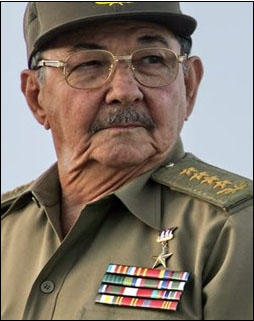
Raul Castro
DOJ recently announced the unsealing of a 20-page indictment charging erstwhile Cuban strongman Raul Castro and five “Castro Regime” co-defendants with conspiracy to kill three U.S. citizens and a green card holder in connection with the notorious 1996 downing of two aircraft flown by a Miami-based exile group, “Brothers to the Rescue” (BTTR). One of the five, Cuban national Luis Raul Gonzalez-Pardo Rodriguez (Rodriguez), may sound familiar, because I discussed his case in September 2024 after it was revealed he came here under the Biden administration’s (fraud-ridden) CHNV Parole program.
Brothers to the Rescue
BTTR was a U.S.-based NGO that used small planes to search the waters of the Florida Straits between Florida and Cuba, looking for migrants who had fled the Castro regime and taken to the high seas.
In February 1996, two Cessnas belonging to the organization were shot down by Cuban air force MiG-29 jets, killing Carlos Costa, Armando Alejandre, Mario de la Pena, and Pablo Morales. Costa, Alejandre, and de la Pena were U.S. citizens, while Morales was a Cuban national and U.S. lawful permanent resident.
Not surprisingly, a shootdown of unarmed prop planes by military jets triggered an international incident and spurred a lot of finger-pointing and recrimination from both Havana and Washington.
As the Miami Herald has reported, the group had “sponsored thousands of missions across” the straits, “generally steering clear of Cuban airspace as they searched for wayward rafters”, though on two occasions its “pilots dropped leaflets over Cuba as part of their effort to incite revolution”.
BTTR admitted to dropping the leaflets but denied they were in Cuban airspace when they did so. The Herald was quick to add that BTTR’s “missions were almost universally regarded as humanitarian”.
A year after the incident, President Clinton issued a statement revealing that a June 1996 investigation by the International Civil Aviation Organization had “confirmed that the shootdown was unlawful and without any justification”, and even the U.N. Security Council “strongly deplored Cuba's illegal use of violence against the aircraft”.
The shootdown was an extremely big deal at the time and still is in certain places, and a whole section of the U.S. Foreign Relations Act, 22 U.S.C. § 6046, permanently condemns the attack.
Raul Castro
Raul Castro is the younger brother of the late Fidel Castro, whom he replaced as head of the Cuban state (formally “president of the Council of State and the Council of Ministers”) on an acting basis in 2006 and permanently in 2008, before stepping down in 2018.
More importantly for the government’s case, U.S. v. Raul Modesto Castro Ruz, et al., the younger Castro was minister of the Cuban government’s Ministry of the Revolutionary Armed Forces (“MINFAR”, based on its Spanish-language acronym) between the end of the Cuban revolution in 1959 and sometime in 2008 — including in 1996 when the BTTR planes were shot down.
The Government’s Claims
According to the indictment, sometime around 1992, the Cuban Directorate of Intelligence (DI) sent two spies, Rene Gonzalez, aka: “Castor”, and Juan Pablo Roque, aka: “German” and “Vedette”, posing as exiled pilots seeking refuge in the United States, to south Florida to infiltrate BTTR, while Roque/German also offered his assistance to the FBI.
The Cuban government’s July 1994 sinking of the "13 de Marzo", a tugboat carrying 70 migrants fleeing the island nation, triggered street protests a month later, which BTTR attempted to promote by dropping the leaflets alluded to above.
The Cuban government didn’t retaliate against the group at that time, but the Cuban Coast Guard (also under MINFAR) formed a blockade against a flotilla that steamed toward Cuba to commemorate the sinking in July 1995, and scrambled MiGs to chase off BTTR aircraft that accompanied the flotilla.
These actions and two more BTTR airdrops of leaflets on January 9 and January 13, 1996, allegedly prompted the DI to plan Operacion Escorpion (Operation Scorpion) to, in the words of the indictment, “perfect the confrontation of the counterrevolutionary actions of” BTTR (though it likely sounded more cogent in the original Spanish).
Apparently (and again, allegedly), a portion of Operacion Escorpion involved Rodriguez and fellow pilots from the Cuban Revolutionary Air and Air Defense Force (DAAFAR) practicing on “locating and following low, slow flying civilian aircraft like the ones used by BTTR”, part of Raul Castro’s purported plan to use “deadly force” against the humanitarian group.
Finally, according to the indictment but commonly acknowledged as noted above, on February 24, 1996, three unarmed BTTR airplanes departed Opa-Locka Airport in south Florida bound for the Florida Straits.
The indictment alleges that two of those planes were shot down by MiGs flown by two DAAFAR pilots, Lorenzo Perez-Perez (an indicted co-conspirator) and Luis Perez-Perez (who wasn’t indicted), killing the three U.S. citizens and the green card holder aboard.
After that shootdown, according to the indictment, Rodriguez and two other pilots followed the third BTTR aircraft, which nonetheless managed to escape.
The Charge
Rodriguez, Castro, Lorenzo Perez-Perez, and three other DAAFAR pilots are charged in the first count of that indictment under 18 U.S.C. § 2332(b)(2), for “conspiracy to kill U.S. nationals”.
That provision makes it is a federal crime to engage in a conspiracy to kill a “national of the United States” outside of this country, punishable by imprisonment “for any term of years or for life” and/or a fine, meaning that if you, a U.S. citizen, go abroad and are harmed or murdered, the feds have grounds to come looking for your assailant.
CHNV Parole
Neither Rodriguez nor any other co-conspirator aside from Lorenzo Perez-Perez and Castro are charged under any of the six remaining counts, four counts of murder and two counts of “destruction of aircraft”, but that single charge is a serious one — which raises the question of how Luis Rodriguez got here.
The answer, as Stephen Dinan at the Washington Times recently reported, was “CHNV Parole”, which was launched by the Biden administration in January 2023 to hide the then-disaster at the Southwest border by allowing up to 30,000 nationals of Cuba, Haiti, Nicaragua, and Venezuela without visas or any other right to be admitted to enter monthly and receive two-year periods of “parole”.
In September 2024, when I discussed Rodriguez’s entry into the United States under that program, his identity was an open secret in the Cuban expat community, with Dr. Emilio Gonzalez (USCIS director under President George W. Bush) tweeting the following:
State Sponsor of Terrorism communist #Cuban Air Force colonel, involved in murdering four US nationals over intl waters, now living large in the US under #CHNV humanitarian parole.#BidenHarrisBorderCrisis allowed this.
No oversight, no security, no accountability, no nothing. pic.twitter.com/eXWzBnXAq1— Emilio T. González, Ph.D. (@emiliotgonzalez) September 16, 2024
His apparent CHNV parole was even more remarkable given that, at the time, Biden’s DHS was claiming applicants under the program were required to “undergo and clear robust security vetting” — which either wasn’t true or wasn’t all it was cracked up to be (or both).
That’s because, as Dinan explained, if DHS “had gone looking, it could have spotted his military past” because Rodriguez “admitted in a 2016 visa application that he spent 30 years in Cuba’s armed forces”, though “a year later, in another visa application, he omitted that” fact.
The Separate Fraud Charge
Curiously, given the notoriety Rodriguez had already garnered into the Cuban diaspora press following his CHNV entry, he didn’t stop there, assuming DOJ charges in a separate criminal case are correct.
On November 12, the department issued a press release headlined “Cuban Air Force Pilot Indicted for Immigration Fraud”, in which it claimed Rodriguez had applied for adjustment of status under section 245 of the INA in April 2025, but falsely claimed in his application that “he had never received any weapons or military training, never participated in any group of any kind that used weapons or threatened to use weapons, and never served in a military or police unit”.
Based on those allegations, Rodriguez was indicted separately in November for “fraud and misuse of visa, permits, and other documents, and making a false statement to a federal agency”, apparently in violation of 18 U.S.C. § 1546(a) (the specific charge was not listed in the release).
It seems that he has since been convicted of that offense, given that the latest DOJ press release states that he “is in U.S. custody pending sentencing later this month”, suggesting he should have either left the United States after Emilio Gonzalez started tweeting about his case or at least shouldn’t have pushed his luck by applying for a green card once Trump returned.
Dinan cited reports that Rodriguez “has turned state’s witness and is telling what he knows”, which makes sense given that the indictment against Raul Castro and the others was unsealed after his apparent conviction on the fraud charge.
The Trump administration and Secretary of State Marco Rubio (the child of Cuban emigres) are “actively seeking regime change in Cuba”, as the Wall Street Journal puts it, and the prospect of the nonagenarian Castro ending up in a Miami courtroom on murder charges for the high-profile 30-year-old incident simply adds to the pressure on Havana to come to terms.
And as Gonzalez told Dinan, Rodriguez “was in the cockpit, he was in the air, he heard the kill order”, and therefore would be the best witness the government could bring to prove its case.
Fighter pilots are known to take risks, but if all the allegations against Cuban national Luis Raul Gonzalez-Pardo Rodriguez are correct, he demonstrated hubris bordering on recklessness, first in applying under (and becoming the poster boy for) Biden’s CHNV parole program and then in seeking a green card from Trump’s DHS. At this point, Raul Castro likely wishes he had stayed home.