
During the border crisis of 2021-2024, the Biden administration granted entry to five to six million migrants who did not have visas. Although the administration and allied media often portrayed these migrants as “asylum seekers” who were “fleeing violence”, critics charged that most were here for economic reasons. New evidence supports the critics.
New Evidence
A recent article in the peer-reviewed journal Social Sciences brings fresh data to bear on the question of migrant motivations. The study’s authors examined records and conducted interviews in 2022 at Casa del Migrante San José, a shelter for transiting migrants in Honduras. Most of the migrants were either Honduran or Venezuelan nationals, but people from a wide range of Western Hemisphere countries were present at the shelter. A handful were even from China or Africa.
The most important part of the study is its analysis of the shelter’s administrative records, which contain the migrants’ stated reasons for travel. The figure below summarizes the results.
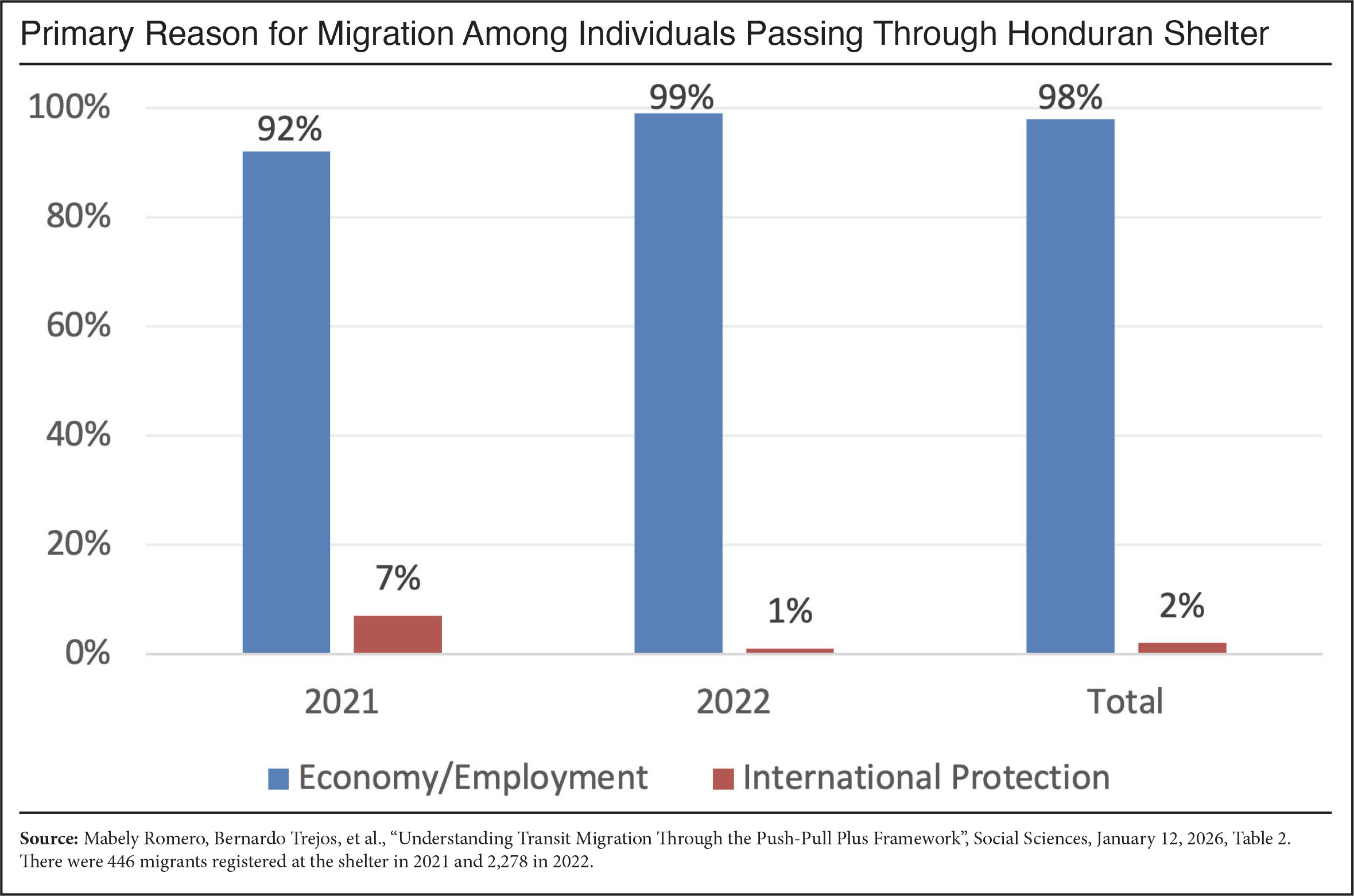 |
As the “Total” category indicates, 98 percent of migrants who passed through the shelter in 2021 and 2022 were economic migrants. Just 2 percent said they were in need of international protection.
The study’s authors try to add nuance by conducting “semi-structured” interviews with a sample of 75 migrants. Despite the open-ended questions, economic motivations still predominated in their answers. Economics received 67 mentions by interviewees, compared to 49 mentions of family-related reasons and 14 mentions of sociopolitical reasons. Even the latter two categories could still be economic in nature. For example, the authors coded “wanting to start anew” as a family-related motivation and “heard about the border opening” as sociopolitical.
Migrant demographics also point more toward people seeking manual labor jobs than toward families fleeing violence. Three-quarters of the migrants passing through Casa del Migrante San José were male, just 9 percent were married, and 61 percent were between the ages of 21 and 40. In terms of education, 93 percent had no more than a high school diploma, including 64 percent who did not graduate at all. It’s understandable that young, unmarried men without a lot of education would want to move to find better jobs, but to say they are “fleeing violence” is contrary to the data.
Of course, this study covers only one shelter, and not all the migrants there would have claimed asylum or even gained entry to the U.S. Nonetheless, there is little reason to believe that migrants at this particular shelter were unusually predisposed to economic motivations. As the authors note, the shelter is “the only migrant shelter on Honduras’s western border”, and its traffic volume increased in 2022, right along with the surge at the U.S. border. Since such an overwhelming percentage at this shelter reported economics as their primary reason for moving, most other migrants who came from (or passed through) Central America were probably traveling for the same reason.
Lessons for Asylum
The Biden administration allowed millions to cross the Southern border and live in the U.S. while their asylum claims or related immigration cases were adjudicated. If these applicants were anything like the migrants passing through the shelter in Honduras, then a large share of “asylum seekers” were actually economic migrants.
Qualification for asylum requires a well-founded fear of persecution based on identity or group membership. Examples include political dissidents threatened with imprisonment, religious leaders forced from their pulpits, and ethnic minorities targeted for violence. Having poor job prospects, as difficult as that can be, simply does not fit the category. We can sympathize with economic migrants who seek a better life for themselves, but they are not victims of persecution and are not the intended beneficiaries of asylum.
One reason to suspect that most of the Biden-era “asylum seekers” were economic migrants is that they failed to apply for asylum in Mexico or in other countries they passed through on their way to the U.S. For example, a Venezuelan dissident should not need to travel 3,000 miles to the U.S.-Mexico border to avoid persecution by the Maduro regime. Such a long and perilous journey could be made shorter and safer by applying for asylum in any one of the half-dozen countries in between. Insisting upon the U.S. as the only acceptable destination suggests a motivation unrelated to (or at least well beyond) avoiding persecution. The data from the Honduran migrant shelter casts further doubt on persecution as the motivating factor.
Why did so many economic migrants attempt to enter through the asylum system? Because the Biden administration made it a win-win for them by allowing entry before their cases were adjudicated. If a sympathetic judge then happens to grant the migrants legal status, that’s great for them. But in the more likely event that their cases are rejected (or dismissed because they don’t show up to the hearing), that’s still a win — they’re in the U.S., and, like other illegal immigrants, they have little chance of being deported. As long as asylum works this way, then practically every economic migrant has the incentive to claim it.
To reduce that incentive, the Trump administration has attempted a variety of policies that (arguably) stay within domestic law and international treaty obligations. These include requiring migrants to “Remain in Mexico” while their claims are adjudicated, rejecting their asylum claims if they passed through safe third countries first, and sending them away to apply in different countries altogether. Although these policies are more effective than the Biden approach, CIS Executive Director Mark Krikorian has argued that they are no substitute for withdrawing from the governing treaties and developing a new asylum system based on the national interest.