
Summary
- Over the last few months, three naturalized U.S. citizens have murdered or attempted to murder Americans in apparent Islamist terrorist attacks. It strains credulity to believe that they actually met the naturalization requirement of being “of good moral character, attached to the principles of the Constitution of the United States, and well disposed to the good order and happiness of the United States”. Yet they all successfully passed through the naturalization process to become naturalized citizens.
- Why does it matter that they were naturalized? Naturalized citizens are not subject to deportation. They can serve in the U.S. Congress, they can vote in federal elections, and they have an unfettered ability to work for the federal government. The Supreme Court has concluded that naturalization “carries with it the privilege of full participation in the affairs of our society”.
- How can we prevent the naturalization of national security threats? Both the Supreme Court and commentators have suggested more rigorous pre-naturalization vetting. But there are major impediments to the effectiveness of enhanced vetting. The volume of naturalization adjudications is staggering. The average number of naturalizations has increased by 418 percent since the 1970s, to an average of 730,000 each year from 2010 to 2019. Even assuming the availability of unlimited resources for vetting, how much of aliens’ pasts can actually be vetted? U.S. Customs and Border Protection Commissioner Rodney Scott has explained that “running records checks on any alien that has not been arrested by U.S. law enforcement in the past or is not currently known by U.S. intelligence is like looking for something on an empty hard drive. There is simply no data to compare it with. The alien could be a saint, or he/she could be a serial killer.”
- And no matter the sincere efforts of the Trump administration, future administrations will almost assuredly sometimes (if not all the time) find it expedient to sacrifice vetting for volume. The Clinton administration’s Citizenship USA scandal is a case in point, in which advocacy groups promised the administration that faster naturalizations would mean more voters for Democrat candidates in the upcoming 1996 election, and there was a mad rush to naturalize aliens in time to vote. The result: 18 percent of those persons naturalized during CUSA, close to 200,000, were not subjected to a complete criminal history background check. We will never know how many criminal and other ineligible aliens were wrongly naturalized during CUSA and have been voting in our elections to this day.
If enhanced vetting is not a silver bullet, what of the “1798 Solution”? It has not always been the case that the waiting period before eligibility to naturalize was five years. From 1798 to 1802, it was 14 years. What if Congress were to require lawful permanent residents to wait a significantly longer amount of time before becoming eligible to naturalize? Doing so certainly would give applicants, and especially national security threats, more time to show their “true colors”. It is much harder for an alien who has been an LPR for 10 or 15 years to hide their proclivities than it is for one who has been an LPR for five. It is much harder to keep up the façade of being “a person of good moral character, attached to the principles of the Constitution of the United States, and well disposed to the good order and happiness of the United States”. And there will be more of a track record simply in terms of any criminal history in the U.S.
Congress should give serious consideration to increasing the waiting period before eligibility to naturalize.
Introduction
Over the last few months, three naturalized U.S. citizens have murdered or attempted to murder Americans in apparent Islamist terrorist attacks:
- Ndiaga Diagne, a naturalized U.S. citizen from Senegal, murdered three people and injured more than a dozen in a mass shooting in Austin, Texas. Tony Plohetski, Austin Sanders, and Alexis Simmerman reported in the Austin-American Statesman that Diagne “was wearing clothing at the time of the shooting that bore the words ‘Property of Allah’ and an image of the Iranian flag, raising questions about whether Diagne may have been motivated by the joint U.S.-Israeli strikes on Iran”.
- Mohamed Bailor Jalloh, a naturalized U.S. citizen from Sierra Leone, shot to death an ROTC instructor at Old Dominion University while “reportedly shout[ing] ‘Allahu Akbar’”, according to a report from Fox News’s Julia Bonavita. He was a “former member of the Virginia National Guard who [had] previously served prison time for attempting to aid the terrorist group ISIS [Islamic State of Iraq and Syria]”, according to a report from CNN’s Alaa Elassar.
- Ayman Ghazali, a naturalized U.S. citizen from Lebanon, rammed a truck carrying 35 gallons of gasoline and commercial-grade fireworks into a synagogue in West Bloomfield, Mich., while more than 100 children were present. Security officers exchanged gunfire with Ghazali, who killed himself. Cindy Von Quednow and Holmes Lybrand reported for CNN that the FBI labeled the attack “a Hezbollah-inspired act of terrorism purposely targeting the Jewish community and the largest Jewish temple in Michigan” and that U.S. Attorney Jerome Gorgon said that Ghazali had “acted under [State Department designated foreign terrorist organization since 1997] Hezbollah’s direction and control”. According to the Israeli military, “one of his brothers [who had been killed in an Israeli airstrike] … was a Hezbollah commander in charge of managing weapons operations in the Iranian proxy group’s Badr unit”.
It strains credulity to believe that Diagne, Jalloh, or Ghazali actually met the statutory naturalization requirement of being “a person of good moral character, attached to the principles of the Constitution of the United States, and well disposed to the good order and happiness of the United States” or that they sincerely recited the required oath “to support the Constitution … renounce and abjure absolutely and entirely all allegiance and fidelity to any foreign … state … support and defend the Constitution and the laws of the United States against all enemies, foreign and domestic … [and] bear true faith and allegiance to the same”.
Yet they all successfully passed through the naturalization process to become naturalized U.S. citizens, joining the 25,837,972 other naturalized citizens residing in the United States in 2024 (per the Census Bureau’s estimate).
Why does it matter that they were naturalized?
It is true that lawful permanent residents (LPR) can reside in the U.S. for the rest of their lives even should they choose not to naturalize, which they can generally do pursuant to § 316 of the Immigration and Nationality Act (INA) after having “resided continuously [as LPRs] within the United States for at least five years [three years if the spouses of U.S. citizens] and during the five years [three years if the spouses of U.S. citizens] immediately preceding the date of filing … [were] physically present [in the U.S.] for periods totaling at least half of that time”. However, as long as they are LPRs, whether for five months or five decades, they are still aliens subject to removal pursuant to the INA’s grounds of deportability (ranging from criminal and terrorism-related grounds to grounds based on falsely attesting to U.S. citizenship and illegally voting).
Once an alien naturalizes, everything changes. The Supreme Court proclaimed in its 1946 decision in Knauer v. United States that “Citizenship obtained through naturalization is not a second-class citizenship … [but] carries with it the privilege of full participation in the affairs of our society.”
Naturalized citizens are no longer subject to deportation. They can generally only lose their citizenship on the same basis that native-born citizens can lose theirs — by voluntarily relinquishing it. The Supreme Court ruled in its 1967 decision in Afroyim v. Rusk that “the Fourteenth Amendment was designed to, and does, protect every citizen of this Nation [native-born or naturalized] against a congressional forcible destruction of his citizenship”. That is, Congress cannot “enact a law stripping an American of his citizenship which he has never voluntarily renounced or given up”. Thus, federal law now provides that a U.S. citizen can only “lose his nationality by voluntarily performing [certain] acts” such as “committing treason or serving as an officer in a foreign nation’s military”, if they do so with “the intention of relinquishing United States nationality”.
Of course, under the U.S. Constitution, no person “except a natural born Citizen … shall be eligible to the Office of President” (art. II, § 1, c. 5), “shall be a [U.S.] Representative who shall not have … been seven Years a Citizen of the United States” (art. I, § 2, cl. 2), or “shall be a [U.S.] Senator who shall not have … been nine Years a Citizen of the United States” (art. I, § 3, cl. 3). And federal law provides that:
It is unlawful for any alien to vote in any election held solely or in part for the purpose of electing a candidate for the office of President, Vice President, Presidential elector, Member of the Senate, [or] Member of the House of Representatives … unless—
(1) the election is held partly for some other purpose;
(2) aliens are authorized to vote for such other purpose under a State constitution or statute or a local ordinance; and
(3) voting for such other purpose is conducted independently of voting for a candidate for such Federal offices, in such a manner that an alien has the opportunity to vote for such other purpose, but not an opportunity to vote for a candidate for any one or more of such Federal offices.
This criminal provision was enacted as part of the Illegal Immigration Reform and Immigrant Responsibility Act of 1996, originating as a Senate floor amendment to S. 1664 by Sen. Alan Simpson (R-Wyo.). On April 24, 1996, Simpson explained during Senate floor consideration of his amendment that:
This amendment would help to guarantee that a majority of citizens of the United States, those who owe their full political allegiance to this country, retain political control of every political unit and every political issue. If aliens are allowed to vote, it becomes quite possible that a relatively small group of citizens in a particular jurisdiction could outvote a citizen majority, if the group had enough noncitizen allies. I do not feel that that is acceptable. That is not consistent with the form of government that the Founding Fathers believed to be a fundamental right of the American people.
As to the form of government that the Founding Fathers believed to be a fundamental right of the American people, the Supreme Court concluded in its 1978 decision in Foley v. Connelie that:
The act of becoming a citizen is more than a ritual, with no content beyond the fanfare of ceremony. A new citizen has become a member of a Nation, part of a people distinct from others. … The individual, at that point, belongs to the polity, and is entitled to participate in the processes of democratic decisionmaking. Accordingly, we have recognized “a State’s historical power to exclude aliens from participation in its democratic political institutions,” as part of the sovereign's obligation “to preserve the basic conception of a political community.” [Quoting the Court’s 1973 decision in Sugarman v. Dougal, in turn quoting the Court’s 1972 decision in Dunn v. Blumstein (emphasis added by Foley).]
And the Court concluded in its 1979 decision in Ambach v. Norwick that:
The Constitution itself refers to the distinction [between citizens and aliens] no less than 11 times … indicating that the status of citizenship was meant to have significance in the structure of our government. The assumption of that status, whether by birth or naturalization, denotes an association with the polity which, in a democratic republic, exercises the powers of governance [citing Foley]. … [A]n oath of allegiance or similar ceremony cannot substitute for the unequivocal legal bond citizenship represents. It is because of this special significance of citizenship that governmental entities, when exercising the functions of government, have wider latitude in limiting the participation of noncitizens.
While the INA generally makes “discriminat[ing] against [an LPR] … with respect to … hiring … or the discharg[e] … from employment” an “unfair immigration-related employment practice”, U.S. citizenship can be required “in order to comply with law, regulation, or executive order, or [as] required by Federal, State, or local government contract, or wh[en] the Attorney General determines [it] to be essential for an employer to do business with an agency or department of the Federal, State, or local government”. As to employment with the federal government, federal regulations provide that “No person shall be given any appointment in the competitive service unless such person is a citizen or national of the United States,” though the Office of Personnel Management “may, as an exception to this rule and to the extent permitted by law, authorize the appointment of aliens to positions in the competitive service when necessary to promote the efficiency of the service in specific cases or for temporary appointments”.
Denaturalization
Naturalized citizens can be denaturalized in certain circumstances, but denaturalization is extremely hard to accomplish. As Aram Gavoor, now the associate dean for academic affairs and associate professor of law at the George Washington University School of Law, and Daniel Miktus, now a partner at the Akerman law firm, have written in the William & Mary Bill of Rights Journal, “obtaining citizenship illegally or by willful misrepresentation appears to be the only grounds upon which naturalization may constitutionally be cancelled”.
The Supreme Court explained in its 1981 decision in Fedorenko v. United States that “every certificate of [naturalized] citizenship must be treated as granted upon condition that the government may challenge it ... and demand its cancellation unless issued in accordance with [statutory] requirements”, and that “This judicial insistence on strict compliance with the statutory conditions precedent to naturalization is simply an acknowledgment of the fact that Congress alone has the constitutional authority to prescribe rules for naturalization.”
Thus, INA § 340 provides that:
It shall be the duty of the United States attorneys … upon affidavit showing good cause therefor, to institute proceedings … for the purpose of revoking and setting aside the order admitting [a] person to citizenship and canceling the certificate of naturalization on the ground that such order and certificate of naturalization were illegally procured or were procured by concealment of a material fact or by willful misrepresentation … effective as of the original date of the order and certificate, respectively. [Emphasis added.]
Justice Antonin Scalia explained in the Supreme Court’s 1988 decision in Kungys v. United States that “four independent requirements” have to be met: “[1] the naturalized citizen must have misrepresented or concealed some fact, [2] the misrepresentation or concealment must have been willful, [3] the fact must have been material, and [4] the naturalized citizen must have procured citizenship as a result of the misrepresentation or concealment.”
Further, the Supreme Court ruled in its 1943 decision in Schneiderman v. United States that the government must prove these elements by “‘clear, unequivocal, and convincing’ evidence which does not leave the issue in doubt”. While the Court later seemingly indicated in its 1980 decision in Vance v. Terrazas that Congress has the power to substitute a lower standard of proof, unless and until that happens, the government’s burden is quite high.
As I have written, while the Supreme Court has expressed reservations about the government utilizing evidence of post-naturalization behavior/beliefs in order to demonstrate that a citizen had unlawfully procured naturalization, the Court has never ruled doing so to be per se unconstitutional. However, such evidence can only be used as “evidential facts” as to the citizen’s behavior/beliefs at the time of naturalization, as the Fourth Circuit Court of Appeals put it in its 1944 decision in Orth v. United States.
Further, the Supreme Court concluded in its 1913 decision in Luria v. United States that Congress may constitutionally create statutory presumptions (subject to countervailing evidence) that certain post-naturalization behavior demonstrates that naturalization was unlawfully procured — but only so long as there is a rational connection between the proscribed post-naturalization behavior and the prospective citizen’s state of mind at the time of naturalization. Additionally, the Court concluded that the longer the length of time between naturalization and the proscribed behavior, the less convincing evidence the naturalized citizen has to provide to defeat the presumption.
How Can We Prevent the Naturalization of National Security Threats?
Enhanced Vetting?
Both the Supreme Court and commentators have suggested that more rigorous pre-naturalization vetting should greatly reduce the need for the government to resort to denaturalization, especially given the obstacles the government has to overcome in denaturalization proceedings. The Court observed in its 1944 decision in Baumgartner v. United States that “relaxation in the vigor appropriate for scrutinizing the intensity of the allegiance to this country embraced by an applicant before admitting him to citizenship is not to be corrected by meagre standards for disproving such allegiance retrospectively”, the inference being that the government was to blame for not engaging in sufficient pre-naturalization vetting. Gavoor and Miktus have likewise suggested that the government should devote more effort to “ensuring that naturalization fraud is not occurring prior to naturalization”, admonishing the government that:
[T]he First Amendment ... should [not] excuse investigatorial laziness. The government possesses several mechanisms to prevent naturalization fraud … [such as] … further investigat[ing] whether a candidate for citizenship is actually attached to the principles of the United States Constitution before it grants citizenship. … [R]educ[ing] naturalization fraud in the first place [would] decrease the need for denaturalization altogether.
Could enhanced vetting of naturalization applicants in fact reduce the number of national security threats who are passing through the naturalization process? On March 30, 2026, U.S. Citizenship and Immigration Services (USCIS) concluded that:
Through an ongoing comprehensive review of pending workloads and benefit applications, USCIS ascertained that prior screening and vetting measures were wholly inadequate. Many applicants for naturalization and lawful permanent residence were not sufficiently vetted. As a result, applications were approved and individuals were naturalized who should not have been. These gaps expose the United States to significant national security and public safety risks and compromise the integrity of the immigration system.
Earlier, on December 22, 2025, USCIS announced that:
Pursuant to long-neglected statutory authority, USCIS [has] restored the practice of conducting neighborhood investigations of potential new citizens. The purpose of a neighborhood investigation is to verify aliens’ eligibility for naturalization by reviewing their residency, moral character, loyalty to the U.S. Constitution, and commitment to the nation’s well-being. These investigations are vital to maintaining the integrity of the naturalization process, assuring assimilation, and safeguarding the value of American citizenship.
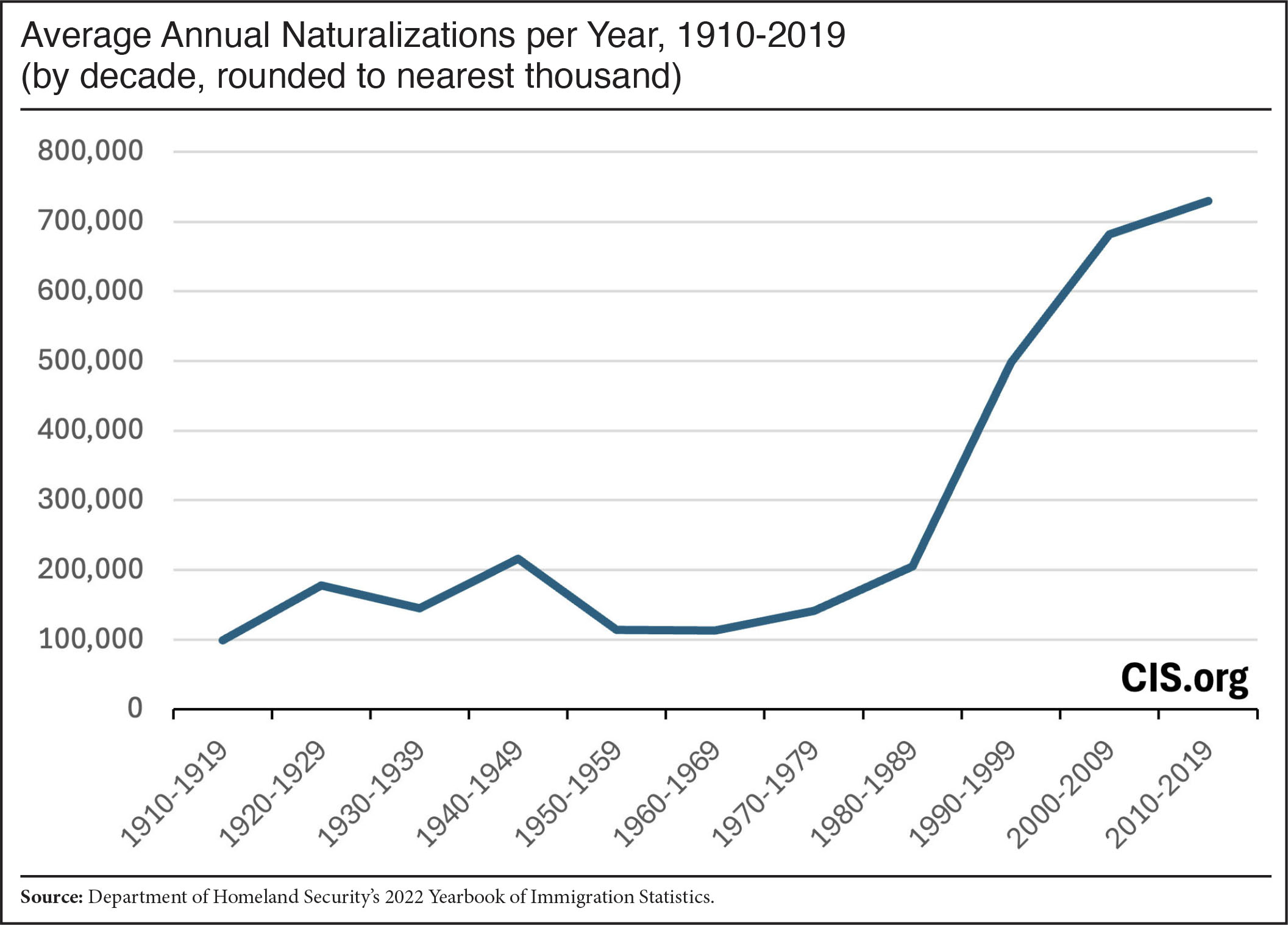
Unfortunately, there are two major impediments to the effectiveness of enhanced vetting. First is numbers. Just as in real estate it’s “location, location, location”, in vetting, it’s “volume, volume, volume”. And the volume of naturalization adjudications is staggering. According to the Department of Homeland Security’s 2022 Yearbook of Immigration Statistics, the average number of yearly naturalizations has increased by 418 percent since the 1970s:
- 1910-19: 99,000 (to the nearest thousand)1
- 1920-29: 178,000
- 1930-39: 145,000
- 1940-49: 216,000
- 1950-59: 114,000
- 1960-69: 113,000
- 1970-79: 141,000
- 1980-89: 205,000
- 1990-99: 498,000
- 2000-09: 682,000
- 2010-19: 730,000
 |
Even assuming for the sake of argument the availability of unlimited resources for vetting, how much of aliens’ pasts can actually be vetted? The House Committee on Homeland Security’s 2024 report on the impeachment resolution against President Biden’s Secretary of Homeland Security Alejandro Mayorkas quoted Rodney Scott, Secretary Mayorkas’ first U.S. Border Patrol (BP) Chief and now the Commissioner of U.S. Customs and Border Protection, explaining the difficulties in ‘‘thoroughly’’ or ‘‘rigorously’’ vetting many aliens:
The Secretary knows that when [BP] agents run those records checks … on foreign nationals ... it is only checking U.S. databases really … primarily only criminal offenses that have happened in the U.S.
On a limited basis, we will get information from ... INTERPOL or we’ll have a connectivity to another nation, but we don’t have direct plug-ins to other nations’ criminal databases. And many of the nations these people are coming from, we know for a fact, don’t even have good criminal database records systems to pull from.
And, a lot of times, we have no idea even who the person is. So the fingerprints, [are] valid, but they can make up any name they want.
In the perfect world, if an agent has any suspicion, then that agent has the ability to work through the State Department or the consulate’s office, go to that country, ask a bunch of more questions. But when you’re handling over a thousand arrests a day, let alone 10,000, the agents don’t have time to do any of that.
This has all been briefed to ... Secretary [Mayorkas]. He knows that vetting is a joke. It’s literally a check-the-box. It’s only people that have been in the U.S., committed a crime, and either left on their own or been deported. And we have no idea what any of these people did anywhere else in the world.
The report also quoted Scott’s testimony before the House Judiciary Committee, where he put things in stark terms:
To ensure there is no confusion here, running records checks on any alien that has not been arrested by U.S. law enforcement in the past or is not currently known by U.S. intelligence is like looking for something on an empty hard drive. There is simply no data to compare it with. The alien could be a saint, or he/she could be a serial killer.
Scott elaborated that:
When law enforcement officers at any level in the U.S. use a person’s biographical and biometric information to run records checks, that freshly collected information is being compared to existing records in specific U.S. agency databases. It is extremely rare for any information about criminal acts committed by a foreign national outside the U.S. to be documented within these U.S. criminal history databases. When Secretary Mayorkas or any U.S. official asserts that aliens are properly vetted, they are really telling you that they checked U.S. databases to see if the alien had any known criminal history inside the U.S. or if the alien had been identified and placed in the Terrorist Screening Database or Data Set.
And no matter the sincere efforts of the Trump administration, future administrations will almost assuredly sometimes (if not all the time) find it expedient to sacrifice vetting for volume. A case study and cautionary tale can be found in the Clinton Administration’s Citizenship USA (CUSA) scandal.
As I have recently written, the Immigration and Naturalization Service launched CUSA in the summer of 1995 in response to a rapidly growing backlog in naturalization applications. The Department of Justice’s Office of the Inspector General (OIG) concluded that “INS failed to address known system weaknesses before implementing a program that they knew would tax that system as it never had been taxed before” and that given its “lack of commitment to repair the deficiencies, the promise of backlog reduction within one year also meant a certain recklessness about the quality of the resulting adjudications”.
The OIG initiated an investigation after reports surfaced “that some INS offices were naturalizing applicants so quickly that applicant criminal history reports … were arriving in INS offices only after the applicant had been sworn in as a United States citizen … suggest[ing] that INS had sacrificed naturalization processing integrity in the name of processing applicants more quickly”. (Emphasis in original.)
Advocacy groups had promised the Clinton administration that faster naturalizations would mean more voters for Democrat candidates in general and the Clinton-Gore ticket in particular in the upcoming 1996 election. Following complaints that CUSA wasn’t producing more citizens fast enough, Vice President Al Gore told his “reinventing government” office — the National Performance Review (NPR) — to intervene. One NPR official leading the effort described the goal as “produc[ing] a million new citizens before election day”. The OIG concluded that “the White House and NPR attention to and involvement with CUSA did add pressure on INS officials to increase production and make good on INS’ previously announced ambitious goals”.
What were the consequences? In March 1997, DOJ reported that, of the 1,049,867 naturalizations that took place between August 31, 1995, and September 30, 1996, the FBI had returned the proffered fingerprint cards in 124,111 cases as not suitable for comparison and the FBI had no record of conducting any fingerprint checks in 61,366 additional cases. The OIG’s conclusion was that “for 18 percent of those persons naturalized during CUSA, INS had not conducted a complete criminal history background check”. As a result, more than 6,000 cases were referred to INS for possible denaturalization proceedings. Of course, only a handful of former criminal aliens were ever denaturalized. And as Commissioner Scott has pointed out, the criminal history background checks that were conducted for the most part only covered applicants’ criminal histories in the U.S.
We will never know how many criminal and other ineligible aliens were wrongly naturalized during CUSA and have been voting in our elections to this day.
Of course, there is nothing new under the sun regarding an administration perverting the naturalization process for political gain. On May 3, 1798, two centuries prior to CUSA, U.S. Rep. John Allen (Federalist-Conn.) “alluded to the vast number of naturalizations which lately took place in [Washington, D.C.] to support a particular party in a particular election” during the U.S. House of Representatives’ floor debate on the Naturalization Act of June 18, 1798.
The “1798 Solution”
If enhanced vetting is not a silver bullet, what of the “1798 Solution”? What if Congress were to require LPRs to wait a significantly longer amount of time before becoming eligible to naturalize? Doing so certainly would give applicants, and especially national security threats, more time to show their “true colors”. It is much harder for an alien who has been an LPR for 10 or 15 years to hide their proclivities than it is for one who has been an LPR for only five. It is much harder to keep up the façade of being “a person of good moral character, attached to the principles of the Constitution of the United States, and well disposed to the good order and happiness of the United States”. And there will be more of a track record simply in terms of any criminal history in the U.S.
It has not always been the case that the waiting period has been five years. The nation’s first naturalization law, the Naturalization Act of March 26, 1790, provided that an eligible alien had to have “resided within the limits and under the jurisdiction of the United States for the term of two years” (emphasis added) and be a “person of good character, and tak[e] the oath or affirmation prescribed by law, to support the constitution of the United States”.
That law was repealed by the Naturalization Act of January 29, 1795, which provided that an eligible alien first had to “have declared on oath or affirmation … three years, at least, before his admission [as a naturalized citizen], that it was bona fide, his intention to become a citizen of the United States”. To apply, the alien had to “declare on oath or affirmation … that he has resided within the United States, five years at least” (emphasis added) and that “he will support the constitution of the United States … [and] absolutely and entirely renounce and abjure all allegiance and fidelity to every foreign prince, potentate, state or sovereignty whatever”.
That law was modified by the Naturalization Act of 1798, to the extent that an eligible alien first had to “have declared his intention to become a citizen of the United States, five years, at least, before his admission” and before applying had to “declare and prove … that he has resided within the United States fourteen years, at least” (emphasis added).
This increase in the required period of residence from five to 14 years was precipitated in large measure by tensions with France during the French Revolution. E.P. Hutchinson wrote that:
[A] strong antialien sentiment found expression in the 5th Congress (1797-1799). Various reasons for this … have been suggested: concern during the unsettled period of the French Revolution and Napoleonic wars in Europe, strained relations with France approaching undeclared war, and distrust of alien minorities. It has been suggested also that partisan politics played a part in the antialien movement in Congress, the Federalists then in power being well aware that their Jeffersonian opponents attracted the support of many immigrants.2
As to the French Revolution, CATO Institute Senior Fellow Doug Bandow explained that:
Violence [during the French Revolution] reached its crescendo under the Jacobins. … With Maximilien Robespierre at their head, the Jacobins created the Committee of Public Safety and Committee of General Security and instituted the infamous Reign of Terror. Heads rolled — literally, as the guillotine was put to prodigious use. By one count 17,000 people were beheaded before the Jacobins lost power a little more than a year later.
Then came war clouds. Gregory Fehlings has written in the Tulsa Journal of Comparative and International Law that:
Following “The Terror,” the French Directory, a ruling council of five directors, assumed power in 1795. When Presidents George Washington and John Adams refused to allow the United States to be dragged into France’s wars against Great Britain and other European powers, the Directory launched a retaliatory war of commercial plunder against America. The French seized over 2,000 American merchant ships during the war.
Congress became alarmed over growing French hostility ... and the potential for ... invasion and insurrection. John Quincy Adams, President Adams’ son and U.S. Ambassador to Prussia, advised his father that France intended to invade America's western frontier. The Speaker of the House ... speculated publicly that troops already massed in French ports were destined for America. Innumerable others thought a French invasion imminent. To oppose such an invasion, President Adams summoned ... George Washington from retirement to command the United States Army.
Federal officials feared parts of America were rife with French agents and sympathizers who might rise up in support of an invasion. ... Washington anticipated that, if the French invaded ... they would invade the Southern states “because they will expect ... to find more friends there.”
I should note that on May 21, 1798, U.S. Rep. James Bayard (Federalist-Del.) stated on the House floor that he “believed there were as many Jacobins and vagabonds come into the United States during the last two years, as may come for ten years hence”. Keep in mind regarding this and other quotes from the House floor that the Library of Congress explains that “The Annals of Congress ... were not published contemporaneously, but were compiled between 1834 and 1856, using the best records available, primarily newspaper accounts. Speeches are paraphrased rather than presented verbatim, but the record of debate is nonetheless fuller than that available from the House and Senate Journals.”
On May 1, 1798, U.S. Rep. Samuel Sewall (Federalist-Mass.) stated on the House floor that:
[A]liens are admitted to become citizens of the United States when, in the opinion of this [C]ommittee [for the Protection of Commerce and the Defence of the Country], there is not sufficient evidence of their attachment to the laws and welfare of this country to entitle them to such privilege; and that, for this purpose, a longer residence within the United States, before admission … is essential, and ought to be required. [Emphasis added.]
Thus, the committee recommended that “provision ought to be made by law, to prolong the term of residence within the United States which shall be proved by an alien before he shall be admitted to become a citizen of the United States, or of any State”. On May 2, “Mr. Sewall said”:
[T]he term of residence now required from foreigners before they can become citizens, is five years. The committee think this period too short; it is much shorter than the period adopted by the French Government. The committee were of opinion that a residence of at least ten years should be required; but this might be left a blank in the bill, and afterwards filled.
Some members of the House thought that naturalization should be done away with altogether. On May 2, U.S. Rep. Robert Goodloe Harper (Federalist-S.C.) “believed that”:
[I]t was high time we should recover from the mistake which this country fell into when it first began to form its constitutions, of admitting foreigners to citizenship. This mistake, he believed, had been productive of very great evils to this country, and, unless corrected, he was apprehensive those evils would greatly increase. He believed the time was now come when it would be proper to declare, that nothing but birth should entitle a man to citizenship in this country. He thought this was the proper season for making the declaration. He believed the United States had experience enough to cure them of the folly of believing that the strength and happiness of the country would be promoted by admitting to the rights of citizenship all the congregations of people who resort to these shores from every part of the world. …
[S]trangers … , however acceptable they may be in other respects, could not have the same views and attachments with native citizens. … [H]e was convinced it was an essential policy, which lay at the bottom of civil society, that none but persons born here in the country should be permitted to take part in the Government.
For U.S. Reps. Sewell, Harrison Gray Otis (Federalist-Mass.), and Samuel Sitgreaves (Federalist-Pa.), the goal was to not allow immigrants to serve in the legislature and high office. Otis stated on the House floor on May 3 that this “open[ed] the door to the intrigues of other countries”, elaborating that:
[W]e know there are countries whose chief attention is paid to the obtaining of influence in the internal concerns of the countries over which they wish to have dominion. [read: France]. … It had not only been thought good policy, in times past, to encourage foreigners to come to this country, but also to admit them into the Legislature, and important offices. But now, said he, America is growing into a nation of importance, and it would be an object with foreign nations to gain an influence in our councils; and, before any such attempt was made, it was proper to make provision against it; for if the time ever should arrive when a number of persons of this description had found their way into the Legislature, a motion of this kind would of course be very odious.
On the same day, Sitgreaves stated that:
[I]n attaining an object in which all seemed to concur, they might avoid any Constitutional embarrassment; and this it was allowed might be done by extending the time of residence of aliens so far, as to prevent them from ever becoming citizens, by which means persons who could not be considered as having a common interest with the citizens of the country, would be effectually excluded from holding offices in the Government.
The great object was to prevent such persons from being elected into either branch of the Legislature, or into the office of President or Vice President; offices in which the sovereignty of the country is materially concerned, and in which, of course, foreign influence might prove most mischievous.
On May 21, Rep. Sewall stated on the House floor that:
[T]he liberty which the United States have given in this respect [allowing aliens to become naturalized citizens and to hold seats in the Government after a residence of five years] heretofore has been unexampled, and it was high time the evils which had arisen from this imprudent liberality should be remedied. The present distracted state of the world, and the attempts made to disturb other Governments, showed the necessity of the proposed regulations.
But the Naturalization Act of 1798 was not to last.
President Jefferson stated in his first address to Congress on December 8, 1801, that “I cannot omit recommending a revisal of the laws on the subject of naturalization. Considering the ordinary chances of human life, a denial of citizenship, under a residence of fourteen years, is a denial to a great proportion of those who ask it”.
E.P. Hutchinson explained that:
The Federalists, who had pushed through the antialien legislation in the 5th Congress, continued to hold a House majority in the 6th Congress and were even more firmly in control of the Senate, but signs of declining Federalist strength began to appear.3
[In the 7th Congress, t]he political composition of Congress had changed … for [Thomas] Jefferson became President and … members of [his] Democratic Republican party[] gained a majority in both houses of Congress; and with the change in controlling party came some relaxation of suspicion and severity toward immigrant[s].”4
Four years after the enactment of the 1798 Act, it was repealed by the Naturalization Act of April 14, 1802, which reverted back to “reside[nce] within the United States five years at least” (emphasis added) and required that applicants have “behaved as a man of a good moral character, attached to the principles of the constitution of the United States, and well disposed to the good order and happiness of the same”.
Conclusion
Congress should give serious consideration to increasing the waiting period for naturalization. As mentioned, doing so would give naturalization applicants more time to show their “true colors”. It is much harder for an alien who has been an LPR for a long period of time to hide their proclivities than it is for one who has been an LPR for a short period. It is much harder to keep up the façade of being “a person of good moral character, attached to the principles of the Constitution of the United States, and well disposed to the good order and happiness of the United States”. The “1798 Solution” might be our best available tool to prevent the naturalization of national security threats.
End Notes
1 According to the Census Bureau’s Statistical Abstract of the United States 1950, “Naturalization statistics for the United States began with the fiscal year 1907. Prior to this time each court kept records of naturalizations but no national data were compiled.”
2 E.P. Hutchinson, Legislative History of American Immigration Policy, 1798-1965, 12 (1981).
3 Id., at 16.
4 Id., at 17.