
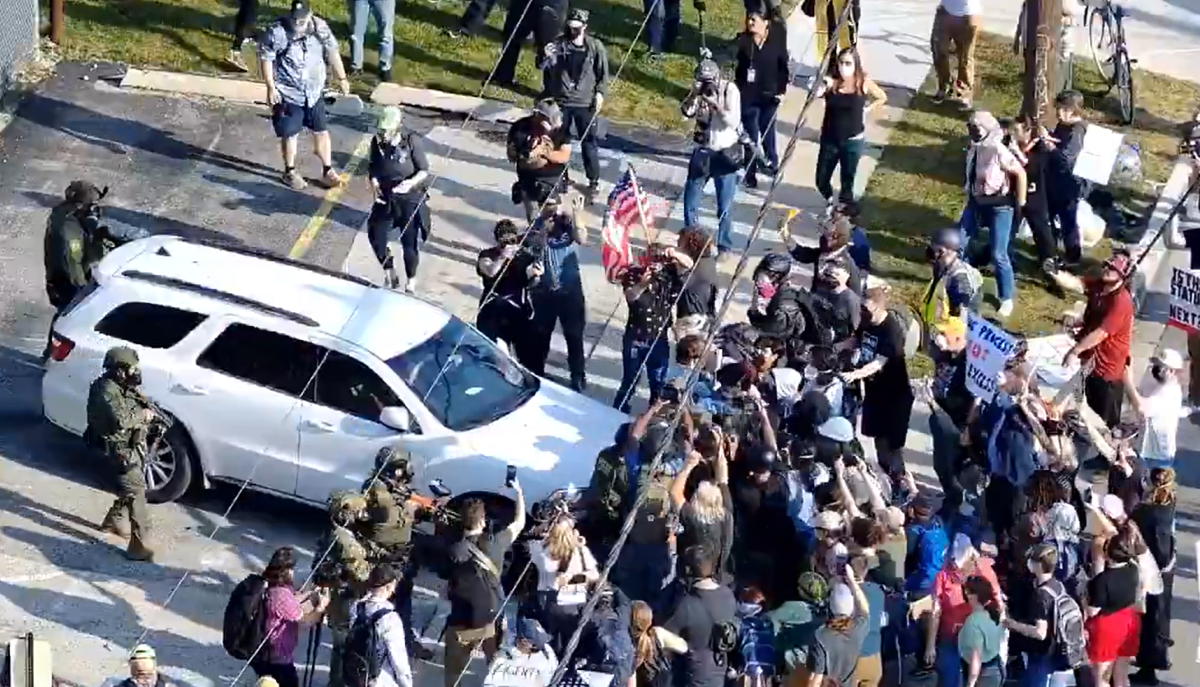
Following President Trump’s dispatch of Immigration Czar Tom Homan to Minneapolis in January, the violent attacks on Department of Homeland Security officers have subsided. Nevertheless, the intense opposition to immigration enforcement among certain hard-left networks means such violence could resume, whether in Minnesota or elsewhere in the country. And renegade states and localities could also attempt to disrupt enforcement. On multiple occasions this year, Philadelphia District Attorney Larry Krasner has threatened to arrest and prosecute ICE agents, to hunt them down like Nazi war criminals.
If that were to happen, what legal options would President Trump have to call on the U.S. military to protect DHS personnel from attack by violent protestors intent on disrupting efforts to enforce our nation’s immigration laws, or from malicious arrests and prosecutions by renegade states and localities seeking to achieve the same result?
Summary
What legal options does President Trump have to call on the U.S. military to protect Department of Homeland Security personnel from attack by violent protestors intent on disrupting efforts to enforce our nation’s immigration laws?
Do these same legal options exist if the attempts at disruption come from renegade states and localities? On multiple occasions this year, Philadelphia District Attorney Larry Krasner has threatened to arrest and prosecute ICE agents, to hunt them down like Nazi war criminals, if they dare to enforce the law in the City of Brotherly Love. In 2022, the Pennsylvania House of Representatives had impeached Krasner, contending that Philadelphia “ha[d] descended into an unprecedented crisis of lawlessness” as a result of his actions.
- In December, the Supreme Court in Trump v. Illinois tentatively concluded that 10 U.S.C. § 12406(3), which President Trump utilized to call into federal service the Illinois and Texas National Guards to protect DHS personnel in the Chicago area, cannot be used for such purpose. The Court concluded that this law only authorizes a president to use the National Guard to “execute” the law, and serving a protective function does not constitute executing the law.
- The U.S. Solicitor General indeed told the Court that the National Guard’s role in Chicago was not to execute the immigration laws or engage in civilian law enforcement functions. However, he argued that, apart from any specific legislation, a President has the inherent constitutional power to use the military for the protection of federal properties and federal functions.
- Justice Alito complained in dissent that while the Court majority apparently agreed that a president possesses this inherent protective power, the majority failed to explain why President Trump could not use this inherent authority to call on the National Guard. Alito also objected to the majority’s seeming suggestion that the Posse Comitatus Act, which generally prevents the military from executing the laws, would stand in the way of a president’s inherent constitutional power.
- Rather than affirming a president’s inherent protective power under the Constitution, I believe it is more accurate to say that the majority in Trump v. Illinois simply acknowledged that the executive branch has long argued that the president has such an inherent power. However, prior Supreme Court opinions, most notably In Re Neagle in 1890 and In Re Debs in 1895, seem to have clearly recognized a president’s inherent protective power, as William Rehnquist argued when he led the Department of Justice’s Office of Legal Counsel (before himself becoming the Supreme Court’s chief justice).
- While the Supreme Court has, at least tentatively, ruled out a president’s use of 10 U.S.C. § 12406(3) to call a state’s National Guard into federal service to protect DHS personnel, President Trump may still have the Insurrection Act available for this purpose (and also available to call on the regular military). However, the Court’s decision puts into some question whether the Insurrection Act itself permits the military to perform a protective function. The Supreme Court has suggested for well over a century that a president has an inherent constitutional protective power over federal personnel and property, which would eliminate the need for any statutory authority. The question is whether this remains the belief of the Court’s current majority.
- If the president does have authority through the Insurrection Act, or indeed through the Constitution itself, to use the military to protect federal personnel and the carrying out of federal functions, there is seemingly little reason why he could not use the military to protect federal personnel and functions from renegade states and localities seeking to impede the enforcement of federal law through malicious arrests and prosecutions of federal law enforcement officers.
Introduction
What legal options does President Trump have to call on the U.S. military to protect Department of Homeland Security personnel from attack by violent protestors intent on disrupting DHS’s efforts to enforce our nation’s immigration laws, or from malicious arrests and prosecutions by renegade states and localities seeking to achieve the same result? ? I will focus on the situation in the Chicago area, as this is the locus of an important legal battle in Trump v. Illinois that has already reached the Supreme Court.
As U.S. Solicitor General D. John Sauer described the situation to the Supreme Court in the Trump administration’s “Application to Stay the Order Issued by the United States District Court for the Northern District of Illinois and Request for an Immediate Administrative Stay” (Stay Application):
[A] disturbing and recurring pattern[ has developed]: Federal officers are attempting to enforce federal immigration law in an urban area containing significant numbers of illegal aliens. The federal agents’ efforts are met with prolonged, coordinated, violent resistance that threatens their lives and safety and systematically interferes with their ability to enforce federal law.
That resistance succeeds to an alarming degree in … obstructing federal agents from enforcing federal immigration law. Federal agents are forced to desperately scramble to protect themselves and federal property, allocating resources away from their law-enforcement mission to conduct protective operations instead. Receiving tepid support from local forces, they are often left to fend for themselves in the face of violent, hostile mobs.
Solicitor General Sauer concluded in his November 10, 2025, letter brief to the Supreme Court that: “Federal agents faced with such threats and violence … operate, on a daily basis, in a climate of fear for their lives and safety, forced constantly to focus on self-defense and protection instead of executing federal law.”
Justice Samuel Alito concluded in his dissent to the Supreme Court’s December 23, 2025, denial of a stay requested by the administration (Trump v. Illinois) that “U.S. Immigration and Customs Enforcement (ICE) operations in and around Chicago have been the target of unprecedented sabotage and violence since June” 2025. As Alito described the situation (based on U.S. government declarations):
Hundreds of rioters have converged at the [DHS] facility in Broadview, Illinois, the only intake and processing center for ICE operations in the Chicago area. These rioters have been organized, gathering offsite and arriving in vans, then getting picked up several hours later by vans returning with new rioters. They have arrived armed with shields, gas masks, protective padding, and other tools for physical combat. And they have blocked entry and exit at the ICE facility, physically assaulted personnel attempting to enter or leave work, significantly damaged the building, and vandalized both Government and personally owned vehicles.
Justice Alito continued that “The resulting violence has endangered the lives of federal personnel,” elaborating that:
Multiple rioters have been found with loaded guns, some of them semi-automatic. Rioters have hit, punched, and shoved officers; thrown bottles, rocks, and tear gas canisters at officers; attempted to grab officers’ firearms and munitions; pulled gas masks and tear gas canisters off the officers’ uniforms; targeted officers with bullhorns and whistles that can cause permanent hearing loss; aimed strobe lights and lasers at officers’ faces; and shot fireworks at officers. … As of early October, more than 30 federal officers had suffered injuries, and multiple officers had been hospitalized.
Alito described “a widely publicized event on October 4”, in which:
[A] federal vehicle carrying Border Patrol agents was boxed in on a public road by 10 civilian vehicles, and 2 of those vehicles rammed the Government vehicle. As the agents exited their vehicle, one of the civilian vehicles was driven directly at an agent, forcing the agent to fire in self-defense. Hundreds of rioters then converged near the scene, throwing glass bottles and other dangerous objects at the agents. A federal vehicle sent to assist the besieged agents was itself rammed. Later in the day, a federal van was surrounded by rioters who slashed its tires, but no emergency assistance was available because of damage done to other Government vehicles earlier that day.
Justice Alito concluded that “Local police departments have provided insufficient assistance”:
When the October 4 ramming incident was reported to the Chicago Police Department, an internal dispatch stated that “NO UNITS WILL RESPOND TO THIS.” On September 13, when rioters threw rocks, slashed tires, and poured flour into a federal vehicle’s gas tank, ICE officers called the Broadview Police Department three times to ask for assistance. The Broadview Police never responded.
In sum, injuries, threats, vandalism, and harassment have significantly impaired efforts to execute the laws. The agencies have had to reallocate resources from enforcing the immigration laws to the provision of security for officers, the Broadview facility, and other Government property.
He noted that “Even when not on duty, federal officers have been targeted”:
They have been followed to their homes and “doxed.” Officers and their families have been threatened, and their homes and vehicles have been vandalized. Criminal enterprises have offered bounties for kidnapping or murdering immigration officers. More than 20 officers have had their home addresses posted on social media, and posts have called for officials to be shot and killed on sight.
The Trump administration’s Stay Application explained that “[c]onfronted with intolerable risks of harm to federal agents and coordinated, violent opposition to the enforcement of federal law”, President Trump “determine[d] that he [was] unable to enforce the laws of the United States with the regular forces and calls up the National Guard to defend federal personnel, property, and functions in the face of ongoing violence”. He utilized his powers under 10 U.S.C. § 12406(3) — which provides that “[w]henever … the President is unable with the regular forces to execute the laws of the United States; the President may call into Federal service members and units of the National Guard of any State in such numbers as he considers necessary to … execute those laws” — to call members of the Illinois and Texas National Guard into active federal service and send them to the Chicago area.
Trump v. Illinois
As the Supreme Court explained in Trump v. Illinois, “The United States District Court for the Northern District of Illinois [in Illinois v. Trump] entered a temporary restraining order barring the federalization and deployment of the Guard in Illinois,” following which “The Seventh Circuit denied in relevant part the Government’s motion for a stay, permitting the Guard to remain federalized within Illinois but maintaining the bar on deployment.” The Trump administration then requested that the Supreme Court stay the District Court’s order.
The Supreme Court denied the stay request, basing its denial on two separate but interrelated factors. First:
[T]he term “regular forces” in 12406(3) likely refers to the regular forces of the United States military. … Because the statute requires an assessment of the military’s ability to execute the laws, it likely applies only where the military could legally execute the laws. Such circumstances are exceptional: Under the Posse Comitatus Act [PCA], the military is prohibited from “execut[ing] the laws” “except in cases and under circumstances expressly authorized by the Constitution or Act of Congress.”… So before the President can federalize the Guard under §12406(3), he likely must have statutory or constitutional authority to execute the laws with the regular military and must be “unable” with those forces to perform that function.
At this preliminary stage, the Government has failed to identify a source of authority that would allow the military to execute the laws in Illinois. The President has not invoked a statute that provides an exception to the [PCA].
Second:
[President Trump] relies on inherent constitutional authority that, according to the Government, allows him to use the military to protect federal personnel and property. But the Government also claims — consistent with the longstanding view of the Executive Branch — that performing such protective functions does not constitute “execut[ing] the laws” within the meaning of the [PCA]. … If that is correct, it is hard to see how performing those functions could constitute “execut[ing] the laws” under §12406(3). … Thus, at least in this posture, the Government has not carried its burden to show that §12406(3) permits the President to federalize the Guard in the exercise of inherent authority to protect federal personnel and property in Illinois.
Justice Brett Kavanaugh agreed in his concurrence that “‘regular forces’ likely refers to the U. S. military” and “it does not appear that the President has yet made the statutorily required determination that he is ‘unable’ with the … military … to ensure the execution of federal law in Illinois”. “On that narrow ground”, he would have denied the application for a stay, noting that “We need not decide more, so I would not decide more.”
Justice Alito (joined by Justice Clarence Thomas) dissented, having “serious doubts about the correctness of the Court’s views” and complaining that “Instead of abiding by the standard rule on party presentation, the Court took it upon itself to raise the question whether [both] parties’ understanding of ‘regular forces’ was correct.”
Justice Neal Gorsuch also dissented, finding a stay warranted for many of the reasons explained in Justice Alito’s dissent, and adding that “all the weighty question[s]” should have been left “for another case where they are properly preserved and can receive the full airing they so clearly deserve.”
I will not focus in this piece on the debate over the proper meaning of “regular forces” in § 12406(3), except to note Solicitor General Sauer’s contention in his November 10 letter to the Court that “While the term ‘regular forces’ may in other situations refer to the standing military, the particular text, structure, and history of Section 12406(3) demonstrate that the term [here] refers instead to the civilian forces that regularly execute the laws currently being obstructed.”
What Might Be the Consequences of a President Being Unable to Call the National Guard to Perform Protective Functions?
Justice Alito stated in his dissent that “According to the Court’s apparent reasoning, National Guard members may enforce the immigration laws by, for example, arresting and processing aliens, but they may not perform the protective functions for which they are better suited.” He remarked “That … is surprising.”
Justice Kavanaugh wrote in his concurrence that:
The Court’s legal interpretation, as I understand it, could lead to potentially significant implications for future crises that we cannot now foresee. … Suppose a mob rapidly gathers outside the U. S. Courthouse in Philadelphia in response to an unpopular decision (or to influence the outcome of a pending matter). Suppose also that the mob is threatening to storm the courthouse and attack the federal judges, prosecutors, and other personnel inside, and to damage or burn down the building, thereby preventing the execution of federal law. Suppose further that U. S. military forces cannot readily mobilize to deploy to the site in time, that the local police and federal court security officers are outnumbered, and that the President wants to federalize National Guard units to protect the courthouse and the judges, prosecutors, and other personnel. Under the Court’s order today, even in those circumstances the President presumably could not federalize the National Guard under §12406(3).
It was for this reason that Kavanaugh concluded that “the potential consequences [of the Court’s concluding that protecting federal personnel and property does not constitute execution of the laws], combined with the novelty and difficulty of the statutory issues … underscore why I would not opine more broadly than necessary to resolve this application”.
Does a President Have the Inherent Constitutional Authority to Protect Federal Personnel, Property, and Functions?
Solicitor General Sauer wrote in his November 10 letter that “the standing military … can facilitate the execution of the laws pursuant to the President’s Article II authority ‘to use troops for the protection of federal property and federal functions’”, citing the Supreme Court’s 1890 decision in In re Neagle and 1895 decision in In re Debs (both of which will discussed forthwith). Similarly, Sauer wrote in the Stay Application that “the President was responding to repeated acts of violence that threatened the safety of federal personnel and property — concerns that implicate the President’s inherent Article II authority ‘to use troops for the protection of federal property and federal functions’”, also citing to those decisions.
Justice Alito contended in his dissent that “the Court fails to explain why the President’s inherent constitutional authority to protect federal officers and property is not sufficient to justify the use of National Guard members … for precisely that purpose”, explaining that:
[The Court] cites with apparent approval a body of [the U.S. Department of Justice’s] Office of Legal Counsel [OLC] opinions sanctioning this understanding of inherent Presidential power.
Although the Court recognizes this inherent Presidential power, it does not explain why it is not sufficient to satisfy the new element that the Court has added to §12406(3).
The Court seems to suggest that the [PCA] stands in the way of what the President did here, but that is puzzling. Does the Court mean to suggest that the [PCA] somehow limited a President’s inherent constitutional authority? [Emphasis in original.]
I am not sure, however, that the majority’s opinion necessarily “recognize[d] this inherent Presidential power”. All the opinion said in regard to the asserted protective power was that President Trump “relies on inherent constitutional authority that, according to the Government, allows him to use the military to protect federal personnel and property” (emphasis added) and that “the Government has not carried its burden to show that §12406(3) permits the President to federalize the Guard in the exercise of inherent authority to protect federal personnel and property”. Was the Court 1) recognizing an inherent protective power; 2) recognizing such a power but questioning whether it would allow a president to use the military for protective purposes; or 3) leaving open the question of whether indeed there is an inherent protective power? The opinion can be read in ways to support each conclusion. Further, the opinion cited the OLC opinions not to bolster the case for an inherent presidential protective power, but merely to document the executive branch’s “longstanding view” that performing protective functions does not equate to “execut[ing]” of the laws, as generally prohibited under the PCA.
Justice Kavanaugh made less of a stretch than Justice Alito, stating in his concurrence that “the Court’s opinion does not … purport to disturb the President’s long-asserted Article II authority to use the U. S. military … to protect federal personnel and property and thereby ensure the execution of federal law”. Kavanaugh also cited one of the OLC opinions, but (as in the majority opinion) merely to demonstrate that the executive branch has “long-asserted Article II authority” for the protective power.
Kavanaugh did quote Jack Goldsmith, nonresident senior fellow at the American Enterprise Institute, as “succinctly explain[ing]” that:
The protective power is the president’s inherent or independent Article II power to protect federal personnel, property, and functions. The key point is that the president can assert the protective power without reliance on Section 12406. He can deploy regular armed forces without any need to federalize the Guard. Presidents often have.” [Emphasis added by Goldsmith.]
Does quoting Goldsmith’s “succinct[] expla[nation]” mean that Justice Kavanaugh agreed with the contention that the Constitution does indeed include a protective power? It is not clear. Additionally, Kavanaugh must have read the other pronouncements in Goldsmith’s blog — which he did not quote — questioning whether the existence of the protective power has indeed been firmly established:
[T]he Article II protective power … is untested in federal court.
[T]he protective power has a long pedigree in practice but an uncertain basis in Article II and Supreme Court case law. If the president relied on Article II alone to use regular armed forces for the protective function, it is hard to know what the Supreme Court would say about its validity or about the deference due to the president.
I will now put to the test Goldsmith’s contention that the president’s asserted protective power is “untested in federal court”, first by considering In re Neagle and In re Debs.
In re Neagle (1890)
Professor Stephen Vladek at the Georgetown University Law Center has written in the Yale Law Journal that:
In Neagle, the [Supreme] Court was confronted with the legality of an Executive Order (not based on any underlying statutory authority) authorizing a U.S. marshal to protect Justice Stephen Field. The marshal killed a would-be assassin and, after he was arrested by California authorities, filed a habeas petition seeking his release, alleging that he was being held for actions taken under the lawful authority of the United States.… [T]he Court[] concluded that the marshal was acting pursuant to lawful authority, for the President was entitled, under the [Constitution’s] Take Care Clause [the President “shall take care that the laws be faithfully executed” (Art. II, § 3)], to authorize protection for a sitting Supreme Court Justice even in the absence of a specific constitutional grant or an act of Congress.
Vladek concluded that “The Neagle Court suggested that there are some limited presidential protective powers inherent in the authority under the Take Care Clause.”
The Supreme Court stated in In re Neagle that:
It would be a great reproach to the system of government of the United States, declared to be within its sphere sovereign and supreme, if there is to be found within the domain of its powers no means of protecting the judges, in the conscientious and faithful discharge of their duties, from the malice and hatred of those upon whom their judgments may operate unfavorably.
If a person in the situation of Judge Field could have no other guarantee of his personal safety, while engaged in the conscientious discharge of a disagreeable duty, than the fact that, if he was murdered, his murderer would be subject to the laws of a State, and by those laws could be punished, the security would be very insufficient. … We do not believe that the government of the United States is thus inefficient, or that its Constitution and laws have left the high officers of the government so defenceless and unprotected.
The Court’s sentiments fit the predicament of ICE personnel very well. The federal government is sovereign and supreme within the sphere of immigration. As the Supreme Court concluded in its 1976 decision in De Canas v. Bica, “Power to regulate immigration is unquestionably exclusively a federal power.” The Court explained in its 1982 decision in Toll v. Moreno that:
Our cases have long recognized the preeminent role of the Federal Government with respect to the regulation of aliens within our borders. See, e.g., Mathews v. Diaz … (1976); Graham v. Richardson … (1971); Takahashi v. Fish & Game Comm’n … (1948); Hines v. Davidowitz … (1941); Truax v. Raich … (1915). Federal authority to regulate the status of aliens derives from various sources, including the Federal Government's power “[t]o establish [a] uniform Rule of Naturalization," U.S. Const., Art. I, § 8, cl. 4, its power “[t]o regulate Commerce with foreign Nations”, id. cl. 3, and its broad authority over foreign affairs, see United States v. Curtiss-Wright Export Corp. … (1936); Mathews v. Diaz … ; Harisiades v. Shaughnessy … (1952).
It would certainly be a great reproach to our system of government if the executive branch had no adequate means of protecting ICE personnel in the conscientious and faithful discharge of their duties from the malice and hatred of those opposed to the enforcement of our immigration laws. If ICE personnel have no other guarantee of their personal safety, while engaged in the conscientious discharge of these duties, than that if assaulted or even murdered their assailants and murderers would be subject to the laws of a state, the security would be very insufficient. Have the Constitution and laws left ICE personnel so defenseless and unprotected?
The Court in Neagle pointed to the Take Care Clause (and the president’s status under the Constitution as commander-in-chief of the Army and Navy) and asked whether “this duty [was] limited to the enforcement of acts of Congress … according to their express terms, or does it include the rights, duties and obligations growing out of the Constitution itself … and all the protection implied by the nature of the government under the Constitution?” (Emphasis in original.)
The Court then answered its question:
[I]f the President or the Postmaster General is advised that the mails of the United States, possibly carrying treasure, are liable to be robbed and the mail carriers assaulted and murdered in any particular region of country, who can doubt the authority of the President or of one of the executive departments under him to make an order for the protection of the mail and of the persons and lives of its carriers, by doing exactly what was done in the case of Mr. Justice Field, namely, providing a sufficient guard, whether it be by soldiers of the army or by marshals of the United States, with a posse comitatus properly armed and equipped, to secure the safe performance of the duty of carrying the mail wherever it may be intended to go? [Emphasis added.]
We cannot doubt the power of the President to take measures for the protection of a judge of one of the courts of the United States who, while in the discharge of the duties of his office, is threatened with a personal attack which may probably result in his death.
The Court “selected” two cases “as being the most forcible expressions of the [Court’s] views … having a direct reference to the nature of the case before us”. The first was its 1879 decision in Ex parte Siebold, whose views the Court in Neagle stated were “very pertinent to this subject, and express our views with great force”. The Court went on:
[Ex parte Siebold] was a case of a writ of habeas corpus, where Siebold had been indicted in the Circuit Court of the United States for the District of Maryland for an offence committed against the election laws during an election at which members of Congress and officers of the State of Maryland were elected. He was convicted, and sentenced to fine and imprisonment, and filed his petition in this court for a writ of habeas corpus to be relieved on the ground that the court which had convicted him was without jurisdiction. The foundation of [Siebold’s] allegation was that the Congress of the United States had no right to prescribe laws for the conduct of the election in question.
The Neagle Court then quoted Ex parte Siebold:
We hold it to be an incontrovertible principle that the government of the United States may, by means of physical force, exercised through its official agents, execute on every foot of American soil the powers and functions that belong to it. This necessarily involves the power to… enforce its laws and to execute its functions in all places[, which] does not derogate from the power of the State to execute its law … except where both cannot be executed at the same time. In that case, the words of the Constitution itself show which is to yield. “This Constitution, and all laws which shall be made in pursuance thereof, ... shall be the supreme law of the land.”... [T]he national government … must execute its powers, or it is no government. … [I]t must necessarily have power to command obedience, preserve order, and keep the peace, and no person or power in this land has the right to resist or question its authority so long as it keeps within the bounds of its jurisdiction.
The second case was the Court’s 1879 decision in Tennessee v. Davis. The Neagle Court wrote that in Tennessee the Court “quot[ed] from the [1816] case of Martin v. Hunter[’s Lessee] … : “The general government must cease to exist whenever it loses the power of protecting itself in the exercise of its Constitutional powers”.
The Court in Neagle then quoted from Tennessee:
The United States is a government with authority extending over the whole territory of the Union, acting upon the States and the people of the States. While it is limited in the number of its powers, so far as its sovereignty extends, it is supreme. No state government can exclude it from the exercise of any authority conferred upon it by the Constitution, obstruct its authorized officers against its will, or withhold from it for a moment the cognizance of any subject which that instrument has committed to it.
Gov. Pritzker of Illinois and Gov. Walz of Minnesota might want to reflect on that principle.
So might Philadelphia District Attorney (DA) Larry Krasner. On January 27, Krasner referred to ICE agents as “a small bunch of wannabe Nazis, that’s what they are.”1He vowed that “There will be accountability now. … There will be accountability after Trump is out of office. If we have to hunt you down the way they hunted down Nazis for decades, we will find your identity, we will find you, we will achieve justice.”2
Earlier in January, Krasner stated that:
If … any ICE agent, is gonna come to Philly to commit crimes, then you can get the F out of here. … Do you here me, ICE agents, do you hear me, National Guard, do you hear me, military. You’re going to jail if you commit crimes in the city of Philadelphia. You will [sic] accountable.
On March 24, Krasner sanctimoniously lectured ICE agents that “I do view mass deportation in the United States carried out in this fashion as immoral,” though he assured them that “It does not matter whether I personally approve of policies that you are following.”3 Sure it doesn’t. But then he warned:
You commit crimes within the jurisdiction that is the city and country of Philadelphia, I prosecute you. … And, yes, I will put you in handcuffs and I will put you in a courtroom and if necessary I will put you in a jail cell if you decide to make the terrazzo floor of this airport anything like what you did in the streets of Minneapolis, which involved the criminal homicide of unarmed, innocent people.4
As I have made clear on a number of occasions, any potentially unlawful use of force — especially deadly force — by federal law enforcement officers must be fully and fairly investigated and potentially lead to sanctions up to and including criminal prosecution. However, as to the tragic deaths of Jeffrey Pretti and Nicole Good, 1) it is widely accepted that Jeffrey Pretti was in fact armed; 2) the matter of whether Pretti and Good were “innocent” is still being investigated; and 3) the matter of whether there are sufficient grounds to prosecute DHS officers for criminal acts (or whether they were acting in legitimate self-defense) is still being investigated.
Krasner then told ICE: “To any agent who might think about doing it in illegal way, I’ll be seeing you in court. And you’re not going to like it because a Philly jury is not going to like what you did if it is illegal. That’s kind of how it works here in Philly.”5 Further, “[while w]e’ve got a lot of love[ and] we’re a welcoming city … we don’t welcome people who come here and commit crimes. That’s not what we do.”6
Krasner doesn’t welcome people who come to Philadelphia and commit crimes? The Pennsylvania House of Representatives would beg to differ. In 2022, it passed a resolution impeaching Krasner for misbehavior in office, stating that:
District Attorney Krasner … has been derelict in his obligations to the victims of crime, the people of the City of Philadelphia and of this Commonwealth and has failed to uphold his oath of office.
[U]nder [DA] Krasner’s administration … the city has descended into an unprecedented crisis of lawlessness. … Shootings on public transportation, in populated neighborhoods with families and children, near schools and in the center city business district have now become frequent and routine. Open air drug markets have become ubiquitous. … Krasner has decriminalized retail theft resulting in numerous businesses leaving the city. He has released criminals back onto the street who go on to commit even more heinous crimes of murder, rape and robbery. … This crisis of crime and violence is a direct result of … Krasner’s incompetence, ideological rigidity and refusal to perform the duties he swore to carry out. … He has deliberately eviscerated the [DA’s] Office’s ability to adequately enforce the laws of this commonwealth; endangered the health, welfare and safety of more than 1.5 million Pennsylvanians that reside in Philadelphia and the tens of millions of Americans who visit the city every year; and, his conduct has brought the office of [the DA] and the justice system itself into disrepute.
Krasner’s trial in the Pennsylvania Senate was short-circuited by the 2024 decision of the Pennsylvania Supreme Court in Krasner v. Ward that the articles of impeachment “became null and void upon the expiration of the 206th Session of the General Assembly on November 30, 2022 … thus, the Senate of the 207th Session … is not empowered by that charter to conduct a trial on the Articles to determine if the DA should be convicted and removed from office under them.”
Krasner helpfully explained during his March 24 remarks that “Let me just simplify it by saying this. ICE, play nice.”7 Let me just simplify it by saying this: ICE, enforce federal immigration law. But to Krasner, enforcing the duly enacted laws of the United States is apparently not playing nice. He would rather play (not so nicely) with the lives of American citizens.
As to Krasner’s bluster about arresting and prosecuting ICE officers, let me let Pennsylvania State Sen. Jarrett Coleman (R-Allentown) do the talking. On January 26, Stepheny Price reported for Fox News that:
Coleman … the top Republican on the Senate committee overseeing interactions between local, state and federal governments, dismissed [Krasner’s] comments as “empty threats,” saying local officials “cannot interfere” with federal immigration enforcement.
“The district attorney and sheriff know they can’t interfere, and they won’t interfere with federal law enforcement[.] If they do obstruct federal law enforcement efforts, the Pennsylvania Senate will be the least of their worries.”
And let me let the Supreme Court do the talking. In In re Neagle, the Court concluded that:
[I]f [the U.S. Marshall] is held in the state court to answer for an act which he was authorized to do by the law of the United States, which it was his duty to do as marshal of the United States, and if, in doing that act, he did no more than what was necessary and proper for him to do, he cannot be guilty of a crime under the law of the state of California. When these things are shown, it is established that he is innocent of any crime against the laws of the state, or of any other authority whatever. There is no occasion for any further trial in the state court, or in any court. [Emphasis in original.]
Getting back to In re Neagle, Justice Alito described the case as “recognizing an inherent authority to protect federal judges”. Assistant Professor Christopher Mirasola at the Houston University Law Center concluded in the Harvard National Security Journal that the decision “imputes powers of the general government, derived from more inchoate notions of nationhood and sovereignty, to the President through the Take Care Clause”.
In an April 29, 1971, OLC memorandum opinion cited by Solicitor General Sauer and by both the majority and dissent in Trump v. Illinois entitled “Authority to Use Troops to Prevent Interference With Federal Employees by Mayday Demonstrations and Consequent Impairment of Government Functions”, Assistant Attorney General (and later Chief Justice of the Supreme Court) William Rehnquist informed the Army’s acting general counsel that the president had “inherent authority to use troops for the protection of federal property and federal functions”. Rehnquist wrote in the opinion that:
Although In re Neagle … involved the use of a marshal to protect a federal officer, the Court indicated that troops might have been used when necessary. Citing the example of obstruction to the mails, it noted that troops could be used to prevent such obstruction to a vital federal function pursuant to the inherent authority of the President.
In an earlier March 27, 1970, OLC memorandum opinion entitled “Authority to Use Troops to Execute the Laws of the United States”, Rehnquist told the Army’s general counsel that the “inherent authority for the President to use troops to ‘take care that the laws be faithfully executed[]’” has “been recognized by the Supreme Court in terms which suggest that it is unquestioned”, noting that while In re Neagle’s statement that “who can doubt the authority of the President … to make an order for the protection of the mail and of the persons and lives of its carriers” was dicta, “the absolute certainty of the Court in this respect is noteworthy”.
In a still earlier October 4, 1967, OLC memorandum opinion during the Lyndon Johnson administration entitled “Use of Federal Troops to Protect Government Property and Functions at the Pentagon Against Anti-War Demonstrators”, Assistant Attorney General Frank Wozencraft cited In re Neagle for the proposition that “The Supreme Court has in fact indicated, in powerful dicta, that the right of the President to protect Federal property with troops, even in the absence of any authorizing statute, is not open to doubt.”
In re Debs (1895)
Attorney General Herbert Brownell, Jr., informed President Eisenhower that “[A] Federal district court issued a sweeping order enjoining strikers in the Pullman company riots at Chicago in 1894. When the mobs continued their lawless course, Federal troops, both regular and National Guardsmen, were dispatched to the city and actively intervened to restore order.” The case reached the Supreme Court as In re Debs.
In Debs, the Supreme Court wrote that:
[T]he United States, finding that the interstate transportation of persons and property, as well as the carriage of the mails, is forcibly obstructed, and that a combination and conspiracy exists to subject the control of such transportation to the will of the conspirators, applied to one of their courts … for an injunction to restrain such obstruction and prevent carrying into effect such conspiracy.
Professor Mirasola explained that “[In re Debs] affirmed the circuit court’s finding that Eugene Debs, one of the principal organizers of the strike, was in contempt of the injunction”.
In reaching this conclusion, the Court asked whether “the relations of the general government to interstate commerce and the transportation of the mails [are] such as authorize a direct interference to prevent a forcible obstruction thereof?” It then explained that the relations “are those of direct supervision, control, and management”, and further explained that:
Among the powers expressly given to the national government are the control of interstate commerce and the creation and management of a post office system for the nation. Article I, section 8, of the Constitution provides that “the Congress shall have power ... to regulate commerce … among the several States `... [and] to establish post offices and post roads.”
Under the power vested in Congress to establish post offices and post roads, Congress has, by a mass of legislation, established the great post office system of the country, with all its detail of organization, its machinery for the transaction of business, defining what shall be carried and what not, and the prices of carriage, and also prescribing penalties for all offences against it.
The Court concluded that “As, under the Constitution, power over interstate commerce and the transportation of the mails is vested in the national government, and Congress, by virtue of such grant, has assumed actual and direct control, it follows that the national government may prevent any unlawful and forcible interference therewith.”
The Court then pondered “[but how shall this be accomplished?” It noted that “Doubtless it is within the competency of Congress to prescribe by legislation that any interference with these matters shall be offences against the United States, and prosecuted and punished by indictment in the proper courts.” The Court then asked “But is that the only remedy? Have the vast interests of the nation in interstate commerce and in the transportation of the mails no other protection than lies in the possible punishment of those who interfere with it?” It then stated that “To ask the question is to answer it.”
The Court then explained the risks of prosecution as the only remedy in an antagonistic state:
If all the inhabitants of a State, or even a great body of them, should combine to obstruct interstate commerce or the transportation of the mails, prosecutions for such offences had in such a community would be doomed in advance to failure. And if the certainty of such failure was known, and the national government had no other way to enforce the freedom of interstate commerce and the transportation of the mails … the whole interests of the nation in these respects would be at the absolute mercy of a portion of the inhabitants of that single State.
The Court then emphatically affirmed that criminal prosecution was not the only remedy — that “there is no such impotency in the national government”. It wrote that:
The entire strength of the nation may be used to enforce in any part of the land the full and free exercise of all national powers and the security of all rights entrusted by the Constitution to its care. The strong arm of the national government may be put forth to brush away all obstructions to the freedom of interstate commerce or the transportation of the mails. If the emergency arises, the army of the Nation, and all its militia, are at the service of the Nation to compel obedience to its laws.
The Court held that:
[I]n the exercise of th[e national government’s] powers [over interstate commerce and the transportation of the mails], it is competent for the nation to remove all obstructions upon highways, natural or artificial, to the passage of interstate commerce or the carrying of the mail; that … it may be competent for the government (through the executive branch and in the use of the entire executive power of the nation) to forcibly remove all such obstructions.
Gov. Pritzker of Illinois, Gov. Walz of Minnesota, and DA Krasner might also want to reflect on that principle.
Justice Alito in his dissent described In re Debs as “recognizing an inherent authority to protect highways for the passage of interstate commerce and mail”. Mirasola likewise concluded that “[i]nstead of analyzing the relevant statutory regime, the Court relied on the inherent authorities of the government to reach this conclusion” (though Professor Vladek believed that the Court “was ultimately vague as to the actual source of the President’s power”).
Professor Paul Monaghan at the Columbia University School of Law contended in the Columbia Law Review that:
Neagle can be defended, and Debs at least understood, in … terms [of]: inherent in the concept of the American Chief Executive is the power (and perhaps the duty) to use force as necessary to enforce federal law when a breakdown in the normal civil process has occurred, and not only to defend the United States against sudden attack, but also to “protect” the government's personnel, property, and instrumentalities. While this latter “protective” power finds its clearest illustrations in cases of immediate danger, it is, in principle, not so limited. It includes the general right of the executive, without express statutory authority, to make contracts and, more importantly, to sue to protect the personnel and the property interests of the United States, and when necessary to use force and other resources to protect them.
Monaghan clarified that his “claim for recognition of an executive protective power is advanced to meet only the separation-of-power objection”. As to “[w]hat limits exist on the protective power, if it is not to amount to recognition of a general presidential emergency power to act without statutory authority?”, he wrote:
My response is that the protective power contended for here is limited to the protection of the personnel, property, and instrumentalities of the United States. Examples of appropriate responses to such clear and direct threats include Lincoln's defensive moves prior to the opening of the Civil War, the protection of Justice Field, and suits brought to vindicate the contract and property rights of the United States.
Monaghan urged that “Controversy over the precise dimensions of ‘The executive Power’ should not obscure the existence of a valid presidential power to protect the personnel, property, and instrumentalities of the United States.” He wrote that:
As the Attorney General argued in Neagle, “‘No one questions the right or duty of the President to furnish guards for the mail or an escort for a paymaster carrying government treasure wherever danger is apprehended.’”… In the nineteenth century, the opportunities to defend presidential conduct simply on the basis of an existing statutory authority seemed more difficult, as Neagle [and] Debs … show. It was, accordingly, necessary to fashion apparently novel principles that would reflect the deeply felt conviction that the President possessed a protective power.
The Office of Legal Counsel on Inherent Authority
In his 1971 memorandum opinion, Assistant Attorney General Rehnquist noted “the historic and judicial recognition of the President’s inherent powers to use troops to protect federal property and functions as a necessary adjunct of his constitutional duties under Article II, Section 3 of the Constitution” and that “Presidents have maintained and the Supreme Court has recognized an inherent authority to use troops in taking care that the laws be faithfully executed.” He wrote that “[i]t is [OLC’s] view … that where federal functions are obstructed, invocation of … statutory provisions is not essential to the use of troops in a protective capacity” and that “It is the President’s constitutional duty to protect this functioning and prevent [the Mayday Movement’s intended] obstruction [of all federal functioning in Washington, D.C.], and he has the inherent authority to use troops, if necessary, to carry out this duty.”
Rehnquist wrote another memorandum opinion in 1970 (filed on May 11) entitled “Authority to Use Troops to Protect Federal Functions, Including the Safeguarding of Foreign Embassies in the United States”, in which he wrote:
Presidents have long maintained that the obligation to “Take Care that the Law Be Faithfully Executed” … together with the natural right of the sovereign to protect itself, gives rise to inherent authority to use troops when this becomes necessary to protect the federal government, its functions and its property. This inherent authority has been maintained independent of any statutes expressly providing for the use of troops in specific circumstances.
As to In re Neagle and In re Debs, Rehnquist concluded in his March 1970 memorandum opinion that “Again, as in Neagle, the [Debs] Court treats this [inherent] authority as unquestioned.” And he concluded in his May 1970 memorandum opinion that “The Supreme Court has recognized this inherent authority as a natural and necessary attribute of sovereignty. The most forceful language to this effect is found in [In re Neagle] and in [In re Debs].”
In his 1967 memorandum opinion, Assistant Attorney General Wozencraft wrote that:
Questions have arisen concerning the legal basis for the use of Federal troops to protect property and functions of the Federal government from interference by anti-war demonstrators, who plan to appear at the Pentagon on October 21, 1967. It is estimated that approximately 100,000 demonstrators may be involved. Under these circumstances, the responsible civilian law-enforcement agencies may not be able to supply a sufficient number of guards to police the Pentagon area. Thus the question arises whether Federal troops may be used for that purpose.
He explained that “There are two possible grounds for such a use of Federal troops … [one], a nonstatutory ground, is the inherent right of the Government to use military force, if necessary, to suppress unlawful force which threatens Federal property or functions.” As to the inherent right, he stated that “this principle does not depend upon any express provision of the Constitution or Act of Congress”, but concluded that “its validity has long been recognized by the courts and other legal authorities”, citing to the Supreme Court’s 1849 decision in Luther v. Borden, and to In re Debs. He also wrote that “The [protective] principle is at least available to justify the defensive use of troops to protect property and internal functions of the Government against forcible interference. Such a restricted use of troops is not likely to be seriously challenged.”
Wozencraft provided additional background:
The asserted right of the United States to protect its own property presumably implies (if it does not actually include) the right to prevent interference with the use of such property in the performance of Federal governmental functions. … [I]n a memorandum dated January 25, 1946 … the Judge Advocate General [JAG] expressed the opinion that the War Department “may, through its troops, use such force as is reasonably necessary to overcome interference with the execution of … Governmental functions.”
According to [a 1963] JAGA Memorandum … the right asserted … is “the sovereign right of any nation to protect itself, its agencies, and its property against molestation and to use for that purpose such of the means at its disposal as circumstances require.” The memorandum goes on to list an unbroken line of JAG opinions affirming the right of the Federal Government to protect its property by intervention with Federal troops in an emergency.
[T]his “sovereign right” is a particular expression of the martial law principle that when unlawful force threatens the order of the State and the appropriate civil authorities are unable to preserve order, the sovereign may use military force to whatever degree is necessary for that purpose. [citing Luther v. Borden]
The Office of Legal Counsel on the Posse Comitatus Act
As to the inherent authority’s relationship with the PCA, Assistant Attorney General Rehnquist wrote in his 1971 memorandum opinion that:
It is the opinion of [OLC] that the [PCA] does not prevent the use of troops to protect the functioning of the government by assuring the availability of federal employees to carry out their assigned duties and that troops may therefore be utilized to prevent traffic obstructions designed to prevent the access of employees to their agencies.
He explained that:
In a series of memoranda, [OLC] has taken the position that the [PCA] applies to the use of troops to perform essentially law enforcement duties and does not impair the President’s inherent authority to use troops for the protection of federal property and federal functions.
These conclusions are based on the history of the [PCA], which was originally enacted in 1878 for the purpose of preventing United States Marshals, on their own initiative, from calling upon troops to assist them in performing their duties. … [The PCA] was designed to prevent use of troops in direct law enforcement under command of minor civilian officials and does not reach essentially protective duties. The conclusions are likewise supported by [the President’s inherent protective authority].
Rehnquist concluded in his May 1970 memorandum opinion that “the President has inherent authority to use troops when necessary to perform federal functions; that the protection of foreign embassies is a federal function; and that the [PCA] is not applicable to the use of troops in this context”.
Assistant Attorney General Wozencraft wrote in his 1967 memorandum opinion that “whether the [PCA] would prohibit basing the use of Federal troops on the sole ground of the sovereign’s inherent right to protect its own functions by force” was a “difficult” question. He concluded that “[t]he [PCA] was not intended to prevent the President or the military departments from using Federal troops, where necessary, to protect property and internal functions of the Government against unlawful interference” and that “[t]his conclusion is based primarily upon the historical background and legislative history of the Act”.
Can Protective Functions Constitute Executing the Law?
The majority opinion in Trump v. Illinois stated that “the Government … claims — consistent with the longstanding view of the Executive Branch — that performing such protective functions does not constitute ‘execut[ing] the laws’ within the meaning of the [PCA]”, citing Solicitor General Sauer’s November 10 letter and Assistant Attorney General Rehnquist’s 1971 memorandum opinion. The Court then concluded, as I have noted, that “If that is correct, it is hard to see how performing those functions could constitute ‘execut[ing] the laws’ under §12406(3),” quoting its admonition in Azar v. Allina Health Services (2019) that “This Court does not lightly assume that Congress silently attaches different meanings to the same term in the same or related statutes.”
Solicitor General Sauer indeed wrote in the Stay Application that:
[The President] did not … order members of the National Guard themselves to execute federal immigration laws. Instead, the President ordered the Guardsmen to perform [a] … protective mission.
[T]he President ordered the Guardsmen] to “perform duties in accordance with the federal protection mission as authorized by the President.”… to respond “to requests for assistance from Federal Government agents and agencies only when they are related to protection of federal personnel performing official functions, as well as requests for protection duties such as protection of federal buildings.”… “The federalized National Guard will not be engaged in law enforcement activities.”
All of those soldiers … will be deployed solely in a protective capacity — not to engage in civilian law enforcement functions.
But, at the very least, protecting ICE personnel and facilities facilitates the execution of the law. In his November 10 letter, Solicitor General Sauer stated that “the standing military … can facilitate the execution of the laws pursuant to the President’s Article II authority ‘to use troops for the protection of federal property and federal functions’” and that “the President could reasonably determine that using the standing military rather than the National Guard to protect DHS personnel and property in Illinois would significantly impede execution of the federal immigration laws because the standing military is less well suited than the National Guard to perform such protective functions on the streets of American cities”.
In the Stay Application, Sauer wrote that the district court’s order “prevents the Guard from ensuring the enforcement of federal law” and that “The National Guard’s deployment would … free up resources for actual law enforcement, and assist federal law enforcement in carrying out their duties effectively.” Similarly, he contended that:
[ICE] has been forced to divert resources away from its core mission of enforcing immigration law toward instead protecting its personnel and property — necessarily thwarting, in significant part, the enforcement of federal immigration law.
Immigration enforcement in Chicago would be far more effective if DHS were not facing coordinated, prolonged, violent assault.
[I]t stands to reason that federal immigration authorities’ ability to engage in vigorous enforcement of existing laws is greatly impeded if they must do so in the midst of a climate of violent mass resistance. They could do more … in the absence of ongoing threats to their safety.
[F]ederal officers must choose whether, and to what degree, to dedicate resources to securing both their personnel and property from actual and threatened violent attacks, which necessarily diverts resources from their law enforcement mission.
Additionally, it is possible that Sauer erred (both as a matter of law and litigation strategy) by telling the Court that the National Guard was not executing the law, and that the Court also erred. Justice Alito stated:
The Court finds the [PCA] relevant largely because the same phrase — “to execute the laws” — also appears in §12406(3). The Court’s reasoning appears to go as follows. Under a position long taken by the Government, the [PCA] does not forbid the use of the military for “protective functions.” This must mean that the performance of such functions does not constitute the execution of the laws. Section 12406(3) allows the use of federalized National Guard members “to execute the laws.” Therefore, it follows that the National Guard may not be used for protective functions.
The Court’s reasoning rests on the presumption that a phrase has the same meaning when it is used in closely related statutory provisions, but that presumption is not conclusive, and there are reasons to question its application here. OLC’s interpretation of the [PCA] is based heavily on the history and purpose of that Act, not the ordinary meaning of the phrase “execute the laws,” which easily encompasses protective functions … [citing Assistant Attorney General Rehnquist’s 1971 memorandum opinion which] examin[ed] the “history,” “purpose,” and “desig[n]” of the [PCA]. … Moreover, one of OLC’s reasons for narrowly interpreting the [PCA]’s reach was to avoid intrusion on the President’s inherent Article II powers and duties. … Interpreting the phrase “execute the laws” in §12406 in accordance with the ordinary meaning of its terms would not pose any similar problem. [Emphasis in original.]
Alito concluded that “It is … entirely possible that the phrase has different meanings in §12406 and the [PCA]” — “especially since what §12406 authorizes is not the use of the regular military but the National Guard.”
The Trump administration’s Stay Application also made the intriguing claim that:
[T]he plaintiffs and the lower courts err in focusing exclusively on the ability of federal authorities to detain and remove illegal aliens. Other federal laws are relevant as well, including the laws forbidding interference with federal functions and assaults on federal officers and property. See, e.g., 18 U.S.C. 111, 1361. The President was entitled to conclude that federalization of the National Guard was necessary to ensure adequate federal forces to faithfully execute those laws as well.
Was Solicitor General Sauer claiming that while the president had not ordered members of the National Guard to execute federal immigration laws, he had ordered them to execute federal laws forbidding interference with federal functions and assaults on federal officers and property? After all, Justice Alito had noted that “laws protecting federal officers and property are not excepted” from the Take Care Clause. If Sauer was making that claim, and the claim stands up, then utilizing the National Guard in a protective role would be a permissible use of § 12406(3).
But what would it matter if protective efforts could be considered executing the law under §12406(3), as they would also constitute impermissibly executing the law under the PCA? It would matter first because the PCA explicitly allows the military to execute the law when “expressly authorized by the Constitution or Act of Congress”. If a president has the inherent right under Article II to protect federal personnel and property, that could constitute constitutional authorization. And § 12406(3) would constitute statutory authorization. Second, if a president has the inherent right, that would trump the PCA. As Justice Alito had pondered, “does the Court mean to suggest that the [PCA] somehow limited a President’s inherent constitutional authority?”
Finally, in Assistant Attorney General Rehnquist’s May 1970 OLC memorandum opinion, he stated that “it is our view that the PCA is not applicable to situations in which the President deems it necessary to call upon troops to carry out a federal function” and that “There is fairly clear indication in the [congressional] debates … that the [PCA] was not intended to limit the President’s authority to use troops in circumstances where this was necessary to carry out or protect the performance of federal functions.”
Rehnquist differentiated between carrying out and protecting the performance of federal functions and performing police functions:
[T]he inherent authority to use troops should not be exercised to perform routine and normal police function such as protection against burglary.”
The [PCA] is not directed to the performance of functions commanded by law but rather to law enforcement in the narrower sense.
The statutory limitations deal almost exclusively with the use of troops for war or police purposes and are silent with respect to the use of troop to perform legal obligations.
But does enforcement of our immigration laws constitute a federal function, is it more akin to a routine and normal police function, or, does it possibly qualify as both? Utilizing the military to enforce or protect the enforcement of immigration laws is not quite the same as using the military to prevent burglaries in that the “[p]ower to regulate immigration is unquestionably exclusively a federal power”, a federal function. Through the Take Care Clause, the enforcement of immigration law becomes a legal obligation. So, would Rehnquist have viewed the military carrying out immigration law enforcement through the lens of federal functions or that of “law enforcement in its narrower sense” in terms of a president’s inherent power? Would he have viewed the military protecting federal personnel carrying out immigration law enforcement through the lens of federal functions or that of “law enforcement in its narrower sense” in terms of being subject to the PCA?
Implications of Trump v. Illinois for the Insurrection Act
For an extensive history of the enactment and utilization of the Insurrection Act, please see “Don’t Fear the Insurrection Act”. I have concluded that President Trump has “ample justification” to utilize the Act “to allow for military assistance with large-scale deportation efforts”, meaning “[t]he U.S. military could provide a key assist in DHS’s monumental task” — “help[ing] track down removable aliens”, “help[ing] detain them”, and “help[ing]” remove them”.
But can President Trump use the Insurrection Act to protect U.S. ICE personnel from attacks by violent protestors or protect them from malicious arrests and prosecutions by state or local agencies and officials such as DA Krasner? Justice Kavanaugh wrote in his concurrence in Trump v. Illinois that “As I read it, the Court’s opinion does not address the President’s authority under the Insurrection Act.” And Justice Alito wrote in his dissent that “we [do not] read the Insurrection Act … as preventing the President from ordering troops to serve protective functions”.
What does the Insurrection Act provide? 10 U.S.C. § 252 provides that:
Whenever the President considers that unlawful obstructions, combinations, or assemblages, or rebellion against the authority of the United States, make it impracticable to enforce the laws of the United States in any State by the ordinary course of judicial proceedings, he may call into Federal service such of the militia of any State, and use such of the armed forces, as he considers necessary to enforce those laws or to suppress the rebellion. [Emphasis added.]
10 U.S.C. § 253 provides that:
The President, by using the militia or the armed forces, or both, or by any other means, shall take such measures as he considers necessary to suppress, in a State, any insurrection, domestic violence, unlawful combination, or conspiracy, if it—
...
(2) opposes or obstructs the execution of the laws of the United States or impedes the course of justice under those laws. [Emphasis added.]
If the Supreme Court believes that when the military performs a protective function, it is not executing the laws for purposes of the PCA and § 12406(3), would the Court consider the military performing a protective function to be “enforcing” the laws for purposes of the Insurrection Act? Would it consider the military performing a protective function to be a “measure[] … to suppress … a[] insurrection, domestic violence, unlawful combination, or conspiracy”? If not, does Trump v. Illinois imply that a president cannot, in fact, rely on the Insurrection Act to protect ICE personnel from attack?
Conclusion
The Supreme Court, at least tentatively, has ruled out a president’s use of 10 U.S.C. § 12406(3) to call a state’s National Guard into federal service to protect DHS personnel. President Trump may still have the Insurrection Act available for this purpose (and also available to call on the regular military). However, the Court’s decision in Trump v. Illinois puts into some question whether the Insurrection Act itself permits the military to perform a protective function. Yet the Supreme Court has suggested for well over a century that a president has an inherent constitutional protective power over federal personnel and property, which would obviate the need for any statutory authority. The question is whether this remains the belief of the Court’s current majority.
If the president does have authority through the Insurrection Act, or indeed through the Constitution itself, to use the military to protect federal personnel and the carrying out of federal functions, there is seemingly little reason why he could not use the military to protect federal personnel and functions from renegade states and localities seeking to impede the enforcement of federal law through malicious arrests and prosecutions of federal law enforcement officers.
End Notes
1 Video beginning at 0:00.
2 Id., beginning at 1:11.
3 Video beginning at 1:09.
4 Id., beginning at 1:46.
5 Id., beginning at 2:42.
6 Id., beginning at 3:00.
7 Id., beginning at 3:26.