
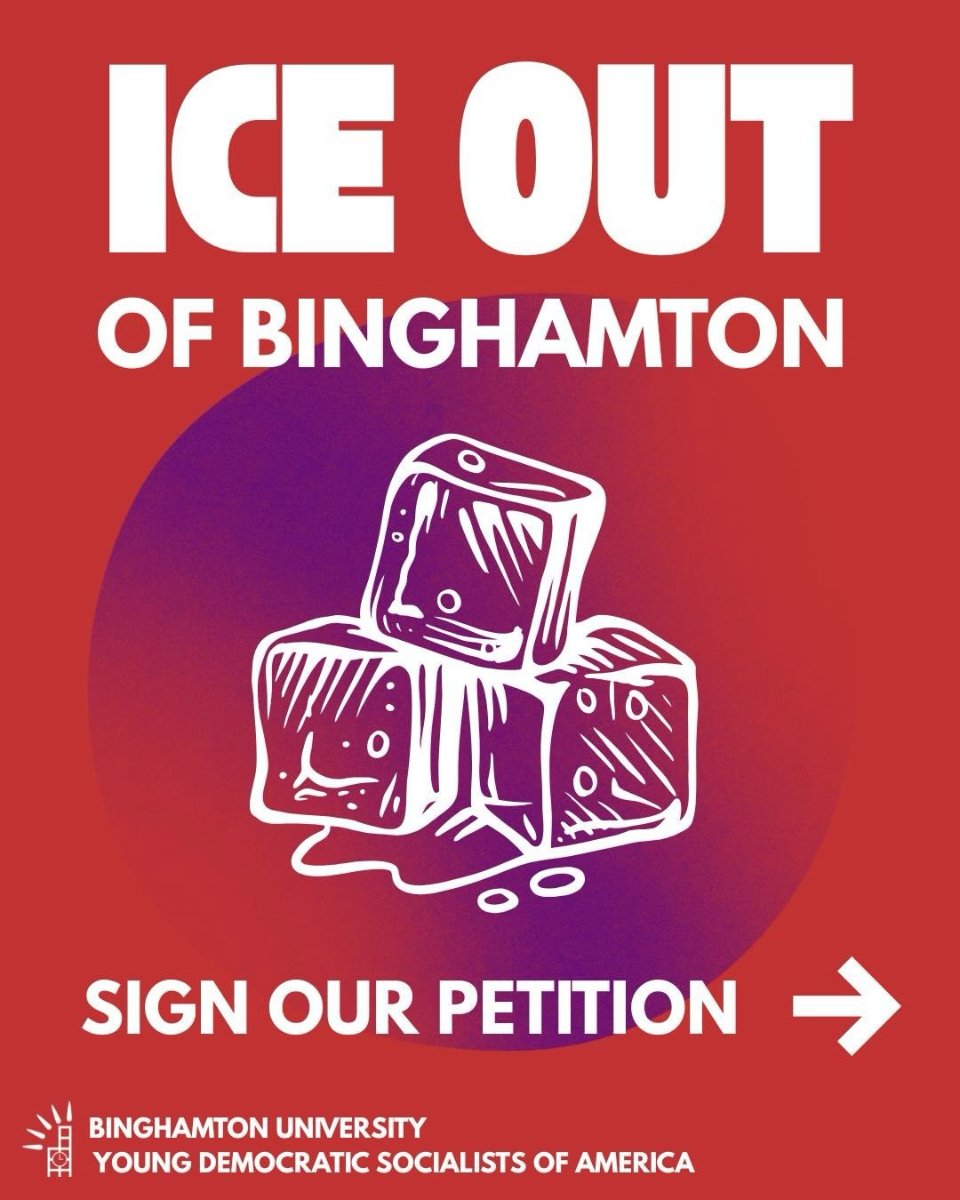
Anti-ICE activism has become a familiar feature of campus political life. At Binghamton University, for example, the Young Democratic Socialists of America chapter (YDSA) has organized protests, posted flyers, circulated petitions, and issued statements opposing Immigration and Customs Enforcement (ICE). Its slogans have included “ICE out of Binghamton” and the familiar demand to “Abolish ICE.” As vice president of the Binghamton College Republicans, I have watched this activism unfold.
The anti-ICE position is not treated as a fringe or especially radical stance on campus. In fact, it’s subsidized. According to student budget allocation materials publicly released by an on-campus student magazine, Binghamton’s YDSA chapter receives more funding for the 2026–2027 academic year than the College Republicans and College Democrats combined. Campus radicalism often presents itself as rebellion while functioning as a subsidized part of institutional life. The revolution, it turns out, has a budget line.
Binghamton is only one example, but it illustrates a broader problem on college campuses. Immigration enforcement is routinely presented as a conflict between compassion and cruelty. On one side are migrants, illegal aliens, asylum seekers, and deportable noncitizens. On the other side are ICE agents, restrictionists, and anyone who believes immigration laws should be enforced. The moral script is written before the argument even begins. But this framing leaves out the most important question: compassion for whom?
Misplaced Compassion
Anti-enforcement policies are obviously intended to benefit illegal aliens who wish to avoid removal, but they also impose costs on American workers, taxpayers, and local communities. Those costs may include pressure on public services, competition in the labor market, strain on housing, public-safety concerns, weakened rule of law, and the erosion of political control over who may enter and remain in the country. In other words, anti-ICE activism does not favor eliminating costs, but merely wants to change who is expected to bear them.
This is the part of the debate campus activists usually avoid. I have seen it myself. At Binghamton University’s annual Great Debate, I have repeatedly participated in the segment on immigration. In my last debate, my opponent — a YDSA sympathizer — spent much of his time portraying the restrictionist position as “racist” rather than engaging seriously with its claims about national interest, enforcement, labor markets, assimilation, or public obligation. The implication was clear: Immigration restriction was not a position to be answered, but a moral defect to be denounced.
Word Games
Another feature of campus activism is sloganeering. Terms such as “undocumented”, “migrant justice”, “sanctuary”, “community safety”, and “no human is illegal” do not merely describe a policy position. They frame the issue in advance. “Undocumented” softens the violation of immigration law. “Sanctuary” suggests protection rather than obstruction. “Migrant justice” implies that opposition to illegal immigration is injustice. “Community safety” allows activists to present non-enforcement as protection, even when the relevant “community” excludes the citizens and lawful residents affected by illegal immigration.
The same language works in reverse against restrictionists. Support for immigration enforcement is described as “xenophobia”, “racism”, or “anti-immigrant hate”. These are not arguments; they are moral shortcuts. Their function is to end debate before it begins. If one side is allowed to call its position “migrant justice”, while the other side must spend the first half of every sentence proving it is not motivated by hatred, the debate has already been rigged.
“Abolish ICE” is an especially effective slogan because it sounds more precise than it actually is. It targets a specific agency, but often smuggles in a much broader attack on immigration enforcement itself. That ambiguity needs to be challenged. If “Abolish ICE” means replacing ICE with another federal agency that enforces immigration law, removes illegal aliens, detains those subject to removal, and cooperates with local authorities, then the slogan is misleading. But if “Abolish ICE” means ending deportation, detention, interior enforcement, and meaningful penalties for unlawful presence, then activists should be forced to admit it openly. In that case, the demand is not simply anti-ICE, but anti-border.
That distinction matters. A country can debate how immigration enforcement should be carried out. It can debate detention standards, agency structure, prosecutorial discretion, asylum procedures, and the relationship between federal immigration authorities and local law enforcement. But a country cannot abolish enforcement and still pretend that its immigration laws are more than suggestions.
Campus activists often avoid this problem by speaking in moral absolutes. Deportation becomes “violence”. Enforcement becomes “terror”. Cooperation with immigration authorities is “complicity”. But these slogans do not answer the practical questions. Who should be removed? Who should be allowed to stay? What happens to visa overstayers? What happens to illegal aliens who commit crimes? What happens when asylum claims fail? What happens when a university is asked to cooperate with lawful federal authorities? The anti-ICE position cannot be evaluated seriously until its advocates answer these questions.
Subsidized Rebellion
There is also an institutional dimension to campus immigration radicalism. Campus activists often imagine themselves as insurgents against power. But in practice, their activism is frequently funded, recognized, and normalized by the very institutions they claim to oppose. As noted above, the YDSA chapter at Binghamton receives more student funding than both major party clubs combined. Its anti-ICE activism is not some courageous and isolated act of dissent taken by political underdogs; it is part of a campus political ecosystem in which immigration activism is often treated as neutral civic engagement, while pro-enforcement activism is treated as controversial by default.
This creates an asymmetry. Anti-ICE protests can be presented as compassion, justice, or student safety. Pro-enforcement arguments are forced into a defensive crouch, constantly answering against moral accusations. Pro-illegal-alien advocates get to speak in the language of moral urgency. Restrictionists, meanwhile, are expected to speak in disclaimers.
That asymmetry affects how students organize. When Binghamton College Republicans invited CIS Resident Scholar Jason Richwine to speak, we debated how publicly to promote the event because of concerns about disruption. Unlike most major campus events, which are advertised weeks in advance, we put flyers in only a few buildings and made one brief social media post a few days before the event. At one point during his presentation, two suspicious individuals in hoodies entered the room and left after university police came by to check on the event. We cannot know for certain whether they intended to disrupt it, but the fact that we had to think in those terms at all says something about the campus climate surrounding immigration restrictionist speech. That caution was not baseless. When Binghamton College Republicans invited its previous speaker — economist Art Laffer, hardly a rhetorical bomb-thrower — student protesters shut down the event.
Speakers and forums sympathetic to the rights of aliens do not appear to face the same presumption of controversy. Quite the opposite: They are often hosted or sponsored by university departments and institutes. Binghamton’s Institute for Genocide and Mass Atrocity Prevention has hosted a forum featuring multiple immigration activists, and the Human Rights Institute promoted Angela Naimou as keynote speaker for the 2026 Diaspora Studies Conference, where she was scheduled to speak on “International Law, Diaspora Fiction, and the Claims of Refugee History”. One side arrives on campus under the respectable banners of “human rights”, “genocide prevention”, and “academic inquiry”. The other, meanwhile, has to worry about whether publicizing an immigration restrictionist speaker will invite disruption.
This is what campus censorship looks like in practice. It is not always an administrator formally banning a speaker or a student being officially punished for his views. Sometimes, it is the quieter calculation that the safest way to hold an event is to make sure too few hostile people notice it. The result is a political environment in which anti-enforcement activists can chant, flyer, petition, and organize loudly, while students who support immigration restriction often learn to proceed cautiously. Technically, students are free to defend immigration restriction. But in practice, many understand that doing so can invite mob action before the policy argument even begins. There is no precise way to measure how often students self-censor on immigration specifically, but the broader pattern of students being reluctant to speak openly is familiar to anyone involved in campus politics.
This is how campus radicalism sustains itself. It does not need to win every argument. It only needs to control which arguments are considered morally admissible.
What Restrictionist Students Should Do
Fortunately, immigration restrictionists can do more on campus than simply complain. At my own university, there are lessons I have drawn from watching anti-ICE activism up close. The problem is not simply that campus activists organize around bad ideas. The problem is that they organize seriously, confidently, and without apology, while students who support immigration restrictionism often allow themselves to be pushed into a reactive posture. That has to change.
First, students must contest the language of the debate. The activist slogans should not go unanswered. “Abolish ICE” should be met with “Abolish enforcement?” “Sanctuary campus” should be met with “Sanctuary for whom?” “No human is illegal” should be met with the reality check that actions can be illegal and that citizenship loses meaning if the distinction between citizen and noncitizen is erased.
Second, they should force anti-enforcement activists to explain their actual policy demands. Do they support deportation in any cases? Do they believe universities should cooperate with federal immigration authorities when presented with lawful requests? Do they believe immigration law should be enforced against visa overstayers? Do they support detention for aliens who pose flight risks? If they oppose ICE, what institution do they believe should carry out removals? The perceived moral superiority of the activists will lose its weight the more they have to reveal what they actually believe.
Third, they should make the costs of non-enforcement visible. Campus activists focus on illegal aliens facing removal. Restrictionist students should talk about everyone else who is harmed by allowing illegals to remain. They should ask who pays, who loses, who is displaced, and who is ignored when immigration enforcement is obstructed.
Fourth, they should treat campus politics as real politics. That means holding events, inviting speakers, publishing fact sheets, scrutinizing student government funding, supporting candidates, and giving students practical experience in campaigns and policy advocacy. Illegal-alien advocates understand that politics is not only about debate but also about effective organization. Restrictionists should learn the same lesson.
Finally, restrictionist students should never apologize for the existence of borders. A nation has the right to decide who may enter, who may remain, and whom its government is obligated to prioritize. That principle is not extreme in the slightest. It is the foundation of a political community.
Conclusion
Campus anti-ICE activism presents itself as humanitarian, but its humanitarianism is selective. It asks students to see the alien facing enforcement, but not the citizen who is harmed. It asks them to see the hardship of deportation, but not the costs of non-enforcement. The activists speak of “sanctuary”, “justice”, and “safety”, but rarely ask who is being protected and who is being sacrificed.
At Binghamton, this national debate appears in miniature. The anti-ICE side has funding, slogans, petitions, protests, and an institutional environment that generally understands and supports its moral language. Students who support enforcement, a basic prerequisite for having a sovereign country, have to build something more difficult: a public case for borders in a setting where borders are often treated as morally suspect.
The central question is not whether immigration policy will impose costs. Every policy does. The question is who will bear them. Anti-ICE activists have already chosen their answer. They believe illegal aliens should be shielded from enforcement, and that everyone else should absorb the consequences. At the very least, that might be a coherent position, but it should not be mistaken for universal compassion. The purpose of abolishing ICE is not to abolish unjust suffering, but to redistribute it onto Americans. The first task of restrictionist students is to make visible the people whom this campus compassion leaves behind.