
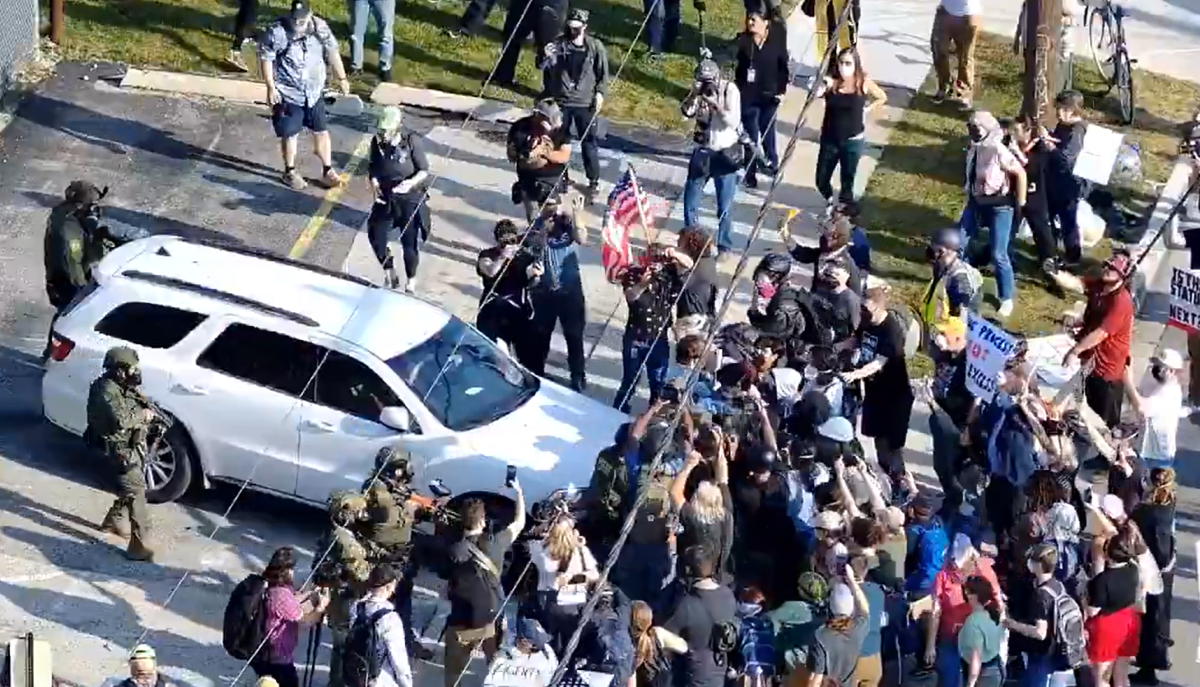
This report discusses what happens when state and local governments criminally prosecute federal law enforcement officials in order to obstruct the enforcement of disfavored federal laws. What protections are available to federal officers targeted for prosecution simply for carrying out their duties under federal law?
Summary
- DHS immigration officers are being prosecuted at the state/local level for alleged crimes committed while enforcing federal immigration laws.
- Any potentially unlawful use of force — especially deadly force — by federal law enforcement officers must be fully and fairly investigated and potentially lead to sanctions up to and including criminal prosecution. However, when a prosecution is not at the federal level but rather is a state or local prosecution, there is an inherent risk, in the words of the Tenth Circuit, that instead of being a “bona fide effort to punish”, the prosecution could be simply “an attempt to hinder a locally unpopular federal program”. This risk is especially high when DHS officers are prosecuted in sanctuary jurisdictions where politicians and prosecutors alike express open hostility toward federal immigration law enforcement.
- The U.S. Constitution’s Supremacy Clause provides that the Constitution and the laws of the United States “shall be the supreme law of the land; and the judges in every state shall be bound thereby”. Thus, as the Tenth Circuit has explained, to prevent states from impeding or frustrating the legitimate execution of federal law, “federal officers have long been held immune from state prosecutions for actions reasonable and necessary in the discharge of their … responsibilities”.
- Federal officials do not receive immunity from state or local prosecution, however, simply by virtue of being federal employees, or because their alleged crimes occurred while carrying out their official duties. To receive immunity, they must be carrying out duties they are authorized to perform under federal law, and, in the words of the Supreme Court, “d[o] no more than what was necessary and proper … to do”.
- Additionally, as the Supreme Court has explained, “[t]o protect the Federal Government from state-court ‘interference with its operations,’ Congress has given federal courts jurisdiction over some suits against federal officers” brought in state or local courts, “one of the most important reasons for removal [to federal court being] to have the validity of the defense of official immunity tried in a federal court”. “State-court proceedings may reflect ‘local prejudice’ against unpopular federal laws or federal officials.” The Supreme Court has made clear, though, that transfer requires that the federal defendant raise a federal defense (such as Supremacy Clause immunity).
- DHS immigration officers diligently and responsibly carrying out their duty to their agency and their country deserve protection against malicious state or local prosecutions. Because of a long and inglorious history of states and localities prosecuting federal law enforcement officers in order to impede or frustrate the enforcement of disfavored federal laws and court orders — from wartime trade restrictions to environmental laws to desegregation orders — such protections have long been in place. Supremacy Clause immunity and the transfer of adjudications to federal court should defang prosecutors acting in bad faith.
Introduction
On July 8, Allison McCann reported in the New York Times that since the beginning of President Trump’s second term, Department of Homeland Security (DHS) law enforcement officers have “shot at” 23 people, killing six, during immigration enforcement operations. “[N]early all of [the shootings] involved officers firing at people in vehicles…. [with m]any of the[se] drivers … later … charged with assaulting a federal officer with a deadly weapon — their vehicle.”
On April 16, Sheila Eldred, Ernesto Londoño, and Julie Bosman reported in the New York Times that “Prosecutors in Minneapolis … charged a [U.S. Immigration and Customs Enforcement (ICE)] agent with assault, accusing the agent of pointing a gun at motorists along a state highway.”
On May 18, Londoño and Mitch Smith reported in the New York Times that Minnesota prosecutors charged an ICE agent with four felony counts of second-degree assault and one misdemeanor count of falsely reporting a crime in the shooting of a Venezuelan illegal alien, who was shot in the leg but not seriously injured. On July 13, Philip Marcelo and Rebecca Boone reported for the Associated Press that “federal officials asked the state … for evidence gathered in the investigation of [the] ICE agent”, who “[p]rosecutors say … fired through a home’s front door and shot [an alien] in the thigh while in pursuit of another man”.
As I have made clear on a number of occasions, any potentially unlawful use of force — especially deadly force — by federal law enforcement officers must be fully and fairly investigated and potentially lead to sanctions up to and including criminal prosecution.
When a prosecution is not a federal prosecution for a violation of federal law, but instead a state or local prosecution for violation of state or local law, however, there is an inherent risk, in the words of the U.S. Tenth Circuit Court of Appeals in its 2006 decision in Wyoming v. Livingston, that rather than being a “bona fide effort to punish a violation” of state or local law, the prosecution could be simply “an attempt to hinder a locally unpopular federal program”.
I would posit that such a risk is especially high when DHS officers are prosecuted in sanctuary jurisdictions where politicians and prosecutors alike express open hostility toward federal immigration law enforcement and the officers whose sworn duty is to carry it out. For example:
- Minnesota Gov. Tim Walz labeled DHS’s large-scale immigration law enforcement endeavor in Minnesota — “Operation Metro Surge” — as “a physical assault”, “an armed force that’s assaulting, that’s killing my constituents, my citizens” and raised the specter of civil war, musing “I mean, is this a Fort Sumter?”
- Broadview, Ill., Mayor Katrina Thompson accused ICE of “a pattern of escalating aggression”, and of “making war on my community”.
- Chicago Mayor Brandon Johnson proclaimed that President Trump and DHS have “declare[d] war on Chicago and American cities across this country” and that the president “is using ICE as his private militarized occupying force”. Johnson promised that “Whether it’s in the courts, whether it’s in the streets or with policy, we’re going to continue to defend and stand up for working people.” (Emphasis added.)
And then there is Philadelphia District Attorney Larry Krasner. On January 27, Krasner referred to ICE agents as “a small bunch of wannabe Nazis, that’s what they are”.1 He vowed that “There will be accountability now. … There will be accountability after Trump is out of office. If we have to hunt you down the way they hunted down Nazis for decades, we will find your identity, we will find you, we will achieve justice.”2 On March 24, Krasner warned ICE agents that:
You commit crimes within the jurisdiction that is the city and county of Philadelphia, I prosecute you.… And, yes, I will put you in handcuffs and I will put you in a courtroom and if necessary I will put you in a jail cell if you decide to make the terrazzo floor of this airport anything like what you did in the streets of Minneapolis, which involved the criminal homicide of unarmed, innocent people.
On January 27, Shaila Dewan reported in the New York Times that:
Nine progressive prosecutors from cities around the country [including Krasner] are launching a coalition to assist in prosecuting federal law enforcement officers who violate state laws. …
The organization, which is called the Project for the Fight Against Federal Overreach, will also include Mary Moriarty, the elected prosecutor in Minneapolis. … F.A.F.O.[s’] … formation was spurred by “growing concerns about warrantless entries, unlawful detentions, and coercive enforcement tactics by federal agents,” according to a news release.
Although the precipitating issue — immigration law enforcement — may be new, clashes between the federal government and states and localities over the enforcement of locally unpopular federal laws, policies, and court orders are as old as our republic, and have sometimes devolved into abusive state or local prosecutions of federal law enforcement officials designed to frustrate enforcement efforts. The Tenth Circuit explained in Livingston — which “involve[d] the highly charged issue of federal reintroduction of wolves in Wyoming” — that:
[S]ome of the most dramatic clashes between states and the federal government in U.S. history [have included] Mississippi’s prosecution of a federal marshal for breach of the peace for using tear gas to control riots erupting over the admission of the first African American student to its state university [citing the U.S. District Court for the Northern District of Mississippi’s 1964 decision in In re McShane’s Petition], California’s prosecution of a federal marshal for killing a former justice of the state supreme court who he thought was about to assassinate Supreme Court Justice Stephen Field [citing the Supreme Court’s 1890 decision in In re Neagle]; and … Idaho’s prosecution of a federal agent for killing an unarmed woman … in connection with the notorious raid on a cabin at Ruby Ridge. [Citing the Ninth Circuit’s 2001 decision in Idaho v. Horiuchi.]
The Tenth Circuit concluded there: “The record evidence supports the suspicion that the prosecution … was not a bona fide effort to punish a violation of Wyoming trespass law … but rather an attempt to hinder a locally unpopular federal program.”
Bryna Godar has written for the University of Wisconsin’s State Democracy Research Initiative that “States have a long history of prosecuting federal officials … with a variety of motives,” elaborating that:
[M]any cases in the 1800s stemmed from states’ disagreements with federal policies and represented outright efforts to obstruct federal action. For example, during the War of 1812, some New England states openly resisted federal trade embargoes, including by pursuing state criminal actions against federal customs officers for seizing goods. In the mid-1800s, some Northern states opposed to the Fugitive Slave Act charged U.S. marshals for capturing or failing to release previously enslaved individuals. …
In the late-1800s and early 1900s, state prosecutions often centered on federal officers’ enforcement of revenue and prohibition laws. In an 1898 case [the Fourth Circuit’s decision in Virginia v. Bingham], for example, Virginia prosecutors charged a federal tax collector’s posse with killing several cattle during a shoot-out. According to the federal officers, the shoot-out ensued after they were ambushed by a group defending violators of the tax laws. In other examples, states charged federal officers with murder or attempted murder for using lethal force while carrying out arrests or other enforcement actions, such as seizing equipment from an illicit distillery. [Citing the Supreme Court’s 1926 decision in Maryland v. Soper and 1879 decision in Tennessee v. Davis, the Eighth Circuit’s 1918 decision in Castle v. Lewis, the U.S. District Court for the District of Oregon’s 1920 decision in Oregon v. Wood, the U.S. District Court for the Southern District of Florida’s 1922 decision in Ex parte Huston, the U.S. District Court for the District of Massachusetts 1923 decision in Massachusetts v. Bogan3, the U.S. District Court for the Western District of Kentucky’s 1922 decision in Smith v. Gilliam, and the U.S. Circuit Court for the Northern District of Georgia’s 1877 decision in Findley v. Satterfield4.]
While it is true, as the Tenth Circuit stated in Livingston, that “state criminal law provides an important check against abuse of power by federal officials” and “[t]he framers of the American federal system expected the federal and state governments each to check the abuses of the other”, it is also true, as the court wrote, that:
The flipside of this mutual checking function … is the danger that one level of government would improperly restrict the other, and especially that states would impede or frustrate the legitimate execution of federal law.
[T]he supremacy of federal law precludes the use of state prosecutorial power to frustrate the legitimate and reasonable exercise of federal authority.
The Fourth Circuit concluded in its 1904 decision in West Virginia v. Laing that “A state court has not the right to arrest, convict, and punish an officer of the United States for an act lawfully done by him in the discharge of his official duties. If such court has that right, then the federal government is without the power necessary for its own protection.” And the circuit similarly stated 83 years later in its 1987 decision in Maryland v. DeShields that “if the courts of the state could arrest and punish the officers of the federal government for acts done by them when they were lawfully discharging their duties … [this] would carry with it the power to prevent them from discharging their duties”.
The Ninth Circuit stated in Horiuchi, “If federal agents are to perform their duties vigorously … they cannot be unduly constrained by fear of state prosecutions.”
And the Supreme Court warned in Tennessee v. Davis that:
[We] said in [our 1816 decision in] Martin v. Hunter … “the general government must cease to exist whenever it loses the power of protecting itself in the exercise of its constitutional powers.”… The legislation of a state may be unfriendly. It may affix penalties to acts done under the immediate direction of the national government and in obedience to its laws. It may deny the authority conferred by those laws. The state court may administer not only the laws of the state, but equally Federal law, in such a manner as to paralyze the operations of the government. And even if, after trial and final judgment in the state court, the case can be brought into the United States court for review, the officer is withdrawn from the discharge of his duty during the pendency of the prosecution and the exercise of acknowledged federal power arrested.
The Court concluded that “We do not think such an element of weakness is to be found in the Constitution,” for:
The United States is a government with authority extending over the whole territory of the Union, acting upon the States and the people of the States. While it is limited in the number of its powers, so far as its sovereignty extends, it is supreme. No State government can exclude it from the exercise of any authority conferred upon it by the Constitution, obstruct its authorized officers against its will, or withhold from it for a moment the cognizance of any subject which that instrument has committed to it.
What happens when state and local governments criminally prosecute federal law enforcement officers? What happens when they do so in order to obstruct the enforcement of federal law? What protections are available for federal officers targeted for prosecution simply for carrying out their duties under federal law? This piece examines these vital questions.
Federal Officials’ Immunity from Prosecution Under the Constitution’s Supremacy Clause
The Supreme Court proclaimed in its 1819 decision in McCulloch v. Maryland that “The nation, on those subjects on which it [is supreme], must necessarily bind its component parts,” stating further that:
[T]he people have, in express terms … sa[id this through the Supremacy Clause and have] require[ed] that the members of the State legislatures and the officers of the executive and judicial departments of the States shall take the oath of fidelity to it. “[T]he Members of the several State Legislatures, and all executive and judicial Officers, both of the United States and of the several States, shall be bound by Oath or Affirmation, to support this Constitution”. (Art. VI, § 3)]
The Tenth Circuit explained in Livingston that “[t]o prevent [states from impeding or frustrating the legitimate execution of federal law], federal officers have long been held immune from state prosecutions for actions reasonable and necessary in the discharge of their … responsibilities” and that the “seldom-litigated corner of the constitutional law of federalism known as Supremacy Clause immunity … governs the extent to which states may impose civil or criminal liability on federal officials for alleged violations of state law committed in the course of their federal duties”.
The Tenth Circuit noted that Supremacy Clause immunity (logically) is “rooted in the [U.S. Constitution’s] Supremacy Clause” (Art. VI, § 2), which provides that:
This Constitution, and the laws of the United States which shall be made in pursuance thereof; and all treaties made, or which shall be made, under the authority of the United States, shall be the supreme law of the land; and the judges in every state shall be bound thereby, anything in the Constitution or laws of any State to the contrary notwithstanding.
No Statutory Authorization Required
Supremacy Clause immunity requires no specific statutory authorization. In 1824, the Supreme Court explained in Osborn v. Bank of United States that:
An officer … is ordered to arrest an individual. It is not necessary, nor is it usual, to say that he shall not be punished for obeying this order. His security is implied in the order itself. It is no unusual thing for an act of Congress to imply, without expressing, this very exemption from State control. … The collectors of the revenue, the carriers of the mail, the mint establishment, and all those institutions which are public in their nature are examples in point. It has never been doubted that all who are employed in them are protected, while in the line of duty; and yet this protection is not expressed in any act of Congress. It is incidental to, and is implied in the several acts by which these institutions are created, and is secured to the individuals employed in them by the judicial power alone.
As the Tenth Circuit explained in Livingston: “Supremacy Clause immunity does not require that federal law explicitly authorize a violation of state law. … The question is not whether federal law expressly authorizes violation of state law, but whether the federal official’s conduct was reasonably necessary for the performance of his duties.”
The Breadth of Immunity
In Livingston, the Tenth Circuit discussed the Supreme Court’s 1899 decision in Ohio v. Thomas, which involved:
An Ohio statute, presumably pressed by dairy farmers, [that] required any establishment serving or using oleomargarine to prominently display that fact on a large placard. … In disregard of this vital labeling law, the eating house at the Central Branch of the National Home for Disabled Volunteer Soldiers impetuously served oleomargarine without advertisement.
“Impetuously”?! I love it. In any event:
Unwilling to countenance this affront to its laws, the State of Ohio indicted … the governor in charge of the eating house … [who] was convicted … and … ordered … imprisoned until he paid a $50 fine; he refused to pay, and instead filed a writ of habeas corpus in the Southern District of Ohio, which the court granted. … The Sixth Circuit affirmed and Ohio appealed to the Supreme Court. The Court affirmed on the grounds that the eating house was a federal facility and [the Central Branch’s governor] had authorization from the Secretary of War to serve oleomargarine to his charges.
The Supreme Court in Thomas, in its own words, addressed “the question [of] whether [the state of Ohio] had the power to legislate so as to control the governor of the home … in regard to the internal administration of the affairs of the home, and in respect to the conditions upon which an article of food might be provided by the governor under such directions and authority”.
The Thomas Court noted that “The home is a federal creation, and is under the direct and sole jurisdiction of Congress”, and concluded that “a state legislature has no constitutional power to interfere with such management as is provided by Congress”. Further, “Whatever jurisdiction the state may have over the place or ground where the institution is located, it can have none to interfere with the provision made by Congress for furnishing food to the inmates of the home.”
Importantly, as the Tenth Circuit noted:
Th[e Supreme Court’s] holding gives grants of federal authority a generous sway. [The governor] was not prosecuted for serving oleomargarine, but for failing to notify patrons he was doing so. This requirement was not incompatible with [his] federal authorization to serve oleomargarine; [he] could have complied with the state law without shirking his federal duty. Nevertheless, the Court concluded that the grant of federal authority was sufficient not only to permit serving oleomargarine, but to prevent Ohio from regulating the manner and circumstances of service as well.
In 1920, the Supreme Court in Johnson v. Maryland addressed “whether the State has power to require [a U.S. Post Office worker transporting the mail by truck] to obtain a license by submitting to an examination concerning his competence and paying three dollars, before performing his official duty in obedience to superior command”, and, thus, whether “the State can interrupt the acts of the general government itself”.
The Court explained that:
With regard to taxation, no matter how reasonable, or how universal and undiscriminating, the state’s inability to interfere has been regarded as established since [the Supreme Court’s decision in McCulloch]. The decision in that case was not put upon any consideration of degree, but upon the entire absence of power on the part of the states to touch, in that way at least, the instrumentalities of the United States … and that is the law today.
As to Maryland’s license requirement, the Court concluded that “Such a requirement does not merely touch the government servants remotely by a general rule of conduct; it lays hold of them in their specific attempt to obey orders, and requires qualifications in addition to those that the government has pronounced sufficient.” The Court ruled that:
[T]he immunity of the instruments of the United States from state control in the performance of their duties extends to a requirement that they desist from performance until they satisfy a state officer upon examination that they are competent for a necessary part of them and pay a fee for permission to go on.
The Limits of Immunity
As the Supreme Court made clear in its 1932 decision in Colorado v. Symes, “Federal officers and employees are not, merely because they are such, granted immunity from prosecution in state courts for crimes against state law.” And, as the Court stated in Johnson, “Of course, an employee of the United States does not secure a general immunity from state law while acting in the course of his employment.”
Then when is a federal officer protected by immunity? In Neagle, the Supreme Court ruled that:
[If a U.S. marshal] is held in the state court to answer for an act which he was authorized to do by the law of the United States, which it was his duty to do as marshal of the United States, and if, in doing that act, he did no more than what was necessary and proper for him to do, he cannot be guilty of a crime under the law of the State of California. When these things are shown, it is established that he is innocent of any crime against the laws of the State, or of any other authority whatever. There is no occasion for any further trial in the state court, or in any court.
As to Neagle, the Court concluded that:
[I]n the protection of the person and the life of [the Supreme Court Justice] while in the discharge of his official duties, Neagle was authorized to resist the attack … was correct in the belief that, without prompt action on his part the assault … would have ended in the death of the [Justice] … [and] such being [Neagle’s] well founded belief, he was justified in taking the life of [the assailant], as the only means of preventing the death of the man who was intended to be his victim … [and] in taking the life of [the assailant], under the circumstances, he was acting under the authority of the law of the United States, and was justified in so doing.
The “Neagle test”, as articulated by the Tenth Circuit in Livingston, is that “a federal officer is not entitled to Supremacy Clause immunity unless, in the course of performing an act which he is authorized to do under federal law, the agent had an objectively reasonable and well-founded basis to believe that his actions were necessary to fulfill his duties”. The court also clarified that “Supremacy Clause immunity cases require courts to evaluate the circumstances as they appear to federal officers at the time of the act in question, rather than the more subtle and detailed facts later presented to a court.” (Citing Neagle.)
Is the Neagle test a purely objective one, or does it also have a subjective element? In 1977, the Ninth Circuit in Clifton v. Cox ruled that an officer’s actions must be both objectively and subjectively (in the officer’s mind) reasonable, stating that whether an action was necessary and proper “must rest not only on the subjective belief of the officer but also on the objective finding that his conduct may be said to be reasonable under the existing circumstances”.
The Ninth Circuit explained that:
Proper application of this standard does not require a petitioner to show that his action was in fact necessary or in retrospect justifiable, only that he reasonably thought it to be. Thus, in In re Neagle … the officer killed … the alleged assailant[] when he reasonably thought [him to be] reaching for a knife [even though i]t was later learned that [the assailant] was not carrying a knife.
The District Court for the Northern District of Mississippi in McShane’s Petition noted that an officer is entitled to immunity “even though his belief was mistaken or his judgment poor”.
The Ninth Circuit in Clifton cited the District Court for the Eastern District of Pennsylvania’s 1944 decision in Brown v. Cain, where the court put the test as:
[Did the officer have] reasonable cause to believe and … honestly believe that the person he shot was guilty of the offense for which he was trying to arrest him, and [did he], in attempting to make the arrest … act[] within the scope of his authority and use[] no more force than he honestly and reasonably believed was necessary.
The Ninth Circuit also quoted McShane’s Petition’s similar wording: if “petitioner shows ... that he had an honest and reasonable belief that what he did was necessary in the performance of his duty ... then he is entitled to the relief he seeks”.
The court in McShane’s Petition cautioned that:
The statutory habeas corpus provision for the benefit of federal officers was not intended to place beyond the reach of a state’s criminal law federal officials who employ means which they cannot honestly consider reasonable in discharging their duties or who otherwise act out of malice or with some criminal intent.
It wrote that “[t]his standard has been applied consistently by the federal courts which have been faced with similar questions” and cited a number of cases including the U.S. District Court for the District of Nebraska’s 1900 decision in In re Fair5, which looked to whether the officer acted “in good faith, without any criminal intent, but with an honest purpose to perform a supposed duty”, and the U.S. District Court for the Southern District of California’s 1919 decision in Ex parte Beach6, which looked to whether the officer “was at no time possessed of any ulterior design or motive, or any intention of doing anything other than merely to perform his full duty toward his government”.
The Sixth Circuit in its 1988 decision in Kentucky v. Long provided a succinct summary: “[O]n the subjective side, the agent must have an honest belief that his action was justified. On the objective side, his belief must be reasonable.”
However, in Horiuchi, the Ninth Circuit questioned in dicta the validity of requiring subjective reasonableness:
[N]one of the[] cases [using the subjective test] consider the impact of [the Supreme Court’s 1982 decision in] Harlow v. Fitzgerald … which rejected the subjective prong for the qualified immunity defense [against liability under 42 U.S.C. § 1983, which provides (simplified) that “[e]very person who, under color of any statute … of any State … subjects … any … person … to the deprivation of any rights, privileges, or immunities secured by the Constitution … shall be liable … for redress”] and held that immunity requires only a showing that the conduct was objectively reasonable. Harlow’s reasoning would seem to apply equally to Supremacy Clause immunity.
However, the Ninth Circuit concluded that “Because it makes no difference on this appeal, we leave the issue for consideration where it matters.” The Tenth Circuit in Livingston agreed with the Ninth Circuit’s dicta, and also “le[ft] for another day the question whether that belief must be both subjectively and objectively reasonable”. Ah, dicta upon dicta.
The Tenth Circuit elaborated that:
We are … concerned with the incorporation of a subjective element into the reasonableness of a federal officer’s actions … [which] first appeared in district court decisions in the mid-twentieth century. In Brown v. Cain … and McShane … the courts held that a federal officer must have an “honest[ ]” belief that his actions are reasonable and necessary to the exercise of his authority. Although most circuit courts have adopted the subjective approach without analysis, the en banc Ninth Circuit [in Horiuchi] has recently questioned whether [it] is appropriate in light of … Harlow.
While acknowledging that “qualified immunity and Supremacy Clause immunity have different sources and functions”, the Tenth Circuit contended that “there is a functional similarity between these two doctrines”:
Both … reduce the inhibiting effect that a civil suit or prosecution can have on the effective exercise of official duties by enabling government officials to dispose of cases against them at an early stage of litigation. [quoting the Supreme Court’s 1987 decision in Anderson v. Creighton] (“[D]amages suits against government officials can entail substantial social costs, including the risk that fear of personal monetary liability and harassing litigation will unduly inhibit officials in the discharge of their duties.”) … Just as the Supreme Court jettisoned the subjective element of the qualified immunity test because it was incompatible with the goal of promptly determining whether qualified immunity was appropriate on a motion for summary judgment … it may also be appropriate to reject a subjective element of the Supremacy Clause immunity test.
Significant Immunity Cases Involving the Use of Force by Federal Officers
In Livingston, the Tenth Circuit noted that “[t]he Supreme Court has decided no Supremacy Clause immunity case since 1920” and thus that “Modern Supremacy Clause immunity doctrine has … largely been developed in the lower federal courts”.
In Re McShane’s Petition. This case involved James McShane, the chief of the Executive Office of the U.S. Marshals, who in September 1962 was sent at the attorney general’s direction to the University of Mississippi in order to supervise deputy U.S. marshals in “remov[ing] all obstructions of justice to insure that [federal court] orders … would be executed and enforced” directing that James Meredith be admitted to the University without discrimination and “on the same basis as other students” and prohibiting actions to “impair, frustrate or defeat his right to enter the University”.
As the U.S. District Court for the Northern District of Mississippi described the situation: “Disorders and a riot occurred on … campus … and elsewhere in the immediate vicinity in connection with the … admission of Meredith. At least two people were killed, many others were injured, and much property was damaged or destroyed.” A Lafayette County, Miss., grand jury returned an indictment against McShane charging that he “did unlawfully and feloniously use physical acts, to-wit: the ordering of tear gas to be fired into a crowd … at [the] University … and such conduct did lead to a breach of the peace and did incite a riot … and as a result … [a person] … was killed”.
The district court stated that while “there are issues … which are bitterly contested”, certain facts “are not in dispute”, among them that:
Plans were made by … the Department of Justice [DOJ] to bring … Meredith onto the campus for registration as a student.
Shortly after deployment of [McShane’s] force, incoming traffic … composed largely of returning students [from a football game] and some parents, began to increase. … [A] crowd began to build up. … [that] first began to sing and yell and then … to jeer and taunt [McShane’s] force.
As the day progressed, the crowd grew in size and its members, who were angry and in a highly emotional state, increased the intensity of their jeering, taunting and harassing of [McShane’s] force.
Objects hurled by the crowd at [McShane’s] force progressed … to soda bottles [“Apparently at least one bottle was filled with gasoline or lighter fluid.”] stones and pieces of metal pipe [“At least one piece of pipe struck one deputy marshal.”] Efforts were made to set fire to a tarpaulin on one of the army trucks and to let the air out of truck tires.
All this sounds remarkably similar to the tenor of recent anti-ICE protests around the country. Supreme Court Justice Samuel Alito concluded in his dissent to the Court’s December 23, 2025, denial of a Trump administration stay request (Trump v. Illinois) that ICE “operations in and around Chicago have been the target of unprecedented sabotage and violence since June” 2025. As Justice Alito described the situation (based on U.S. government declarations):
Hundreds of rioters have converged at the [DHS] facility in Broadview, Illinois. … These rioters have been organized, gathering offsite and arriving in vans, then getting picked up several hours later by vans returning with new rioters. They have arrived armed with shields, gas masks, protective padding, and other tools for physical combat. And they have blocked entry and exit at the ICE facility, physically assaulted personnel attempting to enter or leave work, significantly damaged the building, and vandalized both Government and personally owned vehicles.
Justice Alito continued that “The resulting violence has endangered the lives of federal personnel,” elaborating that:
Multiple rioters have been found with loaded guns, some of them semi-automatic. Rioters have hit, punched, and shoved officers; thrown bottles, rocks, and tear gas canisters at officers; attempted to grab officers’ firearms and munitions; pulled gas masks and tear gas canisters off the officers’ uniforms; targeted officers with bullhorns and whistles that can cause permanent hearing loss; aimed strobe lights and lasers at officers’ faces; and shot fireworks at officers. … As of early October, more than 30 federal officers had suffered injuries, and multiple officers had been hospitalized.
In any event, the district court wrote that “an effort was made by some of [McShane’s] force to employ tear gas to disperse the crowd, but [McShane refused]. … [R]ecommendations continued to be made … to use tear gas, and [McShane finally] issued orders” to do so. According to the court, “[W]hen the gas was used the riot erupted. The crowd became a violent mob and got entirely out of control.”
The court noted “a sharp difference of opinion with respect to the temper of the crowd and as to the use of tear gas”, but it emphasized that “[E]stimating the temper of a crowd, which can change into a mob in the twinkling of an eye, is a matter of judgment. The difference between a mob and a crowd is gossamer thin.”
The court concluded that:
[McShane] was under specific orders … and [a] specific statutory duty to assist in the execution of the two federal court orders when he found himself faced with a large and growing crowd of people who were demonstrating violently their disapproval of said orders and who, as it appeared to him, were bent on obstructing the carrying out of these orders, and had for some time been engaged in doing things dangerous to persons and property. … [H]e had reasonable cause to believe that drastic action was necessary to carry out his duties … [and] reasonable cause to believe (and did so believe) that the use of tear gas … was a proper measure to be taken.
Thus, “In this situation [McShane] cannot be held answerable to the State of Mississippi on the aforementioned indictment charging him with a violation of state law.”
Idaho v. Horiuchi. Horiuchi (later vacated as moot) involved, as the Ninth Circuit put it, “the outer bounds of Supremacy Clause immunity in the context of Idaho’s attempt to prosecute FBI Special Agent Lon T. Horiuchi for killing Vicki Weaver during the infamous Ruby Ridge incident”. The court explained that:
[In August] 1992, six Deputy [U.S.] Marshals … conducted a reconnaissance mission on the Weaver property in preparation for [later] serving an arrest warrant. … They … were detected by a party consisting of Kevin Harris, Randy Weaver, his son Samuel and their dog. … [A] firefight erupted … [and] the marshals killed [the dog] and Samuel Weaver. … One of the Weaver party … shot and killed Deputy Marshal William Degan. …
Special Agent Horiuchi and … other [FBI] members … arrived on the scene the following morning.
[That evening] Kevin Harris, Randy Weaver and Weaver’s sixteen-year-old daughter, Sara, walked out of the Weaver cabin. … Horiuchi did not know the identities of the individuals, but he determined that at least one of them was holding a “long gun.” At the same time, Horiuchi says he heard the engines of the FBI helicopter in the general vicinity … [and] saw the armed individual (later identified as Randy Weaver) look up to the sky as if he might fire at the helicopter. Horiuchi fired once, wounding Weaver and causing him to drop from sight.
Randy and Sara Weaver ran into the cabin through a door … perpendicular to Horiuchi's line of sight. Harris was the last of the three to disappear … and, as he did, Horiuchi pulled the trigger. … Before hitting Harris … [the bullet] struck [and killed] Randy’s wife, Vicki, who had been standing behind the door cradling an infant.
The Ninth Circuit noted that DOJ had declined to prosecute Horiuchi and Idaho then charged him with involuntary manslaughter, alleging that:
[Horiuchi] did unlawfully, but without malice, kill Vicki J. Weaver … in a reckless, careless or negligent manner … discharging the firearm through the front door of the Weaver residence in an attempt to shoot Kevin Harris … without first determining whether any [other] person … was present on the other side of the door.
The Ninth Circuit explained that “Horiuchi removed the case to federal district court … [and there] moved to dismiss the indictment on grounds of Supremacy Clause immunity”, “claim[ing] he acted reasonably in trying to kill Harris in order to keep him from harming the law enforcement agents … in the helicopter”.
The court stated that “Were we to accept [his] story at face value … we … would conclude that he was entitled to immunity.” However, it concluded that:
[Horiuchi’s] statement suggests that [he] had decided to shoot the man with the gun, whether or not he continued to be a threat to the helicopter.
[I]t seems highly debatable whether a reasonable agent in Horiuchi’s position would have believed that the helicopter would be endangered if the man with the gun reached the cabin.
There is also doubt about whether Horiuchi is making up the helicopter story to cover up his real reason for the shooting, which was to follow the orders he had been given to shoot any armed man on sight.
This evidence suggests that Horiuchi shot Harris because he was following the unconstitutional Rules of Engagement, not because he thought Harris would pose a danger to the helicopter if he reached the cabin.
[W]e cannot say that a reasonable agent in Horiuchi’s position would have concluded that Harris presented the kind of immediate danger that made the use of deadly force reasonable. At the very least, the matter is in dispute.
Thus, “Because we find that there are material questions of fact in dispute which, if resolved against Horiuchi would strip him of Supremacy Clause immunity, we must reverse the district court’s order dismissing the case.” It instructed that “On remand, the district court may conduct an evidentiary hearing to determine whether the evidence supports Agent Horiuchi's entitlement to immunity.”
United States ex rel. Drury v. Lewis. The Supreme Court’s 1906 decision in United States ex rel. Drury v. Lewis involved an Army officer and an enlisted soldier who had been charged by Allegheny County, Pa., with murdering a man they believed had stolen copper fixtures from a federal arsenal. The soldier testified that as the man “fled he was called on several times … to halt, with warning that unless he halted [he] would [be] fire[d upon”, but that the man “did not halt, but continued his flight, and to prevent his escape … [the soldier] fired”.
Two witnesses, however, testified that the man “stopped, turned around facing the pursuing soldier … , threw up his hand, said, ‘Don't shoot,’ ‘I will come back,’ or ‘I will give up,’ and that just then [the officer] said ‘Fire!’ and [the soldier] fired the shot that killed [him].”
The Court concluded that if the man had surrendered, “it could not reasonably be claimed that the fatal shot was fired in the performance of a duty imposed by the federal law”, in which case “the state court had jurisdiction”. Thus, “if the question of [the man] being a fleeing felon was open to dispute on the evidence … it was for the state court to pass upon it”.
United States ex rel. McSweeney v. Fullhart. In 1891, the U.S. Circuit Court for the Western District of Pennsylvania decided United States ex rel. McSweeney v. Fullhart7, involving a federal judge ordering U.S. marshals to arrest a man under federal indictment for counterfeiting for purposes of trial.
Two U.S. deputy-marshals went to the man’s house, arrested him, and brought him to court where he pleaded guilty and was sentenced. As the marshals and the man returned, they drove across a bridge at the end of which, as the court described, “quite a crowd had collected, and, as the wagon approached, a man jumped out of the crowd, caught the horses, and said, ‘I want you fellows.’”
The marshals “drew their revolvers, and, pointing them at [the man], told him to let go of the horses, which he did, and the[y] drove on”. The marshals were later arrested and charged by Warren County, Pa., for “assaulting and pointing a gun at … constables[]”. McSweeney surrendered and petitioned the Western District for a writ of habeas corpus.
The circuit court concluded that:
It was the duty of the deputy-marshals to execute the process placed in their hands … to arrest the defendant … and bring him … [to] where the court was sitting. They had the right, in the performance of that duty, to use all necessary force to make the arrest. … Having arrested the prisoner, it was their duty to keep him in custody until further order of the district court, and in the performance of that duty they had the right to use all necessary force to prevent his escape or rescue. The arrest was authorized by the laws of the United States, the deputies were authorized to make the arrest by those laws, and it was their duty so to do, and the act for which it is sought to hold the relator in the state courts was one committed while in the performance of his duty.
Further:
The deputies are suddenly confronted, in a narrow passage on the bridge, by what they were justified in believing an assembled crowd of sympathizers with the prisoner. A man steps forward and seizes the horses, and brings them to a stop beside the crowd. Under the circumstances the deputies did exactly what they should have done. If they had not done as they did, but had stopped to parley, and their prisoner had been pulled out of the wagon and hustled away by the crowd, the deputies would have been guilty of gross neglect of duty. They did nothing more than was proper and necessary.
[H]ad it not been for the prompt action of the deputies, and had they shown any hesitancy or trepidation, they would have been involved in a serious difficulty, which might have resulted in the rescue or escape of the prisoner, and possibly loss of life.
Consequently, the court ruled that McSweeney must be discharged from custody.
Significant Immunity Cases Not Involving Use of Force by Federal Officials
Wyoming v. Livingston. In Livingston, the Tenth Circuit had to decide “whether [Wyoming] may prosecute the [U.S. Fish and Wildlife Service (USFWS)] agent in charge of the wolf reintroduction program [and a contractor] … for alleged violations of the Wyoming law[] against trespass … [for] unknowingly enter[ing] private property in the course of tranquilizing and installing collar monitoring devices on wolves”.
The court explained that the defendants were acting under Endangered Species Act regulations, which “do not merely authorize, but impose an obligation on the USFWS to monitor wolves” and that as to “[t]he reasonableness of their decision to immobilize the wolves and place them on land that might turn out to be private”, the defendants “argue that they made reasonable attempts to determine whether they were on private land … and that there were no [such] indications”.
The court concluded that “while the[y] were attempting to fulfill their federal duty to monitor the wolves … they confined their acts to an objectively reasonable view of the scope of their authority. Thus, the district court correctly granted immunity to the Defendants and correctly dismissed the indictment.”
Maryland v. DeShields. The Fourth Circuit decision in Maryland v. DeShields involved the availability of Supremacy Clause immunity in the case of a state prosecution for automobile manslaughter against “a member of the United States Army Reserve … on active duty[ who,] while acting in accordance with the orders of a superior army officer[, was] involved in a fatal” accident.
During a 331st Military Intelligence Company off-base picnic, Sgt. Wilson Lymon injured his ankle. Sgt. Alfonso Powell, the noncommissioned officer-in-charge, approached Specialist 4th class Gerald DeShields about taking Sgt. Lymon to a hospital. Upon determining that DeShields did not appear to be under the influence of alcohol — since almost everyone at the picnic was drinking beer — and appeared able to operate a vehicle, Sgt. Powell ordered him to do so.
Then, as the court described:
In an effort to avoid colliding with the rear of the vehicle in front of him, DeShields swerved to the left, lost control, crossed the median and collided with an oncoming vehicle. … [T]he driver of the other vehicle was killed and [DeShields] and Lymon sustained serious injuries.
Anne Arundel County, Maryland … charg[ed] … DeShields with automobile man slaughter, driving under the influence of alcohol, reckless driving, negligent driving, failure to drive right of center, and driving at a speed greater than reasonable.
After the case was removed to federal court, DeShields filed a motion to dismiss relying on Supremacy Clause immunity. The district court ruled in favor of DeShields and upon appeal the Fourth Circuit agreed, noting that “in Lymon’s opinion DeShields drove carefully, safely and within the speed limit from the time he left the picnic until the collision occurred” and concluding:
DeShields … was carrying out a legal order from a superior while driving the vehicle that was involved in the collision, and … his conduct … was necessary and proper in the performance of his duties[. A]ny error made by him in the operation of the vehicle was an error of judgment, which error does not deprive him of protection by the Supremacy Clause under the Neagle test.
Transfer to Federal Court
The Supreme Court concluded in its 1867 decision in The Mayor v. Cooper that “It is the right and the duty of the national government to have its Constitution and laws interpreted and applied by its own judicial tribunals,” elaborating that:
A different principle would lead to the most mischievous consequences. … There would be no uniformity of decisions. For every act of an officer, civil or military, of the United States … he would be liable to harassing litigation in the state courts. However regular his conduct, neither the Constitution nor laws of the United States could avail him, if the views of those tribunals and of the juries which sit in them, should be adverse. The authority which he had served and obeyed would be impotent to protect him. Such a government would be one of pitiable weakness, and would wholly fail to meet the ends which the framers of the Constitution had in view.
Earlier this year, the Supreme Court explained in Chevron USA Inc. v. Plaquemines Parish that “[t]o protect the Federal Government from state-court ‘interference with its operations,’ Congress has given federal courts jurisdiction over some suits against federal officers or those acting under them”, quoting the Court’s 2007 decision in Watson v. Philip Morris Cos..
In Philip Morris, the Court quoted from its 1969 decision in Willingham v. Morgan that “one of the most important reasons for removal is to have the validity of the defense of official immunity tried in a federal court”, explaining that:
State-court proceedings may reflect “local prejudice” against unpopular federal laws or federal officials. [quoting the Court’s 1926 decision in Maryland v. Soper] In addition, States hostile to the Federal Government may impede through delay federal revenue collection or the enforcement of other federal law. … And States may deprive federal officials of a federal forum in which to assert federal immunity defenses.
In Willingham, the Supreme Court explained that:
The federal officer removal statute has had a long history. … The first such … removal provision was included in an 1815 customs statute … part of an attempt to enforce an embargo on trade with England over the opposition of the New England States, where the War of 1812 was quite unpopular. It allowed federal officials involved in the enforcement of the customs statute to remove to the federal courts any suit or prosecution commenced because of any act done “under colour” of the statute. Obviously, the removal provision was an attempt to protect federal officers from interference by hostile state courts. … [O]ther periods of national stress spawned similar enactments. South Carolina's threats of nullification in 1833 led to the passage of the so-called Force Bill, which allowed removal of all suits or prosecutions for acts done under the customs laws. … A new group of removal statutes came with the Civil War, and they were eventually codified into a permanent statute which applied mainly to cases growing out of enforcement of the revenue laws. … Finally, Congress extended the statute to cover all federal officers… as part of the [Act of June 25, 1948].
The Court concluded that “The purpose of all these enactments is not hard to discern,” quoting from its decision in Tennessee v. Davis:
[The Federal Government] can act only through its officers and agents, and they must act within the States. If, when thus acting, and within the scope of their authority, those officers can be arrested and brought to trial in a State court for an alleged offence against the law of the State, yet warranted by the Federal authority they possess, and … if their protection must be left to the action of the State Court — the operations of the general government may at any time be arrested at the will of one of its members.
The Tenth Circuit stated in Livingston that while “federal officer removal statutes are designed to protect the operations of the federal government from state interference”, as is Supremacy Clause immunity, “the principles are distinct”.
It explained that while immunity “provides an absolute immunity to prosecution”, “[f]ederal officer removal statutes … provide federal officers with a federal forum for the entire trial, including determinations of guilt or innocence as well as the applicability of official immunity” in order to “protect[] against the possibility of a hostile state forum … when the federal officer is enforcing a locally unpopular national law.”
Currently, 28 U.S.C. § 1442 provides that a “civil action or criminal prosecution … commenced in a State court … may be removed … to the [appropriate] district court of the United States” in certain instances, including where it is against or directed to:
The United States or any agency thereof or any officer (or any person acting under that officer) of the United States or of any agency thereof, in an official or individual capacity, for or relating to any act under color of such office or on account of any right, title or authority claimed under any Act of Congress for the apprehension or punishment of criminals or the collection of the revenue.
The provision also applies to “[a]ny officer of the courts of the United States", such as U.S. Marshals, "for or relating to any act under color of office or in the performance of his duties”. There is a similar provision (28 U.S.C. § 1442a) for members of the armed forces.
The Supreme Court concluded in Willingham that “At the very least, [the removal statute] … cover[s] all cases where federal officers can raise a colorable defense arising out of their duty to enforce federal law. … [H]av[ing] such defenses litigated in the federal courts” was “[o]ne of [its] primary purposes”. Further, to procure removal, a federal officer need not demonstrate “a clearly sustainable defense”, need not “win his case before he can have it removed”, for “one of the most important reasons for removal is to have the validity of the defense of official immunity tried in a federal court.”
Constitutionality
In its 1926 decision in Maryland v. Soper, the Supreme Court explained that:
The constitutional validity of [removal] rests on the right and power of the United States to secure the efficient execution of its laws and to prevent interference therewith, due to possible local prejudice, by state prosecutions instituted against federal officers in enforcing such laws, by removal of the prosecutions to a federal court to avoid the effect of such prejudice. [Citing the Court’s decision in Davis.]
The Tenth Circuit in Livingston explained that “early removal statutes were often met with constitutional challenges, based on the theory that the cases did not arise under the Constitution or laws of the United States, and thus were outside the scope of Article III” of the Constitution, which provides that “[t]he judicial power of the United States, shall be vested in one supreme Court, and in such inferior Courts as the Congress may from time to time ordain and establish” and “shall extend to all Cases, in Law and Equity, arising under this Constitution, the Laws of the United States, and Treaties made, or which shall be made, under their Authority”. (Art. III, §§ 1-2.)
The Supreme Court, in its 1867 decision in Cooper, “entertain[ed] no doubt of the constitutionality” of the removal statute at that time, explaining that Article III’s power “is given in general terms”, “[n]o limitation is imposed”, and “[t]he broadest language is used”, “remitted without check or limitation to the wisdom of the legislature”. As to state courts: “[N]or is there any restriction as to the tribunals — state or federal — in which [cases under the Constitution and laws of the United States] may arise. Wherever found, they are within the reach of [the judicial power], and subject, for its exercise, to the lawmaking power of the nation.” As to the trigger, “Nor is it any objection that questions are involved which are not all of a federal character. If one of the latter exist, if there be a single such ingredient in the mass, it is sufficient. That element is decisive upon the subject of jurisdiction.”
In Davis, the Supreme Court grappled with the question of whether “the Constitution [has] conferred upon Congress the power to authorize the removal, from a state court to a federal court, of an indictment against a revenue officer for an alleged crime against the State … when it appears that a Federal question or a claim to a Federal right is raised in the case and must be decided therein”.
The Court stated that “A more important question can hardly be imagined. Upon its answer may depend the possibility of the general government's preserving its own existence.”
Davis involved a deputy collector of internal revenue who was indicted for murder in Grundy County, Tenn. As the Court described:
[T]he act for which he was indicted was performed in his own necessary self-defense, while engaged in the discharge of his duties … under the authority of the internal revenue laws of the United States … to seize illicit distilleries and the apparatus that is used for the illicit and unlawful distillation of spirits. … [W]hile so attempting to [do so] … he was assaulted and fired upon by a number of armed men, and that in defense of his life he returned the fire.
As to the constitutionality of the removal of civil cases, the Court explained that:
The constitutional right of Congress to authorize the removal before trial of civil cases arising under the laws of the United States has long since passed beyond doubt. It was exercised almost contemporaneously with the adoption of the Constitution, and the power has been in constant use ever since. The Judiciary Act of Sept. 24, 1789, was passed by the first Congress, many members of which had assisted in framing the Constitution, and though some doubts were soon after suggested whether cases could be removed from state courts before trial, those doubts soon disappeared. … [It] was ruled in [the Court’s 1871 decision in Railway Company v. Whitton’s Administrator] to be constitutional.
The Court then concluded as to the constitutionality of the removal of criminal cases that:
It ought … to be considered as settled that the constitutional powers of Congress to authorize the removal of criminal cases for alleged offences against State laws from State courts to the circuit courts of the United States, when there arises a federal question in them, is as ample as its power to authorize the removal of a civil case.
The Court reasoned that:
[I]f there is power in Congress to direct a removal before trial of a civil case … and direct its removal … it is impossible to see why the same power may not order the removal of a criminal prosecution. … The judicial power … mak[es] no distinction between civil and criminal, and the reasons for conferring upon the courts of the national government superior jurisdiction over cases involving authority and rights under the laws of the United States are equally applicable to both. … [S]uch a jurisdiction is … essential to a uniform and consistent administration of national laws … for the preservation of that supremacy which the Constitution gives to the general government. … The founders of the Constitution could never have intended to leave to the possibly varying decisions of the state courts what the laws of the government it established are, what rights they confer, and what protection shall be extended to those who execute them. If they did, where is the supremacy over those questions vested in the government by the Constitution? If, whenever and wherever a case arises under the Constitution and laws or treaties of the United States, the national government cannot take control of it, whether it be civil or criminal, in any stage of its progress, its judicial power is at least temporarily silenced.
The Court rejected “the argument so much pressed upon us that it is an invasion of the sovereignty of a state to withdraw from its courts into the courts of the general government the trial of prosecutions for alleged offenses against the criminal laws of a State”, even when “the defence presents a case arising out of an act of Congress”. The Court wrote that:
[W]hen the national government was formed, some of the attributes of state sovereignty were partially, and others wholly, surrendered … [to] the new government created, and … withdrawn from the sovereignty of the State. … [A] denial of the right of the general government … to take charge of and try any case arising under the Constitution or laws of the United States, is a denial of the conceded sovereignty of that government over a subject expressly committed to it.
The Court quoted the chairman of the Judiciary Committee who introduced the Act of March 2, 1833, providing for removal and who stated that without its availability, “nullification [was] ratified and sealed forever, for a State would have nothing more to do than to declare an act a felony or misdemeanor to nullify all the laws of the Union”.
Scope of Removal
In 1989 in Mesa v. California, the Supreme Court had to decide whether “Postal Service employees may … remove … state criminal prosecutions … for traffic violations committed while on duty.” The Court explained that:
[P]etitioners … were … [Postal Service] mailtruck drivers. … In unrelated incidents, the State of California issued criminal complaints … charging [one] with misdemeanor-manslaughter and driving outside a laned roadway after her mail truck collided with and killed a bicyclist, and charging [the other] with speeding and failure to yield after his mail truck collided with a police car. …
[T]he United States Attorney … filed petitions … for removal … because … “the … charges arose from an accident … which occurred while defendant was … acting in the course and scope of her employment with the Postal Service.”
The Court noted that the federal government “would read ‘under color of office’ to permit removal ‘whenever a federal official is prosecuted for the manner in which he has performed his federal duties[’]”, while California would “impose a requirement that some federal defense [a defense based on federal law or a federal right, such as immunity pursuant to the Supremacy Clause] be alleged by the federal officer seeking removal”.
The Court explained that “an unbroken line of this Court’s decisions extending back nearly a century and a quarter have understood all the various incarnations of the federal officer removal statute to require the averment of a federal defense”. While “the Government contends that ‘under color of office’ cannot bear the weight of a federal defense requirement”, the Court emphasized that it has “upheld the constitutionality of the federal officer removal statute precisely because the statute predicated removal on the presence of a federal defense”. Further, “The Government’s view … raises serious doubt whether, in enacting § 1442(a), Congress would not have ‘expand[ed] the jurisdiction of the federal courts beyond the bounds established by the Constitution.’” (Quoting the Court’s 1983 decision in Verlinden B. V. v. Central Bank of Nigeria.)
The Court wrote that in Verlinden, “We discussed the distinction between ‘jurisdictional statutes’ and ‘the federal law under which [an] action arises, for Art. III purposes,’ and recognized that pure jurisdictional statutes which seek ‘to do nothing more than grant jurisdiction over a particular class of cases’ cannot support Art. III ‘arising under’ jurisdiction.” As to § 1442(a), the Court found that:
[It] is a pure jurisdictional statute, seeking to do nothing more than grant district court jurisdiction over cases in which a federal officer is a defendant. … [T]herefore, [it] cannot independently support Art. III “arising under” jurisdiction. Rather, it is the raising of a federal question in the officer’s removal petition that constitutes the federal law under which the action against the federal officer arises for Art. III purposes.
Therefore, the Court concluded that “[a]dopting the Government’s view would eliminate the substantive Art. III foundation … and unnecessarily present grave constitutional problems” and that “We are not inclined to abandon a longstanding reading of the officer removal statute that clearly preserves its constitutionality and adopt one which raises serious constitutional doubt.”
The Court rejected the government’s argument “that the full protection … from interference by hostile state courts cannot be achieved if … a federal defense must be a predicate to removal” and that the “generalized congressional interest in protecting federal officers from state court interference suffices to support Art. III … jurisdiction”. The Court stated that “removal … impose[s] potentially extraordinary burdens on the States when absolutely no federal question is even at issue” and that:
In the[] prosecutions [at issue in this case], no state court hostility or interference has even been alleged by petitioners, and we can discern no federal interest in potentially forcing local district attorneys to choose between prosecuting traffic violations hundreds of miles from the municipality in which the violations occurred or abandoning those prosecutions.
Further, the Court stated that:
We are simply unwilling to credit the Government’s ominous intimations of hostile state prosecutors and collaborationist state courts interfering with federal officers by charging them with traffic violations and other crimes for which they would have no federal defense in immunity or otherwise. … In those cases where true state hostility may have existed, it was specifically directed against federal officers’ efforts to carry out their federally mandated duties. … As we said in [the Court’s 1926 decision in] Maryland v. Soper (No. 2) … :
“In answer to the suggestion that our construction of [the then extant removal statute] and our failure to sustain the right of removal in the case before us will permit evilly-minded persons to evade the useful operations of [it], we can only say that, if prosecutions of this kind come to be used to obstruct seriously the enforcement of federal laws, it will be for Congress in its discretion to amend [the statute] so that the words ... shall be enlarged to mean that any prosecution of a federal officer for any state offense which can be shown by evidence to have had its motive in a wish to hinder him in the enforcement of federal law, may be removed for trial to the proper federal court. We are not now considering or intimating whether such an enlargement would be [constitutionally] valid; but … the present [statutory] language of … can not be broadened by fair construction to give it such a meaning.
But Justice William Brennan cautioned in his concurring opinion (joined by Justice Thurgood Marshall) that:
In most routine traffic accident cases … no significant federal interest is served by removal; it is, accordingly, difficult to believe that Congress would have intended the statute to reach so far. It is not at all inconceivable, however, that Congress’ concern about local hostility to federal authority could come into play in some circumstances where the federal officer is unable to present any “federal defense.” The days of widespread resistance by state and local governmental authorities to Acts of Congress and to decisions of this Court in the areas of school desegregation and voting rights are not so distant that we should be oblivious to the possibility of harassment of federal agents by local law enforcement authorities. Such harassment could well take the form of unjustified prosecution for traffic or other offenses, to which the federal officer would have no immunity or other federal defense. The removal statute … might well have been intended to apply in such unfortunate and exceptional circumstances.
Brennan concluded by writing that:
The Court today rightly refrains from deciding whether removal in such a situation is possible, since that is not the case before us. But the Court leaves open the possibility that, where a federal officer is prosecuted because of local hostility to his function, “careful pleading, demonstrating the close connection between the state prosecution and the federal officer’s performance of his duty, might adequately replace the specific averment of a federal defense.” … With the understanding that today’s decision does not foreclose the possibility of removal in such circumstances even in the absence of a federal defense, I join the Court’s opinion.
Judge or Jury?
The Ninth Circuit in Horiuchi addressed the question of whether, “[p]resuming that Horiuchi wishes to press his immunity claim, a trier of fact will have to resolve the[] factual issues”, “[w]ill this be the district judge … or the jury[?]” It concluded that:
While there is practically no law, and very little guidance, we conclude that … factual issues must be resolved by the district court prior to trial; and if there continues to be conflicting evidence pertaining to key aspects of Horiuchi’s immunity claim … the factual disputes must be resolved by the district court.
The Ninth Circuit noted that “[In t]he only case to speak directly to this issue [the Fourth Circuit’s decision in Laing], the court concluded that ‘Congress certainly intended, in cases of this character, that [federal] judges … should hear the evidence, and without a jury proceed in a summary way to pass upon the federal question involved.’”
It also noted that:
We also find persuasive modern courts’ practice of deciding factual questions underlying criminal immunity claims [such as double jeopardy], rather than submitting them to juries. Having to live through the anxiety of a criminal trial destroys most of the benefits of immunity, and so courts often dispose of factual questions underlying immunity defenses prior to allowing the jury to deliberate on criminal liability.
The Ninth Circuit found two “significant policy reasons supporting our decision”. First:
While the jury must decide the case under state law, Supremacy Clause immunity is a matter of federal law. The state standard for justification may or may not be the same as the federal standard, and asking the jury to apply two similar — yet distinct — legal standards to the same set of facts can only lead to confusion.
Second:
Perhaps most significant … having the district court hear the evidence and make factual findings before the state prosecution can go forward will act as a substantial safeguard against frivolous or vindictive criminal charges by states against federal officers. As experience with qualified immunity cases shows, if merely presenting a disputed issue of fact were sufficient to get to a jury, then state prosecutions of federal agents could become quite common. Such prosecutions — whether successful or not — place a heavy burden on the agent charged and the agency that employs him.
The court acknowledged that “It’s true that, in the civil context, we have held that the disputed factual issues underlying the immunity defense must be put to the jury.” (Citing its 1993 decision in Act Up!/Portland v. Bagley.) But it reasoned that:
[C]riminal liability threatens the officer personally in a way that civil liability does not. … In the civil context, the government agency may indemnify an officer against suits, and agencies regularly do so. … Thus, the principal aim of civil suits is not to punish the officers as much as it is to force law enforcement agencies to internalize social costs imposed by its officers, so that the agency will weigh those costs against the benefits it seeks to achieve.
But “[c]riminal liability is quite another matter”, for “The sanction is more severe. … [T]he agency can’t serve prison time for the officer … restore voting or other civil rights, or make up for the shame that results from a … conviction. … [U]nlike civil damages[ it] … is fundamentally about personal blame and accountability.” Thus, “the procedures we follow in the civil context will not sufficiently protect officers from the risk of state criminal prosecution”.
Finally, the Ninth Circuit concluded that “Interposing a federal judge between the state prosecutor and the jury will provide a significant restraint on overzealous state prosecutors and ensure such prosecutions remain an avenue of last resort in our federal system.”
Habeas Corpus and Removal
As the U.S. district court explained in Fullhart, “United States officers … held in custody by state authorities for acts which they were authorized or required to do by the constitution and laws of the United States, are entitled to be released … and the writ of habeas corpus is the appropriate remedy for that purpose.”
The habeas corpus statute, 28 U.S.C. § 2241(c), provides that the writ may be extended to a prisoner in certain circumstances, including when “in custody for an act done or omitted in pursuance of an Act of Congress, or an order, process, judgment or decree of a court or judge of the United States”.
As to the genesis of such statutory provisions, the Supreme Court explained in Neagle that:
The [federal statutes] on the subject of the writ of habeas corpus are the result of a long course of legislation forced upon Congress by the attempt of the States … to exercise the power of imprisonment over officers … asserting rights under the federal government … which the States denied. … [W]hen, during the controversy growing out of the nullification laws of South Carolina, officers of the United States were arrested and imprisoned for the performance of their duties in collecting the revenue of the United States in that State, and held by the state authorities, it became necessary for … Congress … to take some action for their relief. Accordingly, the act of Congress of March 2, 1833 … among other remedies for such condition of affairs, provided … that the federal judges should grant writs of habeas corpus in all cases of a prisoner in jail or confinement, where he should be committed or confined on or by any authority or law, for any act done, or omitted to be done, in pursuance of a law of the United States, or any order, process or decree of any judge or court thereof.
Both remedies — habeas corpus and removal to federal court — are available to federal officers being prosecuted by states or localities. As the Supreme Court explained in its 1893 decision in Virginia v. Paul:
The prosecution and punishment of crimes and offenses committed against one of the States ... can be interfered with by [federal courts] so far only as Congress, in order to maintain the supremacy of the constitution and laws of the United States, has expressly authorized either a removal of the prosecution into the Circuit Court of the United States for trial, or a discharge of the prisoner by writ of habeas corpus issued by that court.
And the U.S. District Court for the Northern District of Mississippi noted in McShane’s Petition that:
[The removal statute] does not bar relief by habeas corpus. Contemporaneously with the enactment of the habeas corpus statutes involved in this case, Congress passed a removal statute. … [That] original statute of 1833 established both remedies simultaneously, and there has been no indication on the various occasions of the expansion of the removal remedy that habeas corpus was to be affected in any way.
Conclusion
DHS officers diligently and responsibly carrying out their duty to their agency and their country by enforcing the United States’ immigration laws deserve protection against malicious prosecutions by state and local sanctuary jurisdictions. Because of a long and inglorious history of states and localities prosecuting federal law enforcement officers in order to impede or frustrate the enforcement of disfavored federal laws and court orders — from wartime trade restrictions to environmental protections to desegregation orders — such protections have long been in place. Supremacy Clause immunity and the transfer of adjudications to federal court should defang prosecutors acting in bad faith.
Should state or local prosecutors resort to unjustified prosecutions for traffic offenses and the like for which federal officers have no federal defense, as feared by Justices Brennan and Marshall, the Supreme Court should take these justices’ sage advice and allow for transfer to federal court.
End Notes
1 Video beginning at 0:00.
2 Id., beginning at 1:11.
3 285 F. 668 (D. Mass. 1923).
4 9 F. Cas. 67 (C.C.N.D. Ga. 1877).
5 100 F. 149 (D.Neb. 1900).
6 259 F. 956 (S.D. Calif. 1900).
7 47 F. 802 (C.C.W.D. Penn. 1891).