

Jason Richwine recently noted an encouraging sign in the labor market: Among native-born men ages 25 to 54 without a college degree, the share outside the labor force — neither working nor looking for work — has fallen in recent months. As he explained, this may be consistent with the idea that tighter immigration enforcement is changing employer incentives and creating more opportunities for less-skilled American workers. But he also cautioned against claiming too much too quickly. Labor markets do not adjust overnight, and the economy is noisy enough that any short-term trend should be treated with some care.
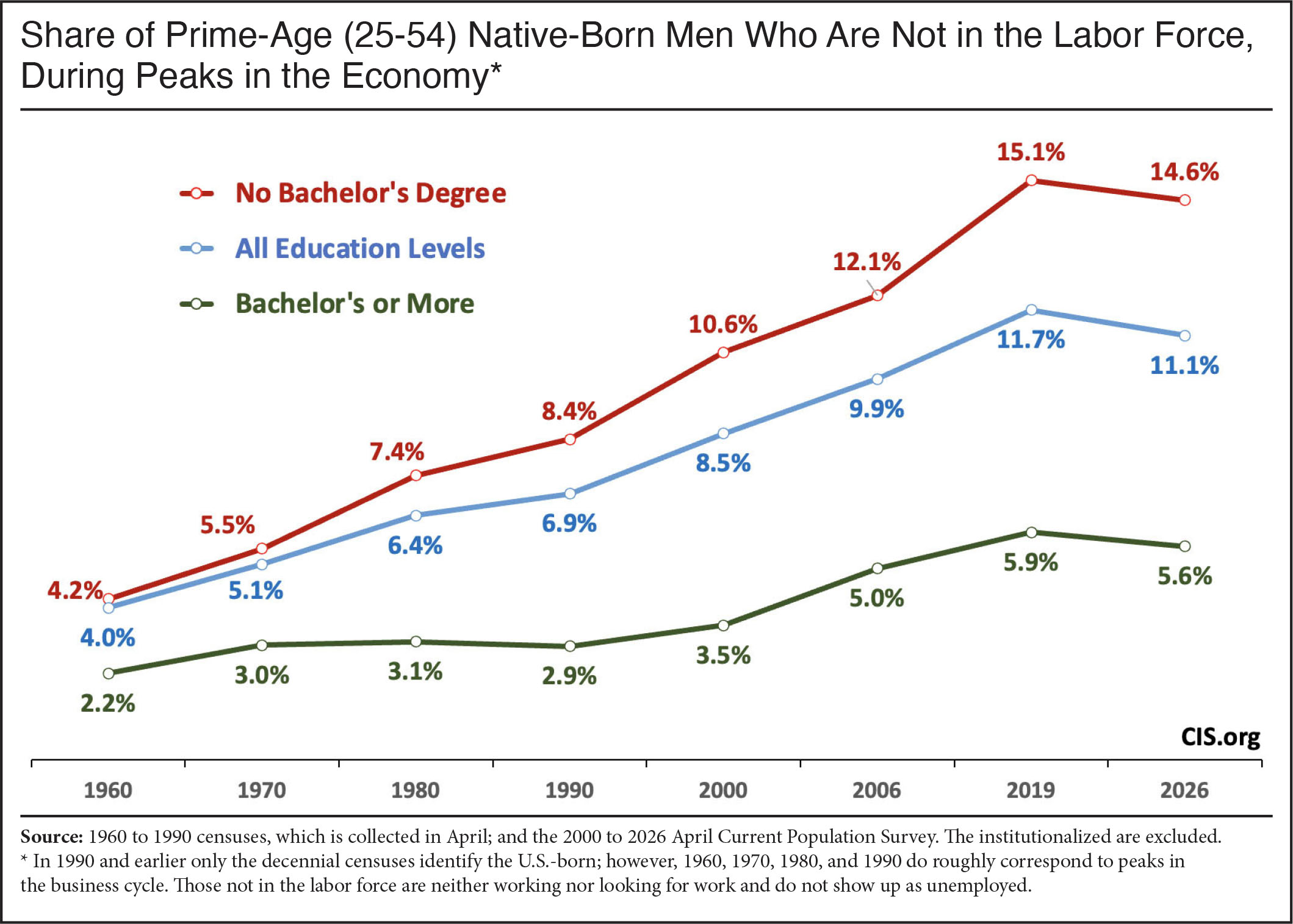
That caveat is important, but so is the broader context. Even if the recent improvement is real, the country remains far from anything resembling a healthy labor market for less-skilled men. Zoom out and it’s clear that the long-term trend is stark. In 1960, only about 4 percent of native-born men ages 25 to 54 were not in the labor force. By 2026, that figure was 11.1 percent. The increase is even more dramatic for men without a bachelor’s degree, whose nonparticipation rate rose from 4.2 percent in 1960 to 14.6 percent in 2026.
This recent improvement does not change the basic story. America still has a large class of prime-age, native-born men who are neither working nor looking for work. The problem is not merely that a few marginal workers had a bad month in the jobs report, but that millions of men in the very years when they should be most attached to work have instead drifted outside the normal rhythms of economic life.
 |
This matters for reasons that go well beyond direct economic output. Work is not just a paycheck. For men especially, employment is tied to marriageability, family formation, social status, daily structure, self-respect, and connection to the broader community. A man who is out of the labor force is not simply “taking time off”. In many cases, he is disconnected from the institutions that pull people into responsible adult life. That disconnection has social consequences. Communities with large numbers of idle, prime-age, native-born men are more likely to struggle with dependency, family breakdown, drug abuse, and personal alienation. A society can absorb a certain amount of unemployment during a recession. It is much harder to absorb a permanent class of men who do not work at all.
Immigration is not the sole cause of the labor-force participation decline. The causes are debated, and likely include some mix of weak demand for less-educated labor, low wages, disability and welfare dependence, criminal records, addiction, and changing norms around work. But the point is not that immigration explains everything. The point is that mass immigration makes the problem easier to ignore.
When employers say they cannot find workers, the usual policy response is to bring in more labor from abroad. But that shortcut relieves pressure on the very institutions that should be adapting to the workers already here. Employers do not have to raise wages as much. They do not have to improve working conditions. They do not have to invest as seriously in training, recruitment, automation, or productivity. They do not have to ask why so many American men are sitting on the sidelines. Instead, the economy learns to route around them.
This does not mean every job currently held by an immigrant would otherwise go to a native-born worker. Labor markets are more complicated than that. But it does mean that immigration can weaken the incentives that would otherwise force employers, policymakers, and communities to confront the work crisis directly.
Another particularly important point to consider is mobility. Immigrants tend to move toward high-demand labor markets. That is understandable from their perspective, but it also changes the bargain for native-born workers in struggling regions. If booming areas can satisfy their labor needs through immigration, they have less reason to recruit from distressed parts of the country or make relocation worthwhile for sidelined Americans. One paper finds that immigrants account for a much larger share of local population adjustment than their share of migration flows would suggest. But that does not mean immigration simply makes the labor market adjust better. The same paper finds that immigration largely crowds out internal migration, meaning that foreign inflows substitute for movement by people already in the United States. The effect is so large that immigration can account for nearly the entire observed decline in the internal migratory response to local employment shocks since the 1960s. For Americans, the result is not always direct job displacement — though it often is. Sometimes, it is an opportunity that never materializes.
The recent decline in nonparticipation among less-educated native-born men may therefore be a sign worth watching. If tighter immigration policy forces employers to search harder for domestic workers, then some men who had been written off may be drawn back into the labor market. That would be good news. But it would only be a beginning. The share of native-born men without a bachelor’s degree outside the labor force remains far higher than it was for most of the postwar period. A small move in the right direction does not erase decades of deterioration.
The real lesson is not that immigration enforcement has already solved the male work crisis. Plainly, it has not, and the country still has a long way to go. Rather, the lesson is that labor scarcity can force a society to notice the people it has become accustomed to ignoring. If employers cannot endlessly draw on imported labor, they may eventually have to rediscover the men already here. That process will be slow, uneven, and incomplete. But it is still better than using immigration as a band-aid for a wound we refuse to treat.