
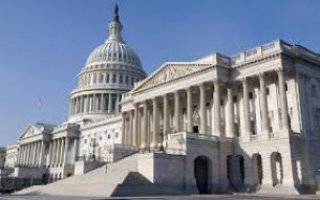
In the wee hours Friday, the U.S. Senate passed a “DHS funding” bill by unanimous consent, which will now go to the House for final approval, likely ending a 42-day departmental shutdown. The quotes are necessary because that bill doesn’t fully “fund” either ICE or CBP, two agencies that technically remain within a department created in the wake of September 11th to “secure” the “homeland”. Many on the right are not happy, and it is difficult to blame them.
The Game of “Chicken”
In the second act of the 1955 teen angst classic, Rebel Without a Cause, Buzz Gunderson (Corey Allen) challenges Jim Stark (James Dean) to a “chickie run”, where each races stolen cars toward the end of a cliff; under the terms of the game, the loser is the first to bail out.
Jim is technically the “loser” because he jumps from his car short of the promontory, and Buzz wins, I guess, but only because his jacket catches on the handle and he is trapped, plummeting to a fiery death.
The “game of chicken” concept has subsequently been applied to other situations where two parties are gripped in an existential battle in which the last to yield is the winner, even when — like Buzz — they are piloting their own metaphorical 1949 Mercury Eight Coupes over their own metaphorical cliffs.
That is especially true in increasingly common congressional funding fights.
They occur when annual appropriations expire, leaving the whole of government or individual departments without funding, forcing them to technically “shut down”. In reality, most government functions continue, but the individuals performing them — and sometimes recipients of government benefits — don’t get paid.
As the House website explains, shutdowns are a rather novel concept. Agencies didn’t shut down in whole or in part and people were paid as usual in the not-so-distant past because everybody understood the funding would eventually come, and the world’s largest debtor has an unlimited credit line.
That changed, however, during the Carter administration when then-Attorney General (AG) Ben Civiletti issued two opinions, one in April 1980 and another in January 1981, which concluded the Antideficiency Act (ADA), “a longstanding law that prohibits government agencies from authorizing expenditures in excess of the amount Congress provided them by law”, barred payments for operations during a “funding gap”.
Consequently, there have been scores of shutdowns of various durations ever since, in which each party has dared the other to yield while holding the American people hostage.
Civiletti died in 2022, but in a January 2019 interview with the Washington Post, he expressed disbelief that his decisions had the impact they did:
“I couldn’t have ever imagined these shutdowns would last this long of a time and would be used as a political gambit,” he said. My opinion “was a purely direct opinion on a fairly narrow subject and has been used in ways that were not imagined at the time.”
Buzz Gunderson was not available for comment.
The Democrats’ Demands
By February 14, Congress had funded every government department and agency through the end of FY 2026 (on September 30), except for DHS.
The shooting death of Alex Pretti during an immigration-enforcement action on January 24 was the pretext for congressional Democrats to demand restrictions on ICE and CBP operations, including a requirement that agents obtain judicial warrants when entering private property to make arrests; a bar on immigration arrests at hospitals, daycare centers, schools, and churches; and a prohibition on ICE officers wearing masks and a mandate that they wear bodycams.
On March 17, “Border Czar” Tom Homan (whom the president dispatched to Minneapolis to run operations shortly after the Pretti shooting) sent a letter to Senate leadership agreeing to certain of those demands, including for issuing bodycams, limiting “civil immigration enforcement at certain sensitive locations”, and using “visible officer identification for DHS law enforcement carrying out immigration enforcement activities”.
Other diktats, Homan contended, “would make it impossible to fully protect American citizens from dangerous criminal aliens and expose law enforcement and their families to increasing threats of violence”, thus “prioritiz[ing] illegal aliens above American families”.
The Backlash
Neither side budged, not even after then-DHS secretary nominee Markwayne Mullin promised the Senate he would implement immigration-enforcement reforms if he were confirmed.
Mullin was confirmed as DHS secretary on March 23, replacing Kristi Noem, on whose watch the issues Democrats complained about occurred, but the department remained shuttered.
Transportation Security Administration (TSA) officers staffing America’s airports were among the DHS employees going unpaid during the shutdown, and after weeks of impasse, some quit and many others stopped showing up for work, leading to long lines at airports in Houston, Atlanta, New Orleans, New York, and elsewhere.
Trump sent ICE to back up TSA at the airports on March 23, prompting Philadelphia district attorney, Larry Krasner (D), to spin up a strawman argument for the ages in threatening them with arrest:
I will put you in handcuffs and I will put you in a courtroom and, if necessary, I will put you in a jail cell if you decide to make the terrazzo floor of this airport anything like what you did in the streets of Minneapolis, which involved the criminal homicide of unarmed, innocent people. We are not having that.
Having flown through Philadelphia International Airport a few times, I have many memories of the place, though admittedly the “terrazzo floors” there didn’t make the list.
The Terms of the Funding Deal
In any event, with a two-week congressional break in the offing and millions of constituents facing travel delays and flight cancellations, something had to give.
On Thursday evening, the president announced he’d sign an order to pay TSA officers’ salaries, presumably using existing DHS money, which likely would have placed congressional Democrats in the curious but uncomfortable position of suing the administration to prevent that unionized force from receiving their checks.
Neither the order nor the presumable suit will likely be needed now, however, given the unanimous Senate agreement.
The bill funds TSA, along with FEMA, the Coast Guard, the Cybersecurity and Infrastructure Security Agency, and other DHS entities — except for immigration enforcement by ICE and CBP.
Under funding provided in the “One Big Beautiful Bill Act” (OBBBA), which Trump signed last July 4, ICE and CBP officers and agents still get paid during the shutdown, but support staff aren’t. As Bill Melugin from Fox News tweeted on March 24:
One aspect of the DHS shutdown that has flown under the radar:
Yes, ICE's frontline deportation officers are funded via OBBB, but their civilian support staff/non-law enforcement personnel are not. They haven't been paid since the DHS shutdown began.
They may not be the ones…— Bill Melugin (@BillMelugin_) March 24, 2026
Assuming the Senate bill gets the thumbs-up in the House, and even with the OBBBA funding, Congress must therefore still pass an ICE and CBP funding bill, which congressional Republicans contend they will do through “reconciliation”, an act of legislative legerdemain that wouldn’t require support from Democrats.
Many immigration hawks are not pleased, particularly because it’s not clear when or how such a reconciliation bill will be presented.
After the agreement was announced, conservative commentator Ryan Neuhaus tweeted:
In the dark of night, Senate Republicans caved and passed an approps bill without funding for ICE and CBP. The two most important sub agencies for carrying out mass deportations.
Proponents of the bill will argue that reconciliation funds ensure ICE and CBP have enough capital… https://t.co/gBklaaDBA2— Ryan Matthew Neuhaus (@RyanMNeuhaus) March 27, 2026
For her part, Rosemary Jenks, cofounder of the Immigration Accountability Project (IAP), opined: “Once again, the smell of jet fumes has prevailed in the Senate. Now they go on vacation, while a significant number of support staff at ICE and Border Patrol go unpaid, and the SAVE America Act stalls.”
Dangerous Precedents, and Possible Solutions
Likely the worst aspect of the deal is the dangerous precedent it sets: Representatives who wish to abolish immigration enforcement — and risk political backlash — can simply starve it of needed funding instead, now that congressional Republicans have separated ICE and CBP out from other DHS funding.
Funding ICE and CBP through reconciliation will only work so long as Republicans have majorities in both chambers of Congress. One Democrats gain control of one or both, that procedure would be a no-go.
Perhaps current Attorney General Pam Bondi could revisit the opinions of her Carter-era predecessor, Ben Civiletti.
The Antideficiency Act dates to 1870, and for more than 100 years, it didn’t imperil government workers’ paychecks every time Congress had a funding spat. Even the late Civiletti didn’t anticipate the ramifications of his opinions, but then he probably never met Larry Krasner, either.