
With 2026 in the offing, it’s time to look back at key laws and policies implemented in January 2025 – likely the most significant month in immigration history, when a newly returned President Donald Trump began acting on the border security and enforcement promises he made on the 2024 campaign trail, aided by Congress’s passage of the most important piece of immigration legislation in over a decade.
The Prelude: December 2024
By the waning days of the Biden-Harris administration in December 2024, Border Patrol apprehensions of illegal migrants at the Southwest border had fallen to just over 47,300, their lowest monthly level in more than four years.
It was largely illusory, because that figure omits the 48,700-plus aliens encountered that month at the Southwest border ports, a direct response to attempts by the Biden-Harris White House to hide the scope of illegal immigration by allowing would-be illegal migrants to secure illicit entry using the CBP One app, a maneuver of questionable legality I dubbed the “CBP One app interview scheme”.
Aliens released into the United States under that scheme were just as removable as those who crossed illegally, and even though it was clear the scheme was riddled with fraud and other risks, most in the media ignored it.
A Flurry of Inauguration Day 2025 Executive Actions
Trump didn’t ignore it, and on Inauguration Day, January 20, he shut down the CBP One shell game in Executive Order (EO) 14165, “Securing Our Borders”, just one of a series of executive actions he took even before the champagne corks popped at inaugural balls across Washington.
That EO also resumed border wall construction, reinvigorated the Migrant Protection Protocols (“MPP”, better known as “Remain in Mexico” ), and directed expanded criminal prosecutions for immigration-related crimes.
That day Trump also issued Presidential Proclamation (PP) 10888, “Guaranteeing the States Protection Against Invasion”, which limited the ability of illegal entrants to seek asylum to protect the states from the adverse impacts of unpredictable migrant flows.
That PP shouldn’t be confused with EO 14159, “Protecting the American People Against Invasion”, which revoked Biden-era immigration guidance, directed federal agencies to begin registering aliens present in the United States, restored “expedited removal” for illegal entrants and other aliens at the ports who lacked proper admission documents, and expanded the use of “287(g)” immigration-assistance agreements with state and local law enforcement.
Then there was EO 14167, “Clarifying the Military's Role in Protecting the Territorial Integrity of the United States”.
That EO declared it to be U.S. military policy to protect the sovereignty and territorial integrity of the United States along our national borders and directed the secretary of Defense to deliver a plan to assist DHS in sealing the borders from illicit drugs, other contraband, and illegal migration.
Enhanced vetting and screening procedures were the subjects of EO 14161, “Protecting the United States From Foreign Terrorists and Other National Security and Public Safety Threats”. That EO also directed federal agencies to take steps to promote assimilation of legal immigrants in the United States.
Next up was EO 14160, “Protecting the Meaning and Value of American Citizenship”, the so-called “birthright citizenship” order.
That EO declared that certain “categories of individuals will no longer be considered to be born ‘subject to the jurisdiction’ of the United States and therefore will no longer be U.S. citizens at birth”, including children born to mothers who were “unlawfully present” or whose presence was “lawful but temporary” and fathers who weren’t either U.S. citizens or lawful permanent residents (i.e., “green card holders”).
Not to get ahead of the story, but many of these actions, including the asylum restrictions in PP 10888 and the birthright citizenship limitations in EO 14160, are being challenged in the courts, with the former proceeding (for now) and the latter on hold awaiting Supreme Court review.
Trump Signs the “Laken Riley Act”
Executive actions are transitory by nature (a future administration can undo them) while statutory changes have more permanence.
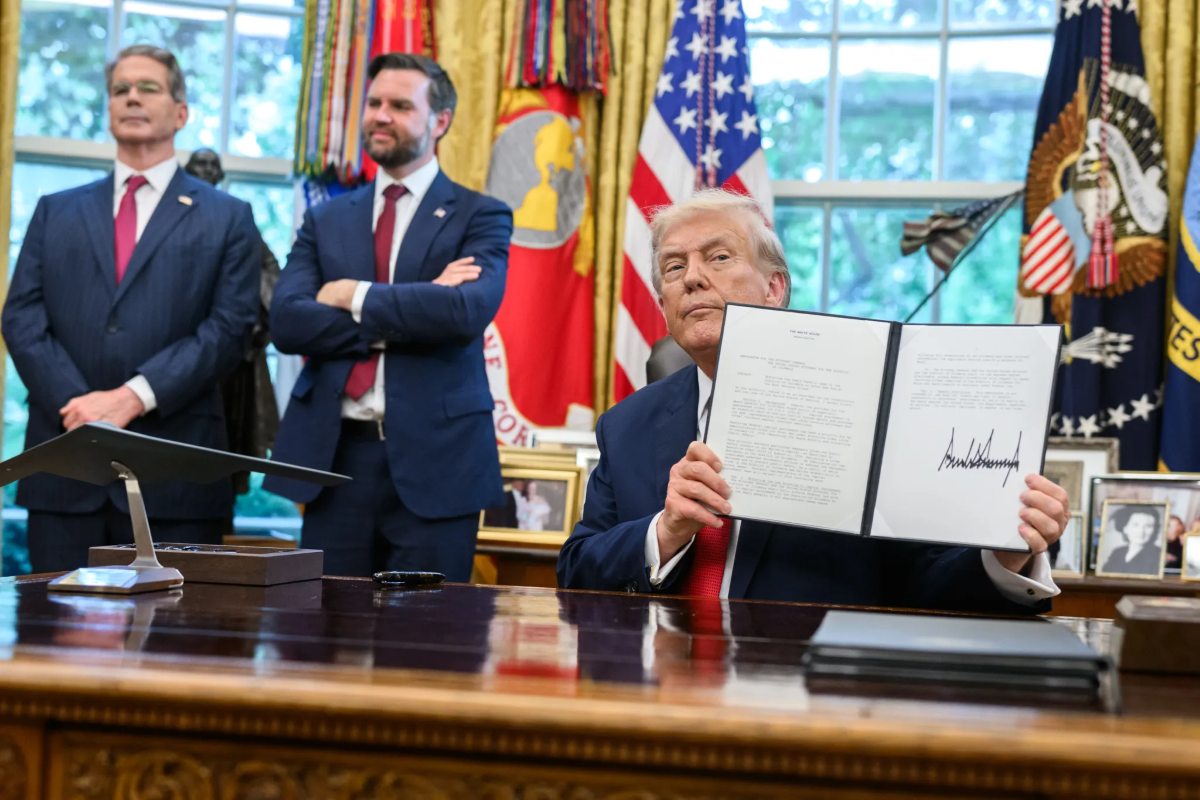
Consequently, January 2025 will likely be remembered in the long run as the month Congress passed (by bipartisan majorities) and President Trump signed Public Law 119-1, the “Laken Riley Act”.
The bill, which became law on January 29, is named for a 22-year-old Georgia university student slain in broad daylight in February 2022 by Jose Ibarra, a Venezuelan migrant who entered illegally in September 2022, was apprehended and released.
Ms. Riley’s murder became a flashpoint for the Biden administration’s open-border policies, especially after the then-president: (1) was forced to acknowledge her killing at his March 2024 State of the Union address; (2) misidentified her, appearing to call her “Lincoln Riley”, the coach of the University of Southern California football team; (3) referred to her killer as an “illegal”; and then (4) apologized for not referring to Ibarra as “undocumented” instead.
The law is a direct rebuke to the worst Biden immigration policies, in particular “guidelines” issued by then-DHS Secretary Alejandro Mayorkas in September 2021 that hindered ICE officers’ ability to “take enforcement action” against criminal aliens in the United States.
The states of Texas and Louisiana sued to block those guidelines and force the Biden administration to comply with detention mandates for criminal aliens in the Immigration and Nationality Act (INA), but in its June 2023 opinion in U.S. v. Texas, the Supreme Court sided with Mayorkas and held that even states lacked standing to force DHS to arrest and detain aliens who pose a danger to the community.
The Laken Riley Act reversed that opinion legislatively by granting state attorneys general such standing and also freed them to file suit to curb abuses of the executive branch’s “parole” authority under section 212(d)(5)(A) of the INA.
By my (conservative) estimate, the Biden administration used its limited parole authority to funnel more than 2.8 million facially inadmissible (read: “illegal”) aliens into the United States.
That’s more people than reside in 15 U.S. states, and a recent Government Accountability Office report found that many of the programs Biden’s DHS relied upon to parole them were riddled with fraud.
In all honesty, I’m not sure whether the senators and congressmen who voted to pass the Laken Riley Act understood just how sweeping the changes in that law were. Regardless, it would bind the hands of a future Gavin Newsom administration if it attempted to repeat many of the immigration blunders of Biden-Harris.
February and Everything Thereafter: The Postscript
How quickly things changed in just 11 days.
By February, Border Patrol apprehensions at the Southwest border fell to just fewer than 8,350, an 82.4 percent decline compared to December, and CBP encounters at the Southwest border ports fell by 93 percent, to fewer than 3,400.
It’s become trite in the interim to note that while President Biden claimed he needed congressional action to secure the border, all that was really needed was a new president – or at least one with the will to use the powers the INA had already given him.
Trite but true, and as I have explained, the Southwest border under Trump II is likely more secure now than it has ever been in history.
That security has extended into the interior, with DHS recently announcing that it’s deported more than 600,000 aliens since Inauguration Day – half again as many as the Obama administration claimed ICE had the capacity to achieve annually, all in roughly 10 months.
The president’s critics, however, complain both that those figures are inflated and that DHS has only achieved the arrests and removals it claims by sweeping up otherwise “law-abiding residents”.
Both those contentions were called into question, however, in a December 26 Washington Examiner article by Anna Giaritelli headlined “Seven in 10 ICE arrests under Trump have criminal histories”.
Let’s just say that Giaritelli has good sources in the current administration, and she reports that:
The Trump administration arrested 595,000 illegal immigrants between Jan. 20 and Dec. 11, according to the Department of Homeland Security. ICE, the federal agency tasked with interior immigration enforcement and deportations, revealed that 70% — or about 416,000 — have “criminal convictions or pending criminal charges just in the U.S.”
The truth is out there, but if I had to choose between the president’s critics and Giaritelli’s sources, I’d go with the latter, especially since the default mode for many in the media is to run with salacious claims of Trump II overreach sourced primarily by one-sided averments from arrestees and their lawyers that often prove to be of questionable veracity.
It’s in the Courts’ Court Now
As noted, many of the president’s Day 1 executive actions, including those involving birthright citizenship and border asylum claims, are currently facing judicial challenges. Consequently, their long-term effectiveness is in the courts’ court now, but they have plainly had an impact in the short run.
The Laken Riley Act, however, is likely to have a long-lasting effect, unless and until some future Congress decides to erase the memory of a slain nursing student and openly promote the cause of criminal aliens, though that’s about as likely as Social Security reform.
Regardless of your point of view, January 2025 was likely the most impactful month in U.S. immigration history, ushering in changes that brought historic lows in border encounters and levels of interior arrests and removals that haven’t been seen in decades. Here’s to continued success in the New Year.