
 |
As I recently reported, the Government Accountability Office (GAO) — Congress’s nonpartisan watchdog — just issued a report on three of the Biden administration’s novel (read: “illegal”) “humanitarian parole programs”: “Uniting for Ukraine” (U4U), “CHNV Parole”, and “family reunification”. The rampant fraud those programs aided and abetted would be comical if the implications weren’t so dire.
Biden’s Parole Abuses, in Brief
Parole in the immigration context is a mechanism under which DHS can allow to enter the United States, on a limited basis, aliens who are inadmissible because they lack proper documents, or on any other ground, for a limited period.
Thus, it’s an exception to the limits Congress has placed on immigration to the United States, and when the legislative branch gave that authority to the executive in section 212(d)(5)(A) of the Immigration and Nationality Act, the idea was for aliens to only be paroled in one of two contexts: to seek emergency medical care (“urgent humanitarian reasons”) or to appear in a U.S. court (“significant public benefit”).
Various administrations, however, have abused that parole authority to allow in other classes of inadmissible aliens, but none held a candle to what Biden did.
In May, I added up the published statistics on Biden-era paroles and conservatively concluded that more than 2.863 million aliens — with no visas and no right to enter — had been ushered in under that “limited authority”, more people than residents of 14 U.S. states.
In most of those cases, the Biden administration created new parole programs to hide the burgeoning disaster at the Southwest border.
An April 2022 rush by inadmissible Ukrainians at the San Diego (Calif.) ports of entry triggered U4U; the apprehension of more than 600,000 illegal entrants from Cuba, Haiti, Nicaragua, and Venezuela in FY 2022 was the impetus for CHNV Parole; and a flood of illegal migrants from Central and South America prompted family reunification.
In other words, the Biden administration wasn’t attempting to drive down the number of illegal entrants from those countries, but rather to wave its magic parole wand over them, make them “quasi-legal” (with work authorization and other benefits — including gun rights, curiously enough), and move them over to a part of the immigration ledger most reporters never looked at.
The “Sponsorship” Dodge
To make these parole programs more politically palatable, Biden’s DHS required aliens seeking parole under U4U, CHNV, and family reunification to find a “sponsor” in the United States who would notionally promise to provide those beneficiaries with support in this country.
Not that you had to be a U.S. citizen to be a sponsor; perish the thought.
Anyone with any status in this country would do, and as my colleague Nayla Rush explained in April: “Sponsors could even be foreign nationals (of any nationality) who have ‘temporary authorization’ to remain in the United States, such as on parole” — an ever-expanding Mobius loop of inanity.
Not that much “support” per se was ever really required, apparently, because GAO reports its “review of the supporter application form found that there was no provision included within that provided DHS with the authority to enforce a commitment to provide financial support by the supporter”.
In fact, that “sponsorship dodge” was even worse than useless — it was primed for abuse by the worst sorts of human beings.
As I explained way back in August 2023, when CHNV Parole was getting up and running, that program was “ripe” for abuse by “malefactors in the United States who seek to ‘exploit’ those aliens once they’re here to work in debt bondage for subpar wages or in the sex trade”.
Regardless of whether you were running a sweatshop and looking for workers to abuse who were willing to live on sub-subsistence wages or attempting to staff up your seedy “massage parlor” on the outskirts of town, the “sponsorship” requirement gave you a golden opportunity.
We’ll likely never know how many Biden-era “parole” beneficiaries suffered such degrading mistreatment (and how many continue to), but what’s apparent is that more than a few sponsors offered their “services” in exchange for illicit payouts.
GAO reports that “Paying filers to submit a supporter application was prevalent across the U4U and CHNV processes, according to [USCIS’s] Fraud Detection and National Security Directorate [FDNS].”
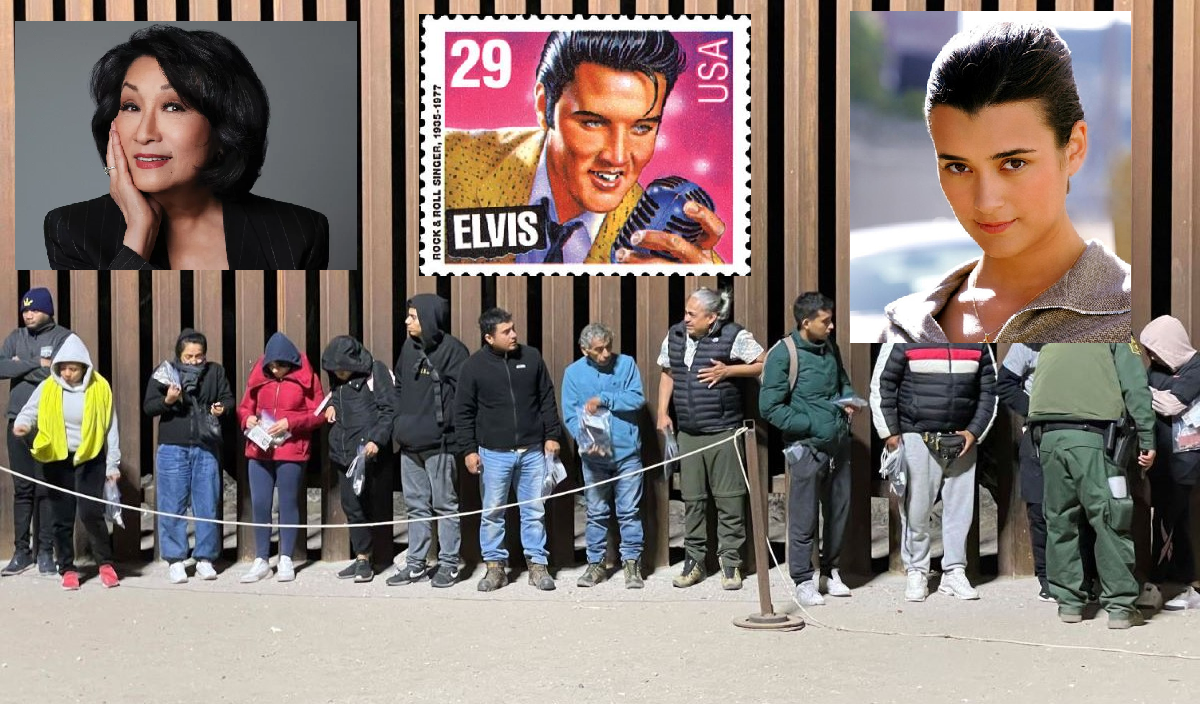
Elvis, Connie, Cote — and “Old Glory”
FDNS aside, no one else in the executive branch took any of it seriously: not the limited nature of parole; not the “support” requirement; and not even the sponsorship application process itself.
Needless to say, if you’re running a sweatshop, a massage parlor, or a simple shakedown scheme to exploit would-be parolees, you may be reticent about putting your “good” name on the line and reluctant to stop after just one victim.
Consequently, more than a few would-be sponsors created fictious identities and used them when applying with USCIS. As per GAO:
Individuals who filed fraudulent supporter applications sometimes used information and altered documents that belonged to real U.S. citizens or fabricated identities altogether. ... Some fraudulent documents showed clear indications that they had been altered.
FDNS found that filers submitted more than 3,000 forms with images of fraudulent U.S. passports. In some cases, filers used the identities of unwitting U.S. citizens and altered document images to include different photos, according to FDNS documentation. Notable examples include a passport image with a photo of journalist Connie Chung and a driver’s license with a photo of actor Cote de Pablo.
As an aside, Connie Chung was the anchor of CBS Evening News for two years in the 1990s, while Cote de Pablo is a Chilean-American actress who portrayed fictional former Israeli Mossad officer and U.S. Special Agent Ziva David on the CBS police procedural NCIS for the better part of two decades.
With that out of the way, GAO continues:
In addition, USCIS determined that some filers were using Social Security numbers and other biographical information associated with deceased individuals. For example, FDNS identified multiple applications using a Social Security number that had belonged to Elvis Presley along with other fake biographical data. As of July 2024, more than 1,400 beneficiaries had arrived in the U.S. whose supporter information was associated with a deceased individual, FDNS found.
But the next line is the real kicker: “According to FDNS, prior to its involvement, USCIS reviewers generally confirmed these supporter applications because they did not have the ability to verify information about U.S. citizen supporters who did not have a prior USCIS filing history.”
They didn’t know that the “King of Rock and Roll” died nearly 50 years ago?
To be fair, would-be sponsors were required to provide financial and employment information to verify that they had the resources to provide for their would-be parolees (a requirement that, again, was never enforced).
That’s great, until you find out that some of them skirted this requirement by uploading “clearly irrelevant evidence”, such as jpegs of stock landscape images and the U.S. flag.
Who designed these “humanitarian parole” application systems? The Mob? I hope this is malfeasance, because if not it’s criminally inexcusable ignorance.
The Trifecta
It’s not rare to find U.S. government programs that were poorly conceived, poorly implemented, or just plain illegal, but somehow U4U, CHNV, and “family reunification” managed to pull off the trifecta.
If the Biden administration concluded it was in the public interest to expand immigration from Ukraine, Cuba, Haiti, Nicaragua, Venezuela, and countless other countries, the proper (and constitutional) way to do so was by asking Congress for permission.
That’s not what happened (though Congress did later authorize certain benefits for U4U beneficiaries), likely because asking for legislation would have exposed how bad things at the Southwest border had become.
Consequently, it makes sense that no one at USCIS or CBP — both of which played a role in these parole programs — wanted to take the lead in implementing those programs properly. That would have been an invitation to answer uncomfortable questions on Capitol Hill once Republicans retook control.
Because no one from USCIS or CBP took responsibility for these poorly conceived programs, they quickly became poorly executed as well. FDNS is owed a debt of gratitude for finding the courage to point out all the fraud in U4U, CHNV Parole, and family reunification — and GAO for highlighting it, albeit belatedly.
Maybe Biden should have put Ziva David on the case.