
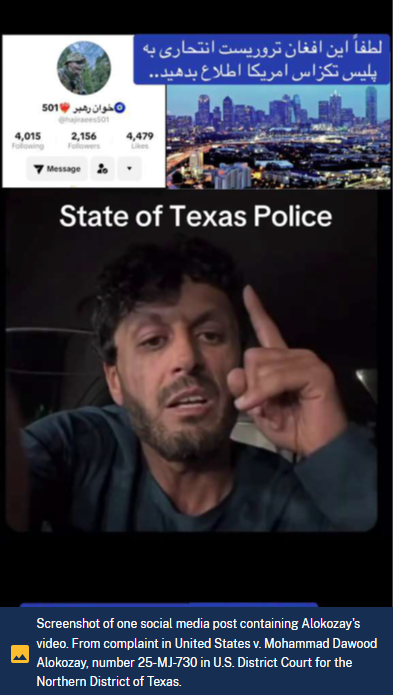
In a December 2 press release, DOJ announced that Mohammad Alokozay, a 30-year-old Afghan national residing in Fort Worth, Texas, had been charged with “threatening to build a bomb, conduct a suicide attack, and kill Americans and others” in an online post on various social platforms. Americans are living under the specter of three key mistakes the Biden administration made in its disastrous departure from that Central Asian country — and will continue to do so indefinitely.
Mohammad Alokozay
I recently discussed a separate, and likely better known, attack allegedly carried out by a different Afghan national, Rahmanullah Lakanwal, who’s charged with shooting two West Virginia National Guard troops (killing one) at a D.C. Metro stop on November 26.
Numerous press reports indicate Lakanwal was paroled by the Biden administration into the United States on September 8, 2021, nine days after U.S. troops left Afghanistan with more than 120,000 nationals of that country in tow — suggesting if not confirming that Lakanwal was one of those evacuees.
It’s not clear at this point when Alokozay came here, though Attorney General Pam Bondi is quoted in the December 2 press release as claiming: “This Afghan national came into America during the Biden administration and as alleged, explicitly stated that he came here in order to kill American citizens”.
It’s also not clear whether DHS paroled Alokozay into this country as well, or whether he has any status such as a visa or asylum (which Lakanwal was reportedly granted in April).
Assuming the facts in the DOJ press release are correct, however (Alokozay is presumed innocent until he’s proven guilty), it’s apparent that he wasn’t “inspired” to make his threats by the Metro shooting.
That’s because the threats he’s alleged to have made were issued on November 23, three days before the D.C. attack.
The Purported Video
The federal charges relate to a video Alokozay purportedly “shared on TikTok, X, and Facebook” of a video call involving him and “at least two other males”, neither of whom DOJ identified.
In the video, Alokozay was supposedly “angrily gesturing and speaking Dari, a language commonly spoken in Afghanistan”, while threatening “to conduct a suicide attack on the other participants on the call, as well as ‘infidels’ and Americans”.
Specifically, DOJ claims, Alokozay “claimed he would build a bomb in his vehicle and talked about a particular yellow cooking oil container favored by the Taliban in building improvised explosive devices (‘IEDs’) in Afghanistan”.
Why would Alokozay want to emulate the Taliban?
Likely because they were the main opponents of the U.S. occupation of that country and because, according to DOJ, “Alozokay stated the Taliban were dear to him.”
That last sentence continues “and ... he came to the United States to kill those on the call”, which, if true, indicates that he came here with a mission that he likely failed to share with U.S. officials.
Three Key Mistakes
The Biden administration made three key mistakes when it resettled tens of thousands of Afghan nationals in the United States following the U.S. withdrawal from that country.
First, there was no reason to have evacuated tens of thousands of largely unscreened Afghan nationals for relocation in this country.
Usually, when there are conflicts (like when Taliban fundamentalists seize control of what had been a nominally pro-Western government), “refugees” from those conflicts are resettled in “refugee camps” in secure areas in the local vicinity.
That’s what happened when the Soviet Union (fundamentalists of a secular sort) invaded Afghanistan in December 1979. The then-Carter administration didn’t attempt to relocate throngs of people fleeing the Red Army in Texas; instead, they went to camps in Pakistan where UNHCR, using U.S. government funds, provided for them.
That may not have been ideal, but as the “Forced Migration Review” has explained:
Over the years, the camps evolved into villages that began to appear much like other villages in Pakistan. Many of the refugees carved out reasonable and predictable lives, at least compared to what they could expect in Afghanistan. Most found at least subsistence work in the local economy or rented land to cultivate. Some maintained a foothold in both countries by living in Pakistan while hiring tenant farmers to work their land in Afghanistan.
Some of those who fled the Taliban advance in the summer of 2021 were eligible for various immigration benefits the U.S. government had made available to Afghans who assisted our military effort there, and DHS and the State Department could have easily adjudicated those applications in the camps and then brought the beneficiaries to the United States.
That was the opposite of what happened, which brings me to the second mistake — how the evacuation was carried out.
The United States had operated a major base 27 miles north of Kabul, Bagram Airfield, which it seized in 2001, fixed up (it had a Burger King and Pizza Hut at one point), and ran as an operations center through most of the time our troops were there.
I say “most of the time our troops were there” because for reasons never fully explained, the Biden administration unexpectedly turned the base over to the (U.S. allied) Afghan National Security Force (ANSF) in the middle of the night in early July 2021.
That’s despite the fact that the ANSF had been fighting a losing battle against the Taliban since early May, and that the handover of Bagram forced the U.S. government to rely on a commercial airport, Hamid Karzai International Airport (HKIA), in Kabul, for its screening and evacuation efforts.
Then-Secretary of Defense Lloyd Austin claimed in late September 2021 that holding Bagram “would have required putting as many as 5,000 U.S. troops in harm's way” (even though the Taliban at the time didn’t have much stomach for fighting U.S. troops), while Gen. Mark Milley, then-chairman of the Joint Chiefs of Staff, contended after the withdrawal that HKIA was better because it was closer to would-be evacuees.
I have no military expertise, but swapping a secure military facility with air capacity for a commercial airport when you’re trying to leave a country seems nuts, and in fact that decision led to the chaos that played out during the U.S. airlift from HKIA.
Thirteen U.S. troops were killed and 45 injured in a terrorist bombing while attempting to secure one of the gates to HKIA and bring some semblance to the chaos there on August 26, 2021, 10 days after videos emerged of hundreds of Afghans surrounding and attempting to board U.S. transport planes, which brought evacuation efforts temporarily to a halt.
And yet, despite all that, CNN reported on August 19, 2021, that:
Biden instructed top military commanders who are facilitating the evacuation from Kabul that he [didn’t] want to see any empty seats on planes, according to a senior official familiar with the directive, who said the President made clear in the meeting he want[ed] every flight leaving the airport filled to capacity.
Inevitably, seats were occupied by Afghan nationals about whom the United States knew little, most destined for this country.
In other words, someone in the Biden White House was willing to take a risk that either none of those unidentified Afghans — coming from a country that continued to harbor al Qaeda and other terrorists — would do any harm here, or that any resulting carnage could be kept at an “acceptable” level.
Which in turn brings me to the third mistake: vetting.
On September 9, 2021, then-DHS Secretary Alejandro Mayorkas claimed that his department “screen[ed]” and “vet[ted] individuals before they board[ed] planes to travel to the United States” from Afghanistan and that the “screening and vetting process” was “an ongoing one and multi-layered”.
That would have been impossible, and as proof I offer the following 2015 congressional testimony by then-FBI Director James Comey, explaining the limitations on our ability to screen and vet foreign nationals coming to the United States:
The only thing we can query is information that we have. So, if we have no information on someone, they've never crossed our radar screen, they've never been a ripple in the pond, there will be no record of them there, and so it will be challenging.
And when it came to tens of thousands of Afghans who were airlifted out of Kabul and brought here, the United States knew very little at all, though it quickly became apparent that due to foul-ups, the U.S. government wasn’t even using the derogatory information it did have in the vetting process.
Specifically, a February 2022 Department of Defense (DoD) Office of Inspector General report revealed many Afghan parolees had not been vetted using information DoD had in its databases, warning that “the United States faces potential security risks if individuals with derogatory information are allowed to stay in the country”.
Nothing indicates, however, that any Afghan national was subsequently removed, even though the New York Post recently reported that the U.S. government had “uncovered ‘potential derogatory information’ on a total of 6,868 people who came from Afghanistan as part of” the Biden administration’s evacuation efforts, including 5,005 who were flagged as posing a “national security concern”.
Back to Alokozay
Removing alien “national security concerns” is exponentially more difficult than keeping them out to begin with (and as an INS terrorist prosecutor, I attempted to do both), which brings me back to the first key mistake: allowing those tens of thousands of Afghan “refugees” in to begin with in lieu of resettling them in camps closer to home, but it’s too late to fix that issue.
If what DOJ claims about Alokozay is true, he’s either: (1) a terrorist extremely sympathetic to the Taliban; (2) an unbalanced lunatic; or (3) both. Regardless, he never should have been brought here.
The crime he’s charged with, transmitting a threatening communication in interstate commerce under 18 U.S.C. § 875(c), carries a five-year maximum prison sentence, meaning if he pleads quickly he could be out by 2030 at the latest.
If he’s guilty, Afghanistan isn’t likely to take him back and there’s little the U.S. government can do to force the issue, while few other countries will be willing to accept someone with knowledge of (and particularity in) bombmaking and a passion for the Taliban. The United States will be stuck with him.
Biden officials gambled with U.S. security when they brought tens of thousands of Afghans here instead of resettling them closer to home, after the United States abandoned the only base where they could have been screened and even though we’ll never know much about many of them until it’s too late. That bet increasingly looks like a bad wager.