

Whether in Congressional hearings or in media “fact checks”, arguments against local cooperation with ICE are often accompanied by the claim that illegal immigrants have a lower crime rate compared to the general population (aside from immigration offenses). The claim itself is dubious — see the addendum below — but the more important point is how little it should matter when deciding whether to turn arrested suspects over to ICE.
There are many ways for state and local authorities to cooperate with ICE, but perhaps the most fundamental is to honor detainer requests. For illustration, imagine that local police arrest a man for, say, drunk driving. They submit his fingerprints to a federal database, and it turns out that the man is known to be an illegal immigrant. ICE notifies the local police and requests that they hold on to him for a few days until ICE can pick him up and initiate removal proceedings.
At this point, the local police have in their custody a specific person with demonstrated criminal behavior. The arrested man’s risk of future offending is surely higher than the average person’s, regardless of whether illegal immigrants as a group have a high crime rate. Put another way, removing a randomly selected illegal immigrant may not lower the community’s expected crime rate, but removing this illegal immigrant certainly would.
Sanctuary jurisdictions nevertheless choose not to cooperate, sometimes with disastrous results. Last September, police in Fairfax County, Va., arrested Marvin Fernando Morales-Ortez on assault and brandishing charges. According to DHS, ICE identified him as an illegal immigrant with a long criminal history. However, when Morales-Ortez’s victim failed to cooperate, the county released him from custody rather than honor the ICE detainer. The very next day, Morales-Ortez shot and killed a local resident.
Now consider Daniel Davon-Bonilla, an illegal immigrant who entered in late 2022 during the Biden border surge. In April 2023, he was arrested at a Brooklyn migrant shelter and charged with rape. ICE placed a detainer, but local authorities agreed to a plea deal and released him pending sentencing. A couple of months later, he committed another rape.
Then there is Fernando De Jesus Lopez-Garcia. According to DHS, ICE lodged a detainer request when he was arrested in 2019 in Stockton, Calif., for domestic violence. The county released him instead. When he was arrested again a month later, ICE again lodged a detainer request, but the county again released him. The following year, he was in custody following a domestic violence conviction. ICE lodged a detainer, but the local authorities released him. Months later, he stabbed two people to death at a church in San Jose.
If these were simply examples of illegal immigrants who have committed crimes, then one could object that every demographic has its bad apples, and they prove nothing about the illegal population as a whole. But that’s not all they are. They are examples of illegal immigrants who have committed crimes after being arrested for earlier crimes and released over the objection of ICE. The claim that illegal immigrants have a low crime rate rings hollow when advocates are willing to release specific illegal immigrants who have demonstrated their criminality.
Addendum
Debate over sanctuaries aside, do illegal immigrants really have a low crime rate overall? It’s difficult to say. The Center’s 2022 analysis of data from the Texas Department of Public Safety showed that illegal immigrants seem to have above-average conviction rates for some serious crimes, especially sexual assault. However, local authorities’ inability to reliably identify illegal immigrants who commit lesser offenses precluded any strong claims about their overall criminality.
Figure 2. Sexual Assault Convictions in Texas per 100K |
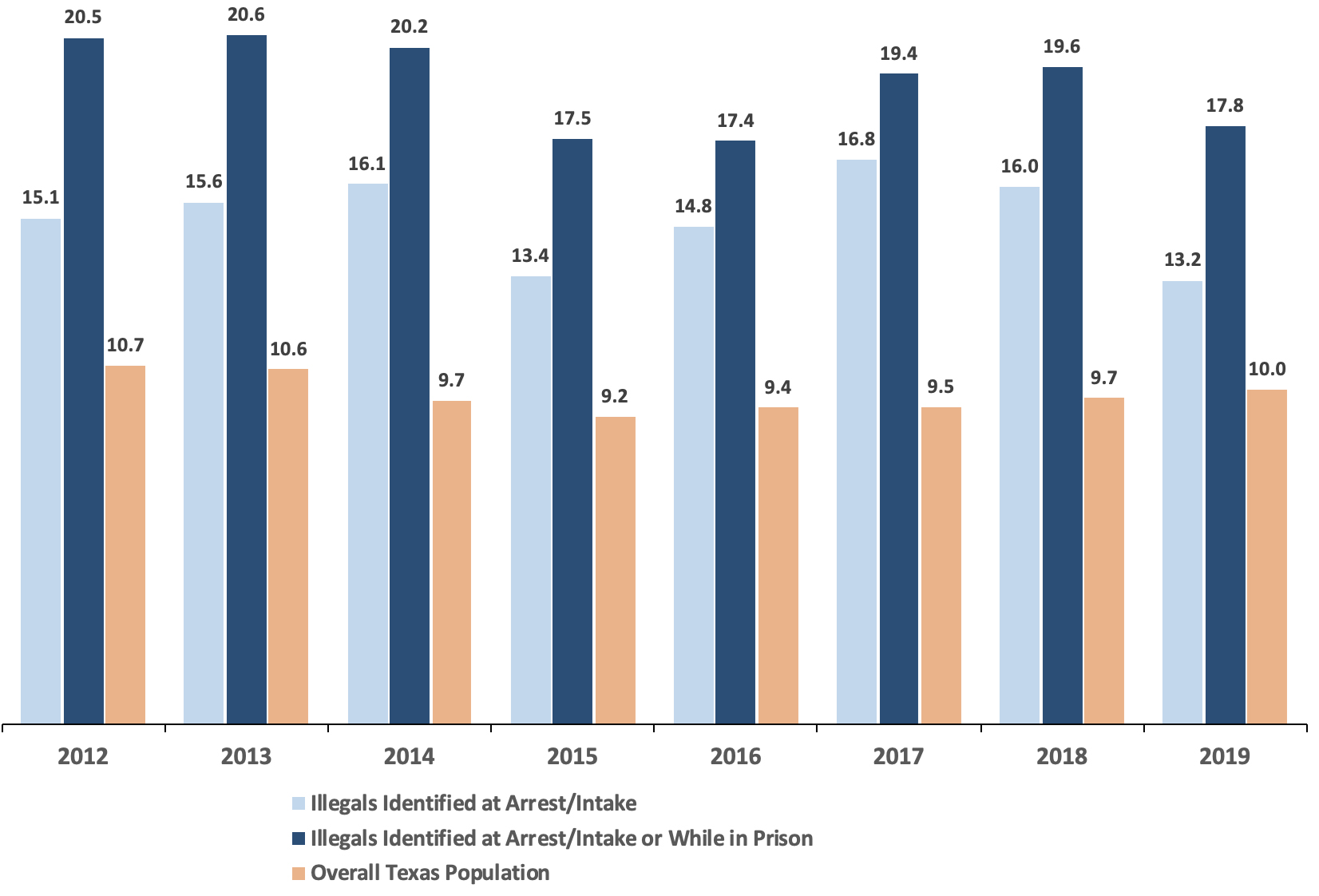 |
Sources: Texas DPS (convictions), CMS (illegal population), and ACS (overall population). |
The Texas data is valuable because the perpetrator’s immigration status is listed for each crime. By contrast, studies based on who is currently in prison are less helpful. The reason is that prison stays are often due to the accumulation of a long criminal record, but immigrants have had less time than natives to develop a rap sheet sufficient for prison. That means incarceration is a biased measure of criminality when comparing immigrants and natives. Writing in City Journal, Matthew Lilley and Robert VerBruggen offer a theoretical example:
Consider ... two groups of 40-year-old men, one American-born, the other immigrants who arrived in the U.S. at age 39. The groups are otherwise identical and have the same crime rates. Will they be equally likely to be incarcerated at age 40? Obviously not. The immigrants will have had just one year to commit a crime and end up behind bars; the American-born will have had decades of opportunities to do so. Accordingly, in this make-believe example, native-born Americans will be mechanically more likely to be incarcerated at age 40, even though the two groups have identical crime rates by design.
Lilley and VerBruggen apply this insight to immigrants from Somalia. Based on who is interviewed in prison by the Census Bureau, it would appear that Somali immigrants and native-born Americans have about the same incarceration rate. However, when the Somali immigrants are limited to those who arrived before the age of 16, their incarceration rises to double the native rate.