
Listen to "USCIS Shift on Green Card Processing" on Spreaker.
View the Podcast Show Notes

DHS has issued a memo stating that the ability of an alien in the U.S. on a temporary visa to “adjust status” to permanent residence without leaving the U.S. “is a matter of [DHS’s] discretion and administrative grace” and that adjustment was “not designed to supersede the regular consular processing of immigrant visas” outside the U.S.
Summary
- Congress created adjustment of status in 1952. The legislative history reveals Congress’s motivation as wanting to provide qualifying aliens in the U.S. the ability to become permanent residents without having to go abroad to a U.S. consulate. Adjustment was designed to replace the administrative workaround of “preexamination”, under which such aliens had been allowed to go to a consulate in Canada to receive their immigrant visas and then immediately return to the U.S. The House Judiciary Committee wrote that adjustment would “save the United States Government, as well as the eligible aliens and their families, considerable expense involved in the preexamination procedure and the journeys to Canada”.
- Congress expanded over the years the categories of aliens with temporary legal status who could utilize adjustment of status. One motivation for expansion was Congress’s desire to get rid of the headache caused by having to consider large numbers of private bills for aliens seeking adjustment who did not qualify at the time.
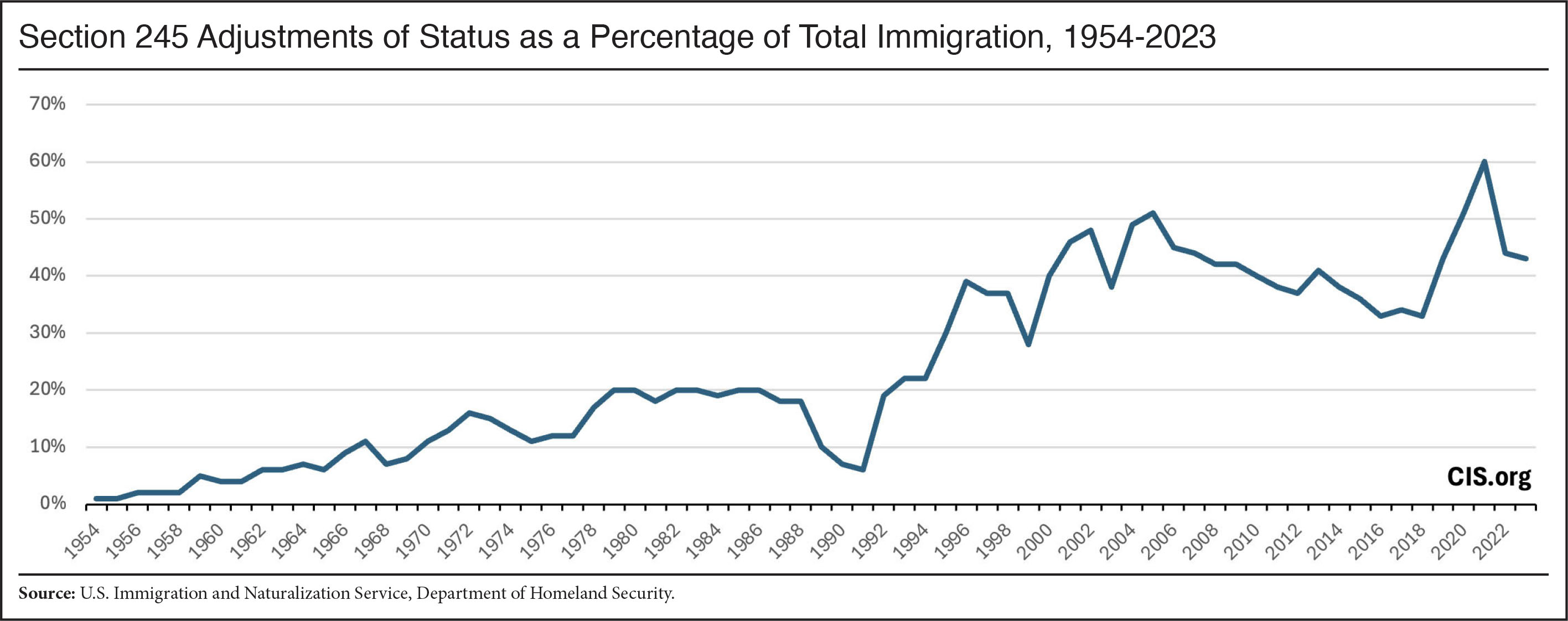
- The usage of adjustment of status has increased dramatically. Throughout the 1950s, adjustments never accounted for more than 2 percent of the number of aliens receiving permanent residence. In 2023, adjustments accounted for 43 percent of total immigration.
- USCIS argued that “Congress expects aliens … admitted … as nonimmigrants to depart rather than pursue adjustment of status. Such aliens are generally expected to pursue an immigrant visa … from outside” the U.S. The legislative history, though, seems to indicate that Congress’s goal was to in fact eliminate the need for qualifying aliens to have to leave the U.S. in order to receive permanent residence.
- The Board of Immigration Appeals and federal courts have indeed stated that adjustment was not designed to circumvent consular processing. But it is likely that they considered “circumvention” to involve aliens obtaining temporary visas by hiding from consular officers their desire to remain in the U.S. permanently and then seeking to adjust status once here. It is unlikely that they considered circumvention to involve aliens who entered the U.S. on temporary visas without any “immigrant intent” but who later sought to adjust status, or those coming under temporary visa programs that allowed for “immigrant intent”.
The USCIS memo argued that adjustment “is granted only as ‘a matter of discretion and administrative grace’”. While certainly true, federal courts have made clear that discretionary denials of adjustment are vulnerable to being overturned on the basis of “abuse of discretion”. But what constitutes abuse of discretion?
USCIS argued that seeking adjustment of status in and of itself is an adverse factor that an alien “may need ‘to offset … by a showing of unusual or even outstanding equities’”. BIA decisions, though, indicate there is only a need to demonstrate such equities when adverse factors need to be counterbalanced. Neither the BIA nor federal courts have indicated that seeking adjustment in and of itself is an adverse factor.
- Depending on how USCIS adjudicates adjustment applications in the future, there may or may not be a solid basis for litigation. If it turns out that denial rates increase dramatically or adjudicators deny applications in cases having no adverse factors, litigation against USCIS will be much more likely to succeed. That is, if litigation is even an option. The Supreme Court has recognized, but not yet answered, the question of whether aliens whose adjustment applications are denied but who are not placed in removal proceedings can appeal the denials in federal court.
Introduction
On May 21, the Office of the Director of the Department of Homeland Security’s U.S. Citizenship and Immigration Services (USCIS) issued a memo titled “Adjustment of Status is a Matter of Discretion and Administrative Grace, and an Extraordinary Relief that Permits Applicants to Dispense with the Ordinary Consular Visa Process” (USCIS Memo) to “remind[] officers and the public that adjustment of status under section 245 of the Immigration and Nationality Act (INA) is a matter of discretion and administrative grace not designed to supersede the regular consular processing of immigrant visas” outside of the United States.
In this report, I will analyze the USCIS memo in light of the legislative history of adjustment of status and relevant decisions by the Board of Immigration Appeals (BIA) and by federal courts.
The Legislative History of Adjustment of Status
Congress created § 245 of the INA as part of the Immigration and Nationality Act of 1952 (1952 Act), known as the McCarran-Walter Act. The Senate Judiciary Committee’s report on S. 2550, the Senate’s foundation for the 1952 Act, explained that the Act was the “result of an intensive investigation and study of our entire immigration and naturalization system which was made over the course of 2 1/2 years by a subcommittee of this committee”, noting that “[t]he subcommittee and its staff spent literally thousands of hours of time in the study and investigation”, which resulted in “the filing of a comprehensive and detailed report on our immigration and naturalization system”.1
The Senate Judiciary Committee’s “comprehensive and detailed” 1950 report explained that aliens “in this country legally but on a temporary basis ... may, under administrative authority, have their status changed to another temporary classification, as, from visitor to student or vice versa, but may not change from a temporary [nonimmigrant] status to the status of an immigrant for permanent residence [as a lawful permanent resident (LPR)]”. Similarly, the Supreme Court noted in its 1978 decision in Elkins v. Moreno that “prior to[the 1952 Act], aliens in the United States who were not immigrants had to leave the country and apply for an immigrant visa at a consulate abroad”.
In 1935, the Immigration and Naturalization Service (INS) had developed the practice of “preexamination”. As the Judiciary Committee’s 1950 report explained:
The situation which prompted the establishment of the preexamination procedure was ... the large number of aliens in illegal status in the United States who were deportable and for whom the administrative authorities desired to afford relief by way of legalization of status. ... [T]he preexamination plan was devised by which some aliens in the United States could have their status adjusted to that of permanent residents by going to Canada or other foreign contiguous territory and obtaining an immigra[nt] visa. An agreement was made with officials of the Canadian Government whereby certain classes of aliens would be permitted entry into Canada temporarily for the purpose of applying at an American consulate for an immigra[nt] visa to the United States.
While preexamination was mostly utilized for illegal aliens, the report explained that “The only aliens who are eligible for preexamination and are not eligible for suspension of deportation are those who (1) are in the United States legally under the nonimmigrant [temporary] provision of the law and (2) have between 5 and 7 years’ residence in the United States.”
The subcommittee recommended that preexamination be abolished and that Congress create an adjustment of status process for nonimmigrants [aliens here on temporary visas or another legal basis] eligible to become lawful permanent residents:
[A]n alien who entered the United States on a nonimmigrant visa may in the discretion of the Commissioner have his status adjusted to the status of a permanent resident if (1) a quota number of the country of which the alien is a national is available, (2) such alien is not inadmissible to the United States under the law, and (3) such alien is not deportable.
[and shall] be limited to the case of an alien who is chargeable to a quota country … .
Congress adopted the recommendations of the subcommittee. Subsection 245(a) of the INA as enacted in the 1952 Act provided in part that:
The status of an alien who was lawfully admitted to the United States as a bona fide nonimmigrant and who is continuing to maintain that status may be adjusted by the Attorney General in his discretion (under such regulations as he may prescribe to insure the application of this paragraph solely to the cases of aliens who entered the United States in good faith as nonimmigrants) to that of an alien lawfully admitted for permanent residence as a quota immigrant or as a nonquota immigrant under section 101(a)(27)(A) [as the spouse or child of a U.S. citizen], if
(1) the alien makes application for adjustment,
(2) the alien is admissible to the United States for permanent residence under this Act,
(3) a quota or nonquota immigrant visa was immediately available to him at the time of his application for adjustment,
(4) a quota or nonquota immigrant visa is immediately available to him at the time his application is approved, and
(5) if claiming a nonquota status under section 101 (a)(27)(A) he has been in the United States for at least one year prior to acquiring that status. [Emphasis added.]
Thus, nonquota classes other than spouses and children of citizens were not eligible for adjustment of status pursuant to § 245.
The House Judiciary Committee’s report on H.R. 5678, the House of Representatives’ foundation for the 1952 Act, explained that adjustment of status “was specifically devised to obviate the need for departure and reentry in the cases of aliens temporarily in the United States, but falling within the preferential categories of immigrants such as ‘skilled specialists’ or close relatives of United States citizen or lawful permanent residents”.2
The Senate Judiciary Committee report on S. 2550 explained that “The adoption of [adjustment of status] will remove the necessity for the administrative practice of preexamination” for nonimmigrants.”3
The 1952 Act’s conference report stated that:
The Senate bill precluded the continuation of the practice of preexamination… [on t]he theory … that the preexamination system was cumbersome, obsolete, and, as practiced, contained certain loopholes for the admission for permanent residence of undesirable aliens. A similar but not identical provision was contained in the House bill.4
As to adjustment of status, the conference report stated:
The conferees agreed to retain the prohibition against preexamination, but modified other provisions of the legislation so that special classes of aliens lawfully in the United States in a temporary status may, under prescribed conditions, have their status adjusted to that of permanent residents without the necessity of leaving the United States.5
At the request of House Judiciary Committee Chairman Chauncey Reed (R-Ill.) in 1954, committee staff prepared a “Report on the Administration of the Immigration and Nationality Act”6 (Report on Administration) on “certain administrative operations under the [INA] during the initial period of 2 years immediately following its effective date”,7 which the staff submitted on February 28, 1955.
As to adjustment of status under § 245, the Report on Administration stated that “a reconsideration of sections 245 and 244, with a view to greater flexibility in permitting adjustment of status in worthy cases, is needed if the committee is to free itself of the time-consuming consideration of private bills proposing such adjustment”.8 It elaborated that:
More than half of the [753 private] bills enacted in the 83d Congress related to adjustment of immigration status of aliens in the United States … .
The analysis of private laws enacted in the 83d Congress, as well as a continuously conducted close scrutiny of the general trend of pending private legislation seeking the adjustment of immigration status of aliens in the United States, appears to warrant the conclusion that sections 244 and 245 … are inadequate to meet the realities.9
The Report on Administration made a number of suggestions to accomplish the goal of greater flexibility:
It would appear that section 245 might appropriately permit the adjustment of status of an alien admitted as a nonimmigrant if he is found to be admissible for permanent residence and is either chargeable to an undersubscribed quota, or is the beneficiary of a petition … which accords him a nonquota status or a preference-quota status under an open portion of a quota.10
It is believed that the principle of unencumbered adjustment of status for the alien whom the law does not exclude should be recognized. Consequently, it is submitted that section 245 should be amended so as to permit the eligible immigrant (except the one who had unlawfully entered this country) to adjust his status through administrative procedure without resorting to the fallacious device of departing from the United States for the sole purpose of obtaining an immigrant visa and immediately returning.11
In 1958, H.R. 13451, legislation embodying this proposal, was enacted into law. It made § 245(a) available to all bona fide nonimmigrants.
The House Judiciary Committee explained that:
The committee has for a considerable period of time watched with apprehension the steadily mounting number of cases in which aliens determined by the [INS] to be eligible for permanent residence in the United States … had to undergo a cumbersome procedure known as preexamination and voluntary departure granted with a view toward applying for an immigrant visa in … United States consular offices in Canada.12
[A] special subcommittee of the Committee … recommended that section 245 should be amended so as to premit the eligible immigrant (except the one who had unlawfully entered this country) to adjust his status through administrative procedure without resorting to the fallacious device of departing from the United States for the sole purpose of obtaining an immigrant visa abroad and immediately returning.13
The Senate Judiciary Committee used similar language.14
On July 30, 1958, U.S. Rep. Francis Walter (D-Pa.) — the “Walter” in the McCarren-Walter Act — stated during House floor consideration of H.R. 13451 that:
[T]he bill … is designed to facilitate the adjustment of status of those aliens in the United States who qualify for permanent residence. Most of them are married to American citizens. … This is essentially a procedural measure designed to simplify existing practices and to save the United States Government, as well as the eligible aliens and their families, considerable expense involved in the preexamination procedure and the journeys to Canada. [Emphasis added.]
In 1960, in H.J.Res. 397, Congress further expanded the availability of § 245 adjustment of status to all aliens (other than crewmen) who were inspected at entry or paroled into the U.S. One of its rationales, as the Senate Judiciary Committee stated, was that eligible aliens would “save the expense of journeys to Canada, rather high when consideration is given to the fact that many of the prospective eligible immigrants live … in areas rather remote from the U.S. consular offices in Canada”15 (emphasis added).
In 2000, Congress made further changes regarding adjustment of status in S. 2045, the “American Competitiveness in the Twenty-first Century Act of 2000”. The period of authorized admission for aliens participating in the H-1B nonimmigrant visa program for workers in “specialty occupations” generally “may not exceed 6 years”. S. 2045 provided that the six-year limitation “shall not apply to any [H-1B worker] on whose behalf a petition [by the alien’s employer] … to accord the alien immigrant status … , or an application for adjustment of status under section 245 … has been filed, if 365 days or more have elapsed since— (1) the filing of a labor certification application on the alien’s behalf … ; or (2) the filing of the petition”. Further, “The Attorney General shall extend the stay of an alien who qualifies for [this] exemption … in one-year increments until such time as a final decision is made on the alien’s lawful permanent residence.”
In addition, S. 2045 provided that:
A[n employment based immigrant visa] petition … for an individual whose application for adjustment of status pursuant to section 245 has been filed and remained unadjudicated for 180 days or more shall remain valid with respect to a new job if the individual changes jobs or employers if the new job is in the same or a similar occupational classification as the job for which the petition was filed.
Such an alien’s labor certification “shall [also] remain valid with respect to a new job accepted by the individual after the individual changes jobs or employers if the new job is in the same or a similar occupational classification as the job for which the certification was issued”.
The Senate Judiciary Committee explained that:
This section addresses the inordinate delays in labor certification and INS visa processing by allowing an individual on an H-1B visa whose adjustment to permanent resident on the basis of employment has progressed far enough to stay in the United States until a final decision is made on his or her case. Individuals in these circumstances are currently being forced to leave the country and disrupt the projects they are working on simply on account of entirely unreasonable administrative delays. [Emphasis added.]
In 2002, S. 2045’s provisions were slightly modified by H.R. 2215, the “21st Century Department of Justice Appropriations Authorization Act”.
Under current law, § 245(a) provides that:
The status of an alien who was inspected and admitted or paroled into the United States or the status of any other alien having an approved petition for classification as a VAWA [Violence Against Women Act] self-petitioner may be adjusted by the [Secretary of Homeland Security], in his discretion and under such regulations as he may prescribe, to that of an alien lawfully admitted for permanent residence if
(1) the alien makes an application for such adjustment,
(2) the alien is eligible to receive an immigrant visa and is admissible to the United States for permanent residence, and
(3) an immigrant visa is immediately available to him at the time his application is filed.
Under current law, § 245(c) provides that “[o]ther than an alien having an approved petition for classification as a VAWA self-petitioner, subsection (a) shall not be applicable to” categories of aliens including:
an alien (other than an immediate relative [a spouse, child or parent of a U.S. citizen] … or [certain] special immigrant[s] … who hereafter continues in or accepts unauthorized employment prior to filing an application for adjustment of status or who is in unlawful immigration status on the date of filing the application for adjustment of status or who has failed (other than through no fault of his own or for technical reasons) to maintain continuously a lawful status since entry into the United States[,]
An alien (other than an immediate relative … ) who was admitted as a nonimmigrant visitor without a visa under [a visa waiver program,]
any alien who seeks adjustment of status to that of an [employment-based] immigrant … and is not in a lawful nonimmigrant status[, and]
any alien who was employed while the alien was an unauthorized alien … or who has otherwise violated the terms of a nonimmigrant visa.
Usage of Adjustment of Status
The usage of adjustment of status under § 245 has increased dramatically since the provision’s enactment. In 1954, aliens who adjusted status under § 245 accounted for only 1 percent of the total number of aliens granted LPR status that year. Through 1958, § 245 adjustments of status never accounted for more than 2 percent of total immigration, rising to 5 percent in 1959. In the 1960s, § 245 adjustments accounted for between 4 and 11 percent of total immigration; in the 1970s, between 11 to 20 percent; in the 1980s, between 10 to 21 percent; and in the 1990s, between 6 to 39 percent. The greatly decreased proportions in the years 1989-1991 were the result of the extremely large numbers of aliens receiving LPR status who were the beneficiaries of amnesty under the Immigration Reform and Control Act of 1986 (and who adjusted status under a different statutory provision). In the 2000s, § 245 adjustments accounted for between 38 to 51 percent of total immigration, and in the 2010’s, for between 33 to 45 percent. In 2021, § 245 adjustments reached an all-time high of 61 percent of total immigration as a result of the travel restrictions and disruptions caused by the Covid 19 pandemic. In 2023, § 245 adjustments of status dropped to 43 percent of total immigration.
 |
Usage of § 245 adjustment of status also varies dramatically by immigrant visa category. A large majority (75 percent in 2023) of aliens receiving LPR status through the numerically limited employment-based preference categories do so by adjusting status under § 245, while a small minority (5 percent in 2023) of aliens receiving such status through the numerically limited family-sponsored preference categories (for the married and unmarried adult sons and daughters of U.S. citizens, the spouses and children and adult unmarried sons and daughters of LPRs, and the siblings of U.S. citizens) do so by adjusting status under § 245. About half (57 percent in 2023) of aliens receiving LPR status through the numerically unlimited immediate relative category (spouses, children, and parents of U.S. citizens) do so by adjusting status under § 245.
The sources for the data discussed above and the basis for the figure are listed in the Appendix. The data is available here. I note that refugees and asylees adjust status under a different statutory provision, as do certain other aliens.
The USCIS Memo and Congress on § 245 Adjustment of Status
The USCIS memo contended that “The nature of adjustment of status relief remains best understood as extraordinary because it permits the alien applicant to avoid the prescribed, ordinary consular visa process to obtain lawful permanent residence without leaving the United States.” The memo also contended that this was Congress’s view:
Congress, in establishing the nonimmigrant admission and parole processes, made it clear that aliens are expected to depart the United States when the purpose of their admission or parole has been accomplished. Generally, when a nonimmigrant or parolee fails to depart as required and instead seeks adjustment of status, it contravenes these Congressional expectations. … [A]s a general matter the discretionary approval of … a[n adjustment] request is extraordinary given Congress’s intent that aliens should depart once the purpose for which they sought parole or nonimmigrant admission from DHS has been accomplished.
With limited exceptions, the statutory scheme suggests that Congress expects aliens paroled into the United States or admitted into the United States as nonimmigrants to depart rather than pursue adjustment of status. Such aliens are generally expected to pursue an immigrant visa and admission from outside the United States if they wish to reside permanently in this country.
However, the previous discussion of the legislative history of § 245 provides no evidence that Congress intended it to be either an extraordinary form of relief or a disfavored alternative to consular visa-issuance abroad. In fact, the legislative history seems to indicate the opposite.
The 1952 House Judiciary Committee report stated that § 245 was “specifically devised to obviate the need for departure and reentry in the cases of [certain] aliens temporarily in the United States” (emphasis added). The 1952 Act’s conference report stated that § 245 was created in order that certain nonimmigrants “may, under prescribed conditions, have their status adjusted … without the necessity of leaving the United States” (emphasis added).
The 1958 House Judiciary Committee report stated regarding a bill to be enacted into law expanding access to § 245 that “The committee has for a considerable period of time watched with apprehension the steadily mounting number of cases in which aliens … had to undergo a cumbersome procedure” involving “applying for an immigrant visa in … consular offices in Canada.” It also referred to the committee’s staff report recommendation that aliens be able to “adjust [their] status through administrative procedure without resorting to the fallacious device of departing from the United States for the sole purpose of obtaining an immigrant visa abroad and immediately returning”. And Rep. Walter stated on the House floor that the bill was “designed to facilitate … adjustment of status” and to consequently “save the United States Government, as well as the eligible aliens and their families, considerable expense involved in the preexamination procedure and the journeys to Canada”.
The 1960 Senate Judiciary Committee report stated regarding a bill to be enacted into law that further expanded access to § 245 that aliens would “save the expense of journeys to Canada, rather high when consideration is given to the fact that many of the prospective eligible immigrants live … in areas rather remote from the U.S. consular offices in Canada”.
In 2000, the Senate Judiciary Committee report stated regarding a bill that would allow aliens with pending adjustment applications to remain indefinitely in H-1B status and be able to switch employers without invalidating their immigrant visa petitions or labor certifications that the aliens would not be “forced to leave the country and disrupt the projects they are working on simply on account of entirely unreasonable administrative delays”.
None of this language reads as if Congress wanted adjustments of status to only be approved in extraordinary circumstances or that Congress disfavored adjustment of status in comparison with consular processing. In fact, the language seemingly indicates the reverse — that Congress created and later amended § 245 precisely in order that adjustment of status be widely available so that aliens could become LPRs without having to resort to consular processing and leave the U.S.
Additionally, the proportion of immigrants making use of § 245 has risen from just a few percent to more than 50 percent in some years. And yet Congress has periodically modified § 245 to make it more widely available — all while the usage of § 245 has exploded. In none of these instances has Congress expressed consternation about the use of § 245, let alone amended it to circumscribe its use.
All this being said, none of these sentiments are reflected in the actual legislative language. The actual language of § 245 states that it “may” be granted to eligible aliens, that the approval of adjustment applications is within the discretion of the agency. The Supreme Court concluded in its 1992 decision in Connecticut Nat’l Bank v. Germain that “We have stated time and again that courts must presume that a legislature says in a statute what it means and means in a statute what it says there. … When the words of a statute are unambiguous, then, this first canon is also the last: ‘judicial inquiry is complete.’”
As to “supersed[ing] the regular consular processing of immigrant visas”, it seems that to the extent that Congress was concerned about adjustment of status superseding consular processing, it was only in regards to those aliens who 1) procure temporary visas with the desire to remain in the U.S. permanently while professing to consular officers not to have a disqualifying “immigrant intent”; and 2) then seek to adjust status. Such aliens are certainly using adjustment of status to circumvent ordinary immigration procedures, as under INA § 101, a requirement for qualifying for many nonimmigrant categories is that an alien “hav[e] a residence in a foreign country which he has no intention of abandoning”.
Consider that § 245 as created by the 1952 Act stated that “bona fide nonimmigrant[s]” could “be adjusted by the Attorney General in his discretion (under such regulations as he may prescribe to insure the application of this paragraph solely to the cases of aliens who entered the United States in good faith as nonimmigrants)” (emphasis added). Congress in 1952 was only willing to allow those nonimmigrants to adjust to LPR status who had entered the United States in good faith as nonimmigrants — “good faith” meaning that they had not possessed an immigrant intent when applying for a visa or entering the U.S.
It is true that in 1958, Congress removed from the statutory text “aliens who entered the United States in good faith as nonimmigrants” and, in 1960, removed “bona fide nonimmigrant”. Does this mean that Congress changed its mind and no longer cared whether aliens on temporary visas had entered with an immigrant intent? No, said the Third Circuit in its 1971 decision in Ameeriar v. INS:
Petitioners … argue that Congress removed from … consideration … whether an applicant for adjustment entered … with a pre-fixed intent to remain, by deleting in 1960 the eligibility requirement that an applicant be a “bona fide nonimmigrant.” The 1960 Committee Report makes clear that such was not the case. “It is intended that only those aliens who enter the United States in good faith and without any intention of circumventing quota restrictions *** shall be entitled to the benefits of section 245(a), as amended.”
I should note that certain nonimmigrant visa programs omit the requirement that aliens cannot have immigrant intent — such as the H-1B and L (intracompany transferee) visa programs. Aliens seeking these visas are allowed to have “dual intent” — the intent both to procure a temporary visa and to pursue LPR status once here. The USCIS memo “remind[ed] its officers that applying for adjustment of status is not inconsistent with simultaneously maintaining nonimmigrant status in a category with dual intent”, though it also stated that “maintaining lawful status in a dual intent nonimmigrant category is not sufficient, on its own, to warrant a favorable exercise of discretion”.
As to those programs that do prohibit immigrant intent at entry, aliens who come to the U.S. without such an intent but develop it once here have not violated the prohibition, as they did not mislead consular officers.
The BIA and the Courts on Adjustment of Status
The USCIS memo stated that:
The [BIA] has consistently characterized adjustment of status as an “extraordinary” form of relief dispensing with ordinary immigration procedures [quoting the BIA’s 1974 decision in Matter of Blas] … and stated that adjustment “was not designed to supersede the regular consular visa-issuing process or to be granted in non-meritorious cases.” [Quoting Matter of Blas, which cited the Sixth Circuit’s 1967 decision in Chen v. Foley.]
What have the BIA and the federal courts made of the legislative text and the legislative history of § 245? Specifically, have they determined adjustment to be an extraordinary and disfavored method of procuring LPR status?
Superseding the Regular Consular Processing of Immigrant Visas
The USCIS memo quoted the BIA’s 1981 decision in Matter of Tanahan for the proposition that adjustment is “not designed to supersede the regular consular visa-issuing processes”. The BIA in Matter of Tanahan in turn cited Chen. The Sixth Circuit in Chen (as to which the Supreme Court declined to grant a writ of certiorari16) did in fact state that “Because this form of relief circumvents ordinary immigration procedures, it is extraordinary and will be granted only in meritorious cases, and the burden is on the immigrant to prove that his case is meritorious.” (Citing the Ninth Circuit’s 1967 decision in Santos v. INS.)
However, it is likely that what the Sixth Circuit was referring to as “circumvent[ing] ordinary immigration procedures” was, as I have described in the context of congressional intent, those aliens who procure temporary visas while hiding their “immigrant intent” from consular officers, and who then seek to adjust status.
The Sixth Circuit pointed out that the BIA in its underlying opinion had concluded regarding an alien appealing the denial of his adjustment application that:
[T]he record of the respondent’s employment and his persistent efforts to adjust his immigration status raises a doubt as to the bona fides of respondent’s entry as a nonimmigrant visitor for pleasure. We have consistently held that a preconceived intent to establish permanent residence via the nonimmigrant route … is a factor to be considered in denying relief under Section 245.
The Sixth Circuit concluded that “[T]he BIA was certainly warranted in inferring that Chen had entered the country with intent to stay permanently.”
The Second Circuit pointed out in its 1979 decision in Jain v. INS that “permitting the [INS] to deny section 245 relief based on the nonimmigrant’s lack of good faith protects the integrity of the consular procedures established by the Act”. The Ninth Circuit in Santos v. INS concluded that “it would have been entirely proper for the [BIA] to deny [adjustment] on the ground that [the] application for a visa to visit the country was made with a preconceived intention of bypassing normal consulate procedures for obtaining permanent residence”. And in its 1984 decision in Patel v. INS, the Seventh Circuit concluded that “Absence of good faith entry is considered a critical adverse factor in an application for adjustment of status … [which] alone may be sufficient to deny adjustment.”
The USCIS memo itself quoted the Fourth Circuit’s statement in its 2010 decision in Lee v. USCIS that:
Congress has limited the use of the adjustment-of-status mechanism to lawfully present aliens in order “to discourage intending immigrants from moving to the United States before becoming fully eligible for permanent residence and to encourage them to follow the orderly consular process for the issuance of immigrant visas.” [Quoting the BIA’s 2007 decision in Matter of Briones; emphasis added.]
In Matter of Briones, the BIA had written that:
Congress has generally limited the availability of adjustment of status to aliens who have been “inspected and admitted or paroled into the United States.” ... The purpose of this … requirement is to discourage intending immigrants from moving to the United States before becoming fully eligible for permanent residence and to encourage them to follow the orderly consular process for the issuance of immigrant visas. [Emphasis added.]
And in Matter of Tanahan, the BIA stated that “the alien’s actions … clearly indicated that he intended to remain in the United States by superseding the regular consular visa-issuing process”.
It seems very likely that this is what the BIA and federal courts meant by “circumvents ordinary immigration procedures” — aliens with immigrant intent procuring nonimmigrant visas as a means of procuring LPR status. Conversely, aliens who enter without immigrant intent who later seek to become LPRs were not in the crosshairs of the BIA or the federal courts.
Discretion and Abuse of Discretion
The USCIS memo stated that “It has been long established that not every alien who meets all other eligibility criteria for adjustment of status will be granted adjustment, because adjustment under most provisions is granted only as ‘a matter of discretion and administrative grace.’” It is in fact true that § 245 provides that the attorney general (now the secretary of Homeland Security) “may” adjust the status of a qualifying alien “in his discretion and under such regulations as he may prescribe”. The decision to approve an adjustment of status application is clearly a discretionary decision.
The USCIS memo also stated that “The Supreme Court has … consistently and routinely stated that adjustment of status is a matter of grace,” primarily citing the Court’s 2022 decision in Patel v. Garland, 2010 decision in Kucana v. Holder, and 1978 decision in Elkins v. Moreno.
In Patel v. Garland, the Court indeed stated that because a grant of adjustment of status is “discretionary, ‘mere eligibility’ for relief does not ‘automatically result in a grant of the application’”. (Quoting the BIA’s 1970 decision in Matter of Arai.) Instead, “‘the actual granting of relief ... is in all cases a matter of grace’”. (Quoting the Court’s 2001 decision in INS v. St. Cyr..) In Kucana, the Court stated that “As the Government explained at oral argument”, discretionary determinations such as with § 245 applications are “‘substantive decisions … made by the Executive in the immigration context as a matter of grace[.]’” And in Elkins v. Moreno, the Court stated that “adjustment of status is a matter of grace, not right”.
However, having discretion does not necessarily mean having unfettered discretion. In 1967 in Chen v. Foley, the Sixth Circuit looked at the question of whether the BIA had “abused its discretion” in affirming the denial of a § 245 adjustment application. The court stated that:
The relief sought by Chen is by the very terms of the statute committed to the discretion of the Attorney General. In an appeal of this type the reviewing court is limited to an examination of the record to ascertain if that discretion has been abused. The Court may not substitute its judgment for that of the administrative agency. [Emphasis added throughout.]
[The Attorney General] must … exercise his discretion in adjustment of status proceedings, and it is only in case of abuse that his decision will be overturned.
And the USCIS memo stated that “The lower courts, likewise, describe adjustment in terms of being an ‘extraordinary act’ of administrative grace.” The memo primarily cited the Seventh Circuit’s decision in Patel v. INS. In Patel, the court indeed wrote that “The applicant bears the burden of proving that his application merits a favorable exercise of discretion, which is an extraordinary act and a matter of grace.” But the Seventh Circuit then stated that its “review of the [BIA’s] denial … is limited to an examination of the record to determine whether or not the Board abused its discretion”.
Additionally, the Sixth Circuit in Chen concluded that “[T]he BIA was certainly warranted in inferring that Chen had entered the country with intent to stay permanently. We are unable to find that [it] abused its discretion.”
Thus, federal courts have made clear that discretionary denials of adjustment of status are vulnerable to being overturned on the basis of the discretionary power having been abused. Of course, that leaves unanswered the question of what constitutes abuse of discretion. Considering the role of favorable and adverse factors provides a partial answer.
Favorable and Adverse Factors
Attorney General Edward Hirsch Levi modified Matter of Blas in 1976 after the chairman of the BIA had referred the case to him. The Ninth Circuit affirmed the decision in 1977. Levi concluded in Matter of Blas that:
Discretion does not … imply a decision without standards or that standards perceived as generally applicable should remain the private beacon of the decision-maker. Rather when a balance of positive and adverse factors can be struck in general terms which, while retaining flexibility, provides both a touchstone for future decision-making and a focus for future argument by parties involved, such a determination should be expressed, disseminated, and maintained unless and until subsequently shown to be unworkable or unjust. … Such guidelines were advanced by the Board with respect to Section 245 petitions in [Matter of Arai, where the BIA stated]:
It is difficult and probably inadvisable to set up restrictive guidelines for the exercise of discretion. Problems which may arise in applications for adjustment of status must of necessity be resolved on an individual basis. Where adverse factors are present in a given application, it may be necessary for the applicant to offset these by a showing of unusual or even outstanding equities. Generally, favorable factors such as family ties, hardship, length of residence in the United States, etc., will be considered as countervailing factors meriting favorable exercise of administrative discretion. [Emphasis added.]
The Supreme Court in Elkins approvingly quoted Matter of Arai’s language. The BIA also stated in Matter of Arai, as quoted by Attorney General Levi in Matter of Blas, that “In the absence of adverse factors, adjustment will ordinarily be granted, still as a matter of discretion.” The BIA in Matter of Blas noted that the “statement should not be misinterpreted as implying that adjustment … must be granted in the absence of major adverse factors”.
Attorney General Levi then stated that a “showing [of eligibility for adjustment], particularly where eligibility carries with it its own strong equities, as with immediate relative status, can have a positive influence on the exercise of discretion and in the absence of adverse circumstances should prevail”.
Attorney General Levi went on to say that:
Procedurally, this statement … [in Matter of Arai] does not establish rigid rules which deny to immigration judges the flexibility necessary to carry out their duty to analyze sensitively the competing factors in each particular case. It does, however, call for an explanation when certain considerations which would ordinarily be regarded as significant are not dispositive. In requiring such an explanation, the Arai standard adopted by the Board attempts to move toward greater equity in the exercise of discretionary adjustment authority.
And he wrote that:
[T]he immigration judge and a majority of the [BIA] … both made findings concerning, and offered as a subsidiary ground for denial of adjustment, respondent’s misleading responses in seeking his initial visitor’s visa. These factual distortions … served, and appear to have been intended to serve, to mislead immigration officials concerning the true nature and purpose of respondent’s desire to enter the United States.
What were the alien’s misleading responses that served to mislead immigration officials? Levi wrote that:
[R]espondent entered the United States with the intention of divorcing his wife who remained in the Philippines … [and] came to this country harbouring hopes that arrangements could be made … [that] would lead to permanent residence. … The immigration judge and the majority of the Board found that in pursuing his plans, respondent did not reveal relevant facts to the American Consul at the time of his visa application.
The attorney general “conclude[d] … that those responses, in the context presented by this case, warrant denial of respondent’s Section 245 application”. Thus, one basis for the AG’s decision was the alien’s deception regarding his immigrant intent.
The other basis for the attorney general’s decision was that the alien had manufactured the equity he was relying on as a counterbalance to other factors. Levi explained the equity as “family ties will ordinarily result in favorable exercise of Section 245 administrative discretion”. However, the alien’s “misleading omissions … while not rising to the level of actual fraud, were in furtherance of a concerted plan calculated to produce the equity … [of] an American marriage”. Levi wrote that “conscious construction of an equity must in the nature of things dilute the quality of that equity and abate its ability to counterbalance the adverse impact of actions committed to produce it”. He concluded that family ties “neither must nor should [result in a favorable exercise in discretion] where it appears that the alien has engaged in a course of deception designed to produce those very ties”. As there were “no alternative affirmative equities sufficient to overcome the adverse impact of respondent’s misrepresentations in applying for entry … , the denial of [the] application was appropriate”.
The Seventh Circuit in Patel v. INS concluded that “In exercising its discretion, the [BIA] must balance the adverse and favorable factors concerning the alien’s application” and that “An applicant may offset adverse factors by showing unusual or outstanding equities in his favor, such as close family ties in this country, hardship, or length of residence in the United States.”
The Seventh Circuit ruled that:
Sufficient adverse factors exist here to uphold denial of petitioner's application as a proper exercise of discretion. [Emphasis added throughout.]
[P]etitioner’s lack of close family ties in the United States would suffice to justify denial of adjustment as a proper exercise of discretion.
If a sufficient reason for the exercise of discretion to deny an application exists, any ill-advised reason for the denial may be disregarded as mere surplusage.
If there need to be “sufficient adverse factors” and “sufficient reason” to “suffice” to uphold the discretionary denial of an adjustment application, then not only is the discretion not unfettered, but some meat is put on the bones of what constitutes abuse of discretion.
The USCIS memo made the bold contention that seeking adjustment of status in and of itself should be considered an “adverse factor[] that [an] alien[] may need ‘to offset … by a showing of unusual or even outstanding equities’” (quoting Matter of Blas; emphasis added by USCIS). The memo elaborated that:
While … aliens may be otherwise eligible for adjustment of status, their contravention of th[e] expectation [that Congress expects aliens paroled into the United States or admitted into the United States as nonimmigrants to depart rather than pursue adjustment of status] and attempt to avoid the ordinary consular immigrant visa process, usually accompanied by their violation of our immigration laws, are adverse factors that the aliens may need “to offset.” [Quoting Matter of Blas.]
But, as discussed, there is no indication that Congress considered aliens seeking adjustment of status to be contravening Congress’s design, at least unless they misled consular officers in obtaining their nonimmigrant visas. Nor is there an indication that the BIA or federal courts consider seeking adjustment in and of itself to be an adverse factor. What did they consider to be adverse factors? The Supreme Court in Elkins gave “fraudulent entry into, or commission of crime in, the United States” as examples of adverse factors. The Seventh Circuit in Patel v. INS gave “[a]bsence of good faith entry”, “[u]nauthorized employment beginning shortly after entry”, and “[a] lack of close family ties in the United States” as examples.
The USCIS memo argued in the alternative that “The absence of adverse factors, by itself, does not demonstrate such unusual or outstanding equities.” However, as discussed, the BIA concluded in Matter of Arai that “unusual or even outstanding equities” may need to be shown “[w]here adverse factors are present” and that “[i]n the absence of adverse factors, adjustment will ordinarily be granted”, and Attorney General Levi concluded in Matter of Blas that eligibility for adjustment, “particularly where eligibility carries with it its own strong equities … in the absence of adverse circumstances should prevail”. These decisions stand for the proposition that there is only a need to demonstrate unusual or outstanding equities in the first place when there are adverse factors that need to be counterbalanced. Not that adjustment must be granted in the absence of such adverse factors, but unusual or outstanding equities are not a prerequisite for adjustment where there is such an absence.
Of course, the current or a future attorney general could take Matter of Arai and Matter of Blas under review and reject this proposition.
Is Judicial Review Even Available for § 245 Denials?
The USCIS memo stated that “When USCIS makes findings in the adjustment of status process they constitute an unreviewable ‘decision or action’ … as well as a[n unreviewable] ‘judgment regarding the granting of relief’ under the statute.” (Emphasis added.) The memo cited INA § 242(a)(2)(B) and the Supreme Court’s decision in Patel v. Garland.
Subparagraph (B) of § 242(a)(2) provides that:
Notwithstanding any other provision of law (statutory or nonstatutory), including section 2241 of title 28, or any other habeas corpus provision, and sections 1361 and 1651 of such title, and except as provided in subparagraph (D), and regardless of whether the judgment, decision, or action is made in removal proceedings, no court shall have jurisdiction to review …
(i) any judgment regarding the granting of relief under section … [245] … , or
(ii) any other decision or action of the Attorney General or the Secretary of Homeland Security the authority for which is specified under this subchapter to be in the discretion of the Attorney General or the Secretary of Homeland Security, other than the granting of [asylum]. [Emphasis added.]
Subparagraph (D) provides that “Nothing … which limits or eliminates judicial review, shall be construed as precluding review of constitutional claims or questions of law raised upon a petition for review [of a removal order] filed with an appropriate court of appeals in accordance with this section.”
Section 242 of the INA was originally enacted as part of the “Illegal Immigration Reform and Immigrant Responsibility Act of 1996” (IIRIRA). U.S. Rep. Lamar Smith (R-Texas), the chairman of the House Judiciary Committee’s Subcommittee on Immigration and Claims in the 104th Congress and the author of H.R. 2202, the House foundation of IIRIRA, wrote shortly after its enactment that § 242 was motivated by the premise that “issues pertaining to purely discretionary relief … should remain within the sole discretion of the Attorney General and, thus, are no longer appealable to the federal courts”.
An alien whose adjustment application is denied, who is placed in removal proceedings, and who is issued a final order of removal can appeal the removal order to a federal appellate court and in that appeal challenge the denial of their adjustment application. However, they can only raise constitutional claims or questions of law — not conclusions of fact made by the immigration judge.
But what about an alien whose § 245 adjustment application is denied but who is not placed in removal proceedings, or is in fact not even subject to a ground of deportability? Is it the case that pursuant to § 242(a)(2) the alien cannot appeal the denial in federal court?
In Patel v. Garland, the Supreme Court concluded that through IIRIRA (as subsequently amended), “Congress has sharply circumscribed judicial review of the discretionary-relief process”, and that “With an exception for legal and constitutional questions, Congress has barred judicial review of the Attorney General’s decisions denying discretionary relief from removal.” The Court described its task in the case as “decid[ing] how far this bar extends — specifically, whether it precludes judicial review of factual findings that underlie a denial of relief”, deciding that “It does.”
Importantly for the question of whether aliens whose § 245 adjustment applications are denied but who are not placed in removal proceedings can bring appeals in federal court, the Court in Patel v. Garland wrote that:
Patel and the Government … [both] briefly suggest that interpreting §[ 242](a)(2)(B)(i) as we do [that it “encompasses not just ‘the granting of relief’ but also any judgment relating to the granting of relief … includ[ing] factual findings”] will have the unintended consequence of precluding all review of USCIS denials of discretionary relief. Those decisions are made outside of the removal context, and subparagraph (D) preserves review of legal and constitutional questions only when raised in a petition for review of a final order of removal. If the jurisdictional bar is broad and subparagraph (D) is inapplicable, Patel and the Government say, USCIS decisions will be wholly insulated from judicial review.
The Court elaborated that:
[P]ost-St. Cyr amendments [to § 242] expressly extended the jurisdictional bar to judgments made outside of removal proceedings at the same time that they preserved review of legal and constitutional questions made within removal proceedings. … [F]oreclosing judicial review unless and until removal proceedings are initiated would be consistent with Congress’ choice to reduce procedural protections in the context of discretionary relief. … So it would be difficult to maintain that this consequence conflicts with the statutory structure.
The Court concluded that “it is possible that Congress did, in fact, intend to close that door”.
The Court further stated that “[Both parties] urge us to interpret §[ 242](a)(2)(B)(i) to avoid the risk of this result. Yet we inevitably swerve out of our lane when we put policy considerations in the driver’s seat. As we have emphasized many times before, policy concerns cannot trump the best interpretation of the statutory text.”
But the Court explained that in the end “[t]he reviewability of such decisions is not before us, and we do not decide it”! So, the short answer is that we do not yet have a definitive answer as to whether those aliens whose applications are denied but who are not placed in removal proceedings can bring appeals in federal court.
The Court also noted that “The parties do not address the independent question whether a USCIS denial of adjustment of status made before the initiation of removal proceedings satisfies threshold finality and exhaustion requirements for [judicial] review. There appears to be disagreement on this question in the courts of appeals.”
Assuming for the sake of argument that aliens not placed in removal proceedings can appeal their adjustment denials to federal court, should it be determined that such denials do not satisfy the finality and exhaustion requirements for judicial review, then their ability to appeal would be blocked through a different mechanism.
Conclusion
The USCIS memo instructed adjudicators that:
Where adjustment of status is in the discretion of USCIS, officers are reminded that they are to consider all relevant factors and information in the totality of the circumstances in exercising that discretion.
Adjudicators must weigh all positive and negative factors, including family ties, immigration status and history, the applicant’s moral character, and any other relevant factor that bears on determining whether the alien warrants a favorable exercise of discretion.
When the denial is based on an unfavorable exercise of discretion, the denial notice must include an analysis containing the positive and negative factors considered, along with an explanation of why the negative factors outweigh the positive factors in the decision.
Depending on how adjudicators decide § 245 adjustment applications in light of the USCIS memo, there may or may not be a solid basis for litigation. It is hard to predict at this point what impact the memo will have. On the one hand, on May 22, a USCIS spokesman stated that “From now on, an alien who is in the U.S. temporarily and wants a Green Card [LPR status] must return to their home country to apply, except in extraordinary circumstances.” On the other hand, on May 29, Hamed Aleaziz, Madeleine Ngo, and Lydia DePillis reported in the New York Times that:
[T]he Homeland Security Department said [that the USCIS memo did not represent] a blanket change and that it would be up to individual immigration officers to decide whether someone should be forced to go abroad to gain a green card. They said that officers have long had such discretion.
“This was just a reminder to officers of their discretionary authority, which has always existed on a case-by-case basis,” a D.H.S. spokesperson said in a statement.
If it turns out that denial rates increase dramatically or adjudicators deny applications in cases having no adverse factors (other than aliens seeking discretionary adjustment in the first place), litigation against USCIS will be much more likely to succeed. That is, if litigation is even an option.
Appendix: Sources
1953: INS, DOJ, Annual Report of the Immigration and Naturalization Service: 1953 at 13, 38;
1954: INS, DOJ, Annual Report of the Immigration and Naturalization Service: 1954 (table 6);
1955: Annual Report of the Immigration and Naturalization Service: 1955 at 9 and 48 (table 6);
1956: INS, DOJ, Annual Report of the Immigration and Naturalization Service: 1956 at 7 and 38 (table 6);
1957: INS, DOJ, Annual Report of the Immigration and Naturalization Service: 1957 at 7 and 20 (table 6);
1958: INS, DOJ, Annual Report of the Immigration and Naturalization Service: 1958 at 24 (table 6) and 28 (table 6D);
1959: INS, DOJ, Annual Report of the Immigration and Naturalization Service: 1959 at 4, 17 (table 6) and 19 (table 6B);
1960: INS, DOJ, Annual Report of the Immigration and Naturalization Service: 1960 at 4, 18 (table 6) and 20 (table 6B);
1961: INS, DOJ, Annual Report of the Immigration and Naturalization Service: 1961 at 21 (table 6) and 23 (table 6B);
1962: INS, DOJ, Annual Report of the Immigration and Naturalization Service: 1962 at 23 (table 6) and 25 (table 6B);
1963: INS, DOJ, Annual Report of the Immigration and Naturalization Service: 1963 at 24 (table 6) and 26 (table 6B);
1964: INS, DOJ, Annual Report: Immigration and Naturalization Service: Fiscal Year 1964 at 24 (table 6) and 26 (table 6B);
1965: INS, DOJ, Annual Report of the Immigration and Naturalization Service: 1965 at 27 (table 6) and 29 (table 6B);
1966: INS, DOJ, Annual Report of the Immigration and Naturalization Service: 1966 at 34 (table 6) and 37 (table 6C);
1967: INS, DOJ, Annual Report of the Immigration and Naturalization Service: 1967 at 36 (table 6) and 39 (table 6C);
1968: INS, DOJ, INS, DOJ, 1968 Annual Report: Immigration and Naturalization Service at 36 (table 6) and 39 (table 6C);
1969: INS, DOJ, 1969 Annual Report: Immigration and Naturalization Service at 40 (table 6) and 43 (table 6C);
1970: INS, DOJ, 1970 Annual Report: Immigration and Naturalization Service at 40 (table 6) and 43 (table 6C);
1971: INS, DOJ, 1971 Annual Report: Immigration and Naturalization Service at 30 (table 6) and 33 (table 6C);
1972: INS, DOJ, 1972 Annual Report: Immigration and Naturalization Service at 28 (table 6) and 31 (table 6C);
1973: INS, DOJ, 1973 Annual Report of the Immigration and Naturalization Service at 30 (table 6) and 33 (table 6C);
1974: INS, DOJ, 1974 Annual Report: Immigration and Naturalization Service at 30 (table 6) and 33 (table 6C);
1975: INS, DOJ, 1975 Annual Report: Immigration and Naturalization Service at 36 (table 6) and 39 (table 6C);
1976: INS, DOJ, Annual Report of the Immigration and Naturalization Service: 1976 at 44 (table 6) and 50 (table 6C);
1977: INS, DOJ, Annual Report of the Immigration and Naturalization Service: 1977 at 38 (table 6) and 41 (table 6C);
1978: INS, DOJ, 1978 Statistical Yearbook of the Immigration and Naturalization Service at 8 (table 6) and 11 (table 6C);
1979: INS, DOJ, 1979 Statistical Yearbook of the Immigration and Naturalization Service at 9 (table 6) and 12 (table 6C);
1980: INS, DOJ, 1980 Statistical Yearbook of the Immigration and Naturalization Service at 7 (table 4) and 15 (table 6);
1981: INS, DOJ, 1981 Statistical Yearbook of the Immigration and Naturalization Service at 7 (table 4), 10 (table 4A), and 17 (table 6);
1982: INS, DOJ, 1982 Statistical Yearbook of the Immigration and Naturalization Service at 19 (table 2.2) and 38 (table 3.1);
1983: INS, DOJ, 1983 Statistical Yearbook of the Immigration and Naturalization Service at 19 (table 2.2) and 38 (table 3.1);
1984: INS, DOJ, 1984 Statistical Yearbook of the Immigration and Naturalization Service at 19 (table 2.2) and 38 (table 3.1);
1985: INS, DOJ, 1985 Statistical Yearbook of the Immigration and Naturalization Service at 18 (table 2.2) and 36 (table 3.1);
1986: INS, DOJ, 1986 Statistical Yearbook of the Immigration and Naturalization Service at 10 (table 4) and 14 (table 6);
1987: INS, DOJ, 1987 Statistical Yearbook of the Immigration and Naturalization Service at 8 (table 4) and 14 (table 6);
1988: INS, DOJ, 1988 Statistical Yearbook of the Immigration and Naturalization Service at 8 (table 4) and 14 (table 6);
1989: INS, DOJ, 1989 Statistical Yearbook of the Immigration and Naturalization Service at 8 (table 4) and 14 (table 6);
1990: INS, DOJ, 1990 Statistical Yearbook of the Immigration and Naturalization Service at 54 (table 4) and 60 (table 6);
1991: INS, DOJ, 1991 Statistical Yearbook of the Immigration and Naturalization Service at 34 (table 4) and 40 (table 6);
1992: INS, DOJ, 1992 Statistical Yearbook of the Immigration and Naturalization Service at 32 (table 4), 33 (table 5), and 42 (table 7);
1993: INS, DOJ, 1993 Statistical Yearbook of the Immigration and Naturalization Service at 32 (table 4) and 33 (table 5);
1994: INS, DOJ, 1994 Statistical Yearbook of the Immigration and Naturalization Service at 32 (table 4) and 39 (table 5);
1995: INS, DOJ, 1995 Statistical Yearbook of the Immigration and Naturalization Service at 34 (table 4) and 40 (table 5);
1996: INS, DOJ, 1996 Statistical Yearbook of the Immigration and Naturalization Service at 34 (table 4) and 40 (table 5);
1997: INS, DOJ, 1997 Statistical Yearbook of the Immigration and Naturalization Service at 32 (table 4) and 39 (table 5);
1998: INS, DOJ, 1998 Statistical Yearbook of the Immigration and Naturalization Service at 28 (table 4) and 34 (table 5);
1999: INS, DOJ, 1999 Statistical Yearbook of the Immigration and Naturalization Service at 29 (table 5);
2000: 2000 Statistical Yearbook of the Immigration and Naturalization Service at 28 (table 5);
2001: INS, DOJ, 2001 Statistical Yearbook of the Immigration and Naturalization Service at 26 (table 5);
2002: Office of Immigration Statistics (OIS), DHS, 2002 Yearbook of Immigration Statistics at 20 (table 4) and 21 (table 5);
2003-2012: OIS, DHS, 2012 Yearbook of Immigration Statistics at 18 (table 6);
2013-2022: Office of Homeland Security Statistics (OHSS), DHS, 2022 Yearbook of Immigration Statistics at 18 (table 6); and
2023: OHSS, DHS, 2023 Yearbook of Immigration Statistics (table 7).
End Notes
1 S. Rep. No. 82-1137, at 2 (1952).
2 H.R. Rep. No. 82-1365, at 63 (1952) (emphasis added).
3 S. Rep. No. 82-1137, at 26.
4 H.R. Rep. No. 82-2096, at 128 (1952).
5 Id.
6 The Report on Administration was reprinted in H.R. Rep. No. 84-1570 (1955).
7 Id. at III (H.R Rep. No. 84-1570, at 49).
8 Id. at 35 (H.R Rep. No. 84-1570, at 87).
9 Id. at 32 (H.R. Rep. No. 84-1570, at 84).
10 Id. at 35 (H.R. Rep. No. 84-1570, at 87).
11 Id. at 32-33 (emphasis added) (H.R. Rep. No. 84-1570, at 84-85). Congress had reauthorized preexamination subsequent to enactment of the 1952 Act.
12 H.R. Rep. No. 85-2258, at 2-3 (1958) (emphasis added).
13 Id. at 3.
14 S. Rep. No. 85-2133, at 2 (1958).
15 S. Rep. No. 86-1651, at 16 (1960).
16 393 U.S. 838 (1968).