
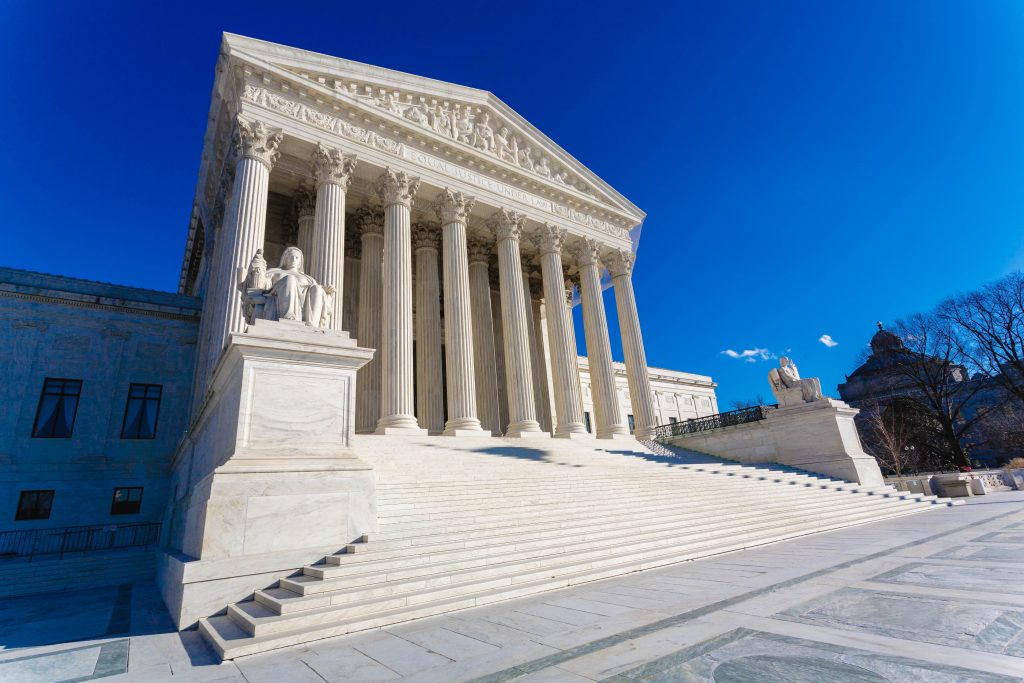
The Supreme Court this week issued a per curiam (unsigned and for the Court as a whole) opinion in Margolin v. Nat’l Assoc. of Immigration Judges [NAIJ], reversing a Fourth Circuit opinion that had held immigration judges could access the federal courts on claims related to workplace issues without going through administrative tribunals. Despite the title, the opinion has little to do with “immigration” per se — except that it appears to send a message to the lower courts on judicial overreach, a significant problem when it comes to their review of the current administration’s immigration policies.
In the interest of full disclosure, I was a member of NAIJ at some point when I served as an immigration judge (IJ) between November 2006 and January 2015, but I am not currently a member. In other words, I don’t have a dog in this fight.
Background
Immigration judges at the nation’s 73 immigration courts serve under the Office of the Chief Immigration Judge (OCIJ), which is a component of the Executive Office for Immigration Review (EOIR) within DOJ.
In October 2021, EOIR issued a “speaking engagement policy” for IJs, requiring judges to obtain supervisory approval whenever they are speaking publicly about any “subject matter that directly relates to their official duties”.
That policy followed similar ones instituted by EOIR in September 2017 and January 2020.
NAIJ complained that this policy:
categorically prohibits immigration judges from speaking publicly in their private capacities about immigration law and policy or about EOIR programs or policies. On these topics, judges can seek approval to speak in an official capacity — that is, to be a mouthpiece for the agency — but they cannot share their private views.
The group first sued EOIR in July 2020, challenging the then-iteration of the policy in the U.S. District Court for the Eastern District of Virginia (E.D. Va.), where it was assigned to Judge Leonie Brinkema.
It alleged the policy violated the members’ First Amendment rights and that it was “void for vagueness”, and I will skip over some convoluted litigation history to note that in September 2023, Judge Brinkema issued an opinion dismissing the group’s complaint.
Specifically, she held that the Civil Service Reform Act of 1978 (CSRA) deprived her of jurisdiction over NAIJ’s claims, as that act required the group instead to seek recourse from the two administrative agencies, the Office of Special Counsel (OSC) and the Merit Systems Protection Board (MSPB).
Thereafter, review of MSPB final orders is available in the U.S. Court of Appeals for the Federal Circuit, a specialized court of limited jurisdiction, or in specific situations to other Article III courts.
Consequently, the E.D. Va., Judge Brinkema concluded, lacked jurisdiction over NAIJ’s claims.
NAIJ appealed to the Fourth Circuit, arguing that its specific claims were not covered by the CSRA while conceding that the CSRA did channel other employment-related claims through the aforementioned administrative process.
In June 2025, a three-judge panel of the Fourth Circuit reversed, concluding (as Judge Brinkema had) that NAIJ’s claims were covered under the CRSA and conceding that “Congress designed the CSRA to divest district courts of jurisdiction to review legal challenges like those raised by NAIJ.”
On its own accord (“sua sponte”, in legalese), however, the Fourth Circuit questioned “the functioning of both the MSPB and the Special Counsel”, given challenges by Trump II to the independence of MSPB and OSC and the fact that — at the time it issued its opinion — Trump had “removed ... two members of the MSPB such that it currently lacks a quorum” and couldn’t issue opinions.
“These removals and the lack of quorum in the MSPB raise serious questions as to whether the CSRA’s adjudicatory scheme continues to function as intended,” the panel concluded. “We cannot allow our black robes to insulate us from taking notice of items in the public record, including, relevant here, circumstances that may have undermined the functioning of the CSRA’s adjudicatory scheme.”
On this basis, the circuit panel remanded to the E.D. Va. “to assess the functionality of” that scheme.
“The Principle of Party Presentation”
In November, the Fourth Circuit denied the government’s request for rehearing en banc by all the judges on the circuit court, from which four judges dissented, so on December 23, DOJ filed a petition for writ of certiorari with the Supreme Court.
“The Fourth Circuit’s deeply misguided decision”, the government contended, “warrants summary reversal on two independent grounds”.
First, DOJ argued, the circuit, “by adopting an argument that no party raised” had “departed dramatically from the principle of party presentation”, which prevents one or both parties from being blindsided when the court rules based on issues they had not raised and thus never had the opportunity to contest.
Second, the government contended the circuit panel “failed to adhere to Supreme Court precedent that is directly on point”, which holds “the CSRA channels federal personnel claims to the MSPB”.
“The Court of Appeals Lost Sight of those Principles”
The Supreme Court opinion focused mainly on the government’s first point and didn’t hold back in chastising the Fourth Circuit for failing to comply with the party presentation principle “when it decided a case different from the one [NAIJ] advanced”.
The justices continued:
The court transformed respondent’s argument that the CSRA did not channel its claims into one that the CSRA might not — in light of current conditions — channel any claims. And the court did so without giving either side a chance to address its theory.
...
Federal courts are not “roving commissions,” ... licensed to “sally forth each day looking for wrongs to right.” ... The Court of Appeals lost sight of those principles here. [Emphasis in original; citations omitted.]
“Sally forth each day looking for wrongs to right”? Ouch — that’s going to leave a mark.
The Bigger Picture
It should be noted this is the second time in just over six months that the Supreme Court reversed the Fourth Circuit for violating the party presentation principle.
The first time, in Clark v. Sweeney, the circuit was considering a habeas claim in which the petitioner had alleged ineffective assistance of counsel.
The appellate court flipped that claim into a finding of “a combination of extraordinary failures from juror to judge to attorney”, which the circuit concluded had deprived the petitioner of his rights to confront his accusers and to an impartial jury.
The justices (in yet another unanimous per curiam opinion) were calmer that time, reminding the circuit court that “courts ‘call balls and strikes’; they don’t get a turn at bat”.
Consequently, it’s only natural that the justices unanimously felt free to drop the hammer on this specific appellate court in NAIJ.
You will also note nothing up to this point involves “immigration”, aside from the fact that the plaintiffs adjudicate immigration issues in their day jobs.
That said, the justices are clearly becoming less judicious in expressing their pique at the inferior courts for their overreach, particularly on hotly contested political issues.
As Judge Marvin Quattlebaum complained in dissent from the Fourth Circuit’s denial of DOJ’s request for an en banc hearing in NAIJ, that panel opinion:
usurps Congress’ role by allowing unelected judges to update the intent of unchanged congressional statutes if the court believes recent political events — like those of the current administration it cites — alter the operation of a statute from the way Congress intended.
Respectfully, and solely in my own opinion, the same could be said of the thousands of habeas (and two circuit court) opinions striking down the Trump administration’s interpretation of section 235(b)(2) of the Immigration and Nationality Act (INA) as mandating the detention of all aliens who entered the United States illegally (a subject I have written on extensively for a year).
As the 11th Circuit recently held in rejecting Trump II’s claim that the INA requires it to detain those who entered illegally: “When evaluating interpretations of an agency’s statutory authority, a court must greet claims to the exercise of great power with greater skepticism.”
With due respect to that court, but with deliberate allusion to Spiderman’s Uncle Ben, Trump’s DHS isn’t claiming “great power” so much as it is “great responsibility”, specifically the duty of applying the law as Congress wrote it in 1996.
The only reason that and other courts call it a Trump power grab is because Donald Trump’s administration is the first one in 30 years that’s bothered to read section 235(b)(2) and see what it says.
That statute is written in mandatory terms (“the alien shall be detained”), and had Presidents Clinton, Obama, or Biden applied those terms faithfully, would any court deem them to have made “a claim to the exercise of great power”?
To ask the question is to answer it, but unfortunately for the Supreme Court, the justices will now be forced to wade once again into the political waters it detests so much and issue an opinion on the proper scope of section 235(b)(2) that likely won’t make anyone happy.
Claims the Supreme Court is “politicized” are so common even the National Library of Medicine has a paper on the issue, but I’d argue the justices only appear politicized because they are increasingly forced to strike down clearly politicized opinions like the Fourth Circuit’s in Nat’l Assoc. of Immigration Judges — a case that actually has little to do with “immigration”, except to the degree it does.