
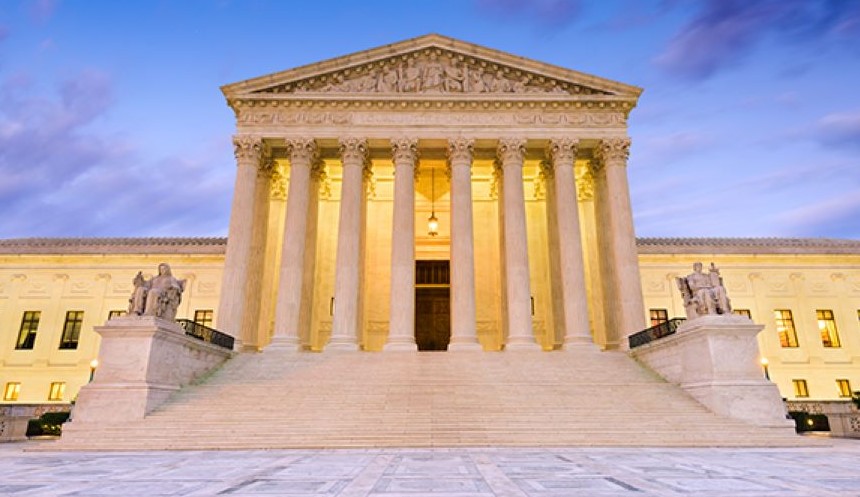
On Friday, the Supreme Court agreed to hear the government’s appeal of an order from the U.S. Circuit Court for the District of Columbia (D.C. Circuit) in Mullin v. Refugee and Immigrant Center for Education and Legal Services (RAICES), which would block asylum restrictions imposed by the Trump administration that are key to border security. As cases go, the stakes in this one could hardly be greater.
“Credible Fear”
Section 235(b)(1) of the Immigration and Nationality Act (INA), permits DHS to subject aliens who are apprehended by Border Patrol agents after entering the United States illegally to “expedited removal”, that is, to order them removed and expel them from the United States without placing them in formal removal proceedings before an immigration judge (IJ).
If, however, an alien subject to expedited removal claims a fear of persecution, the expedited removal process is placed on hold while CBP refers the alien for what’s called a “credible fear” interview before a USCIS asylum officer (AO).
The purpose of that credible fear interview is to determine whether there’s a “significant possibility” an IJ would grant the alien asylum under section 208 of the INA. Thus, “credible fear” is a screening process to determine whether an IJ may grant the alien asylum.
The first problem is that credible fear interviews take a lot of time, and under section 235(b)(1), DHS must keep the alien in detention until the AO issues a “credible fear determination”.
Moreover, by statute, if an AO issues a “negative credible fear determination” to an alien, the alien has a right to ask an IJ to review that decision, which simply drags out the process even more.
But since detention space has long been a limited resource, the department has often been forced to ignore the statute and release aliens into the United States before it has screened them, rendering expedited removal a dead letter.
The second problem is that there aren’t enough AOs to perform those interviews at scale. In July 2024, Government Executive reported that there were then “824 officers in place” and another 250 AOs in training, during a month in which Border Patrol agents apprehended more than 56,000 illegal migrants at the Southwest border (a “slow month” by Biden administration standards).
The third problem is that would-be illegal migrants — and more importantly, their smugglers — figured out years ago that making a credible fear claim is a quick ticket into the United States.
In FY 2006, just fewer than 104,500 aliens were subject to expedited removal, and just 5 percent of them (5,338 aliens) made a credible fear claim. A decade later, in FY 2016, roughly 243,500 aliens were subject to expedited removal, and more than 94,000 of them (39 percent) made credible fear claims.
The fourth problem is that because that screening standard is so low, AOs and IJs have long issued “positive credible fear determinations” to aliens who never sought or were ultimately denied asylum.
For example, of the hundreds of thousands of aliens who claimed credible fear between FY 2008 and FY 2019, 83 percent received positive credible fear determinations from AOs and IJs, according to DOJ data.
Of those 83 percent of aliens who were subject to expedited removal, made a credible fear claim, and received a positive credible fear determination during that 12-year period, however, just 54.2 percent filed asylum applications with IJs, and IJs granted less than 17 percent of them asylum.
So many millions of aliens crossed the Southwest border illegally between FY 2021 and January 2025 that the Biden administration essentially abandoned expedited removal entirely, assumed that every illegal migrant was an “asylum seeker”, and released the vast majority of the ones who weren’t subject to CDC “Title 42” pandemic-related expulsion orders into the United States.
In October 2023, the House Judiciary Committee reported that just 6 percent of the 2.148 million illegal aliens DHS released into the United States between January 20, 2021, and March 31, 2023, received credible fear interviews; worse, as of March 2023, DHS had removed only 874 illegal aliens who received positive credible fear determinations but whose asylum applications were denied by IJs.
Proclamation 10888
Those Biden-era releases simply encouraged even more aliens to come illegally, and by the time Donald Trump returned to office, the border had been in freefall for years, imposing crushing fiscal costs on towns and cities across the United States and exposing the American people to unconscionable peril.
In response, on Inauguration Day 2025 Trump issued Proclamation 10888, “Guaranteeing the States Protection Against Invasion”.
Under congressional authority provided to the president in sections 212(f) and 215(a) of the Immigration and Nationality Act (INA), section 1 of the proclamation suspended the entry of “aliens engaged in the invasion across the southern border” (i.e., illegal entrants) and section 2 restricted their ability to apply for asylum under section 208 of the INA.
Relying again on sections 212(f) and 215(a) of the INA, section 3 suspended the entry of both illegal entrants and aliens stopped at the ports who failed “to provide Federal officials with sufficient medical information and reliable criminal history and background information” necessary to determine whether they are inadmissible under sections 212(a)(1) through (3) of the INA (barring admission of aliens on health-related, criminal, and national security grounds, respectively).
Relying on the federal government’s duty to “protect each state against invasion” in Article IV, section 4 of the U.S. Constitution, section 4 of Proclamation 10888 again “suspend[ed] the physical entry of any alien engaged in the invasion across the southern border of the United States”.
And turning again to sections 212(f) and 215(a) of the INA (and to the Constitution generally), section 5 directed DHS, DOJ, and the State Department to “take all appropriate action to repel, repatriate, or remove any alien engaged in the invasion across the southern border of the United States”.
RAICES v. Noem
On February 3, 2025, NGOs filed a complaint in the U.S. District Court for the District of Columbia (D. D.C.) in RAICES v. Noem, arguing — among other things — that the proclamation violates the “asylum statute” at section 208 of the INA, the “statutory withholding” statute (section 241(b)(3) of the INA), and provisions of the Foreign Affairs Reform and Restructuring Act of 1998 (FARRA) that implement the U.N. Convention Against Torture (CAT).
Asylum, statutory withholding, and CAT are forms of protection that bar DHS from removing an alien from the United States. The two latter protections — which are premised on international agreements — are more limited in the benefits they convey than the former.
Basically, aliens granted asylum are placed on a path to a green card and citizenship and can petition for their immediate family members to come to the United States, whereas a statutory withholding or CAT grant simply bars DHS from deporting aliens to a designated country or countries.
While section 208(a) of the INA permits “any alien who is physically present in the United States or who arrives in the United States” to apply for asylum, section 208(b) of the INA allows the attorney general (AG) and DHS secretary to deny asylum to aliens who satisfy the statutory requirements for that protection in the exercise of discretion.
Neither the AG nor the DHS secretary, however, can deny statutory withholding or CAT to aliens who prove eligibility for those protections in the exercise of discretion. Essentially, asylum is a “discretionary” protection the president, DHS, and DOJ can bar aliens from receiving, whereas statutory withholding and CAT are “mandatory” protections they must grant to those who show eligibility.
The D. D.C. Opinion
The complaint in RAICES was assigned to Judge Randolph Moss of the D. D.C., and on July 2, 2025, he issued an opinion granting the plaintiffs’ pending motion for summary judgment, finding neither section 212(f) nor the Constitution permit the president to “abrogate” the INA with respect to illegal migrants’ ability to seek asylum, statutory withholding, and CAT.
Next, over DOJ’s opposition, he certified a class “consisting of all individuals who are or will be subject to the Proclamation and/or its implementation and who are now or will be present in the United States” (emphasis added).
Finally, he enjoined the government “from implementing the Proclamation to remove” members of that broadly expansive class without subjecting them to expedited removal, placing them in removal proceedings under section 240 of the INA, or reinstating their previously issued removal orders under section 241(a)(5) of the INA (the latter a process I recently explained at length).
DOJ’s Emergency Application and the D.C. Circuit’s Administrative Stay
Judge Moss was not completely unaware of the impact of his orders, and so he stayed them for 14 days to give the government an opportunity to seek a stay from the D.C. Circuit. And on July 7, 2025, DOJ filed an emergency motion for a stay pending appeal of Judge Moss’s opinion with the circuit court.
Four days later, a three-judge D.C. Circuit panel granted a temporary administrative stay of that order that exempted the individual named alien plaintiffs pending the panel’s further consideration and set the matter for expedited briefing.
The D.C. Circuit’s August 2025 Per Curiam Order
On August 1, 2025, the three-judge panel issued a per curiam order (unsigned and for the court as a whole) dissolving its earlier administrative stay and denying in part and granting in part DOJ’s application for a longer stay.
That stay temporarily blocked Judge Moss’s order to the degree it vacated portions of the proclamation barring illegal entrants from applying for asylum and narrowed the scope of that order to aliens “present in the United States while Proclamation 10888 and/or its implementation is in effect” — not to those who may come later.
That said, it also denied the government’s request for a stay of the D. D.C. order as it related to aliens seeking statutory withholding and CAT.
The D.C. Circuit’s April 2026 Order
The three-judge panel of the D.C. Circuit considered the merits of the government’s appeal from Judge Moss’s order, and on April 24, it issued a split opinion that was much more problematic for the Trump administration.
The trio consisted of Judge Justin Walker (a Trump I appointee), Judge Cornelia Pillard (appointed by President Obama), and Judge J. Michelle Childs, who was nominated by President Biden and authored the majority opinion, from which Judge Walker dissented in part.
The majority concluded that the “text, structure, and history” of the INA “make clear that in supplying power to suspend entry by Presidential proclamation, Congress did not intend to grant the Executive the expansive removal authority it asserts” — specifically and in particular the ability to bar aliens who entered illegally from applying for asylum.
To be fair, Congress wrote the asylum provision at section 208 of the INA in a strange and complex manner.
It begins at subsection (a) by stating, “Any alien who is physically present in the United States or who arrives in the United States ... irrespective of such alien's status, may apply for asylum in accordance with this section or, where applicable” under the “credible fear” provision for expedited removal.
There are limited exceptions to that “application” rule in section 208(a) of the INA for aliens who can be removed to a “safe third country”, aliens who don’t seek asylum within a year of arrival, and aliens previously denied asylum, but those impediments aside, any alien can apply for asylum.
In section 208(b)(1)(A) of the INA, however, Congress (as noted) gave the executive branch discretion to deny asylum, even to aliens who have shown that they are statutorily eligible for that protection.
What the proclamation and guidance attempted to do was to skip the application step as unnecessary given that the president has already concluded that aliens who have entered illegally won’t be granted asylum in the exercise of discretion.
That was improper according to the majority, which found that every alien must receive an opportunity to seek asylum under sections 208 and/or 235(b), but as Judge Walker in dissent explained the majority’s opinion in the context of expedited removal under section 235(b)(1) of the INA:
The majority does not contest that the President may deny all asylum applications. If a President decides to do that, all [section 235(b)] does is confer upon individuals the special privilege of being forced to languish in a detention facility while their individual asylum applications get inevitably denied. That is pretty odd.
Regardless, however, the majority affirmed Judge Moss’s summary judgment grant, concluding the INA doesn’t allow the president to remove illegal entrants “under summary removal procedures of his own making”, doesn’t allow the executive to categorically use its discretion to suspend such aliens’ “right to apply for asylum” or to deny them “access to” statutory withholding, and doesn’t allow DHS to “curtail mandatory procedures for adjudicating” those aliens’ CAT claims.
Because, unlike “discretionary” asylum grants, statutory withholding and CAT are mandatory forms of protection from removal, Judge Walker concurred with that part of the majority’s opinion but dissented from much of the rest.
The panel withheld the issuance of the mandate in the case pending any government applications for rehearing en banc, by all of the judges on the D.C. Circuit, and on June 8, DOJ filed such a petition, which the circuit court denied on July 23.
That said, the three-judge panel on July 27 again stayed its mandate in the case while the government asked the Supreme Court for review — restoring (for now) the status quo on the asylum bar in Proclamation 10888.
DOJ’s Petition for Certiorari
On September 23, DOJ filed a timely petition for writ of certiorari (appellate review) with the Supreme Court, and U.S. Solicitor General John Sauer underlined the stakes in this case at the outset:
In January 2025, the country faced an unprecedented crisis along the southern border. Federal agents were encountering and releasing thousands of aliens per day, a flood that “overwhelmed” the immigration system and rendered the restrictions on entry in the [INA] “wholly ineffective.”
…
That spawned a vicious cycle of encouraging yet further illegal entry by millions of aliens, who (quite justifiably) inferred that even if they lacked meritorious asylum claims, they would “be released to live and work in the United States during their removal proceedings,” which would “take years to resolve.” Inundated by millions of illegal entrants, the federal government lacked the capacity to identify aliens with criminal records, terrorist affiliations, or contagious diseases. In 2023 and 2024, eight Tajik nationals suspected of having ties to ISIS managed to enter the United States — some of them even filing asylum claims. Cartels exploited the chaos to smuggle in drugs, criminal aliens, and arms and ammunition.
In response, immediately after taking office, President Trump issued a proclamation determining that the illegal entry of aliens across the southern border is “detrimental to the interests of the United States” under [sections 212(f) and 215(a) of the INA. Section 212(f)], which “exudes deference to the President in every clause,” supplements the President’s inherent constitutional authority over foreign affairs and national security by granting him the authority to temporarily suspend the entry of aliens in situations like the border crisis. [Citations omitted; cleaned up.]
“The President thus acted well within his authority”, the petition continued, “in preemptively indicating that asylum applications filed by aliens who violate the proclamation’s entry suspension would be denied — and in effectuating that discretionary policy choice by directing that the government need not accept futile asylum applications from those aliens.”
The government was also quick to highlight just how significantly the border had improved thanks to the president’s actions:
Since the proclamation took effect, border encounters have fallen by 93 percent, dropping to the lowest levels since the 1960s. The “restrictions on asylum” in particular “have been critical to maintaining the effectiveness of the Proclamation.” The dramatic reduction in encounters has “freed up government resources to address national security and public safety threats” at the border, such as combatting the trafficking of humans, drugs, weapons, and other contraband across the border by criminal and terrorist organizations. [Citations omitted; cleaned up.]
“But all of the progress above risks evaporating if the ruling below is allowed to take effect,” DOJ warned.
Section 212(f) v. Section 208(a)
Given that the D.C. Circuit’s orders on asylum are stayed while the justices mull all of this over, it should come as little surprise that the Court waited more than 10 weeks to agree to hear RAICES, but it was likely inevitable that SCOTUS would review it eventually.
Note also that there are really only two questions for the Court to consider, one having to do with the broad class that Judge Moss certified, and the other addressing the question of whether the president can use his 212(f) and 215(a) authority to preempt section 208 asylum claims by illegal entrants.
It was in its 2018 opinion weighing the legality of the Trump I “travel ban”, Trump v. Hawaii, that the justices held that section 212(f), in particular, “exudes deference to the President in every clause”, but the main question is whether that provision supersedes the expansive ability Congress gave aliens to file asylum applications in section 208(a) of the INA.
In fact, this case could more accurately be captioned Section 212(f) v. Section 208(a), and unless and until Congress were to amend either of those provisions, it was always going to be left to the Supreme Court to decide which of those two provisions controls the other.
The Stakes
Of course, the incoming 120th Congress looks different than the current 119th Congress, which means it could amend section 212(f) to trim the expansive deference that provision exudes.
Trump would veto any such attempt, but if enough Republicans join their newly energized Democratic colleagues, they could override such a veto.
The bigger concern from the White House’s perspective would be a “perfect storm”: a Supreme Court majority that agrees with Judge Moss and the D.C. Circuit that every illegal alien must be permitted to play the “credible fear” game coupled with Democrat congressional majorities that starve DHS of the resources (enough AOs and sufficient detention space, in particular) it would need to respond to a new migrant surge.
That could be a tricky gambit for the Democrats, however: While many Americans don’t like the chaotic ICE operations they saw on the streets of Minneapolis and other major cities at the outset of Trump II, they probably were equally (or more) concerned about the massive waves of migrants they saw pouring over the border under Biden.
If the justices rule against Trump and congressional Democrats pile on, I can guarantee you’ll see more GOP campaign commercials showing aliens surging past overwhelmed Border Patrol agents between July and November 2028 than the media saw fit to show you between January 2021 and December 2024.
Trump could also try to fall back on the Migrant Protection Protocols (MPP), better known as “Remain in Mexico”, if the justices strike down Proclamation 10888 and require DHS to give every illegal entrant who makes a credible fear claim a shot at asylum.
Trump I successfully used MPP to curb illegal entries by sending non-Mexican migrants back across the border to await their asylum hearings, and while the Biden administration ended the program (after a few fits and starts that also involved the Supreme Court), Trump brought it back on Inauguration Day 2025 in Executive Order (EO) 14165, “Securing Our Borders”.
Remain in Mexico, however, relies on the willingness of the Mexican government to accept non-Mexican returnees, and if congressional Democrats curb the president’s authority to impose tariffs on our neighbor to the south, Trump may lack the leverage he needs to force Mexican President Claudia Sheinbaum to agree to new MPP returns.
Since Trump returned, I’ve heard immigration hawks suggest that he simply ignore the courts and do what he wants on enforcement. That’s not an option under our constitutional order, however, and in Mullin v. RAICES, the president needs all the good will he can get from the justices to avoid a replay of the Biden-era border fiasco.