
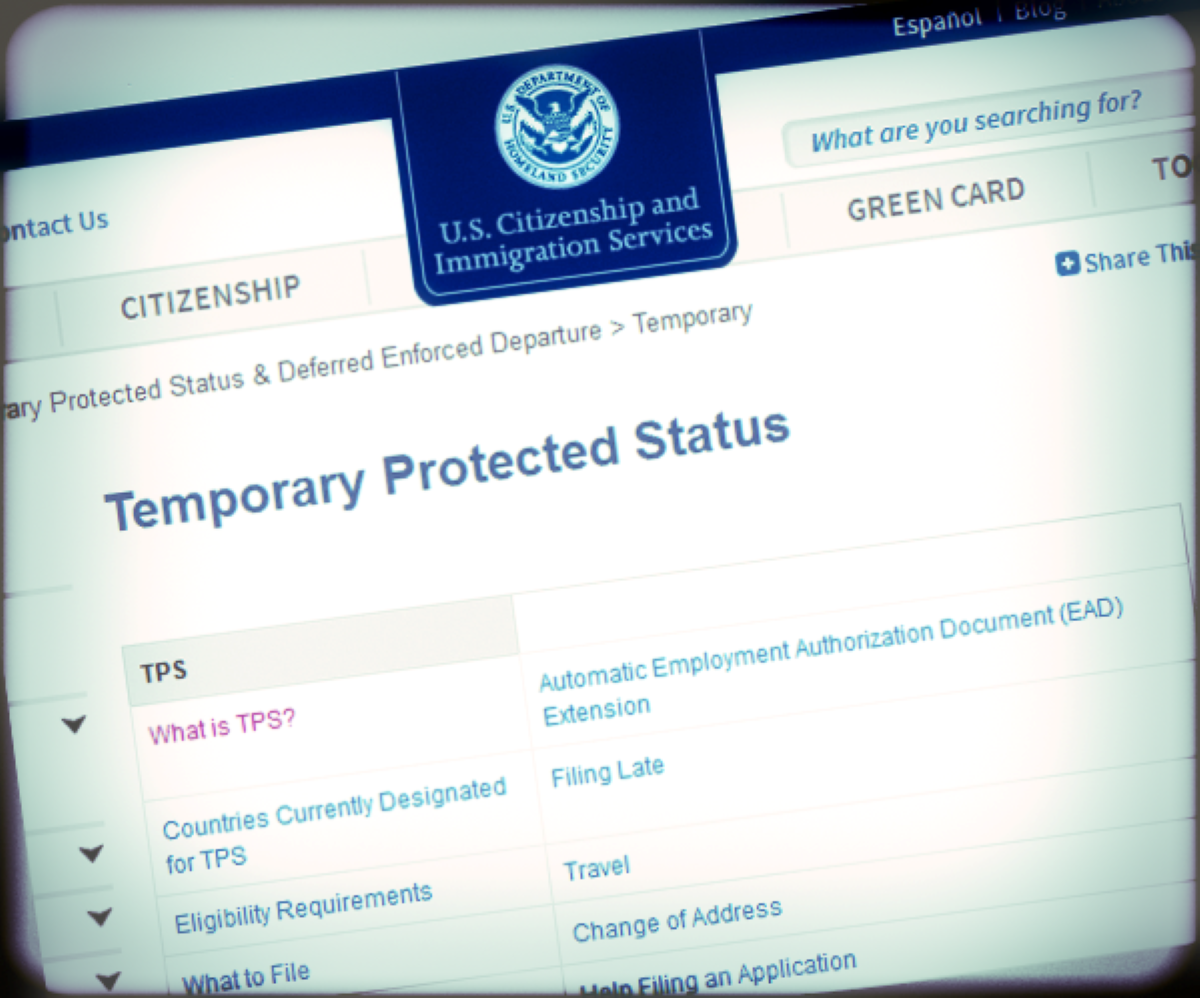
On Sunday, DHS Secretary Markwayne Mullin appeared on CNN, where host Jake Tapper asked him what the end of Temporary Protected Status (TPS) means for the “350,000 protected status holders right now”. Most of what Mullin said was accurate (though admittedly some of it didn’t make any sense), but the secretary likely should have set the stage by explaining that: (1) most of them won’t be deported until they have gone through removal proceedings; and (2) in those removal proceedings they will be eligible to apply for permanent relief that will allow them to remain. Despite the passions from both sides over a recent Supreme Court opinion clearing the way for the end of TPS, few seem to have any idea what ending TPS “means”.
Mullin v. Doe
Mullin should not be in that camp, because he was the named petitioner in the case in question, Mullin v. Doe, which was issued by the Supreme Court last Thursday.
As I explained shortly after that decision was issued, “Temporary Protected Status” under section 244 of the Immigration and Nationality Act (INA) permits the DHS secretary to designate certain countries to which aliens (with exceptions for criminality and national-security threat) cannot be returned for now due to “armed conflict”, “environmental disaster”, or a similar “extraordinary and temporary condition”.
Nationals of those countries — regardless of their immigration status here — can then apply with USCIS for TPS, and while designations are usually effective for up to 18 months, DHS secretaries can renew them and in many cases have done so — for decades and for reasons well beyond the scope of the initial designation.
As Justice Alito writing for the majority in Doe noted, “three countries” — Nicaragua, Honduras, and El Salvador — “retain designations that are more than 25 years old”, and Somalia has been designated since 1991.
The Trump administration considers that an abuse of the statute and the power it conveys, and as a consequence has begun the process of terminating TPS for many designated countries, in this case, Haiti and Syria.
Congress created TPS when it added section 244 to the INA in 1990, and it understood that granting a temporary reprieve from removal for tens of thousands of nationals of any given country would create a constituency that would make it politically difficult to terminate any given TPS designation.
To prevent TPS from becoming a legal football that could be kicked around the courts ad infinitum, Congress at section 244(b)(5)(A) of the INA barred judicial review of the secretary’s TPS considerations.
Here’s the language that appears in that provision: “There is no judicial review of any determination of the [DHS secretary] with respect to the designation, or termination or extension of a designation, of a foreign state under this subsection”. (Emphasis added.)
Various lower courts, however, either aren’t well-versed in the English language or didn’t get the hint, because they found they could review the process by which the secretary made termination decisions, even if they could not review the terminations themselves.
The majority in Doe concluded that section 244 of the INA meant exactly what it said and barred all judicial challenges (except for those brought on strictly constitutional grounds), reversing two lower court interpretations to the contrary.
At this point, you can expect plaintiffs to get inventive in crafting such constitutional challenges, but for now the justices have cleared the way for Trump II to terminate the TPS designations for Haiti and Syria.
Cue the Outrage and Sanctimony
Not surprisingly, that opinion has triggered significant backlash from advocates who complain that the Court’s “unjustifiable decision” will result in crises in the “healthcare, childcare and elder care” industries (and across the economy as a whole), while whipping up panic in immigrant communities that ICE officers will soon be rolling in.
What has been surprising, however, has been the response of pro-enforcement advocates to Mullin’s statements on CNN.
Tapper asked the secretary: “Will you be deporting all of them? Will they be all deported back to their home countries, Haiti and Syria? And when will these deportations start? Will it be immediately?”
Mullin’s response:
Temporary Protected Status was never intended to be permanent, and there’s a lot of people who came over here 15, 20 years ago underneath TPS that’s already changed their status. The whole time these individuals have been here underneath the temporary protected status, they could have applied for a visa, they could have applied for [lawful permanent residence, “LPR”, i.e., a “green card”], they could have applied for different directions . ... These individuals have a couple of different choices. They could try to apply for a permanent residence here, they could try to apply for a temporary visa if they choose to, or they could choose to go back, and if they want to go back we will help them with that. If I were talking directly to the individuals with the Temporary Protected Status, either try to fill out the paperwork and be here under a permanent status or we’ll help you get back to your country.
Newsmax quoted many of the secretary’s statements in an article published shortly after that interview ended, which the outlet then tweeted out:
JUST IN: Haitians who have been in the U.S. for years under Temporary Protected Status can apply for permanent residence or for a temporary visa, Homeland Security Secretary Markwayne Mullin said Sunday. https://t.co/N9Du8fxThk
— NEWSMAX (@NEWSMAX) June 28, 2026
If you check out the various responses to that tweet on X, you’ll see volley of vitriol and disbelief from many on the right directed toward both Mullin and the administration, most of which can be bowdlerized and aptly summed up as “temporary visas and permanent residence for illegal aliens isn’t what we voted for”.
The response got so bad that on Sunday evening, the secretary had to issue the following tweet:
Let me be ABUNDANTLY clear:
Temporary Protected Status is just that: TEMPORARY.
Democrats tried to turn this into a defacto amnesty program. President Trump put a STOP to it.
If you are in the country without status, you are here illegally. Illegal aliens have two choices —… https://t.co/v9CQ9alA5G— Secretary Markwayne Mullin (@SecMullinDHS) June 28, 2026
How the System Works from Here
Given that Mullin has only been in office for three months and that no one confused him in his last gig (as a Republican senator from Oklahoma) with such “immigration gurus” as Reps. Chip Roy (R. Texas) and Brandon Gill (ditto) and Sens. Eric Schmitt (R-Mo.), Tom Cotton (R-Ark.), Ted Cruz (R. Texas), or Chuck Grassley (R-Iowa, the upper chamber’s immigration dean), everybody should probably give him some grace and chalk his responses to Tapper up to rookie mistakes.
That’s especially true given that most of what he had to say wasn’t wrong — he just failed to provide the appropriate context for his statements. Let me explain.
Most of the 350,000-plus Haitians and Syrians who currently have TPS status aren’t under final orders of removal, which means DHS now must either recalendar their removal hearings (if they were “administratively closed” while they had TPS) or (worse) place them into removal proceedings under section 240 of the INA as an initial matter.
While those aliens had TPS status, they could have applied with USCIS for “affirmative asylum” under section 208 of the INA, and likely should have if they had a real fear of persecution back home.
That said, noting in sections 244 or 208 of the INA required them to apply affirmatively for protection, but if they had done so and were granted asylum under the lenient USCIS rules under the Biden administration, they likely would have green cards by now.
And, if they are eligible for a nonimmigrant visa (like an F-1 student visa) and didn’t accrue more than 180 days of unlawful status here before receiving TPS, they could have left the United States and returned in lawful nonimmigrant status or could do so now.
And if they had entered legally in nonimmigrant status, received TPS, and become eligible for an immigrant visa (by marrying a U.S. citizen, for example), they could have (with restrictions) “adjusted” their status pursuant to section 245 of the INA and received a green card.
Regardless, DHS can’t remove any alien here unlawfully until it obtains a final removal order, and that generally occurs at the end of removal proceedings under section 240 of the INA, which would be true with respect to these TPS aliens as any other — aside from aliens subject to “expedited removal” under section 235(b)(1) of the INA.
You can’t blame Mullin or the administration for being forced to comply with the due process rules that Congress has written, nor can you blame the secretary for attempting to respond to the inflammatory sanctimony of those on the other side of the issue from him by calmly, if confusingly and inexactly, explaining the process on CNN.
Leaving aside for now the question of whether some of these TPS beneficiaries may be “amenable” to expedited removal and all the answer entails, in the course of those section 240 proceedings erstwhile TPS recipients can apply for asylum and other humanitarian protections or seek adjustment of status or apply for a green card pursuant to cancellation of removal under section 240A(b) of the INA.
That latter relief (also known as “42B cancellation” after its application form) permits an immigration judge to grant a green card to an alien who: has been here unlawfully for at least 10 years; has been a person of “good moral character” throughout that period; is not removable on criminal or national-security grounds; and “establishes that removal would result in exceptional and extremely unusual hardship to the alien's spouse, parent, or child, who is” a U.S. citizen or LPR.
That latter burden is high, and 42B cancellation grants are capped at 4,000 per year, but at least some of those TPS beneficiaries may be eligible to receive green cards under section 240A(b) of the act.
Of course, DHS must now serve nearly all of those 350,000-plus TPS recipients from Haiti and Syria with notices to appear (NTAs), which the statute requires to initiate removal proceedings.
Because they must update their addresses with DHS to remain in TPS status, the department will know where to serve those NTAs, but if those aliens are criminals ICE may pick them up, serve them with NTAs, and detain them.
If that sounds time-consuming and complicated, it is, but you can’t blame Mullin or the administration for being forced to comply with the due process rules that Congress has written, nor can you blame the secretary for attempting to respond to the inflammatory sanctimony of those on the other side of the issue from him by calmly, if confusingly and inexactly, explaining the process on CNN.
One Common Bond
Speaking of the immigrant advocates on the other side of this TPS “discussion”, one common bond that ties them and many of their pro-enforcement opponents together is a massive misunderstanding of how the removal process works.
Both seem to be laboring under the misapprehension that thanks to Doe, immigration officers can simply trawl the streets looking for former TPS beneficiaries, throw them into the back of their vans, and drive them to the closest airport for drop-off at the awaiting C-130s that will fly them home.
Respectfully, hours before Mullin appeared on CNN, I clarified all of this (edited for time, of course) on that network, and the secretary would have been well served by watching me.
As I explained to CNN, Doe isn’t the end for these aliens, but rather the end of the beginning of a lengthy process that now requires DHS to place former TPS beneficiaries into the removal proceedings where they can apply for relief from removal, and to appeal any adverse decisions they receive. (Assuming they don't return on their own to Chile or Brazil, where many, if not most, were living legally before deciding to come the United States.)
Regardless of your TPS views, calm down. Immigrant advocates should stop fearmongering, while hawks should focus their fire on the last administration, which allowed these TPS issues to fester and expanded TPS beyond anything Congress ever intended. While you can fault Markwayne Mullin for how he explained what lies ahead on TPS, he’s not to blame for the rules Congress created.